The Glory of Library and Museum Materials

I really love the Internet for research. It connects us to materials and people around the world. As a visual person, I find the availability of photographs and other visualizations on just about any subject especially gratifying. You can visit places and eras that you physically may not be able to.

NYPL Digital The Drawbridge

One of the invaluable services libraries and museums provide, especially now that more of their collections are being digitized, is access to historical periods and obscure topics. (Like the Peter Parker collection of 80 paintings of Chinese patients with large tumors or other major deformities – that’s not a joke!)

And that’s only the beginning – using library and museum websites and digital collections to find primary sources for research has other benefits as well:

  • Copious metadata: the provenance (origins and history) of documents or items, including details like dates, original creators, owners, and chain of custody, are clearly marked when known, and when unknown, that is clearly stated, too.
  • Materials that physical items were made of are also given, often with information on the techniques involved or links to further reading in connection with museum exhibits.
  • Many libraries and museums group items in their digital collections into more easily browsable subgroups, for example by era, style, type, or topic.
  • Copyright information is easily available: any limitations to re-using the materials are clearly given. There are also collections that concentrate on items that are in public domain.
  • If digital materials are made available for re-using, often there are multiple formats, sizes, or resolutions. That’s great service!
  • Sets of search results are often smaller than online in general. Finding an answer is faster!
  • Digital collections are created by professionals. While this doesn’t completely eliminate the possibility of errors, online materials at libraries and museums are researched, curated, and checked, which increases the reliability of the information provided.
  • If additional information or clarification is needed, it’s the job of museums and libraries to at least try to help. That’s literally why they’re there!

Below are just some amazing digital collections from museums and libraries around the world:

Must. Resist. Internet. Rabbit. Holes!

Image: The Drawbridge via NYPL (The Miriam and Ira D. Wallach Division of Art, Prints and Photographs: Print Collection, The New York Public Library, New York Public Library Digital Collections; 1748-1751; etching; by Giovanni Battista Piranesi)

Out There is an occasional feature highlighting intriguing art, spaces, places, phenomena, flora, and fauna.

Travel: Animals

160222reindeerFrom the grand howdah-backed elephant to the plodding pack pony, from the solitary stallion to the caravan of a thousand camels, animals are often a part of how our characters get around. In previous entries to the travel series we’ve considered small and large groups traveling on foot. This time we bring animals into the mix.

Animals can be useful for travel, but they also bring their own challenges with them. The first thing we need to consider is what kinds of animals are useful for long-distance travel. Then we’ll look at the three main ways of using animals for travel: riding, pack, and draft. Finally, a word on the care and feeding of transport animals. As usual in this series, we are looking at real-world history: no griffins or dragon-drawn chariots. Take the information here and adjust as necessary for whatever setting you happen to be writing.

Continue reading

Fantasy Religions: Religious Sites

So, you’re creating a fantasy religion for a story or game. When your characters need to interact with their gods, where do they go—if anywhere at all? Down the street to the local temple? To the top of a windswept mountain? To a corner of their kitchen? Today we look at religious sites in historical cultures to inspire our imaginations.

We can start by looking at religion in today’s world. Look at the religious life of a modern western community and you will find some people attending their local church, synagogue, or mosque, some people praying quietly in their own homes, some feeling inspired by solitary walks in the woods, some debating points of theology over the internet, some participating in celebrations of religious holidays, and some not involved at all. Many people will do more than one of the above. No culture or religious tradition is monolithic, and this is just as true in the past as the present. The history of religious expression is one of incredible variety both across and within cultures.

In this variety, though, there are some patterns that recur in varying forms. People use different kinds of religious sites for different  needs. Many different traditions have used similar kinds of religious sites, and within any given tradition different sites are used for different purposes. Today we will look at four common types of religious site out of the wide variety of possibilities: assemblies, temples, household shrines, and natural spaces.

Assembly

The “assembly” type of religious space will be recognizable to anyone familiar with major variants of the modern monotheistic religions. It is a space where a community of believers gathers to perform collective rituals such as praying, singing hymns, hearing sermons, feasting, and witnessing or participating in ritual enactments.

Grand Mosque, Djenne, photograph by BluesyPete via Wikimedia

Continue reading

The Misuses of Myth

160208sphinxMyths, legends, fairy tales, and other stories passed down through the generations are at the root of our storytelling tradition. They are the earliest stories in our literature and some of the first stories we learn as children. It is no wonder that we keep going back to mythology looking for deeper meanings. The drive to find hidden meaning in myth leads to some misguided interpretations. Two common mistakes are Freudian theory and the “forgotten history” theory.

Freudian slips

Freudian theory holds that myths are expressions of universal human drives which we have suppressed in the name of civilization. As the things that we cannot talk about openly come out in our stories, we can hold up mythology as a mirror to our own subconscious in order to see our hidden impulses better. Sigmund Freud’s attempts to explain the human psyche by reference to dreams, myths, and other supposed insights into the unconscious are at the root of this approach, but there are other classic exemplars, such as Bruno Bettelheim’s The Uses of Enchantment, which applies the theory to the Grimms’ fairy tales. (Note that I am speaking of Freudian theory as a way of interpreting myth; I am not in any position to judge Freudianism as a psychological theory.)

Continue reading

Third Person

I have to write a biographical paragraph for a conference. Ugh. I hate writing about myself in the third person.

I’m trying to be all

160205Caesarbut feeling more like

160205jonesOh well. It goes with the territory, I guess. I like to think that being awkward about your own accomplishments is one of the tests of being a decent person. (But, then, does congratulating myself on being a decent person mean I’m actually not..? Argh! Why is it so hard?!)

Oh well. That’s my dose of self-pity for the day.

Images: Bust of Caesar, photograph by Andrea Wahra via Wikimedia (Naples; 1st c. BCE; marble) and text from Caesar, Gallic War 1.54, collage by Erik Jensen. Harriet Jones via brittaperry

When the suckage just sucks too much.

Great Zimbabwe

Aerial view of part of the Great Zimbabwe complex. Photograph by Janice Bell
Aerial view of part of the Great Zimbabwe complex, photograph by Janice Bell via Wikimedia

Great Zimbabwe is a ruined city in Zimbabwe (and in fact has given the modern country its name). Built over centuries beginning in the 9th century, the site was a center of power for the medieval Shona (or Kalanga) kingdom and part of the trade networks that spanned the Indian Ocean. It was abandoned in the 15th century and stands in ruins today, but even in its ruined state it is impressive.

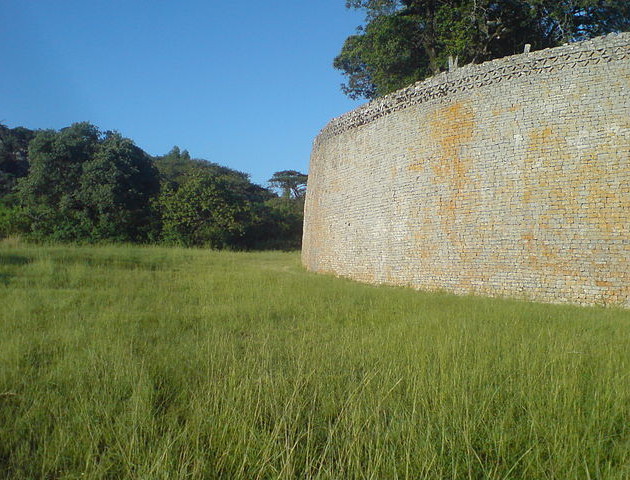
Wall of the great enclosure. Photograph by Jens Klinzing.
Wall of the great enclosure, photograph by Jens Klinzing via Wikimedia

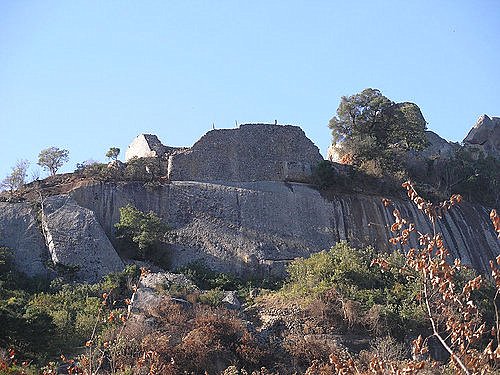
The remains of numerous stone enclosures spread over hundreds of hectares. At its height, Great Zimbabwe may have housed between 15,000 and 20,000 people. The surviving walls reach heights of five meters and are built of stone blocks assembled without mortar. Several different complexes occupy different positions ranging from hills to near the river. The significance of these different complexes remains unclear, but it may indicate that the center of settlement gradually moved over time, away from the more defensible hill sites to the more accessible valley sites, perhaps to better engage with the oceanic trade networks. Ivory and gold were Great Zimbabwe’s major international exports and trade goods from the Arabian peninsula and China have been found at the site.

Interior walkway showing the quality of the stonework. Uploaded by Vinz.
Interior walkway showing the quality of the stonework via Wikimedia

One noteworthy feature of the enclosures is their shape: neither rectangular nor circular but irregular curved shapes adapted to the forms of the landscape on which they sit.

In the colonial period, popular theories held that the site must have been built by ancient European or Asian colonizers. The biblical Queen of Sheba was often mentioned in connection with the site. Although archaeologists realized as early as the early twentieth century that Great Zimbabwe had been built by Africans, the colonial administration in what was then Rhodesia suppressed any such claim. The assertion that Africans were incapable of building such a complex site and needed European guidance to achieve any level of civilization was key to the justification of imperial domination. Colonial authorities could not tolerate any evidence that Africans were capable of creating sophisticated works of art and architecture on their own.

Part of the hill complex seen from the valley below. Photograph by Macvivo.
Part of the hill complex seen from the valley below, photograph by Macvivo via Wikimedia

Thoughts for writers

I have two reasons for sharing a little bit of Great Zimbabwe.

First, it is another example of architecture that does not depend on European examples. When doing our worldbuilding as writers, it is easy to fall back on the things that are familiar: European castles, Egyptian pyramids, Greek temples, and the other things we’ve seen before. Let yourself be inspired by the other amazing things people have built. I’d love to see a city inspired by Great Zimbabwe at its height turn up in a fantasy story, even one not set in an explicitly African-inspired world.

Second, this is another example of how politics can screw up good historical scholarship and so why you need to read broadly and get outside familiar frames of reference. Even today, while the Queen of Sheba is generally left out of it, claims that Great Zimbabwe was built by Arabs or Phoenicians still occasionally creep into popular histories.

History for Writers is a weekly feature which looks at how history can be a fiction writer’s most useful tool. From worldbuilding to dialogue, history helps you write. Check out the introduction to History for Writers here.

Travel: Large Groups on Foot

160118legionSometimes writing fiction means not just moving a few characters around the map but planning entire campaigns for massive armies. In previous entries in the travel series we looked at some basic issues and how small groups travel on foot. For large groups on foot, much of what we discussed in those entries is relevant, but large groups of people, like armies or mass migrations, bring with them their own set of problems. Today we’ll look at some basic questions in the movement of large groups: How large is “large?” What did it take to make the journey successfully? How far could they travel? And how fast?

This post is written with a particular focus on armies, since they are the best-studied large groups that traveled in the pre-industrial world, but any sufficiently large group of people traveling by foot would face the same basic problems.

Continue reading

New Beowulf Adaptation: Return to the Shieldlands

ITV Studios is producing a new Beowulf adaptation. Named Beowulf: Return to the Shieldlands, the mini-series puts a modern spin on one of the oldest poems in Old English. According to Esquire Network:

“Based on the complex protagonist of a classic poem written between the eighth and tenth century, Beowulf takes place in a mythological place, The Shieldlands, and challenges the notions of good and evil, heroes and villains, and the rule of law against one’s moral code. The drama stars Kieran Bew (DA VINCI’S DEMONS), in the lead role Beowulf; multi-award- winning actor William Hurt (DAMAGES); acclaimed actress Joanne Whalley (WOLF HALL); Ed Speleers (DOWNTON ABBEY) and David Ajala (BLACK BOX).”

IMDB Beowulf Return to the Shieldlands
Beowulf: Return to the Shieldlands, ITV via IMDB

Beowulf: RttS started airing in U.K early January 2016, and Esquire Network is bringing it to U.S. January 23. Location work for the production was shot in the north east of England, in county Durham and Northumberland; 13 episodes have been produced so far. The show has a very perfunctory Instagram account and a more active Facebook page. There’s also a behind the scenes piece with live action clips:

Beowulf Behind The Scenes The World Revealed with Kieran Bew and Ed Speleers via Esquire Network

Beowulf: RttS definitely holds some promise. Apart from being inspired by Actual History(TM) and Anglo-Saxons / Old English to boot, it sounds like there’s some gender-bending (International Business Times reports a “new female thane”); in addition, photos include not just white men among the cast (see MedievalPOC and Farawaysite.com).

IMDB Beowulf Return to the Shieldlands2
Beowulf: Return to the Shieldlands, ITV via IMDB

While I’m excited about the recent resurgence of genre films and tv productions in general, I’m discouraged by the apparent lack of quality control that comes with trying to ride the trend to make a quick buck. (Vikings, The Mortal Instruments: City of Bones, or 2015 Fantastic Four, anyone?)

Sadly, it sounds like Beowulf: RttS might be one of them: according to U.K news site Metro, viewers criticize the series for its “unconvincing CGI, stilted dialogue and unrealistic action sequences” and as “a blatant rip-off ” of Game of Thrones. I can add to the list some decidedly silly costuming and a peculiar combination of plausible and fanciful in the sets and props. I’m torn whether to give it a shot or not – on one hand, it’s based on Beowulf, for crying out loud; on the other, WTF is going on with the design!?

In the Seen on Screen occasional feature, we discuss movies and television shows of interest.

Gift Exchange

160111elephantGift exchange is part of festive celebrations for many people in the modern world, including many traditions whose gift-giving season has just passed. In the pre-modern world, though, gift exchange was often a vital part of social, political, and economic life.

The essential principle of gift exchange is reciprocity. Giving someone a gift obliges them to return a gift of equal value. In the modern market economy in which every item can be assigned a monetary value, this is cause for anxiety (and comedy) over gift-giving, but in earlier societies value was measured in other ways. The value of a gift often depended on the prestige of the person giving it. Since gifts were reciprocal, they created a relationship, of which the gift acted as tangible proof. The modern taboo against asking the price of a gift (“Don’t look a gift horse in the mouth”) attempts to reinforce this kind of value in a monetized world.

Continue reading

Quotes: That Is a Strange Country

“I would say that [the Russians] are located somewhere near the Baltic Sea. There are old trade routes there, and in our own time it is a territory closed to us. Their installation may be close to the Finnish border. They could disguise their modern station under half a dozen covers; that is a strange country.”

– Andre Norton: The Time Traders

Did Andre Norton just insult Russia? (And yay, Finland was mentioned!)

Norton, Andre. The Time Traders / Galactic Derelicts [omnibus edition]. Riverdale, NY: Baen Books, 2000 [originally published 1958 / 1959].

(This quote comes from my 21 new-to-me SFF authors reading project. Note: A free e-version is available via Baen Books.)

This post has been edited for clarity.

Serving exactly what it sounds like, the Quotes feature excerpts other people’s thoughts.