The London Picture Archive is a gigantic, free online photo map of the city’s past. The project has been nicknamed Collage.
Managed by London Metropolitan Archives (LMA), the map is made with over 250,000 photos, prints, maps, and drawings from the collections of LMA and Guildhall Art Gallery. Visitors can search by street name, or browse featured galleries and subjects. From the description of Collage:
“The images provide an extraordinary record of London and its people from the fifteenth century to the present day. The whole of Greater London is covered, as are the adjoining counties. Some of the many highlights include photographs of Victorian London; the sixteenth century ‘Agas’ map of London; Hollar’s stunning panorama from 1647; beautifully designed twentieth century posters for London’s tramways; the Cross and Tibbs photographs of Second World War damage to the City of London and the collections formerly held at the Guildhall Print Room. We regularly add new content from the LMA collections and, in particular, continue to develop descriptions and subject tags for the very large London County Council Photograph Library.”
I’ve only poked around for a short time, but for general purposes Collage looks like an endless source of images. For more specific searches it may not do quite so well. It certainly appears to be a worthwhile source for historical or historically inspired worldbuilding.
The Roman emperor Claudius walked with a limp, spoke a with a stutter, and sometimes experienced sudden and uncontrollable movements of his body. These effects were moderate when he was calm but became more pronounced when he was agitated. Claudius’ symptoms are well documented and modern scholars have suggested various diagnoses. Polio was at one time the preferred explanation but has fallen out of favor. More recent suggestions are cerebral palsy and Tourette syndrome.
If he lived today, Claudius could be diagnosed and receive appropriate treatment or accommodation. The systems we have now to describe various disabilities helps us to recognize an individual’s particular set of symptoms as part of an identifiable condition or disease. Knowing what to call things, where they come from, and how to treat or accommodate them makes a difference to how we handle individual cases. In antiquity, all anyone knew was that Claudius behaved strangely in ways that no one could explain.
Lack of labels and explanations does not mean that people did not live with all the same things we live with today. Some are obvious. Romans may not have been able to explain why Claudius’ distant relative, the censor Appius Claudius Caecus, went blind, but there was no doubt about the state of his vision. Other conditions are less obvious, but no less real.
We have only very recently learned to recognize the chronic traumatic encephalopathy experienced by sports players who receive repeated trauma to the head, for example, but brains are not more vulnerable now than they were in past centuries. For most of the past several thousand years, war has meant large numbers of people repeatedly hitting each other in the head, with or without helmets. CTE and the changes in behavior that go with it must have been part of the experience of pre-modern warriors, whether they knew how to identify it or not.
Post-traumatic stress disorder is also a modern diagnosis, but people have always experienced traumatic stresses, not just in warfare but from violence within families and between individuals, sexual assault, and life-threatening accidents. In any population that has experienced such stress, some individuals will experience aftereffects, whether they have a name for them or not.
Similarly, we have only recently (in historical terms) learned to diagnose autism and related conditions, but people have lived with them throughout human history. The same can be said of Alzheimer’s disease. Many people who are described in historical sources as “simple-minded,” “senile,” etc. may have been living with one of these conditions.
Even when people couldn’t name or explain the disabilities and conditions they lived with, their experiences of life could be profoundly shaped by them. Claudius’ family considered him an embarrassment and kept him out of public view. He himself reportedly exaggerated his symptoms and avoided the public sphere when he was a young man to keep himself from seeming like a threat to the rest of the dynasty, which may have helped him survive the murderous palace intrigues of the early empire. When he unexpectedly became emperor after the assassination of Caligula, though, his lack of experience in public business made his claim to the title precarious. To improve his reputation, he initiated the Roman conquest of Britain. Claudius’ condition, whatever it was, ended up affecting the lives of thousands of people.
Thoughts for writers
Historians and writers of speculative fiction are in a similar position: we spend our time thinking about a world in terms that the people living in it would not, perhaps even could not, think of themselves. No historian can suppose that Romans simply didn’t experience post-traumatic stress disorder because they didn’t have a word for it. Writers have a similar responsibility.
Of course, in speculative fiction, anything is possible. We can imagine worlds with magic, or warp drive, or both. We can imagine worlds without gender, without water, without music. All of these are valid artistic choices, but we have to recognize them as choices and take seriously the causes and consequences of those choices.
It’s entirely plausible to construct a fictional world in which people don’t have a word for autism or don’t recognize cerebral palsy as a physical condition, but those conditions exist and affect people whether their culture acknowledges them or not. An ancient Roman could not have explained the laws of gravity, but things still fell down. To create a fictional world in which such conditions simply do not exist is a choice. If we make that choice as writers, we owe it as much serious thought as if we created a world without gravity. Creating a world in which people do not understand disabilities is no excuse for creating a world in which no one experiences a disability.
(Author’s note: I have tried, to the best of my understanding, to use the current accepted terminology to refer to the various symptoms, conditions, and disabilities I have mentioned in this post, but if I have made any mistakes, I welcome corrections in the comments and will update the post accordingly.)
Image: Portrait head of Claudius, photograph by Cnyborg via Wikimedia (currently Ny Carlsberg Glyptotek, Copenhagen; 1st c. CE; marble)
History for Writers is a weekly feature which looks at how history can be a fiction writer’s most useful tool. From worldbuilding to dialogue, history helps you write. Check out the introduction to History for Writers here.
Monday is when I write, from a historian’s perspective, about some interesting or useful tidbit for writers, especially writers of genre fiction. I’m doing that again today, but from a different angle. Today I want to talk about representation, specifically the representation of people who are not straight white cis men in books, television, movies, games, and other media.
First things first: I’m a straight white cis man with no significant mental or physical challenges. I am a native-born citizen of the country in which I live and a native speaker of its majority language. I am financially secure and socially comfortable. I am not, as far as I know, heir to any titles of nobility, but other than that, if a privilege exists in the world, I’ve probably got it.
Yeah. I’m about to talk about representation. If anyone wants to get off this ride, now’s the time.
When creators and fans talk about adding representation to popular media, the refrain from people who look like me is often: “Why do we have to have X in this story? What do you mean you can’t identify with the characters? Why can’t all you Xes identify with people who aren’t exactly like yourselves?”
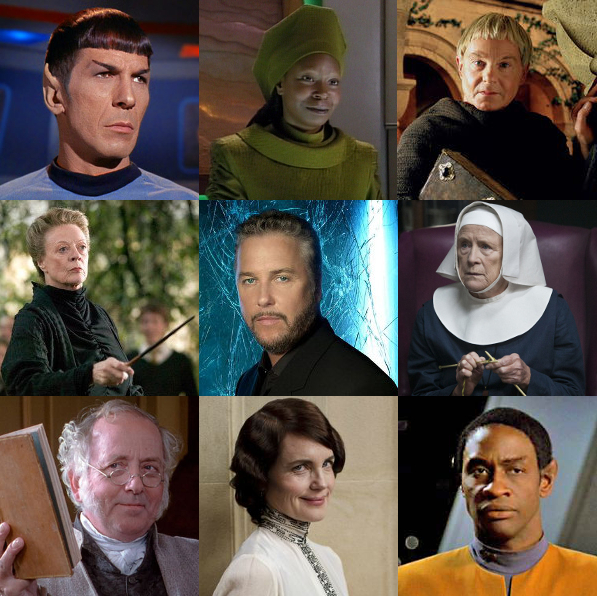
I understand where this response comes from. There are white guys all over the place in popular media, but I’ve never identified with a character just because he was a white guy. There are so many of them that I couldn’t identify with them all if I wanted to. When I look at a character and think Hey! That’s me! it comes from traits other than outward identities. Here are some of the characters I’ve felt connected to over the years:
Spock (Star Trek), Guinan (Star Trek: The Next Generation), Brother Cadfael (Cadfael novels and tv series), Minerva MacGonagall (Harry Potter novels and films), Gil Grissom (CSI), Sister Monica Joan (Call the Midwife), Mr. Bennet (Pride and Prejudice), Cora Crawley (Downton Abbey), Tuvok (Star Trek: Voyager)
They’re not all the same gender, race, age, or even species as I am. Two of them are members of a religious order, and I’m not religious at all. Most of them don’t even (fictionally) live in this century.
What can we learn from this collection? (Other than that I have a thing for Vulcans and a rather inflated sense of my ability to dole out wise advice to young ‘uns.) That representation is an aspect of privilege even when you’re not being represented. Having white guys all over the place frees me to look at the characters in my media and identify with them not based on the outward categories they fall into but because they’re thoughtful, introverted, curious, even-tempered, and passionate about knowledge.
On the other hand, I am a member of a very small minority who is rarely represented in media, and then usually in a dismissive, stereotyped, even offensive way: history professors. According to most books, movies, and tv shows, we are boring, joyless pedants in tweed jackets with elbow patches who obsess over minutiae and care only about names and dates.
“Easily the most boring class was History of Magic, which was the only one taught by a ghost. Professor Binns had been very old indeed when he fell asleep in front of the staff room fire and got up the next morning to teach, and left his body behind him. Binns droned on and on while they scribbled down names and dates, and got Emeric the Evil and Uric the Oddball mixed up.”
– J. K. Rowling, Harry Potter and the Philosopher’s / Sorcerer’s Stone Ch. 8
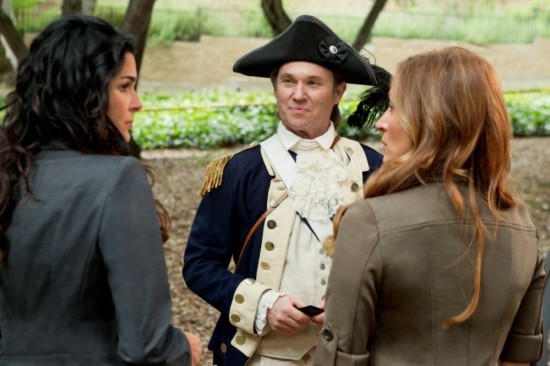
We always wear period clothes and are at best dimly aware of what century we actually live in, if not actively in denial about it.
Professor Dwayne Cravitz from Rizzoli and Isles s. 2 ep. 6 “Rebel Without a Pause”
(Not to mention that we make our (black) graduate students do unpaid labor so that they can have the “authentic slave experience.”)
Oh, and if we’re medieval historians, we’re indistinguishable from renfaire performers. (I can’t find a link to it now, but the memory is seared in my mind of an NPR interview with a scholar attending the annual medieval studies conference in Kalamazoo which made it clear the interviewer thought it was basically a fantasy convention.)
Come on by my history class sometime. I won’t be wearing a costume or droning on about names and dates. I’ll be deep in conversation with my students about social structures, economic forces, multicultrual interactions, source analysis, and all the other interesting parts of history.
Now, history professors are not, by any stretch of the imagination, a historically oppressed or marginalized group. I know how aggravating it can be to be badly represented even as a comfortably privileged middle class white man, but I can’t really imagine what it must be like to be, say, a Native American woman, or a gay man who uses a wheelchair, or a Muslim teenager with Asperger’s, and have to deal with not only the weight of the social disadvantages that come with that and seeing people like myself so rarely and poorly portrayed in media.
Of course we can all identify with people who aren’t like us. That’s not the point. The point is that, no matter who we are, we all deserve to see enough people outwardly like ourselves in books, television, movies, and other media that we don’t have to identify with them just to feel like we’re there.
History for Writers is a weekly feature which looks at how history can be a fiction writer’s most useful tool. From worldbuilding to dialogue, history helps you write. Check out the introduction to History for Writers here.
Language can be beautiful. We all know this as readers and writers. But language can also be beautiful as a visual, even physical work of art. In pre-modern societies where literacy rates were low, most people who looked at written text experienced it as a work of art, not as a work of language.
Here, for example, is the beginning of the Gospel of John in the Book of Kells.
Book of Kells, folio 292r via Wikimedia (Ireland; c. 800; ink on vellum)
It may be hard at first to tell that there is even a text in the midst of this work of art, but if you know where to look you can find the Latin text: IN PRINCIPIO ERAT VERBUM (In the beginning was the word).
Book of Kells via Wikimedia, text highlighted by Erik Jensen
The ancient Mediterranean was a multilingual place. Although a few languages were in common usage—Phoenician, Greek, Aramaic, Punic, and Latin, in different times and places—many other languages were spoken, including Iberian, Gaulish, Etruscan, Oscan, Hittite, Hebrew, Egyptian, and Numidian. Many people, especially in the great port cities like Carthage, Rhodes, and Alexandria, would have encountered numerous different languages in their daily lives. It is no surprise that this experience of a polyglot world was reflected in classical literature. The ways in which ancient writers represented multilingualism and language barriers offer some useful models for us as speculative fiction writers today.
There are just five days to go in the Kickstarter for Hidden Youth, the anthology of speculative fiction about marginalized young people in history. As I posted before, my story, “How I Saved Athens from the Stone Monsters,” is one of the stories in this awesome collection. I wanted to post again to thank everyone who has contributed to making Hidden Youth happen and also to say something about why this collection is so important to me, and would be even if I didn’t have a story in it.
I teach ancient Mediterranean history at a state university. Ancient Mediterranean history is the dead-white-guy-est of all dead-white-guy history. It’s filled with the sorts of dead white guys that people make white marble statues of and that living white guys like to point to as the pinnacles of western literary, artistic, and philosophical achievement. We’ve basically had two thousand years of white guys burnishing their white-guy cred by laying exclusive claim to the legacy of the great dead white guys of the ancient Mediterranean. So successfully have they done this that a lot of people have a hard time imagining an ancient Mediterranean world that isn’t all white guys.
Now, I’m a white guy. I’ve always had the comfort of seeing myself in history. Even as a professional historian, doing my best to be objective and fully conscious of how complicated, contingent, and constructed such identities are, I can never really know what it is like to look at history and not see people who look like me. That’s a barrier I can’t cross, but I have a lot of friends who live on the other side, especially my students.
Half my students are women and a lot of them are black, Hispanic, and southeast Asian kids from working-class towns. They’ve lived their lives in the shadow of other people’s histories. They have been shown the dead-white-guy-marble-statue version of history and told—sometimes subtly, sometimes not so subtly—“This is ours. You don’t belong here.” I consider it my job to say: “Yes, you do. You were always part of this history.”
The ancient Mediterranean world was multicultural, multi-ethnic, multilingual, and full of connections both within itself and to the larger world beyond. Like in my story, there were Egyptians in late classical Athens with their own Isis temple. A Sri Lankan king sent ambassadors to open diplomatic relations with Rome. And it wasn’t all a bunch of men, either. The queen of Halicarnassus was a military adviser to the Persian king. A wealthy woman of African ancestry was buried in style in late Roman York. The evidence is everywhere once you start to look for it.
The power of dead-white-guy-marble-statue history is strong and it needs to be challenged. I confront it in the classroom and my scholarly work, but we also need books like Hidden Youth out there to send the message: history is for everyone, not just people who look like me.
If you’ve already supported Hidden Youth, thank you so much. If you haven’t, please consider it. You can give as little as a dollar, and if you can’t do that, please spread the word.
On a less serious note, let me offer an added incentive to give: if Hidden Youth meets its funding goal, in honor of the collection’s theme I promise to translate and post my picks for The Top Five Greek and Latin Poems that Read Like Teenage Facebook Updates.
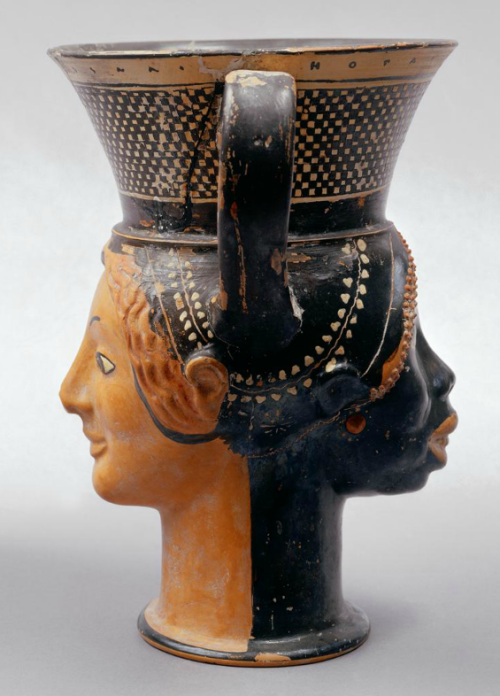
Images: Bull leaping fresco (restored), photograph by Nikater, via Wikimedia (Knossos; 1550-1450 BCE; fresco). Janifrom kantharos, via People of Color in European Art History (Etruria, currently Villa Giulia; 6th c. BCE; ceramic)
When characters in fantasy fiction sit down to a meal, we have a pretty god idea of what to expect. If the setting is Europe-ish, you can count on hearty bowls of stew, roasted meats dripping with savory juices, ripe wheels of cheese, and maybe a little bread to dab up the sauce with. If the setting is Asia-ish, expect sizzling pans of vegetables and fish, skewers of meat steaming with spices both hot and sweet, and maybe a little rice to dab up the sauce with. (And I’m sure some of you out there who have read books I haven’t can tell us what food to expect in Africa-ish, Americas-ish, or other-ish settings.) The trouble with this picture of food is, historically speaking, it’s backwards. The sizzling meats, steaming vegetables, and spicy sauces are not the food. The bread, rice, and other grains are the food.
If you’re inventing a fantasy religion for a story or game, you’ll probably want more than just buildings and rituals. Who uses those buildings? Who performs those rituals? Not just the everyday believers but the people whose job it is to carry out the functions of the faith. For many of the stories we tell that involve imagined religions, knowing something about the people who have expertise in that religion is important.
There are many different kinds of religious experts, even within most religious traditions, and their roles and lives can vary enormously, from the highest priest of a central temple to the attendant who sweeps the dirt off a rural roadside shrine. Some cultures have complex hierarchies of religious people or divide them into many different roles, while in others all people who follow a religious life are the same. Some religious traditions have no special personnel at all.
To try to list all the possible variations of religious people would be overwhelming and unhelpful. Instead, I’d like to offer a way of thinking about different kinds of religious experts that is flexible and practical, especially for worldbuilding. To that end, consider this question: what is it about a person with a special religious role that makes them special? Here are a few possible answers, and bear in mind that more than one of these can apply to the same person.
Special powers
Some religious experts are believed by the adherents of their faith to be endowed with a special ability to invoke divine aid, at least under certain conditions. Historically, it is common to refer to religious experts with such special powers as priests, but different traditions have their own terms.
A familiar example in the modern west is the priests of Catholic Christianity who have the power to, among other things, invoke the miracle of transubstantiation. Many other religions practiced today also have priests who perform important rites, such as Hinduism, Zoroastrianism, Shinto, and Ifa. The priests of most historical religions with an organized structure also fall into this category, including those of ancient Greece, Rome, Egypt, Persia, the Aztecs and the Maya. Many traditions require specific circumstances, locations, and rituals in order for the invocation of divine aid to be effective, but others hold that every act of a holy individual is imbued with divine force.
Life is tough as a flute girl working the streets of Athens—and that’s before the monsters attacked. When the city’s guardian statues suddenly come to life and start rampaging through the city, Mnestra, an Egyptian girl, and her Thracian friend Lampedo get separated in the chaos. Can Mnestra find the courage to rescue her friend and confront not only the monsters tearing up the city but also the most powerful man in Athens?
My short story “How I Saved Athens from the Stone Monsters” will be published this fall in the anthology Hidden Youth, a collection of 22 short fantasy and science fiction stories about young people from marginalized groups throughout history. This anthology follows the previous collection Long Hidden which told the stories of people who are often left out of speculative fiction.
I am honored to have my work chosen for Hidden Youth, but this anthology needs our help to make it out into the world. Check out the Kickstarter for Hidden Youth and consider supporting this work.
After the invention of the printing press, old handwritten books and documents were commonly recycled as reinforcements in new bookbindings made in the 15th through 18th centuries. Now, thanks to an x-ray technique developed in the Netherlands, these hidden manuscript fragments are readable without destroying the book they’re a part of.
It’s all possible with macro x-ray fluorescence spectrometry (MA-XRF), which allows even pages glued to each other to be read. Dr. Erik Kwakkel at Leiden University, one of the academics behind the Hidden Library project attempting to uncover more of these fragments, has both been interviewed and written about the process.
“Every library has thousands of these bindings, especially the larger collections. If you go to the British Library or the Bodleian [in Oxford], they will have thousands of these bindings. So you can see how that adds up to a huge potential.”
Now I’m hoping we will eventually find a wealth of medieval texts in bookbindings. It’s really fascinating what we can discover with modern technology!
Image: A printed book with medieval manuscript fragments inside the spine, photograph by Erik Kwakkel (Leiden, University Library, nr. 583; 16th c. with 12th c. fragments)






 Co-Geeking


.jpg)


You must be logged in to post a comment.