Visual Inspiration: Aztec-Engineered Floating Garden Islands

Did you know that Aztecs created floating garden islands on swamps to feed 200,000+ people? I didn’t before now.

Te Papa Aztec Chinampa Model

An article by Lynette Townsend for the Museum of New Zealand descibes the structure of the chinampas:

“These ingenious creations were built up from the lake bed by piling layers of mud, decaying vegetation and reeds. This was a great way of recycling waste from the capital city Tenochtitlan. Each garden was framed and held together by wooden poles bound by reeds and then anchored to the lake floor with finely pruned willow trees. The Aztecs also dredged mud from the base of the canals which both kept the waterways clear and rejuvenate [sic] the nutrient levels in the gardens.”

Apparently the chinampas were separated by channels, and canoes were used for transport. In addition to food crops and flowers grown, fish and birds drawn to the chinampas were caught for food as well.

Te Papa Aztec Chinampa Model Closeup

What an incredibly smart feature to engineer! It also strikes me as a fantastic (no pun intended), pragmatic thing to adapt into a SFFnal world.

Found via Ultrafacts at Tumblr.

Images: models by artisan collective Te Mahi via Museum of New Zealand / Te Papa Tongarewa.

The Visual Inspiration occasional feature pulls the unusual from our world to inspire design, story-telling, and worldbuilding. If stuff like this already exists, what else could we imagine?

Quotes: Everything in the World Is Beginning to Fail

“No one should be amazed that everything in the world is beginning to fail, since the world itself is already failing and near its end.”

– Cyprian, To Demetrianus 4

(My own translation)

How’s that for a cheery thought to start your week?

We hear a lot of grim takes on the world and its fate these days, but this one is far from recent. This line comes from a letter written by St. Cyprian, bishop of Carthage in the mid-third century CE. Cyprian had plenty of reason to feel gloomy about the state of the world. The Roman Empire was in disarray, in the midst of a long period of civil wars and violence. When the empire did periodically pull itself together, it engaged in repeated persecution of Christians. On top of this, the Mediterranean was in the midst of a widespread epidemic of a deadly infectious disease, possibly smallpox or a hemorrhagic fever similar to Ebola. It’s no wonder that Cyprian’s world felt like it was coming to an end.

I share this quote not to depress you all further, but as a reminder that, however dire our times may seem, they are not unique. The world didn’t end in the third century. The Roman Empire pulled itself back together again, at least for a while. The persecutions were ended, and Christians were allowed to worship in peace. The epidemic passed. None of these things happened quickly or easily. It took an awful lot of hard work and sacrifice from an awful lot of people to bring the Mediterranean world back from the brink, but it happened.

It’s going to take an awful lot of hard work and sacrifice from an awful lot of people to bring today’s world back from the brink, too, but it can be done. Cyprian was wrong about the end of the world. Let’s make sure that today’s direst predictions turn out to be wrong, too.

Trailer for Manikarnika

The story of Rani Lakshmibai, Queen of Jhansi, is not a new one and has been both written and filmed before, but the 2019 movie Manikarnika is the first I’ve heard of her. Apparently she was one of the leaders of the Indian Rebellion of 1857 / the First War of Independence against the British East India Company in northern India after the death of her husband, the Raja of Jhansi.

Manikarnika – The Queen Of Jhansi | Official Trailer | Kangana Ranaut | Releasing 25th January by Zee Studios on YouTube

Phew—the trailer’s even bloodier than the one for Tomiris. (I wonder whether it’s a Game of Thrones effect—the popularity of that bloody show begetting other series with high liquid velocities?) Apart from that, the two trailers and/or stories seem to share a remarkable amount of basic similarities, yet are set thousands of kilometers apart. An interesting coincidence.

On the other hand, Manikarnika looks incredibly gorgeous! According to IMDB, it’s already available—the release date is given as January 25, 2019—and Amazon offers streaming versions in Hindi, Telugu, and Tamil with a selection of subtitles.

The bloodiness makes me really apprehensive, though. I’m in for more humane stories at the moment, but I think I’ll have to keep Manikarnika in mind.

Found via Frock Flicks.

Hey, look! We found a thing on the internet! We thought it was cool, and wanted to share it with you.

The Persian Version

We know the story of the Greco-Persian Wars very well from the Greek side of things, especially from Herodotus whose Histories is all about the conflict. Modern histories have tended to tell the story the same way the Greeks told it—as a triumphant victory of hardy, democratic Greeks over soft, despotic Persians—in large part because we have no Persian version for comparison.

Even though we don’t have a Persian account comparable to Herodotus, however, we do have a hint as to how the wars may have been remembered inside the Persian Empire. This hint comes from a second-hand story reported several centuries after the fact by the Greek rhetorician Dio Chrysostom:

I heard a Mede say that the Persians do not agree at all with the Greeks’ version of events. Instead, he said that Darius sent Datis and Artaphernes against Naxos and Eretria, and that after capturing these cities they returned to the king. A few of their ships—not more than twenty—were blown off course to Attica and the crews had some kind of scuffle with the locals. Later on, Xerxes made war on the Spartans. He defeated them at Thermopylae and slew their king Leonidas. Then he captured the city of Athens, razed it, and enslaved those who did not flee. When this was done, he made the Greeks pay him tribute and returned to Asia.

– Dio Chrysostom, Discourses 11.148-149

(My own translation)

This version of events is not exactly wrong. The basic sequence matches up with our other evidence: in 490 BCE, King Darius sent a campaign against Greece that successfully captured the cities of Naxos and Eretria, but was defeated at Marathon and failed to take Athens. Ten years later, Darius’ son and successor Xerxes led an invasion of Greece which defeated a small Spartan-led holding force at Thermopylae and killed the Spartan king Leonidas, then captured and burned Athens. Numerous Greek cities became tribute-paying subjects of Persia rather than fight Xerxes’ force.

The only real differences between this Persian account and the Greek legend are the ways it emphasizes successes and downplays defeats. The battle of Marathon becomes a mere fistfight between a few stragglers and some local color. The capture and destruction of Athens is celebrated, even though the aim of the campaign was to absorb Athens into the empire, not just burn it and leave. The Persian kings could rightly say that they had made a significant show of force against the Greeks, while leaving out the fact that they hadn’t quite achieved what they set out to. As spin goes, this isn’t spun too far.

We know the Greek stories about the wars so well that we can easily see the places where the Persians seem to have burnished their memories, but that observation should also make us question the Greek stories themselves. If Persians could tweak their story to make themselves look better after the fact, what’s to say that the Greeks didn’t do the same? If we had a fuller Persian account of the conflicts in Greece, we might well find plenty of places where Herodotus and his fellow Greeks had played up their own successes and swept some embarrassing missteps under the historical rug.

Image: A Persian “Immortal,” selection from photograph by Mohammed Shamma via Flickr (currently Pergamon Museum, Berlin; 5th c. BCE; glazed brick) CC BY 2.0

History for Writers looks at how history can be a fiction writer’s most useful tool. From worldbuilding to dialogue, history helps you write. Check out the introduction to History for Writers here.

Trailer for Tomiris

Apparently, there is a Kazakhstani movie on the historical female leader Tomyris of the Massagetae, and we also have a trailer with English subtitles:

TOMIRIS – Official trailer (HD) (English subtitles) by SATAIFILM on YouTube

We know for sure that Tomyris fought Persians in the 500s BCE, but as far as we know she did not unite all the people of the steppe as the movie claims. Well, it wouldn’t be the first movie to play fast and loose with history.

At this writing, IMDB only has the most rudimentary information and gives the year 2019 for release. Director Akan Satayev’s credits include a dozen or so writing and producing projects, mostly local and directed at a decidedly non-English-speaking audience.

It’s possible, then, that Tomiris will also remain outside of the Anglo-American market. I, for one, would find that sad, for the production looks really interesting (although I could do with a little less blood flying around).

Come to think of it, I should have a look to see if I can find any movies of ancient Persia or thereabouts. Anything you can suggest would be welcome!

Found via Helsingin Sanomat (NB. Finnish only).

Hey, look! We found a thing on the internet! We thought it was cool, and wanted to share it with you.

Classifying Warfare: Predatory and Hierarchical

In his history of Western weapons and warfare, Of Arms and Men (Oxford: Oxford University Press, 1991), Robert O’Connell proposes an interesting model for examining the military systems of different cultures by analogy to the animal world. Animals use violence for different purposes and in different ways. Some violence is predatory, as when a wolf hunts a deer or an owl snatches a mouse out of a field. The point of the violence is to kill and consume prey. These animals’ methods and weapons (fangs, claws, beaks) are practical and efficient. They are meant to get the job of killing done as quickly and effectively as possible. Some prey animals have evolved similarly efficient weapons (hooves, horns, teeth) for self-defense. Other times, violence is hierarchical, as when deer lock antlers or dogs tussle with each other to establish an order of dominance within a pack. In these cases, the way that animals fight each other tends to be limited, almost ritualized, in a way that focuses more on display and intimidation than actual wounding—when deer are defending themselves from predators, they can kick and bite with wounding force, but when competing for dominance they lock antlers and shove in a way that minimizes the chance of one deer seriously harming another. The same model can be used as a way of thinking about warfare in human societies.

Some cultures’ ways of making war are like predatory animals’. Their weapons are simple and brutally efficient. Their goal is to kill and destroy, not just to force their opponents into submission. They do not recognize rules of war or limits on where, when, how, or against whom violence can legitimately be used. A classic example is the Roman legion. A legionary’s primary weapon was the gladius, a short sword used for thrusting and slashing at an enemy’s lower torso. The wounds left by a gladius were gory and horrible; the sight of bodies mutilated by Roman blades was enough to demoralize some warriors. Contemporary observers describe Roman soldiers going into a bestial frenzy on the battlefield and slaughtering everything in their path, not just enemy fighters but civilians, children, even animals.

Other cultures fight more like animals competing for dominance within a herd. Their warfare is contained within rules dictating what violence is acceptable and what is not. Battles often begin only after showy demonstrations of power and attempts to negotiate some peaceful resolution. The act of battle itself is brief and bounded by rituals; the goal is not to annihilate the enemy but to compel them to submit and recognize the superiority of the winning side. Ancient Greek hoplite warfare fits this model. Hoplites fought in brief campaigns between city-states, often decided in a single battle on a field which had been mutually agreed to by the two sides. Casualties in a hoplite battle were generally low; victory came when one side broke ranks and fled the field, not with the elimination of one army by the other. The violence of hoplite fighting was real, but it was strictly limited by rules of engagement and commonly understood principles of honor.

Whether a society leans toward predatory or hierarchical violence often depends on who their enemies are. Among people who share culture, history, and traditions, violence tends to be hierarchical. When communicating with the other side is easy and the belligerents in a war already agree on certain principles and ideals, it is easier to agree on limits and rules about war and to be confident that your opponents will abide by their promises. When fighting people with whom you don’t share culture and history, it is harder to rely on commonly agreed rules of war or to trust that the other side will stick to their agreements. Hoplite warfare developed among Greek city-states who were repeatedly fighting their close neighbors, and legionary warfare developed in an expansionist empire venturing further and further into unknown territory, but we can see similar patterns play out in other historical settings as well.

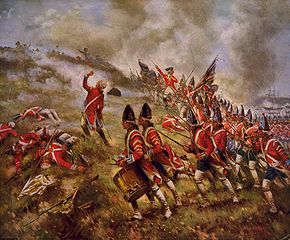
During the eighteenth century, wars among European states were often carried out in hierarchical ways. A British commander facing French troops and not feeling confident of victory could trust that if he surrendered instead of chancing a battle, he and his troops would not be slaughtered but would be treated according to certain basic rules and eventually ransomed back or released at the end of hostilities. Conditions for prisoners of war could certainly be horrendous—especially for the rank and file—but surrender was an acceptable, even honorable, option when there was no reasonable chance of victory. Since the best way to win a battle is to not have to fight it in the first place, convincing enemy troops to give up became as tactically important as fighting them in the first place. Hence the development of flashy, colorful uniforms and elaborate drill performances. The goal was to make one’s own troops look as impressive as possible in order to intimidate the enemy into giving up without a fight.

Meanwhile, in European colonies in the Americas, Africa, and Asia, European settlers faced off against native peoples whose languages, cultures, and traditions they did not share. Neither side could trust that the other would honor agreements or abide by even basic rules on the treatment of prisoners or civilians. Colonial warfare tended to be brutal and predatory. There was no point to trying to intimidate the enemy or force them to come to terms; the only goal of warfare was to kill as efficiently as possible. In England’s North American colonies, settlers developed a style of warfare for fighting against the indigenous people which diverged very far from the elaborate rituals of European warfare at the time. In the early battles of the American Revolution, the orderly performance of the British redcoat drill came up against the guerrilla tactics of American minutemen trained in the harsh school of frontier raiding and counter-raiding.

Hierarchical warfare, seen from outside the culture that practices it, can seem ineffective or even silly, war reduced to symbols and shadowplays, but hierarchical warfare is serious. It has real casualties, sometimes even carnage on a terrible scale. The point of the displays of power, the rules and rituals, is to preserve one’s own fighting force for the moment when it can make a decisive difference. The Cold War between the United States and the Soviet Union was one large struggle for hierarchical dominance, but it had real and devastating consequences for people throughout the world.

Societies that practice predatory warfare, encountering hierarchical-war cultures for the first time, often have an advantage, at least at first. The army not limited by rules of engagement and focused on killing rather than putting on an impressive display can be devastatingly effective against an unprepared opponent. At the same time, predatory warfare can also be self-defeating. The force that does not respect common rules of war can have a hard time concluding truces and treaties and may find itself dragged into wars it does not want to fight because no one trusts them enough to make peace with them.

Thoughts for writers

This way of classifying how societies fight can be useful for defining the terms of conflict in your stories. When you have powers that share a lot of culture and history fighting one another, like a world based on medieval European kingdoms or the states of ancient India, it makes sense to build in rituals, displays of power, and rules of war that are generally recognized. Of course, just because rules of war exist doesn’t mean that everyone follows them, but breaking those rules has consequences, not just for how your enemies treat you but for how your allies or potential allies think about you, too. Therein lies plenty of potential for interesting conflict and character development.

On the other hand, when two or more very different cultures run up against one another, such as in the borderlands between different cultures or at the edge of an expanding empire, warfare is likely to take on a more predatory nature. The absence of agreed-upon rules of war or rituals for establishing dominance without fighting will lead to more violence and brutality. Again, even within a predatory context, there can be opportunities for displays of power taking the place of fighting or the emergence of rough-and-ready rules of engagement. These sorts of developments would be important in-world events for characters engage in, too.

Image: “Battle of Bunker Hill” via Wikimedia (1909; paint on canvas; by E. Percy Moran)

History for Writers looks at how history can be a fiction writer’s most useful tool. From worldbuilding to dialogue, history helps you write. Check out the introduction to History for Writers here.

Quotes: Lords of Creation Don’t Take Advise

I’m (re)reading some things from my childhood, except in English instead of a Finnish translation. This paragraph made me gawk:

“Amy’s lecture did Laurie good, though, of course, he did not own it till long afterward; men seldom do, for when women are the advisers, the lords of creation don’t take the advise till they have persuaded themselves that it is just what they intended to do; then they act upon it, and, if it succeeds, they give the weaker vessel half the credit of it; if it fails, they generously give her the whole.”

– Louisa May Alcott, Little Women

Whoa! Little Women isn’t really the kind of book where you’d expect to see sarcasm this sharp; it sounds more like Jane Austen.

Alcott, Louisa May. Little Women. New York: Puffin Books, 1997 [reissued; published by Puffin 1953; first published 1868], p. 571.

Serving exactly what it sounds like, the Quotes feature excerpts other people’s thoughts.

Deleted Scenes: Greeks and Romans

In the spirit of deleted scenes from movies, here are a few more snippets from Barbarians in the Greek and Roman World that didn’t make it to the final draft. Today’s selections concern the relationship between Greek culture and Roman culture, and the formation of the cultural fusion we know as Greco-Roman.

On the Etruscans as early mediators between Greece and Rome:

The fact that Greek culture first came to the Romans second-hand through the Etruscans explains some oddities in things like the spelling of names. It is easier to see how the name of the Greek hero Heracles became Hercules in Roman mouths, for instance, when we know that in between he was the the Etruscans’ Herkle. In the same way, Greek Persephone became Etruscan Persipnei, who in turn became Roman Proserpina.


On the dynamics of power and culture:

While Rome’s military supremacy only grew over time, the power to confer cultural legitimacy within the larger Mediterranean political and diplomatic sphere remained for a long time the property of the Greeks. The narrative that power lay in Rome but culture in Greece could be tuned to either side’s advantage: it flattered Roman vanity while giving Greeks a claim to special status under Roman rule.


On the similarities between Greece and Rome:

Greek and Roman cultures were compatible in many ways. Both were grounded in the geography of the Mediterranean, tied to its networks of trade and travel, and dependent on the “Mediterranean triad” of wheat, olives, and grapes. The climate and the demands of agriculture imposed regular annual rhythms that structured much of economic and social life. Both were, at least in their formative centuries, city-state societies whose politics revolved around balancing the ambitions of the rich and powerful against agitation from the less well-off. In their early years, their military power depended on unpaid citizen armies. Their economies depended on large slave populations. These fundamental similarities helped bridge the many differences between the two cultures.


On the uses of Greco-Roman culture:

There was no denying the imbalance of power between Greeks and Romans. Greco-Roman culture was not a collaboration of equal partners but a common ground on which relations of political power and cultural authority could be negotiated.

All of these passages got cut for various reasons—because the sections they were in got reworked, because I found a better way to express the same idea, or just for space, but it is nice to bring them out into the light again.

How It Happens is an occasional feature looking at the inner workings of various creative efforts.

Quotes: The Templars, Who Were My Friends

The following story is related by Usamah Ibn Munqidh, a twelfth-century Muslim writer who lived during the time of the early Crusades, about his interactions with some of the Knights Templar who occupied Jerusalem in his day.

Whenever I visited Jerusalem I always entered the Aqsa Mosque, beside which stood a small mosque, which the Franks had converted into a church. When I used to enter the Aqsa Mosque, which was occupied by the Templars, who were my friends, the Templars would evacuate the little adjoining mosque so that I might pray in it.

One day I entered this mosque, repeated the first formula, “Allah is great,” and stood up in the act of praying. Then one of the Franks rushed to me, got hold of me and turned my face eastward, saying, ‘This is the way you should pray!’

The Templars came up to him and expelled him. They apologized to me, saying, ‘This is a stranger who has only recently arrived from the land of Franks and he has never before seen anyone praying except eastward.’

– Usamah Ibn Munqidh, Autobiography


Ibn Munqidh’s experience is certainly not typical of Christian-Muslim relations in the Crusade period, but it is a useful illustration of the kinds of friendly and respectful relationships that could be forged between individuals of different backgrounds, even in times of war.

From another point of view, it is useful to note that the Templars were effectively enforcing an anti-harassment policy on their own members. If a militant religious order in a war zone could do that, then there’s no excuse for modern fan conventions not doing the same.

Translation from Philip K. Hitti, An Arab-Syrian Gentleman and Warrior in the Period of the Crusades. New York: Columbia University Press, 2000, 160.

Serving exactly what it sounds like, the Quotes feature excerpts other people’s thoughts.

The Ancient Underground City of Derinkuyu

The Derinkuyu (also known as Malakopi) underground city is situated in the historical area of Cappadocia, which is in Central Anatolia in modern-day Turkey. And it’s pretty astounding.

Apparently, underground cities were A Thing thereabouts: according to Wikipedia, there are over 200 of them. Looking at the landscape, it’s no wonder.

Flickr Anthony G Reyes Derinkuyu Pigeon Valley

Much of the rock is easily accessible, i.e., not covered by layers and layers of vegetation, and there are plenty of rock faces to carve into.

The first mentions of underground dwellings in Anatolia come from Xenophon’s Anabasis (c. 370 BCE), but they were probably built much earlier as places of refuge from attacks. Derinkuyu seems to have been in use for millenia: the last recorded use was at least as late as 1909.

According to a tourism site, there are about 600 entrances to the underground Derinkuyu, and some can be closed with a door resembling a mill stone.

Flickr Dan Merino Derinkuyu Stone Doorway

Underground City in Cappadocia

In addition to tunnels and rooms themselves, there are other notable features. There are stairs, ventilation shafts, wells, and storage areas with nooks and crannies of various shapes, including wine troughs.

Underground City in Cappadocia

Flickr Helen Cook Derinkuyu Wine Recepticles

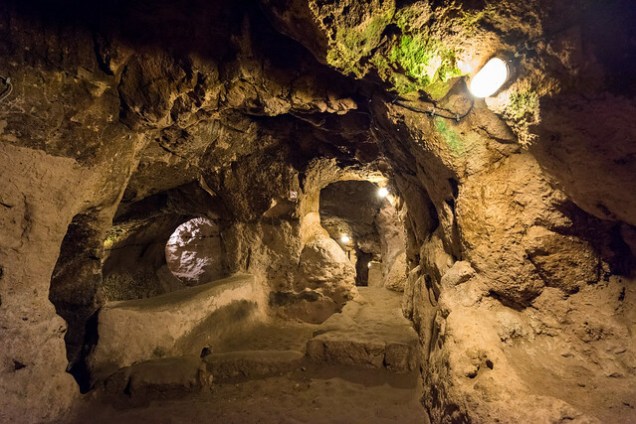
Clearly some areas were left in quite rough shape.

Flickr jyl4032 Derinkuyu Unnamed View

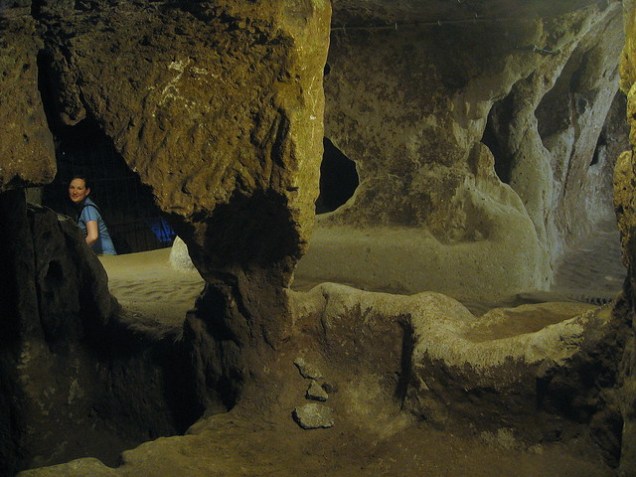
Flickr Patrick Barry Derinkuyu Room w Woman

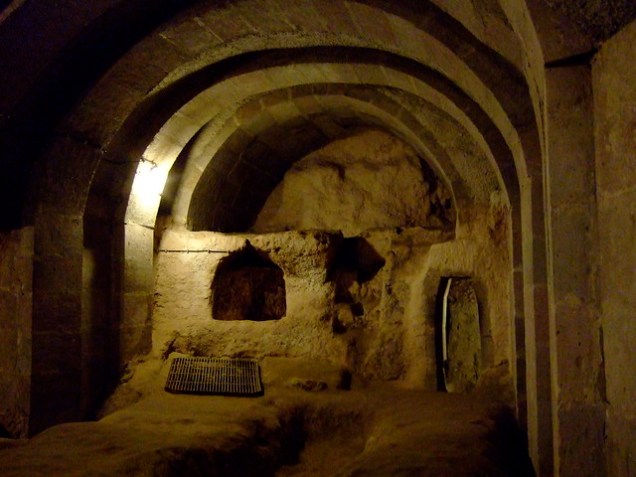
Others were carefully detailed. For example, there is a room with a barrel-vaulted ceiling.

Flickr Takehiko Ono Derinkuyu Vaulted Room

At its largest, Derinkuyu seems to have been able to house 20,000 people and their livestock and supplies.

Found via Ticia Verveer on Twitter.

Images: Cappadocia: Derinkuyu and Pigeon Valley 2015 by Anthony G. Reyes on Flickr (CC BY-ND 2.0). Stone doorway by Dan Merino on Flickr (CC NY-ND 2.0). Stairs down by David Welch on Flickr (CC BY-NC 2.0). Two levels with steps and corridors by David Welch on Flickr (CC BY-NC 2.0). Wine recepticles by Helen Cook on Flickr (CC BY-SA 2.0). Unnamed view of rough corridor by jyl4032 on Flickr (CC BY-ND 2.0). Room with a woman for scale by Patrick Barry on Flickr (CC BY-SA 2.0). Vaulted room by Takehiko Ono on Flickr (CC BY-ND-NC 2.0).

Out There is an occasional feature highlighting intriguing art, spaces, places, phenomena, flora, and fauna.