The Rumor Table

150910rpgSo, you’re game-mastering a tabletop role-playing game and your player characters decide to spread out around town and see if they can pick up any useful information about their current quest. How do you handle it?

There are lots of things you can do. If there’s some info you need to dump on them, now’s the time to hand it over. Or if you want them to just head out into the wilderness and figure it out as they go, you tell them that no one knows anything. You can always just make stuff up off the top of your head. Like with most GMing tasks, as long as your players have a good time, there’s no wrong way to do it. Here’s a tool that might make your job a little easier, though: the rumor table.

When I’m planning an adventure and I know that my players are going to have a chance to snoop around and ask questions, I like to prepare a rumor table for what they might find out. The table is a mix of true and false information that is more or less helpful. I plan it for a roll of 2d6 (you can make it bigger or smaller depending on your needs, but I find a 2d6 table covers most cases). For the numbers 2-12, come up with the following tidbits of information:

  • 2 – False, and potentially disastrous if the player characters believe it
  • 3 & 4 – False
  • 5 & 6 – False but with a grain of truth, such as true information that has been garbled or misinterpreted
  • 7 – Equal parts true and false
  • 8 & 9 – True
  • 10 & 11 – True and probably helpful to the characters at the moment
  • 12 – True and very important

Suppose your campaign is The Lord of the Rings and your characters are meeting for the first time at the Council of Elrond in Rivendell. (I mean, imagine a world in which The Lord of the Rings isn’t a famous novel and movie trilogy that your players already know but is your campaign that you wrote and they are playing through for the first time.)

Here’s what your table might look like:

  • 2 – Saruman is secretly on the side of good
  • 3 – Elves from Lothlorien have been attacking outlying villages on the borders of Rohan
  • 4 – Moria is abandoned and free of orcs
  • 5 – Smeagol has been sighted in Mirkwood heading east towards Dale
  • 6 – Rohan pays a tribute of horses to Sauron for the ringwraiths to ride
  • 7 – Denethor of Gondor has a palantir but he refuses to look into it
  • 8 – The Dunedain rangers were searching for Smeagol not long ago
  • 9 – Saruman has ordered the destruction of Fangorn forest
  • 10 – Wargs have been spotted in great numbers in the wildlands south of Rivendell
  • 11 – Theoden king of Rohan has become weak and listless and lets his advisers make most decisions
  • 12 – A balrog lurks in the depths of Moria

There are some advantages to using a rumor table. For one thing, it takes some of the pressure off you to come up with the perfect responses in the moment. Like mapping a dungeon ahead of time, it lets you prepare in advance. It’s also a convenient way of rewarding your players for good role-playing or taking the characters’ advantages into account. If the PC has a charisma bonus and the player does a good job role-playing the asking around, you don’t have to puzzle out just how much better information they should get; it’s easy to just give them a +2 on the rumor roll.

Another good thing about using the rumor table, if your players know that you have one, is it short-circuits the “it must be important or the GM wouldn’t have told us” metagaming. Your players have to think carefully and evaluate the information they get, just like their characters would have to do.

Now, of course, it’s a tool, not a rule. Use it with discretion. If the character your PCs happen to be talking to wouldn’t know (or wouldn’t say) the answer you roll, don’t use it. Either go up or down the table or make up something different. If there are things that your characters really need to know at a given point in the adventure, then that’s what you give them. (You can always roll the dice anyway, so they don’t know when they’re getting plot-critical stuff.)

Happy rumor-mongering!

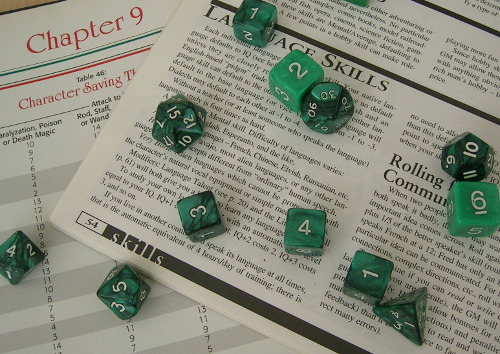
Image by Erik Jensen

Of Dice and Dragons is an occasional feature about games and gaming.
Men, Women, and Games

Lots of women play video games, and lots of gamers are women. This is not news, yet for some reason we have to keep saying it.

The august Pew Research Center was the most recent group to say it. Here’s their Teens, Technology, and Friendships report from earlier this month about how teens use games, among other online services, to connect with one another. Among many other findings, 84% of teenage boys reported playing video games, as did 59% of teenage girls. All teens reported playing a wide variety of different types of games (which is to say: no, all those teenage girl gamers are not just poking at Barbie Sparkle Kardashian Krush on their phones; they’re doing everything from hacking up orcs in World of Warcraft to building imperial star destroyers in Minecraft).

So, if there are so many women playing games, why don’t male gamers see them? The results of another recent study, Insights into Sexism: Male Status and Performance Moderates Female-Directed Hostile and Amicable Behavior by Michael M. Kasumovic and Jeffery H. Kuznekoff showed that male gamers (specifically playing Halo 3) tended to be more aggressive and abusive in voice chat to players who sounded female than those who sounded male. Also not news. Anyone who’s spent time in any online chat environment is likely to have seen the kind of dreck that gets spewed at women who let their identities be known, so it’s understandable that many female gamers choose to conceal their gender when in mixed company.

The Kasumovic and Kuznekoff study offers another interesting detail, however. The abuse directed at the female-voiced player came primarily from male players who were performing poorly, while men who were doing well at the game tended to be positive or neutral in their comments.

I see three important takeaways from these two studies:

  1. There are women in your games. In fact, if you play a multiplayer game, they are all around you. Just because you don’t know they are there doesn’t mean they aren’t. If you don’t hear women’s voices, it only means that the environment is toxic enough that many women choose to stay silent rather than have to deal with it.
  2. The men who harass women in games are not doing it mindlessly or randomly. They are not equal-opportunity dirt-spewers but target women specifically because they are trying to reassert their position in a hierarchy. The people most invested in any hierarchy are not the ones at the top but the ones who are afraid of falling to the bottom.
  3. If you are a male gamer and you want to look like you’re at the top of your game: don’t spew crap at the women around you. Good gamers are decent to their fellow players. The only ones who feel the need to put others down are the scrubs who can’t cut it.

Of Dice and Dragons is an occasional feature about games and gaming.
Gatesmashing

We’re all familiar with gatekeeping: when members of a fandom (or geekishness in general) try to exclude others for not being true fans or real geeks because they haven’t seen/read/played every obscure iteration of the franchise or don’t know every minute detail of the lore. “Oh, you haven’t seen the Holiday Special?” they sniff. “Well, you’re not really a Star Wars fan, then.” “You don’t know how many buttons were on the second Doctor’s costume? Begone, fake Whovian!”

If you’re fortunate enough to have never witnessed or experienced gatekeeping, here’s a few discussions (picked more or less at random) to give you an idea of what it is and why it sucks:

No One Can Deny You Entry to Geekdom, But Some Can Make It Really Hard to Get Through the Door First by Michi Trota on Geek Melange

The Psychology of the Fake Geek Girl: Why We’re Threatened by Falsified Fandom by Dr. Andrea Letamendi on The Mary Sue

A Creator’s Note to “Gatekeepers” by John Scalzi on Whatever

You see what I mean? Gatekeeping is wrong, hurtful, and no fun. And while it’s true that it can be done by anybody to anybody (I’m a straight man and I’ve had my fandom cred challenged by queer women half my age), it is a weapon frequently deployed by the privileged against the un-privileged, in whatever terms those categories may be defined.

Gatekeeping needs to stop. It’s time we all acknowledge that none of us has seen everything and none of us knows everything, even about the things we love the most. No one is any less of a geek or a fan because of the things they don’t know. All it means is there are still things for us to watch and read and play and find out about, and that’s awesome. Seriously, I feel so sorry for anyone who has nothing new left to learn or experience.

And so, I propose a new pastime: gatesmashing! Instead of obsessing over the things we have seen and read and played, let’s proclaim the things we haven’t. Tell us what you’ve never experienced, and tell us proudly. Not a comprehensive list, of course, but the first few things that come to mind.

I’ll go first.

I have never seen:

  • Rocky Horror Picture Show
  • Starship Troopers
  • The Dark Crystal
  • Any Doctor Who starring the first or fifth-through-eighth Doctors

I have never read anything by:

  • Neil Gaiman
  • Terry Pratchett
  • Ursula K. Le Guin

I have never played:

  • Skyrim
  • Minecraft
  • Dragon Age

And the fact that I haven’t doesn’t make me any less of a geek than anyone who has.

Here there be opinions!

Do-It-Yourself Fantasy Place Name Generator

Writing a fantasy story or role-playing scenario? Need to come up with names for towns, rivers, mountain ranges and so on, but tired of thinking up new names all the time? Here’s a handy technique I use. It takes a little work up front, but then it makes coming up with new names really easy.

The thing about place names is: when you dig down deep into their meaning, they’re usually really obvious and descriptive. It’s only time and language change that obscures their meaning.

Look at a map of Europe and you’ll find Copenhagen (“merchant harbor”) and Dublin (“black pool”). In Asia there’s Shanghai (“above the sea”) and Samarkand (“stone fortress”). The same applies to the native names anywhere else in the world. In places that have experienced substantial colonization, the conquerors often imported old names that didn’t relate to the landscape (New York, Wellington), but in other cases the new names given by colonizers were just as descriptive (Cape Town, Salt Lake City).

The reasons for this naming pattern are fairly straightforward. If you live in a landscape where there are several rivers, but only one of them is muddy, or plenty of mountains, but there’s a big one with no trees on top, when you need to refer to that river or that mountain, you’re likely to say: “the black river” or “the bald mountain.” From there it’s only a short step to calling them “Black River” and “Bald Mountain”. As time goes on and language changes, place names tend to become fossilized and preserve older variants and meanings that the rest of the language has left behind.

So, put these facts to work for you. When you’re setting up your map, generate a list of place name elements and then you can quickly combine them to make new names for whatever you need.

Here’s how it works:

Continue reading

World of Warcraft Class Theme Music

Some years ago, back on the old WoW Insider which is no more, there was once a fun post suggesting theme songs for the various character classes. As a classical music fan, I’ve tried to come up with a classical version of the same. Here are my suggestions.

Warrior – Bartok, Hungarian Suite “Bear Dance”

The warrior is an iconic archetype in role-playing games and the World of Warcraft version is much like its ancestors: a heavily-armed fighter who charges into the midst of battle. Bartok’s “Bear Dance” may sound more like a druid thing, but the music carries a feel of martial power fitting to a warrior.

“Bear Dance” via P. András

Continue reading

DIY Portal Mirrors

Reddit user corttana and her husband dahburbb have a pair of Portal-themed mirrors in their basement den:

Reddit User corttana Imgur Portal Mirrors
Reddit User corttana on Imgur

They were DIY-ed with mirrors, LED rope light, and wood, plus glue and various attachment / hanging supplies. There are some detail photos on Imgur, and dahburbb provides a list of materials and a how-to. This project is four years old already, but still oh, so good. 🙂

In Making Stuff occasional feature, we share fun arts and crafts done by us and our fellow geeks and nerds.