Ropecon and Rainbows

The 2025 Ropecon—the largest non-commercial RPG convention in Europe organised entirely by volunteers—is over. Thank you, everybody! I’m exhausted and happy. (And sick; con crud got me this year. Bleah.) I do need to get one thing off my chest, however.

I’m going to make an exception and write in Finnish this time, because I’m responding to a post about inclusion at the con by Merli Juustila, the chair for Ropecon ry., the entity running the con, published this June before the Helsinki Pride parade. (FYI: Juustila’s post is Finnish only.)

TL;DR for those who do not want to attempt Finnish: apparently every year for many years now, the organizers get complaints about rainbows at Ropecon and why that should be; it’s a gaming event, after all, or so says the feedback.

My response: Obviously, it’s because it’s a part of people’s identity and part of their lives. By the same logic, you might as well complain about historical dances, cosplay, card games, kids in strollers, or black clothes being visible all over the place during Ropecon.

Continue reading

Things I Have Learned By and About Going to Ropecon

This coming weekend is Ropecon, the major role-playing convention in Finland and one of the highlights of our year. Eppu and I always attend, whether it’s to play games, run games, catch up with friends, attend talks and workshops, or disco the night away.

As part of our Ropecon routine, once the weekend is over and we’ve recovered a bit, we compare notes and write down things we’ve learned from the experience to make the next year’s con easier, more manageable, or more fun. Here’s a few of the things I’ve learned over the years that have made my con experience better.

Since we live close enough to the convention site to go there and back again each day, here are some handy ways to manage home life for the weekend:

  • Make one big pot of soup or some other warm dish (chili, borscht, beef stew, etc.) and one big bowl of salad to leave in the fridge over the weekend. We can dip into one or both whenever we’re at home and need a low-effort meal.
  • Run and empty the dishwasher the morning of the first day of the con. Then just pile in dishes as you use them over the weekend and run it when it gets full and you have time.
  • Have a big piece of paper that says CLEAN on one side and DIRTY on the other; leave it on top of the dishwasher with the appropriate side up. When you’re half asleep in the morning and in a rush to get to your first panel, it saves time and brain power to not have to stop and think about when the dishwasher was last run or emptied.
  • Have a good store of salty snack foods on hand (chips, pretzels, peanuts, etc.), because you will be sweaty and dehydrated and need a quick electrolyte restorer.
  • Wash and chop a big pile of vegetables like cucumbers, carrots, cherry tomatoes, peppers, etc. on the day before the con for easy-to-grab healthy snacking, too.

Some advance prep also makes the at-con experience easier:

  • Make a daily schedule for the con with an hour-by-hour breakdown of what you want to do, including room numbers. If you’re not sure what you’ll be doing at any given time, write down all the possibilities you’re considering. Share this schedule with anyone you want to meet up with at the con, so they have an idea of where to look for you and when you’ll be free.
  • Write out your contact information (and your partner’s) and make that your phone lock screen for the weekend.
  • Leave a comfortable change of clothes in the bathroom at home every morning before you leave for the con, since you might want an immediate shower and change as soon as you get home.
  • Leave an empty drying rack in the bathroom, too, so you have an easy place to hang sweaty gear to dry before putting it in the laundry.

And some notes for making the con experience as fun and comfortable as possible:

  • If you have one warm, full meal a day, you can get through the rest of the day by snacking when you have free time. Make sure to drink plenty of water as well.
  • Pack a change of clothes in a bag with a zipper closure and leave that at the coat check in case you need to change during the con. Include a dry wash cloth in a plastic bag, so you can wipe yourself down if necessary.
  • There will always be someone at a game who needs to borrow dice, so bring an extra set for lending out.
  • For games that I run, print up a sign with the game name in big, visible letters that can stand on the table so players can easily find me.

If you’re on your way to Ropecon or have another con in your future, I hope you have an easy and wonderful time!

A Delightful Chefpunk Costume

The Glasgow Worldcon—known as A Worldcon for Our Futures—has been done and dusted for a couple of weeks now. Some buddies of mine went, but I didn’t. Instead, I’ve enjoyed reading various reports and stories, and looking at photos, of course.

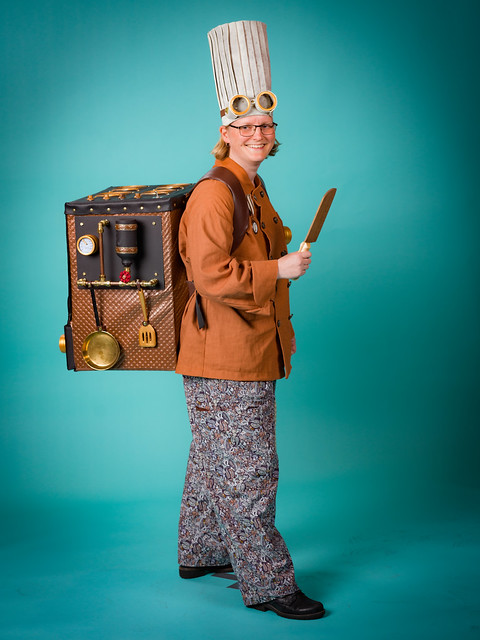
For one, Olav Rokne made his Flickr album for the Masquerade 2024 available. Among the many fantastic photos and costumes my favorite is Linda van der Pal’s chefpunk:

Flickr Olav Rokne Linda van der Pal Chefpunk

A chef, steampunk-style. Aaaah! So inventive and different! 😀

There are the requisite rivets, of course, and valves, dials, gauges, and piping, but also burner coils, a pan, a spatula, and plates (in another photo). What really stopped me in my tracks are the burner coils, though—so, it’s not just any generic steampunk gadget you strap onto your back, it’s a portable stove!

Flickr Olav Rokne Linda van der Pal Chefpunk Closeup

It looks like the stove might have been built from a cardboard box, but I haven’t been able to find the story behind this outfit to confirm. (If anyone knows, please share or link!) It would be interesting to hear details, for instance whether it’s feasible to carry anything inside the oven. So clever, though!

Do you have a favorite among the cosplays?

Images by Olav Rokne via Flickr (CC BY-NC 2.0): Chefpunk. Closeup of chefpunk.

Eppu’s Worldcon 75 Highlights

A random assortment of memorable moments, thoughts, views, and quotes from our time at Worldcon 75 in Helsinki. From the panel: Always Connected, It’s Mandatory with Effie Seiberg, Fred C. Moulton, Jo Lindsay Walton, Kristina K., and Tommi Helenius
  • I missed who said it and whether there were further details, but one panelist mentioned a study with the finding that merely having a cell phone on your desk, even if it’s off, lowers your ability to concentrate by about 20 percent.
The tidbit certainly gives food for thought. If true, it gives an added bonus my decision to keep my phone out the way on a small side table. Phone out of direct line of sight: +2 to concentration roll! From the panel: Pronouns, Who Needs Gender Pronouns with Cenk Gokce, Johanna Sinisalo, Catherine Lundoff, Kelvin Jackson, and John Chu
  • Johanna Sinisalo shared a story from producing the freebie anthology given to congoers, Giants at the End of the World. The translator for a story she was editing asked the gender of a very minor character that passes by in the background in order to use the correct pronoun, so she passed the question on to the author. Their reply was: “Who knows?”
  • John Chu continued on the effect that grammatical details like that have on thinking: in English you have to specify, whereas in languages that have different pronoun systems, speakers may specify the gender of their characters.
  • There was an audience comment on the 3rd person singular pronoun it used of people (in reference to a panelist who remarked that that’s possible in some dialectal uses in some languages). In the commenter’s view, people want to contain multitudes, and using it of people would be taking something away.
Clearly, defining characters’ gender matters greatly to some people and not so much to others (like the “Who knows?” Finnish author). Of course, not all writing nor all works of fiction are or should be the same, or created for the same purpose. For example, when the mood takes me, I’m delighted to read fluffy comfort lit that at other times would drive me to distraction. I think the variety that exists is fantastic, and limiting our expressions—especially in speculative fiction—is, well, limiting. We as a species do indeed contain multitudes. Instagram Lada ladule_b W75 Fandom Is Family Autographs: I got my copy of Maresi by Maria Turtschaninoff signed.
Maresi w Author Autograph
From the panel: Editor’s Dream with Thoraiya Dyer, Masumi Washington, Katrina Archer, and Robert S. Malan
  • Katrina Archer, a Canadian copyeditor who works with both Canadian and American writers, mentioned that she creates a style sheet for each individual story. She includes, among others, notes on word selections (in consultation with the authors) and the dictionary and spellings used.
Self-evident, when you think about the pragmatics of editing. I’m going to steal that idea to apply for my various projects. From the panel: Reviewing 101 with Juan Sanmiguel, Markku Soikkeli, John Clute, and Fred Lerner
  • Fred Lerner, by his own description “a recovering librarian” (yay librarians!), quoted Sturgeon’s Law (to the effect of: 90% of everything is crap) and noted that it therefore follows 10% is of use, so if a reviewer cannot find that 10% maybe they should do something different.
I’ll have to try and remember this. Not that I review things that often, but to vet other reviewers. (Also, note to self, a related critique panel mentioned Mary Robinette’s method which I believe is the one she tweets about here.) In the exhibits hall: On guest of honor Nalo Hopkinson’s table, a puzzle featuring her book covers had been set out for passersby to work on. Irresistible! And a really inventive, unintrusive promo method. Patreon Nalo Hopkinson W75 Book Cover Puzzle Made it: There’s photographic proof I was at Worldcon! From the panel: Jack of All Trades, Master of Several with Carl, Roseanne Rabinowitz, and Jani Saxell
  • Carl remarked that “external brains” (=tech) can help us branch out because looking up information is very easy.
  • Jani Saxell noted that as SF operates at the edges of the new and strange, you cannot prepare for everything; there should be a place for generalists in SFnal stories.
As a Jill of Many Trades myself, I found the topic fascinating. I’d note that finding information may have gotten much easier, but a lot still depends on an individual’s ability to sift the useful from useless and absorbing the appropriate bits. Seen in person: We’ve streamed it a few times before, so we knew the routine, but it was surprisingly exciting to be able to attend the Hugo Awards ceremony. Instagram writer_aki Aki Parhamaa W75 Hugo Awards Seen in person: I also had several nice random meetings with both old friends (some of whom I haven’t seen in over 15 years) and new-to-me people. For example, on Friday we saw a Finnish journalist and fan Jussi Ahlroth on morning tv talking about the con and later that day actually met him. Cool. 🙂 Speaking of cool: Did you know that John Howe (yes, THAT John Howe!) was at Worldcon?!? Instagram writer_aki Aki Parhamaa W75 John Howe From the panel: Older Women in Genre Fiction with Catherine Lundoff, Delia Sherman, Liisa Rantalaiho, and Helena McCallum
  • The panel noted among other things that women’s bodily needs aren’t usually present in stories. Older women don’t have to deal with e.g. menstruation, but they do have physical ailments due to age. Elizabeth Moon was mentioned as someone who is great at describing the difficulty of getting going in the morning, for example. The panelists also talked about how, just like in real life, older women in stories are often hiding in plain sight (i.e., ignored).
  • Liisa Rantalaiho noted: Older women have sex.
Another fascinating panel through and through. Elizabeth Moon’s name came up in other panels, too; clearly I need to look her up. Seen in person: Speaking of looking people up, I found a few other new-to-me authors and artists to try. I often do that if I like what someone’s said at a panel or program item. The end is nigh: At some point during the con, signs for marking the end of the line (when queueing into program rooms) appeared for people to hold up and pass on. Of course it would’ve been nicer if long lines hadn’t happened at all, but it was a practical and humorous solution to an annoying facilities problem. Instragram Tiina Vastamaa tiinatupuna W75 End of Line Please Queue Here From the panel: Gender and “Realistic History” with Cheryl Morgan, Thomas Årnfelt, Gillian Pollack, Jo Walton, and Scott Lynch
  • Jo Walton said that women are left out when canons get formed; if you go looking for women in extant documents, they are there.
  • Thomas Årnfelt mentioned a few examples of women’s occupations gleaned from 12th c. Parisian tax documents: various positions in food and textile industries, barber, goldsmith, locksmith, and night guard, among others.
  • Cheryl Morgan talked about how people have been constructing gender(s) in many various ways in history / around the world. E.g. beer brewing and tavern keeping are now seen as male professions, when in fact they were purely women’s work at one point. Another example she gave is that a man couldn’t work in Nelson’s army (or Napoleon’s?? can’t make out my handwriting) if he didn’t know how to sew.
Lively discussion and many, many examples. I kept missing references writing down others. I wish this panel had been videotaped! Seen in person: A live astronaut. All three presentations / panels with Kjell Lindgren were fascinating! Here’s the video of The Kjell & Jenny Show: A NASA Astronaut and his PAO where Kjell talks about the astronaut selection and preparation process.
The Kjell & Jenny Show: A NASA Astronaut and his PAO by Worldcon 75 Once upon a time on a lunch break: I ate at the Messukeskus Hesburger fast food joint (also fondly known as Hese) purely out of nostalgia. And was proud of myself, both as a Finn and an introvert, for sharing a table and a conversation with a total stranger. I don’t typically do that. At the same place my top half was also, memorably but unfortunately, splattered with hot chocolate. Oh well. Accidents happen, and I wasn’t scalded. From the panel: Pullantuoksuinen – Writing While Multilingual with Nina Niskanen, Aliette de Bodard, Emmi Itäranta, Ken Liu, and Jakob Drud
  • Emmi Itäranta commented that juggling two languages simultaneously is sometimes a hindrance (if you find a fantastic phrase in one language but not the other), but it also makes you a better writer because it forces you to be more specific in your meaning.
  • Ken Liu noted that it’s perhaps more important to explain a cultural concept for yourself than the audience.
I have a bad habit of code-switching out of pure sloth with Erik since he knows Finnish so well. Perhaps I ought to try and stick to one language at a time. Apart from making puns; that I won’t give up. 😀 From the panel: On the Care and Feeding of Secondary Characters with Fiona Moore, Carrie Patel, Mur Lafferty, Teresa Nielsen Hayden, and Diana ben-Aaron
  • “Knowing why characters exist tends to make them flat. Try not to know that.”
Really great quote. If you know who said it, please let me know! (Jo Walton???) Another choice quote:
“I liked the way everyone was pleasant and polite. Panelists seemed to get along well with each other, even when they disagreed. Audiences seemed appreciative. The whole thing was good, low-tension fun. I sometimes think the discussions on the Internet leave people with a really wrong idea of what the experience of attending a convention is like. Problems are few, attitudes are positive, and people laugh and smile a lot.” – Greg Hullender commenting at File 770
There were problems, and I witnessed some true clueless behavior first hand, but on the whole I agree with Greg. I saw so many examples of people greeting each other, sharing small moments of connection, helping each other out in general, troubleshooting tech issues, sharing tips and smiles, and giving up their seats to those who needed it or who might enjoy a panel more. Fandom definitely is my family. ❤ From the panel: Book Blogs with Cora Buhlert, Teresa Nielsen Hayden, Shaun Duke, and Thomas Wagner
  • Shaun Duke of The Skiffy and Fanty Show (I think—please correct me if I’m attributing this to the wrong person) said some authors don’t seem to understand how the Internet works. Apparently he’s chosen not to review some people because he’s seen how they’ve treated other fans and reviewers online.
Yup. Rep gets around. 160204dingy Images: Fandom Is Family by Lada (ladule_b) via Instagram. Maresi by Eppu Jensen. Nalo Hopkinson puzzle by Nalo Hopkinson via Patreon. Art of the Snapshot panel audience by Baron Dave Romm (david_e_romm) via Instagram. Hugo Awards ceremony collage by Aki Parhamaa (writer_aki) via Instagram. John Howe by Aki Parhamaa (writer_aki) via Instagram. End of Line by Tiina Vastamaa (tiinatupuna) via Instragram. Dingy bird via MTV. How It Happens is an occasional feature looking at the inner workings of various creative efforts.

Erik’s Worldcon 75 Highlights

A random assortment of memorable moments, thoughts, and quotes from our time at Worldcon 75 in Helsinki.

From the presentation: Crackpot Archaeology in Scandinavia by Martin Rundkvist

  • One of the distinguishing traits of the crackpot is the insistence on finding meaning in every discernible pattern. To the crackpot, randomness is never acceptable.

(This is a particularly useful observation for me as a historian who works on areas and periods where we have extremely limited evidence. When evidence is so scarce, it is tempting to squeeze as much meaning as we can out of every text or artifact. Sometimes we just have to accept the randomness.)

From the workshop: Beyond the Great Wall of Europe: Worldbuilding for Non-European Settings by Jenn Lyons

  • In this workshop, we were divided up into small groups and assigned to come up with various aspects of worldbuilding for a hypothetical fantasy world. The group assigned to government (which I was not part of) described a society of small scattered bands without permanent leadership who pull together in times of crisis and select a temporary leader. Their ideas were based on certain Native American societies of the northeastern woodlands and gave a fairly accurate description of how societies at that scale historically tended to operate. Some other folks in the room—including the workshop leaders—critiqued them based on a European colonial misunderstanding of native North American cultures.

(It was a good reminder of how difficult it can be, even with the best of intentions, to think ourselves out of Eurocentric traditions—and why it might have been a good idea to spend a little more time working through what we mean by “European.”)

From the panel: Non-Binary Representation with Nick Hubble, D Franklin, and Nino Cipri

  • Non-binary characters in fiction written by binary authors have a tendency to feel like thought experiments rather than people.

From the panel: Editor’s Dream with Thoraiya Dyer, Masumi Washington, Katrina Archer, and Robert S. Malan

  • Always follow the submission guidelines!

(As someone who has coordinated academic conferences, I cannot agree with this strongly enough!)

From the panel: Asexuality in SF with Todd Allis, Kat Kourbeti, and Jo Walton

  • The portrayal of asexuality in fiction tends to be gendered. Female asexual characters are often portrayed as inexperienced, with the assumption that she will blossom into sexuality once she finds the right person, while male asexual characters are often portrayed as quirky, damaged, or focused on obsessions that leave no room for romantic love.

From the presentation: Logic of Empire: Economics of Colonialism in Fantastic Fiction by Jesper Stage

  • North America in the age of European colonialism was a real post-apocalyptic setting, once European diseases had wiped out over 90% of the native population.

(I’ve never thought of it in those terms, but it’s one of the most apt descriptions I’ve ever heard.)

From a panel presenter whose name I didn’t catch, when the audience let him know they couldn’t hear him:

  • “You’re different to English audiences; they just sit quietly and complain at the end.”

From the panel Loses Something in the Translation: Conveying Humor, Idioms, and Cultural Concepts across Languages with Gili Bar-Hilel, Shaoyan Hu, Elena Pavlova, Dirk van den Boom, and Mirka Sillanpää

A few choice quotes:

  • “Writing something funny is actually very serious and hard work.”
  • “Toilet jokes work in most languages”
  • “As you know, Germans are not funny.”

From the panel: Fantasy Worldbuilding without Ableism with Fran Wilde, Marieke Nijkamp, Likhain, Nalo Hopkinson, and Leon Adams

  • Disability can be a too-easy go-to for authors who want to make a hero “unlikely” without engaging with the reality of living with disability.
  • What counts as a disability depends on context. Issues that are trivial to us, such as eyesight problems that are easily corrected with glasses, could be serious disabilities in a world without that technology. On the other hand, dyslexia, which is a challenge in the highly literate modern world, would be trivial in a world without writing.

How It Happens is an occasional feature looking at the inner workings of various creative efforts.

Worldcon 75: Successful Preparations

Our Worldcon 75 trip was a combination of a family visit and con activities. First we went to the north to see relatives, and the latter half of our visit we spent south in Helsinki. Although we were in town primarily to do the con, we did have a chance to visit family there, too, and enjoy some of Helsinki’s offerings, including some walking and eating at our favorite places.

Since it was a long trip and since our luggage needed to accommodate our clothes, presents for family, and books for the con, we needed to prepare more carefully than usual. I’ll share below some of our successful preparation strategies.

For more of our Worldcon 75 thoughts, check out the collected links page.

Accommodation sticker shock: Airbnb to the rescue

We tried Airbnb for the first time, because we knew we wanted to stay extra days in Helsinki both before and after the con and therefore hotel fares would’ve gotten hair-raisingly high. Fortunately, we managed to book an entire apartment in a quiet building about 10 minutes’ tram ride away from Messukeskus, with really considerate, friendly, and helpful hosts, plus in-building laundry, a neighborhood grocery store, all-round excellent transit connections and several restaurants in the vicinity.

Self-catering worked really well. Skipping a hotel meant also missing out on the fantastic, enormous hotel breakfasts, but we made hardy breakfasts ourselves. We also packed a few small ziplock bags for veggies and other finger food instead of buying overpriced snacks at Messukeskus.

Would I do it again: Yes. I would research the heck of the host(s), though, and pack cloth napkins to avoid using disposable ones at the flat.

Con notes: Add a folder

I typically keep notes of my con trips in small paper notebooks. In addition, I lug around a random assortment of A4 / letter-sized papers (notes on directions, restaurants, programming, etc.) folded and tucked into the notebook. At W75 I ended up picking up way more than my usual share of papers, though. For one, I was for some reason completely unprepared to get a bagful of freebies at registration, even though I knew we were going to get at least the pocket program and a souvenir book. (D’oh!)

Would I do it again: Yes, with improvements. I plan to continue using a small notebook for the actual note-taking, but upgrade to a letter-sized folder for the rest. Also, note to self: bring a few sheets of blank paper and maybe a Sharpie.

Day pack: Needs improvement

I traveled with a fairy sizeable day pack, because the trip was a long one and because Helsinki weather forecasts had looked unsettled and uncertain before we left the U.S. I tend to get cold easily, so I wanted carrying capacity for extra clothes, umbrella, water bottle, snacks, etc. Unfortunately, my backpack turned out too bulky for my comfort in the crowded Messukeskus corridors even when it was half-full.

Would I do it again: Probably not, unless I’m planning on cosplaying and need the space. I’m considering getting a smaller backpack (or maybe a cross-body bag) for my extra sweater, scarf, umbrella, book(s), and other bigger con gear, and using it with a small cross-body purse for faster access to water, snacks, pens, and notes.

Fun with flags: So. Many. Languages!

For the first Nordic worldcon, I wanted to flag myself as able (and delighted!) to function in more than one language, so I made myself a language tag to stick on my badge: Finnish and Swedish flags for my Nordic languages, and U.S. flag for American English. (I learned British English at school and at university, but I’ve since gone over to the dark side. Bwahahaha!) For good measure, I added my pronouns (she / they / hän).

Would I do it again: Yes, although I’d print out the flags instead of drawing them freehand. (Poor, butchered U.S. flag!) And make them larger. And as long as I’m including Swedish, I’d add those pronouns as well (hon / hen).

W75 Badge w Ribbons

Introvert care: Off days between activity days

We’re both introverts. When planning this trip, we knew we were likely to feel overwhelmed, so we consciously scheduled introvert care days into our itinerary both before and after the con. Introvert time before the con was necessary, because our visit in the north was a whirwind of family meetings. And it was necessary after the con, because the thought of flying into one of the high-traffic airports in the U.S. in a tin can stuffed full of strangers, then standing in line for goodness knows how long in a room stuffed full of strangers in order to get a shuttle stuffed full of strangers, and, finally, exhausted, to find ourselves driving on roads stuffed full of strangers was just too much immediately after a five-day event—you guessed it—stuffed full of strangers.

Would I do it again: YES! I’m not sure I would’ve been able to do this trip without blocking off the no-people days.
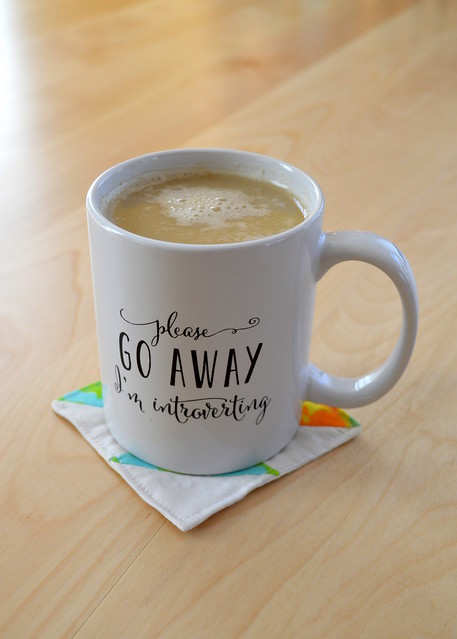
Introverted Tea Mug

Making many meetings succeed: Plan for a spot

I had heard through a Finnish contact that it’s very easy to lose track of people at a Messukeskus con. Although I have a Finland-compatible cell phone, Erik doesn’t, so we couldn’t count on being able to text each other updates during the times when we wanted to go our separate ways. So, after the Messkeskus floor plan was available, we found a spot that looked out of the way enough (to not clog any passageways) but easy to find and fast to get to. Each morning we’d go over our schedules and find at least one and preferably two times that we could meet at our spot to connect and re-plan if necessary. And if it should happen that we didn’t get into any programming we wanted, or didn’t feel like attending, or just had a change of heart and were available for doing things together again, our spot was where we’d find each other.

Would I do it again: Absolutely. We even arranged to meet my sister at our spot a few times.

Maintenance medications and time zones: Make it into a program item

Figuring out the proper time, in Finnish time, to take my maintenance medications was easy. However, I had the darnest time remembering to do it, until I wrote it in my personal con schedule. (Outside the con I had an alarm on my phone, but in Messukeskus I kept the phone on silent.)

Would I do it again: Yes! So easy! If it’s Saturday and 4 o’clock, it must be Food Lies panel and pill time.

Public transit pass for the win!

The W75 membership included a 5-day transit pass for the greater Helsinki area, and it was marvellous. It allowed for so many options for the week. About half the time we just used it to get to Messkeskus and back, but half the time we took additional trips.

Would I do it again: Yes, even if I had to pay for a weekly ticket myself.

Pre-prep is next to godliness: Following Worldcon 75 online

I’m a preparer. Even though I’m a Finn and have visited both Helsinki and Messukeskus before, I’ve been away from Finland long enough to know my local knowledge is partially outdated. I followed W75 on social media and read each and every one of their publications. (I didn’t mind possible overlap; the info put out through different channels varied to some extent and any repetitions were really easy to skip.) Just before the con, the W75 KonOpas / Grenadine guide / online program guide was hugely helpful for updates of new, deleted, or moved program items.

Would I do it again: Yes. And enthusiastically yes for any possible future worldcons, too.

Images: Eppu Jensen

How It Happens is an occasional feature looking at the inner workings of various creative efforts.
Worldcon 75: What Went Wrong

Most of our Worldcon 75 experience was good, but there were, unfortunately, some failures that need to be discussed, so I’m going to get those out of the way first before moving on to the things that went right. I want to stress this at the outset: lots of things went right, and lots of things that started out going wrong were getting better by later in the con. We’re going to talk about those things, too, and soon. Right now, though, here are some problems that need to be talked about so that other people involved in planning and running conventions and similar events can learn from them.

Our first day at the con offers an illustration of a lot of the problems.

My day began with a bright spot at registration, which was swift, efficient, and easy—the best con registration I have ever seen. But things went downhill from there.

My first stop was the information table to sign up for a workshop later in the day, and it was a mess. Staff at the table kept moving sign-up sheets from one part of the table to another. I was about to sign up for my workshop when one staffer told me I had to wait, then walked away; another staffer came over and snippily told me that if I wasn’t signing up for something, I had to leave. I did finally manage to get signed up, but the experience left me so frustrated that I had to leave Messukeskus (the convention center) for the rest of the morning and distract myself with work just so I could go back for the afternoon sessions without a dark angry cloud over my head.

Unfortunately, the afternoon did not go smoothly, either. Only a few panels had been scheduled for the first afternoon, many of them in the smallest panel rooms available. I only got to see one presentation that afternoon, and only by going to the room and getting my seat an hour before the session started. I enjoyed that session, but most of my afternoon was spent in boredom and frustration.

When Eppu and I got together for dinner in the evening, we discovered that most of the restaurants in the convention center had already closed for the day or were running out of food. We got the last two slices of pizza from one of the few places still open. Since one slice of pizza is not enough of a dinner for me, I then went out looking for somewhere, anywhere, I could find something more in time to get back for the next panel I hoped to see. Although the con had provided a helpful restaurant guide, nothing close enough for me to get to was open. I ended up going to the nearest railway station, finding a kiosk, and getting a couple packets of nuts. Thus fortified, I went looking for evening panels, but everything I wanted to see was full. After another couple of hours, I gave up and left.

There were other problems that didn’t affect me directly but I was aware of happening around me. Signage was lacking. There were no maps or directions to help people find their way to off-site event locations. There were no designated gender-neutral bathrooms (a surprising oversight in a convention which featured several panels on gender identity). There were serious traffic flow issues between different parts of the convention center.

Some of the things that went wrong with my first day are just the usual snags and stumbles you can expect when trying to coordinate any large group of people, but some were signs of systemic problems and failures of planning. Here are some lessons I think we can take from the experience:

Know your space and watch your numbers. A lot of the gear-grinding on the first day of the con was caused by the fact that the con was planned for 3,000-4,000 people and almost 5,000 showed up. That kind of mismatch will throw the best planning into chaos, but it is not an unforeseeable problem. The con coordinators knew how many attending memberships they had sold, even the surge that came in the last few weeks before the con. It was not unreasonable to predict that a lot of those members were going to turn up and want to attend the scheduled programming. As some have remarked, getting more people than you expected to show up to your con is a nice problem to have. Maybe for the con-runners, but as an attendee, standing around bored and frustrated all day because you can’t get into any of the programming you came for is decidedly not a nice problem to have.

Plan all parts of the attendee experience. Just like it is reasonable to expect that your con attendees will want to attend something, it is also reasonable to expect that people will want to sign up for things that require sign-ups. How and where people should do this is something that should be figured out before the con begins, not when dozens of people are already waiting in line. Worldcon 75’s registration was a model of good planning. The same attention needs to be given to other aspects of the con experience as well.

Control the things you can control; communicate about the things you can’t. No one can blame the con organizers for the lack of food options in and around Messukeskus. They don’t determine the local restaurants’ opening hours or food stocks. But they knew the con schedule and the opening hours of local eateries. If your con events run until 10 but all the local food joints close at 6, that is something you need to communicate to your attendees clearly, emphatically, and repeatedly.

Take feedback early and often, and act on it. This is one thing Worldcon 75 got absolutely right. There were feedback sessions every day from the second day of the con on, and changes in response to feedback were visible day by day, sometimes hour by hour. This is what saved the con from the disaster that the first day had me fearing it would become.

More Worldcon thoughts to come, and happily a lot more good things to talk about, but anyone in the con-planning scene, please take note of what Worldcon 75 got wrong and got right.

Worldcon 75: Looking Back

We’re back! From Wednesday, August 9th to Sunday, August 13th we were in Helsinki attending the 75th Worldcon, the first Worldcon ever held in Finland and the northernmost Worldcon to date. Now we’re home again and starting to look back at our experiences.

We have a lot to talk about. As we post, we’ll gather those links on this page. In the meantime, here’s some appreciation from Eppu to some of the people who helped make our con a good one.

How It Happens is an occasional feature looking at the inner workings of various creative efforts.

How to Helsinki: Last Call

Worldcon is in Helsinki this year. As a Finnish-American couple, we are very excited about this! In the coming months, we’d like to offer some practical advice about visiting Finland to our fellow fans who are considering going to the event but haven’t had experience with Finland and Finns before.

Worldcon 75 is just a week away now. In case you missed any of our previous posts, you might want to check them out, too:


Here are a few last-minute tidbits, odds and ends, and random pieces of advice that might be worth knowing if you’re getting ready to head to Helsinki:

Low-alcohol beverages, like beer and cider, are available at most grocery stores. For harder liquor (22+ % alcohol), you’ll need to go to one of the state-run Alko stores; you also must be 20 years old and have valid government I.D. Anyone who looks under 30 years of age may be carded when buying alcohol.

Apteekki = pharmacy

Apua! = Help!

Ateneum Art Museum is one of the three museums forming the Finnish National Gallery and located conveniently on the south side of Rautatientori square close to Helsinki central railway station.

Flickr Alessandro Grussu Ateneum Art Museum

DO NOT FEED THE BIRDS. That creates problems for residents, outdoor sellers, and other visitors. The seagulls at Kaupptori, for example, are already quite adept at snatching food from people. (That means they will dive AT YOU and steal your food FROM YOUR HAND. I don’t know about you, but I find that intimidating and I don’t want it to happen to me! –Eppu)

Public drinking water fountains are rare in Finland, but tap water is clean and safe. Carrying a water bottle is a good idea.

Dual flush toilets are becoming very common, and they’re easy to operate: small button for small flush, big for large. Please do take part in our environmental efforts.

Electric sockets and plugs are Europlug type C or the grounded Schuko type F.

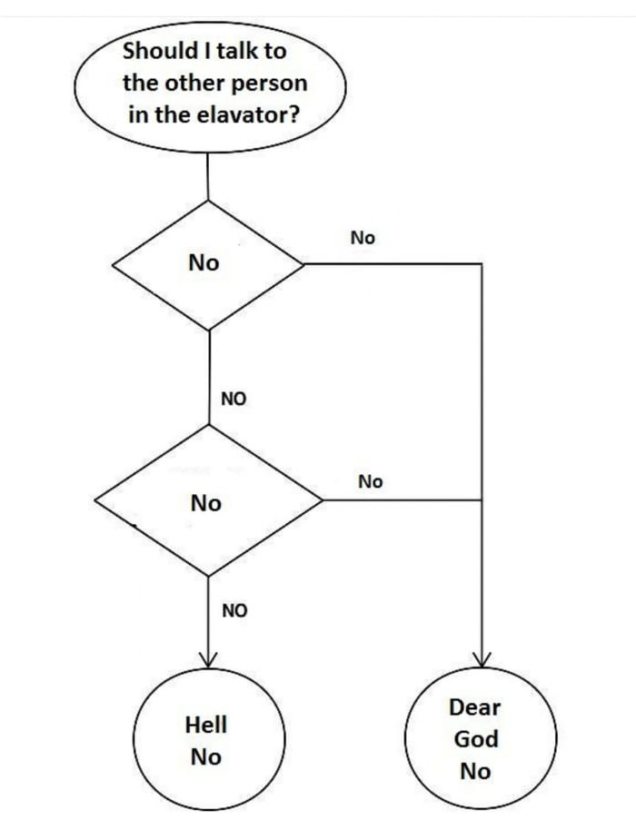
Elevator behavior humorously put: Keep your arms and legs inside the vehicle at all times, and for the sake of everything you hold dear, do not engage in small talk.

9gag Finland Elevator

More seriously: Elevator behavior shouldn’t be a problem; just be mindful that customs may be different than you’re used to and you’ll be fine.

The number for emergency services is 112. Also note that pay phones are almost non-existent in Finland because cell phones are so ubiquitous.

You may not be able to establish eye contact with strangers on the streets. This is perfectly normal in Finland; we love our personal space and want lots of it.

Gasoline is very expensive due to taxation—keep it in mind if planning to rent a car.

If you meet a Finn with whom you share a mutual acquaintance, you may be asked to take greetings to that person. It is vital that you follow through. Carrying greetings (the Finnish word is terveisiä, which covers the whole social scale from “Say hi to your buddies for me” to “Do give my sincerest regards to your honored great-grandmother”) is serious business in Finland.

Indoor spaces tend to be warm due to effective insulation. Dress in layers for the win!

With regard to the language issue, one of the most succinct answers is by author Elizabeth Bear: “[I’ve] heard some concern about the language issue. There is no language issue. If one of your languages is English […] you will have no issues at all navigating. (It’s sort of a running joke with my agent and I that while my books sell very well in the Nordic countries as imports, we can’t get a translation deal there. Because everyone speaks English […]”

Luggage storage is available e.g. at Helsinki central railway station and at the Kamppi long distance bus station.

Mosquitoes are the bane of the Finnish summer. (We actually joke about them being our air force. –Eppu) Current reports are that this has not been a bad mosquito year, but it’s still important to take precautions if you’re sensitive to bites and will be out and about in the late evening or early morning, which are the prime biting times.

The National Museum of Finland concentrates on Finnish history from the Stone Age to 19th century and has an extensive collection of objects. The building itself, of National Romantic style, may also be of interest. Free entry every Friday 4 p.m. to 6 p.m.; at other times, entry fees apply.

National Museum of Finland

Petrol is very expensive due to taxation—keep it in mind if planning to rent a car.

Pharmacy = apteekki

The word please (or the like) doesn’t exist in Finnish. Instead, the same function is embedded in the verb form of the sentence. This doesn’t mean that Finns are inherently rude; we may sound rude to native speakers of languages that use an explicit please word if we forget to use it in other languages, and we well might slip up since it’s not ingrained.

Finnish does not have gendered pronouns. The word hän means both ‘he’ and ‘she.’ It’s not unusual for Finns, even Finns who speak English very fluently and are highly aware of gender identity issues, to slip and use the wrong gendered pronoun when speaking English. (It’s a little like English speakers learning Spanish and having to remember that forks are masculine but spoons are feminine.)

Recycling is becoming very common. Your hotel room and Messukeskus might have containers for different types of trash. Please do take part in our environmental efforts.

If you bump into someone by accident, just saying “Sori” (comes from and sounds pretty much the same as English sorry) is usually sufficient. Finns don’t really do apologies for small accidents.

Towel hooks in bathrooms are only for storing the dry towels. Spread towels to dry elsewhere (rack, over the shower stall door / shower curtain bar) and hang to store.


Some additional reading & browsing

Images: Ateneum Art Museum by Alessandro Grussu on Flickr. Finland elevator behavior via 9gag. National Museum of Finland by Eppu Jensen

In Live and Active Cultures we talk about cultures and cultural differences.