Jane Austen, Mystery Writer

The great mystery novelist P. D. James has noted that Jane Austen’s novel Emma has all the essential elements of a mystery novel: the plot revolves around secrets which are revealed at the climax but to which the heroine and the readers have been given clues all along. I think we can extend that idea further and say that most of Austen’s novels are, in spirit, mysteries.

The plots of most of Austen’s completed novels are about heroines becoming wiser about themselves and the world, usually by discovering things that make them reevaluate the people around them. Elizabeth Bennet discovers that Wickham is a scoundrel and Mr. Darcy has an honorable soul under his proud manner. Marianne Dashwood discovers that Willoughby is a scoundrel and her sister Elinor has feelings as deep as her own. Catherine Morland discovers that Northanger Abbey is not a Gothic haunted house. Other discoveries and reevaluations made by the heroines and other characters also propel the plots along. Darcy learns that Jane Bennet was actually in love with Bingley all along. John Thorpe learns that Catherine was not in line for a fortune after all. Anne Elliot learns that William Elliot is responsible for her friend’s financial difficulties.

Austen also leaves some clues hidden in plain sight, unremarked upon in the novels but waiting for the clever reader to put together for themselves. Why is Mr. Darcy in such an ill humor when Lizzie first meets him at the Meryton ball? Austen never lays it out for us, but once you know his history it becomes clear that only a few months have passed since his beloved younger sister Georgiana nearly eloped with the scheming Mr. Wickham. Of course the sight of young women his sister’s age freely dancing with men they have barely met puts him in a sullen mood, and it is this mood rather than his natural character on which Lizzie first judges him.

Austen’s great literary innovation, the “free indirect style” in which the narrator stands apart from the point of view character but reflects their judgments and perceptions in the narration, represents a careful balance between objectivity and subjectivity that is important in mystery writing. The job of a mystery author working in the classic style is to present the reader with all the necessary facts to resolve the mystery themselves, but to obscure those facts in such a way that the reader does not get ahead of the detective in working out what happened. Austen’s free indirect style achieves precisely this goal, letting the readers in on what is going on in the world around her characters but coloring the facts with the main characters’ own perceptions and biases.

Austen framed her social satires and ethical critiques in the genre of romantic novels since those were popular in her day. I sometimes wonder, if she were alive and writing today, would she have chosen to write mysteries instead?

Image: Portrait of Jane Austen via Wikimedia (National Portrait Gallery, London; c. 1810; pencil and watercolor; by Cassandra Austen)

Story Time is an occasional feature all about stories and story-telling. Whether it’s on the page or on the screen, this is about how stories work and what makes us love the ones we love.

Quotes: Violence Is a Tool That … Begs You to Use It Again and Again

“Violence is a part of our trade, yes. It is one tool of many. But violence is a tool that, if you use it but once, it begs you to use it again and again. And soon you will find yourself using it against someone undeserving of it.”

– Ashara Komayd, former operative for and prime minister of Saypur in City of Miracles by Robert Jackson Bennett

Yup. I’ve been thinking along similar lines with regard to the racism in the U.S. and the ridiculous, racist non-reasons some racist-ass whites justify their calling of police on people of color, especially blacks. It’s racist, wasteful, racist, reprehensible, racist, entitled, racist, cruel, racist, wrong, and racist. It has to stop.

Bennett, Robert Jackson. City of Miracles. New York: Broadway Books, 2017, p. 177.

Serving exactly what it sounds like, the Quotes feature excerpts other people’s thoughts.

Fahrenheit 451 Reboot Trailer

The rebooted Fahrenheit 451 trailer is out:

Fahrenheit 451 (2018) Official Trailer ft. Michael B. Jordan & Michael Shannon | HBO on YouTube

This new movie adaptation of Ray Bradbury’s novel is by writer, director, and producer Ramin Bahrani. The flick stars Michael B. Jordan (lately appearing e.g. in Black Panther and Fantastic Four) and Michael Shannon (e.g. The Shape of Water, Batman v Superman: Dawn of Justice, and Man of Steel). It’s set to come out May 19, 2018.

My first snarky comment solely on the basis of the trailer is “Do you think this movie has something to do with fire?” and the second “My goodness, so many men doing man things—where are the women?” Then again, I know that trailers always lie, and that may be the case here. According to IMDB, at least, the cast does have a number of women, including Sofia Boutella, whom I remember from Kingsman: The Secret Service. It remains to be seen how much of a role they’re given. And I hope Michael B. Jordan is given space to show his depth.

Hey, look! We found a thing on the internet! We thought it was cool, and wanted to share it with you.

Quotes: Humans as the Only Generators of Value and Purpose in the World

Author Kelly Robson describes the core conceit of her novel Gods, Monsters, and the Lucky Peach in an interview with Ilana C. Myer:

“The habs, hives, and hells [i.e., city state -like population centers] compete for economic power, and economic power ultimately comes from populations. A free market requires free movement of population, so everyone is free to basically vote with their feet. If they don’t like the quality of life in the hab, hive, or hell they live in, they are free to move to a different one. A hab, hive, or hell with a shrinking population knows that it better change its quality of life offerings if it wants to stop hemorrhaging people.

“It’s a dynamic world that ultimately respects humans as the only generators of value and purpose in the world. I like it.”

– Kelly Robson describing her novel Gods, Monsters, and the Lucky Peach

Aah, I like it too. 🙂 Plus, voting with your feet is a natural extension of voting with your wallet.

Myer, Ilana C. “Kelly Robson on the Economics of Time Travel in Gods, Monsters, and the Lucky Peach.” Barnes & Noble Sci-Fi and Fantasy Blog, April 02, 2018.

Serving exactly what it sounds like, the Quotes feature excerpts other people’s thoughts.

British Library’s Exhibition Harry Potter: A History of Magic Now Online

The British Library has partnered with Google Arts & Culture to bring online their physical exhibition Harry Potter: A History of Magic.

British Library Google Harry Potter A History of Magic Exhibition

Apart from various aspects of the story and the movie series, the exhibition covers for example illustrations, the history of real-world magic, and early sketches and notes by J.K. Rowling. In addition, on display are a number of items from the Museum of Witchcraft and Magic.

My favorite feature is perhaps the section covering the real-world history of various Hogwarts classes, closely followed by the animals and fantastical beasts section.

Found via Helsingin Sanomat.

Image: screencap from the Google Arts & Culture page for the Harry Potter: A History of Magic exhibition

Out There is an occasional feature highlighting intriguing art, spaces, places, phenomena, flora, and fauna.

Favorite Kinds of Storytelling: Learning to Work Together to Solve Problems

There are some things that we can all pretty much agree are part of a good story, whether on the page or on the screen: compelling characters, an interesting setting, a well-crafted plot. These things are basic to most great stories. But then we have our own individual tastes, the particular things we hunger for and that make us excited about one story more than another.

The two of us have spent some time thinking about exactly what we most want out of stories. Here’s what we came up with.

Avengers How Do We Do This As a Team

Erik here. What I most want out of a story can be summed up as: Problem-Solving. I want to watch characters go through the process of confronting a problem, considering how to deal with it, and figuring out the best solution. I want to see not just the successful results but all the steps it took to get there. I want to know what the characters did, how it worked, and why it worked.

The obvious sort of story for me to go to is a mystery in the Sir Arthur Conan Doyle / Agatha Christie tradition, where the narrative centers around a problem that needs to be solved and the climax comes with the detective meticulously explaining how they worked out that the vicar’s charwoman is actually the long-lost sister of Lady Dudsworthy and the poison was hidden in Colonel Flusterton’s peppermint lozenges.

But I also enjoy other kinds of stories that explore other kinds of problem-solving. Tolkien’s Lord of the Rings is full of problem-solving and process, from Gandalf working out the magic word to open the doors of Khazad-dum to Frodo and Sam donning orc armor to sneak across Mordor. My favorite part of the novel is the Council of Elrond, when our heroes sit down and spend a chapter just talking about the problem, possible solutions, and the limits of their options, rather than rushing off into heroic battle. Jane Austen’s novels also offer a kind of problem-solving, especially my favorites Emma and Pride and Prejudice. Even though the problems are about relationships and social interactions, Austen’s characters approach them with the same attention to what is possible, what is not, and how to best go about achieving their goals.

On tv, I love shows like Leverage and Burn Notice that focus on the practical details of how their characters pull of heists or get out of scrapes. I also enjoy shows that focus on the processes of problem-solving in more human, less technical terms, like Call the Midwife and Downton Abbey. Some of the movies I enjoy the most combine solving practical problems with working out conflicts between people, like The Avengers and Pacific Rim.


Eppu here. My favorite story moments involve a bunch of characters learning to work together. I haven’t yet found a good existing name to describe the device with. The closest ones I’ve found are We Work Well Together (a trope) and team building, but both have a slightly different focus. For the lack of a better term I’m calling mine Learning to Work Together.

Specifically, what I like is the hard-to-capture process of the characters realising (usually after a struggle or struggles) how to fit into a working whole all the separate strengths that each person brings. Optimally, of course, it will be a well-working whole at least from the point of view of plot. It’s nice if the characters will end up at least appreciating if not outright liking each other, too, even if there might be tense moments. At the very least they will have to deal with each other well enough to fulfill their goal(s).

Many ensemble stories tack on a sequence of Learning to Work Together to explain how the characters become a unit after they find each other. Some devote more time and effort into it, but for others the process of getting to know your teammates is more or less handwaved aside to make space for the all-important plot. While plot is necessary, I don’t think it should override everything else: I’m looking for a balanced story—preferably with a good heaping of Learning to Work Together.

Some favorite screen examples include Rogue One: A Star Wars Story, Hunger Games, Marvel’s The Avengers, and the series Leverage (although arguably the latter might better fit under We Work Well Together). One of the reasons I ended up liking Pacific Rim much more than I expected was the attention that was given to the formation of team Raleigh and Mako, with Pentecost hovering at the rim. (Badum-CHING! [Sorry!])

Satisfyingly protracted versions are shown in the series Star Trek: Deep Space Nine and Elementary. While Murdoch Mysteries concentrates more on the problem-solving aspect, now and then recurring side characters or one-off visitors get wonderful sequences of Learning to Work Together. And, come to think of it, several of my favorite Doctor Who episodes involve the characters figuring out who the others are and how to interact with them effectively (“42”, “Blink”, “Silence in the Library”, and “Midnight” to mention a few).

Examples in novels and novellas that I’ve read recently include A Closed and Common Orbit by Becky Chambers, Six Wakes by Mur Lafferty, and Ninefox Gambit by Yoon Ha Lee. Nnedi Okorafor’s Binti trilogy, Malka Older’s Centenal Cycle, and Kate Elliott’s Crossroads series also sprinkle in many instances of Learning to Work Together whenever characters make new connections.


The best stories for the two of us to co-geek over as a couple are stories about groups of people learning to work together in order to solve problems. When we sit down to rewatch a favorite tv series or reminisce about our favorite books together, we go back to the stories about how different people can come together, learn to respect and trust one another, and use their own individual talents to work through a problem that none of them could solve on their own.

Made into a sound bite, Erik’s favorite stories are about “How do we do this?” and Eppu’s favorites are about “As a team.”

Image: screenshot from the 2012 Marvel movie The Avengers

Creative Differences is an occasional feature in which we discuss a topic or question that we both find interesting. Hear from both of us about whatever’s on our minds.

Quotes: One Should Not Seek Ugliness in This World

“One should not seek ugliness in this world. There is no lack of it. You will find it soon enough, or it will find you.”

– Sigrud je Harkvaldsson in City of Miracles by Robert Jackson Bennett

Although my life has been very different from that of a Dreyling operative and assassin, I agree. (For instance, I’ve never understood the appeal of vampire or horror genres, but to each their own.)

Bennett, Robert Jackson. City of Miracles. New York: Broadway Books, 2017, p. 177.

Serving exactly what it sounds like, the Quotes feature excerpts other people’s thoughts.

Quotes: They Could at Least Coexist in the Same Space Well Enough

“With that, Maggie took Frank’s arm, and together, they strolled down the broad avenue without talking. That was one thing Frank liked about Maggie—she didn’t feel the need to fill the silence with gabbing. He wasn’t even sure if she enjoyed his company or not—and frankly, he could say the same of hers—but they could at least coexist in the same space well enough. There were worse things.”

– Michael J. Martinez: MJ-12: Inception

Maggie and Frank belong to a team of superpowered U.S. operatives in a 1940s Cold War speculative world. Even though Maggie is the token female character, it’s really very refreshing that the author doesn’t try to shove in that bane of Smurfette stories, the inevitable romantic subplot.

Martinez, Michael J.: MJ-12: Inception: A Majestic-12 Thriller. New York, NY: Night Shade Books, 2016, p. 247.

Serving exactly what it sounds like, the Quotes feature excerpts other people’s thoughts.

Quotes: Declining to Get Thrilled

From an early Hercule Poirot mystery comes this hilarious quote:

“[…] said Inspector Davis. ‘There’s not going to be much mystery about this crime. Take a look at the hilt of that dagger.’

“I took the look.

“’I dare say they’re not apparent to you, but I can see them clearly enough.’ He lowered his voice. ‘Fingerprints!’

“He stood off a few steps to judge of his effect.

“’Yes,’ I said midly. ‘I guessed that.’

“I do not see why I should be supposed to be totally devoid of intelligence. After all, I read detective stories, and the newspapers, and am a man of quite average ability. If there had been toe marks on the dagger handle, now, that would have been quite a different thing. I would then have registered any amount of surprise and awe.

“I think the inspector was annoyed with me for declining to get thrilled.”

– Doctor Sheppard in The Murder of Roger Ackroyd by Agatha Christie

I’m reading Agatha Christie in English for the first time, and it’s a hoot! Not only are her mysteries top notch, her language is a delight. My (admittely hazy) memories don’t measure up to what I’m seeing now; I don’t know whether it just didn’t translate well or whether I was too young to understand. I’m discovering so much dry humor to irony to outright satire that I’m pretty much snickering my way through the novels.

Christie, Agatha. The Murder of Roger Ackroyd. New York, NY: Black Dog & Leventhal, [2006, orig. published 1926], p. 73.

Serving exactly what it sounds like, the Quotes feature excerpts other people’s thoughts.

Writing, Reading, Living Different Cultures

I saw a Twitter thread about writing culture by author Joan He, on the face of it about her (or your) own but by extension that of others, and it has plenty of food for thought:


As a reader, and specifially a reader of speculative and historical fiction primarily not in my native language, I run into differences in culture a lot. And as a person in a multicultural, multilingual relationship in a strange country where I’m a cultural and linguistic minority, from time to time I find myself slammed against more deep-seated cultural assumptions.

Joan pointed out that culture is a way of thinking, or cognition, or perspective. As an example, I’d like to share two failures of cultural expectations from my personal experience.

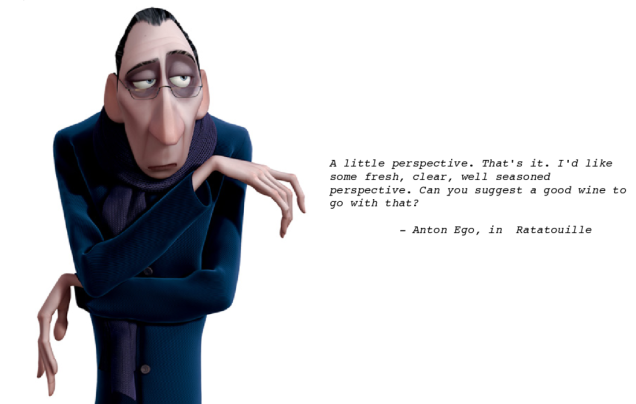
Ratatouille Anton Ego Perspective Quote

At a con once, I wanted to get a book signed by an American author. I happened to know from their online presence that the author is an introvert. Even though we were both at a public place where introverted authors and panelists often don a more outgoing persona than they do in private, as another introvert I wanted to make sure I’d be especially considerate. However, quite without intending to I tripped over a distinctly Finnish quirk.

One of the big unspoken assumptions in the Finnish culture is that silence isn’t a negative. (Erik and I have both written about it for instance here, here, and here.) In essence, how I understand it, silence means space, and space means respect to other people.

Accordingly, at the abovementioned autograph session, when it came my turn I said my hellos, presented the author with my book, and waited silently. It wasn’t until the author asked me “Did you read it?” that I realised they expected me to say something else. And I had thought I was being courteous not to burden them with yet another dose of chitchat on a weekend full of being “on” at a busy con. I can’t remember for sure, since it was a kind of a deer in the headlights moment for me, but I think I was able to stutter my way to an exit without actually breaking into a run. In any case, not terribly smooth on my part.

I’ve also had a previously friendly person walk away from me when, in the middle of a presentation, I (I’m guessing “merely”) nodded to them to acknowledge their presence and silently continued to listen to the speaker (I’m guessing instead of starting a conversation with the friendly person). Although it’s been years, I still find that an utterly, completely, and thoroughly puzzling reaction.

Over the years, I’ve built a store of strategies and stock exchanges I can pull out if needed, but it’s been hard to try and perform—for it is essentially a performance—in a way that feels unnatural and at times even rude to me. Even after 10+ years, I still can’t bring myself to commit to it wholeheartedly. I suspect I’ll always be the odd, quiet one in Anglo-American contexts, but that’s my background and temperament.

So: yes, cultural assumptions and perspectives are difficult to convey, whether in writing or otherwise. Adding surface details to a fictional culture is easy, and it can be a fantastic tool for both creating distance from the everyday world and deepening the invented one. I love seeing glimpses of the practicalities that fictional characters deal with; I would find—and have found—stories seriously lacking without them. Never, though, should the surface glitter be where invention on the part of author ends; that is as unsatisfying as a lack of external cultural markers.

Being a truly exceptional author has, for me, come to mean not only the ability to create layered, nuanced worlds (or convey the complexities of everyday life in historical fiction). In addition, skilled authors I enjoy the most are able to avoid massive infodumps and to suggest underlying cultural values subtly, as inseparable part of narration and dialogue. And that’s a very challenging thing to do. It sometimes takes me more than one read-through to feel I’m beginning to understand a story. Then again, worthwhile things often are the most difficult ones.

Image via The Autodidactic Hacker

In Live and Active Cultures we talk about cultures and cultural differences.