New Ancient Mediterranean Database: Public Monuments in Roman Greece

A new project called Monuments of Roman Greece is under development at the University of Oxford. It covers about four centuries, c. 200 BCE – 200 CE, from when Rome began to expand into the Greek area of influence to the height of the Roman Empire, and will result in a series of articles plus a database.

The Met Bronze Veiled Masked Dancer

From the project website:

“Under the Roman Empire the marketplaces, streets, gymnasia and theatres of the cities of Greece were full of monuments such as tombs, inscribed stelai and – most numerous of all – statues. There were statues of bronze and of marble, portraying gods, heroes, emperors, kings and local dignitaries. Some of these monuments had already stood for centuries; others were fairly recent. Arguably no urban culture in history, with the possible exception of Rome itself, has set up such vast numbers of monuments in its public spaces. The nearest modern analogy for the amount of cultural material on display in the Roman period polis would be the museum. Yet the analogy falls short – the settings where these monuments stood were not places designed primarily for the passive viewing of works of art, they were vibrant public spaces, alive with the tumult and commotion of the city. If we are to understand the society and culture of these cities it is vital that we understand the impact of public monuments on the people who moved about them in their daily lives.“

The work is carried out by Dr. C. P. Dickenson at the Faculty of Classics, with Prof. R. R. R. Smith as scientific adviser. Both the website and the database are still in progress. Also, it sounds like the final home of the database is not finalized at the time of this writing; however, a browsable version is currently up on the University of Oxford website.

Visit the Public Monuments in Roman Greece website for scope and instructions on searching plus more info, or read Dr. Dickenson’s blog for behind-the-scenes tidbits on the development work, among other things.

Image: Bronze statuette of a veiled and masked dancer, from the collections of The Metropolitan Museum of Art, bequest of Walter C. Baker in 1971, accession number 1972.118.95, by Eppu Jensen (Greek; 3rd-2nd century BCE)

Native American Style Mainstream Genre Icons

Jeffrey Veregge, an artist and member of the Port Gamble S’Klallam Tribe in Washington state, makes positively fantastic versions of mainstream genre icons like superheroes, movie characters, Transformers, aliens, and the like.

Jeffrey Veregge Early-Bird
Early Bird by Jeffrey Veregge

Veregge himself says of his work:

“This site, the work that is seen on it is a reflection of a lifetime love affair with comic books, toys, TV and film. Taking my passions and blending them with my Native perspective, artistic background and the desire to simply be me. Basically I am just trying to have fun and get back to that kid that went to art school to begin with, wanting to create artwork that I want to see and make just for the hell of it.”

Jeffrey Veregge Shield-Logo
Shield by Jeffrey Veregge

Several of his designs would make fantastic fabric prints, like this Flash-inspired one, for example:

Jeffrey Veregge scarlet-blurr
Scarlet Blurr by Jeffrey Veregge (2012)

If there was a fabric Flash version, I’d use it for pencil cases, zipper travel pouches, or a table cloth. Or maybe tall, tall shades with a wide border on the bottom; that would look really striking.

Visit Veregge’s home page for more!

Hey, look! We found a thing on the internet! We thought it was cool, and wanted to share it with you.

Tove Jansson to Be Inducted into Eisner Hall of Fame

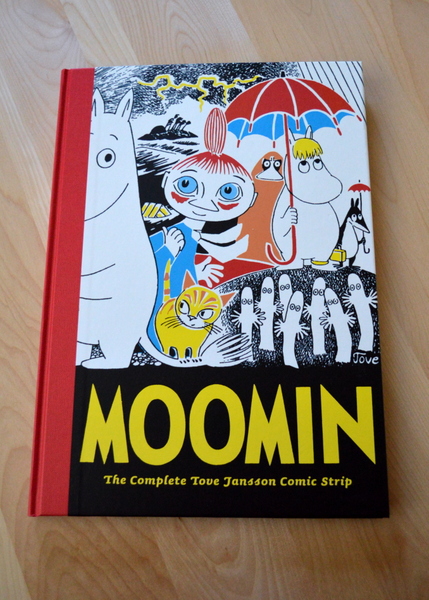
According to Comic-Con International, Tove Jansson, a Finnish visual artist and author, has been selected by the Eisner Award judges to be automatically inducted into the Will Eisner Comic Awards Hall of Fame for 2016. Hooray, Tove!

Tove Jansson Complete Moomin Comic Strip

Jansson (1914-2001) is best known as the creator of the incredibly popular Moomins books and comics. Besides Jansson, there’s a second automatic inductee: Carl Burgos, Golden Age creator of The Human Torch.

In addition, the judges have also chosen 14 nominees from which voters will select four to be inducted in the Hall of Fame. Visit the Comic-Con International: San Diego Eisner Awards page for details. The ceremony takes place July 22, 2016, in San Diego.

Found via File 770.

Image by Eppu Jensen

Gamer Girls ca. 330 BCE

Image: via Esther MacCallum Stewart
Two girls playing knuckleones via Esther MacCallum Stewart

Not that this should come as any surprise to anyone, but girls have been gamers for over 2,000 years.

Here’s a statuette of two girls playing knucklebones from ca. 330 BCE. In the ancient Mediterranean, the heel bones of sheep (commonly, though inaccurately, called “knucklebones” in English) were used for playing a variety of games, as they still are in many parts of the world today. They could be rolled like dice or gathered up in games similar to jacks, which is what these two appear to be doing.

Knucklebones crossed the whole spectrum of ancient society. Men and women, girls and boys all played. The Greek comic playwright Aristophanes mentions them as the toys of poor children (The Wasps 295) while Suetonius quotes a letter by the Roman emperor Augustus enthusiastically recounting his gaming exploits (The Deified Augustus 71). It is hard to think of a pastime that is so widely shared today.

Of Dice and Dragons is an occasional feature about games and gaming.

Art for Early Editions of Dune

Have you read Dune? If so, you might enjoy this early art by John Schoenherr:

Schoenherr Dune Dawn at the Palace of Arrakeen
John Schoenherr: Dawn at the Palace of Arrakeen.
Schoenherr Dune Stilgar and His Men
John Schoenherr: Stilgar and His Men.


Schoenherr Dune Defeating the Sardaukar
John Schoenherr: Defeating the Sardaukar.

Apparently, Frank Herbert said Schoenherr (1935-2010) was “the only man who has ever visited Dune.” Schoenherr’s paintings of Herbert’s Dune were published first in the Analog magazine and later in a fully illustrated version.

For me, along with John Christopher’s The Tripods, Dune is one of the SFF books I read in my (much) younger days and have kept re-reading over the years. Seeing this early art was certainly a treat!

Found via Dangerous Minds – go visit for more info & pics.

Out There is an occasional feature highlighting intriguing art, spaces, places, phenomena, flora, and fauna.

Statue of Lenin Turned to the Dark Side

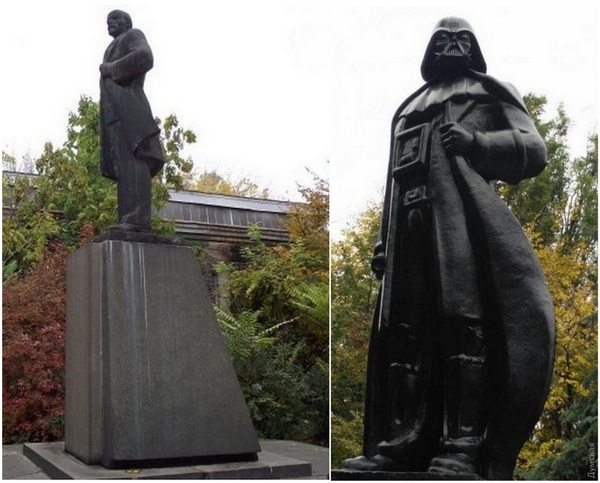
In Odessa, Ukraine, a statue of Lenin fated for demolition instead got a new life – as Darth Vader.

Dumskaya Lenin Vader
Images: Dumskaya.net via Meduza.

The destruction of the statue was called for by a new law that requires the elimination of all landmarks and geographic names dedicated to communist figures. Artist Alexander Milov repurposed the statue and turned Lenin into the dark side. There’s more under Vader’s cloak than a covered-up Lenin’s coat, though: the statue’s head conceals a router delivering Wi-Fi to the immediate area.

Who woulda thunk that Lenin’s pose would be spot on for Vader!

Found via Meduza.

Out There is an occasional feature highlighting intriguing art, spaces, places, phenomena, flora, and fauna.

Theodor Kittelsen’s Naturalistic Fantastical Art

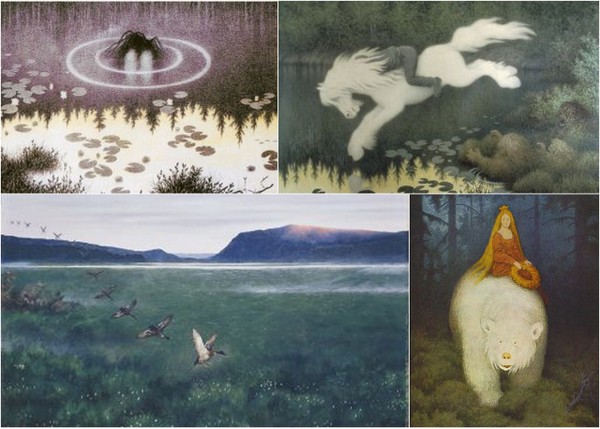
Norwegian Theodor Kittelsen (1857-1914) developed into one of Scandinavia’s most popular artists. He’s especially well known for his nature paintings and illustrations of fairy tales, legends, and trolls.

Trollet_som_grunner_pa_hvor_gammelt_det_er
Theodor Kittelsen: Trollet som grunner på hvor gammelt det er [troll wonders how old it is], 1911. Via Wikimedia Commons.
His art clearly shows how strongly the Norwegian nature inspired him. Kittelsen’s style is said to include aspects naturalism, mysticism, and Art Nouveau.

Kittelsen Collage
Theodor Kittelsen, clockwise from top left: Nøkken [water spirit], 1887–92; Gutt på hvit hest [boy on white horse]; Kvitebjørn Kong Valemon [white bear King Valemon], 1912; 12 villender [12 wild ducks], 1897. Via emmeffe6 on Flickr (one, two, three, four).
The element of a boy on a white horse is connected with water spirit tales. Apparently some näkki water spirits (to use my native Finnish term) can turn into horses to capture humans to pull underwater. I don’t remember that aspect of the näkki stories from my childhood; perhaps there’s a difference between the Scandinavian and Finnish tales.

The landscapes in Kittelsen’s paintings remind me of the Finnish wildernesses a lot. There’s also something solemn and contemplative in the mood of his imagery that makes me connect it with Tolkien’s art and writing, on one hand, and, on the other, with the illustrations of Tove Jansson (see examples of her work on Alice in Wonderland and The Hobbit provided by The Official Moomin site).

Out There is an occasional feature highlighting intriguing art, spaces, places, phenomena, flora, and fauna.

Digital Painting Inspired by The Martian

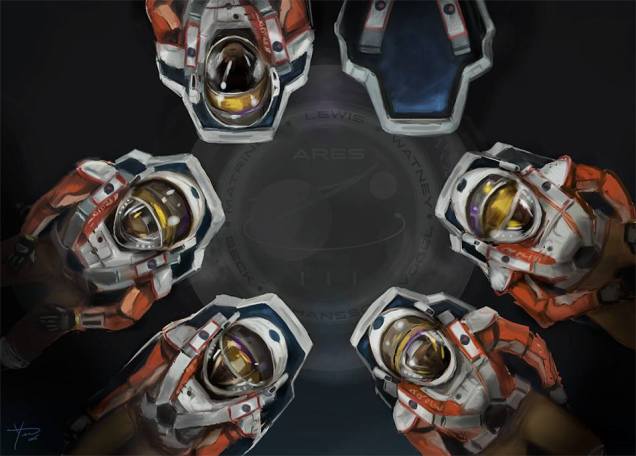
Painter and photographer d. yee was inspired to re-interpret a scene from The Martian as a digital painting:

d. yee.
d. yee.

Says artist:

“Was thinking to use this as a reference for a large format painting (in acrylic). After working on this digital painting over a couple of days I’m starting to rethink the feat. My right hand is not happy.”

Beautiful. Reminds me stylistically of some SF book covers I like. I hope a large format acrylic is coming (and published on their website)!

Out There is an occasional feature highlighting intriguing art, spaces, places, phenomena, flora, and fauna.

Looking at Cleopatra

In this age of selfies and Instagram, we are very aware of how consciously we all create the image of ourselves that we show to the world. The people of antiquity were no less self-conscious about their public image. Look at these two sculptures of Cleopatra VII.

Cleopatra VII Philopator is the famous Cleopatra, Queen of Egypt and lover of both Julius Caesar and Marcus Antonius. She was the last of the Ptolemaic dynasty in Egypt, founded by Ptolemy I, one of the generals of Alexander the Great. The Ptolemies ruled Egypt for almost three hundred years, arguably the first European colonial state in Africa. Like other Macedonian dynasties in the relics of Alexander’s short-lived empire, Ptolemy and his heirs took a pragmatic approach to ruling over a large population that did not share in their Hellenized Macedonian culture. They embraced a kind of cultural bilingualism in which they presented themselves in very different ways to different audiences.

151008marble
Portrait head of Cleopatra VI, photograph by Louis le Grand via Wikimedia (Altes Museum, Berlin; 40-30 BCE; white marble)

This marble head of Cleopatra is sculpted in a Hellenistic style and presents the queen in a Greek cultural context. White marble was favored for sculpture in the Greek world because it reacts to light in ways similar to human skin, making marble sculpture appear more naturalistic. Details like the soft rendering of the mouth, the detailed delineation of the hair, and the slightly off-center tilt of the head are drawn from the artistic repertoire of late Classical and Hellenistic portrait sculpture. This statue asserts Cleopatra’s Greekness and her participation in the broader Mediterranean cultural world. It was probably displayed in Alexandria, the Ptolemaic capital, which had a cosmopolitan population largely made up of Macedonians and Greeks, along with substantial Jewish and Persian communities and a variety of other peoples, but few ethnic Egyptians. It was meant to be seen by an audience that would recognize and appreciate the way this portrait fit into the larger history of Hellenistic ruler portraiture.

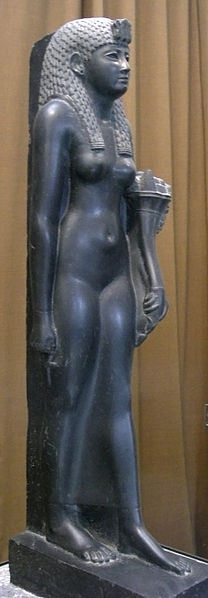
Statue of Cleopatra VII, late 1st c. BCE, Hermitage Museum St. Petersburg, basalt, photograph by George Shuklin
Statue of Cleopatra VII photograph by George Shuklin via Wikimedia (Hermitage Museum, St. Petersburg; late 1st c. BCE; basalt)

This basalt statue of Cleopatra uses not only an Egyptian artistic style, but an almost entirely Egyptian iconographic vocabulary. Many different stones were used for Egyptian portrait sculpture, but basalt was a popular one since the stone is very hard and durable, giving a sense of permanence especially to royal portraiture. Cleopatra is presented here as an Egyptian pharaoh. She wears a wig adorned with the royal uraeus and carries an ankh in her right hand. The cornucopia in her left hand is a Greek symbol, but its connotation of bounty is similar to the ankh’s symbolism of life. Also note that one of her feet is advanced. Egyptian women were typically depicted with feet together and men with one foot advanced, but the adoption of masculine traits to represent a ruling queen is also traditionally Egyptian. This statue was intended for an Egyptian audience and meant to convey Cleopatra’s commitment to ruling over her Egyptian subjects through the forms and structures that they had long been accustomed to.

The Ptolemaic monarchs were aware that their power rested on two precarious premises: that the people of Egypt would accept rulers who were not themselves ethnically Egyptian and that other Mediterranean, African, and Asian powers would respect as equals a royal house of comparatively recent vintage. These sculptures show the confidence with which Cleopatra balanced those two needs and reinvented her image for two different audiences.

(Sadly, there’s not an ostrich to be seen.)

The Visual Inspiration occasional feature pulls the unusual from our world to inspire design, story-telling, and worldbuilding. If stuff like this already exists, what else could we imagine?

Ancient African Trees Look Alien at Night

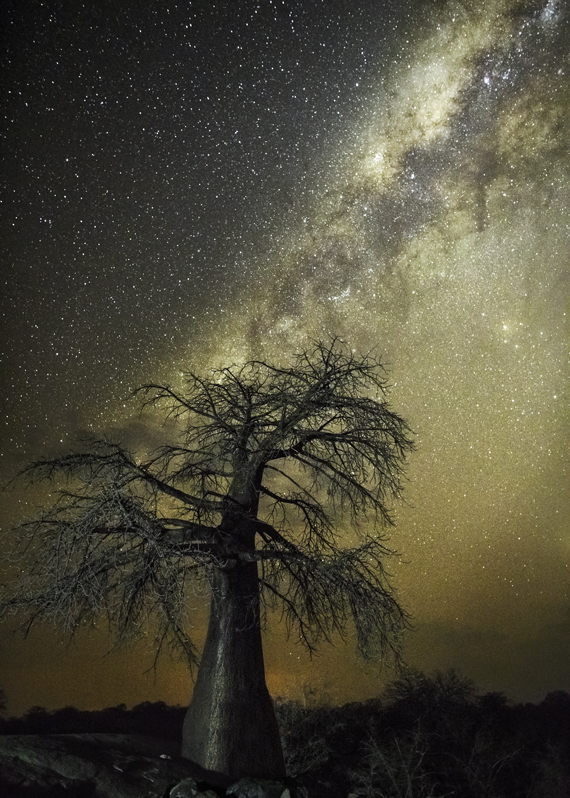
Photographer Beth Moon‘s new series Diamond Nights documents baobabs and quiver trees against moonless, starry night skies with breathtaking results. For a Nordic city dweller like me, the images might as well be from a different planet.

Beth Moon: Aquila, 2015.
Beth Moon: Serpens, 2015.

In her artist’s statement, Moon writes of the technical aspects of shooting:

“The majority of these photographs were created during moonless nights, shot with a wide angle lens and ISO of 3200 – 6400. […] Exposures up to 30 seconds allowed enough light to enter the lens without noticeable star movement. Each location required a lot of experimenting. and different lighting techniques. Sometimes a short burst of diffused light from a flashlight was sufficient, or bounced light from multiple flashlights was used for a softer more natural glow.”

Beth Moon: Ara, 2015.

Photos like these remind me of the incredible diversity of our planet, and how much more of the world we can see and share through the power of Internet than even our parents. Love it!

Found via Colossal.

Out There is an occasional feature highlighting intriguing art, spaces, places, phenomena, flora, and fauna.