The literary works of Agatha Christie and J. R. R. Tolkien may not seem to have much in common. One wrote murder mysteries set in genteel English country houses, the other high fantasy in a mythic secondary world. When you look at the themes and ideas of their work, though, interesting parallels appear.
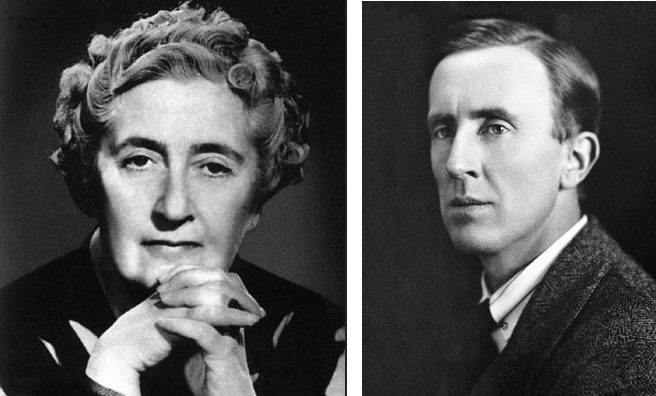
The two authors were close contemporaries; Christie was born in 1890, Tolkien in 1892. They belonged to the generation whose young adulthood was shattered by the First World War. Their experiences were different—Tolkien saw battle firsthand as an officer, Christie its terrible aftereffects as a nurse—but they both reflect the shock of the war in their writing.
One theme that occupies both writers is death. Death was, naturally, a crucial element of Christie’s murder mystery stories. In Tolkien’s legendarium, death and the things people will do out of the fear of it is a running theme. But neither writer’s work is focused on death as a fact; rather, the underlying drive in their work is a search for some way in which death makes sense.
In Christie’s case, this theme is more obvious: she writes about detectives solving crimes. By the time we reach the drawing room summation at the end of the book, we can see clearly how and why the victim or victims died. Order is restored to the world, and reason triumphs over the illogic of death, whether that reason is embodied in a fussy Belgian’s love for methodical neatness or a wise spinster’s deep observation of human nature.
In Tolkien’s work, the drive to make sense of death is subtler. Death often appears pointless in Tolkien. Boromir dies defending Merry and Pippin from Orcs, but after he falls the young Hobbits are captured nonetheless. Denethor dies in despair instead of living to see his city saved. But the larger point of Tolkien’s work is that hopelessness is an illusion. We never know the end of our own story or how profoundly the choices we make will affect the world. In the legendarium as a whole, death is the greatest mystery, but also the greatest hope. The world of Middle Earth had a beginning and will someday end, yet the spirits of mortal beings will not end with the world but transcend it through death.
It is not just the death of individuals that occupied Christie and Tolkien, but also how ways of life come to an end. They both witnessed the end of the world, in a sense. The innocence and hope of the time they grew up in perished on the battlefields of the Great War, but they did not. They kept going and witnessed as the world around them changed.
Tolkien’s The Lord of the Rings is about the ending of an age, the Third Age of Middle Earth to be precise. The story takes place during the last days before the Elves either depart into the magical west or dwindle into creatures of fairy tale and folklore, taking their beauty and wisdom with them. Yet the story also carries hope for what is to come after in the ages of Men—hope without guarantees, as Gandalf puts it. The Elf Legolas and Dwarf Gimli reflect on the promise and weaknesses of humans in the streets of Minas Tirith:
“If Gondor has such men still in these days of fading, great must have been its glory in the days of its rising.”
“And doubtless the good stone-work is the older and was wrought in the first building,” said Gimli. “It is ever so with the things that Men begin: there is a frost in Spring or a blight in Summer, and they fail of their promise.”
“Yet seldom do they fail of their seed,” said Legolas. “And that will lie in the dust and rot to spring up again in times and places unlooked-for. The deeds of Men will outlast us, Gimli.”
– The Lord of the Rings. Book 5, Chapter 9, “The Last Debate”
Christie reflects the changing world in different ways, but also with hope for what the future will bring. Her early works are set in the interwar world of country estates and garden parties that we typically think of when we think of a Christie mystery, but that world was ending. She kept writing through the fifties and sixties as the life and culture of Britain changed around her.
The traces of this change are all over Christie’s writing. One of the ongoing themes in her mysteries is that it is difficult to know who people really are. Many of her plots hinge on people passing themselves off as or being mistaken for someone else. Such impersonations were possible only because the world of country villages and garden parties where everyone knew one another was ending. Miss Marple speaks of this shift in A Murder is Announced:
Fifteen years ago one knew who everybody was. The Bantrys in the big house—and the Hartnells and the Price Ridleys and the Weatherbys … They were people whose fathers and mothers and grandfathers and grandmothers, or whose aunts and uncles, had lived there before them. If somebody new came to live there, they brought letters of introduction, or they’d been in the same regiment or served in the same ship as someone there already.
…
But it’s not like that any more. Every village and small country place is full of people who’ve just come and settled there without any ties to bring them. The big houses have been sold, and the cottages have been converted and changed. And people just come—and all you know about them is what they say of themselves.
– A Murder is Announced. Chapter 10, “Pip and Emma”
At the same time, Christie also saw that the fundamentals of human nature that underlay her stories were not changed by the passing of time. People might live differently, but they still had the same jealousies and aspirations, desires and fears as they ever had. Miss Marple, again, reflects on this fact in The Mirror Crack’d from Side to Side as she explores the new housing development at the edge of her beloved village:
She turned out of Aubrey Close and was presently in Darlington Close. She went slowly and as she went she listened avidly to the snippets of conversation between mothers wheeling prams, to the girls addressing young men, to the sinister-looking Teds (she supposed they were Teds) exchanging dark remarks with each other. Mothers came out on doorsteps calling to their children who, as usual, were busy doing all the things they had been told not to do. Children, Miss Marple reflected gratefully, never changed. And presently she began to smile, and noted down in her mind her usual series of recognitions.
That woman is just like Carry Edwards—and the dark one is just like that Hooper girl—she’ll make a mess of her marriage just like Mary Hooper did. Those boys—the dark one is just like Edward Leeke, a lot of wild talk but no harm in him—a nice boy really—the fair one is Mrs Bedwell’s Josh all over again. Nice boys, both of them. The one like Gregory Bins won’t do very well, I’m afraid. I expect he’s got the same sort of mother…
She turned a corner into Walsingham Close and her spirits rose every moment.
The new world was the same as the old. The houses were different, the streets were called Closes, the clothes were different, the voices were different, but the human beings were the same as they had always been.
– The Mirror Crack’d from Side to Side. Chapter 1
Some days now it feels like we are living through the end of the world we knew, and none of us knows what will come next. In these times, there is comfort in going back to writers who lived through the end of one world and saw that there was hope in the next.
Tolkien, J. R. R. The Lord of the Rings. London: HarperCollins, 1994, p. 855.
Christie, Agatha. A Murder is Announced. London: HarperCollins, 2023, pp. 132-133.
Christie, Agatha. The Mirror Crack’d from Side to Side. London: HarperCollins, 2023, pp. 13-14.
Image: Photo collage of Agatha Christie and J. R. R. Tolkien by Erik Jensen. Photograph of Christie via Wikimedia; photograph of Tolkien via Wikimedia
Post edited to correct formatting errors
Story Time is all about story-telling and how stories work, and what makes us love our favorites.


 Co-Geeking


You must be logged in to post a comment.