My World of Warcraft: Legion First Hidden Artifact Appearance

Somehow I’ve completely missed the fact that the World of Warcraft: Legion expansion includes so-called hidden appearances for artifacts. I confess I haven’t been terribly excited about the appearances to begin with; I tend to transmog my artifacts to look like some of the older weapons in game.

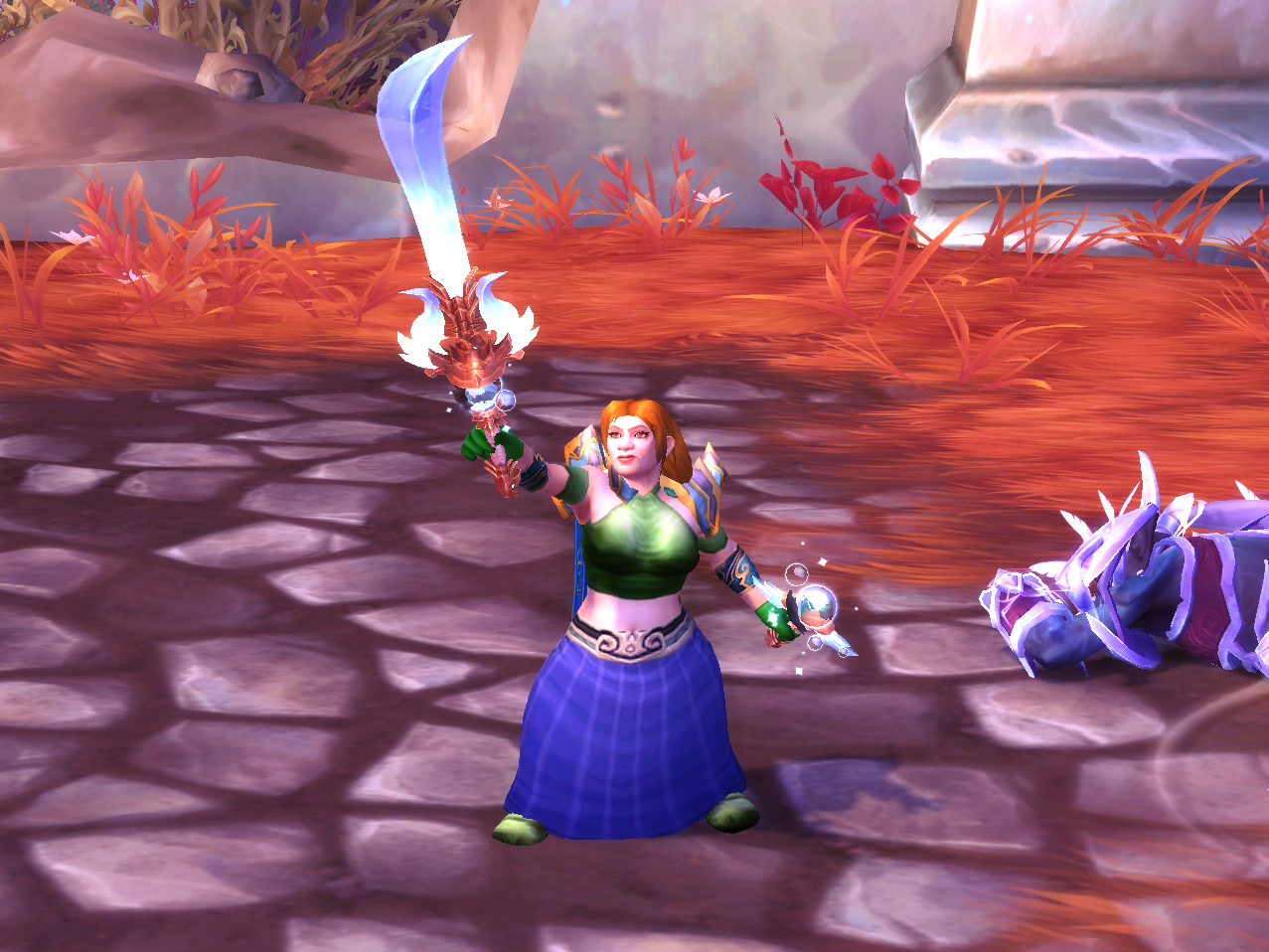
This past weekend, however, I got an exciting random drop on my fire mage: an item that triggers a hidden artifact appearance. It’s called The Stars’ Design, and using the item opens the appearance directly (without any quests or other tricks). And it’s quite beautiful—I managed to get a screencap!

WoW Legion Fire Mage Hidden Art Appearance Stars Design Sm

Once you’ve gotten your first hidden appearance, apparently there are additional color variations you can open by running 20 Legion dungeons, doing 200 world quests, or killing 100(?) enemy players. I don’t do pvp, and I’m still dungeoned out (from *cough cough mumble mumble* when we were running them in a row to gear up for raiding). But: I’ve had less much time for playing this year than before, so when I do get a chance I tend to grind hours on end, so perhaps 200 world quests would be doable… 🙂

Image: screenshot from World of Warcraft

This post has been edited for formatting.

Of Dice and Dragons is an occasional feature about games and gaming.

Thor: Ragnarok Trailers

Good grief, it’s November already! For some reason, the fall always gets away from me, but this year it’s felt even faster than usual. It’s now only two(!!!) days till Thor: Ragnarok opens! Here are the teaser trailer and the official trailer:

Thor: Ragnarok Teaser Trailer [HD] by Marvel Entertainment

“Thor: Ragnarok” Official Trailer by Marvel Entertainment

I’ve long thought that the Thor movies have been the least succesful Marvel Cinematic Universe stories. In fact, excepting the hilarious sequence in Thor: The Dark World where Mjölnir flies between realities through the portals, both were quite deplorable. I hope writers Eric Pearson, Craig Kyle, and Christopher Yost plus director Taika Waititi can change that.

Sidenote: every time I see the teaser trailer with Led Zeppelin’s “Immigrant Song”, all I can think of is…. VIKING KITTENS! Aaaaaaaaa-ah!

Hey, look! We found a thing on the internet! We thought it was cool, and wanted to share it with you.

A Ghost Story

The Met Bronze Veiled Masked DancerWe often tell scary stories not just to evoke screams and chills but with a message. The monsters of our creepy tales reflect our larger fears, but sometimes the point of the story is that the most frightening things are done by our fellow human beings, not by spooks or spectres. Such is the case with a ghost story told by Herodotus.

The source of this tale was a meeting of representatives from various Greek cities convened by the Spartans in the late 500s BCE to consider going to war against Athens. Athens had been in a state of political turmoil and the Spartans proposed invading the city and imposing a tyrant to restore order and stability.

The representatives of Corinth spoke out strongly against the proposal. Corinth had been ruled by tyrants for three generations, and Corinthians knew better than anyone what tyrants were like. Socles of Corinth told the story of Periander, the Corinthian tyrant. Periander had killed his own wife, Melissa. He then tried to consult her spirit when he mislaid a treasure that a friend had left with him:

He sent messengers to the oracle of the dead at the River Acheron in Thesprotia to inquire about his friend’s deposit, but when the spirit of Melissa appeared, she would not indicate, by speech or action, where the deposit lay, for she was naked and shivering. The clothes that had been buried with her were of no use to her since they had not been burned. As proof that what she said was true, she added that Periander had put his loaves in a cold oven.

When this message was reported to Periander, he knew it to be the truth, for he had had intercourse with Melissa when she was dead. He at once issued a proclamation that all the women of Corinth should gather at the temple of Hera. They came out dressed in their best as if for a festival, but Periander had his guards fall upon them and strip them all naked, ladies and servants alike. The clothes were heaped up in a ditch and Periander, with a prayer to Melissa, burned them all.

After this he sent a second time to the oracle, and the spirit of Melissa pointed out where the deposit lay.

– Herodotus, Histories 5.92.g

(My own translation.)

Some things are more frightening than ghosts.

Image: Bronze statuette of a veiled and masked dancer, from the collections of The Metropolitan Museum of Art, bequest of Walter C. Baker in 1971, accession number 1972.118.95, by Eppu Jensen (Greek; 3rd-2nd century BCE)

Story Time is an occasional feature all about stories and story-telling. Whether it’s on the page or on the screen, this is about how stories work and what makes us love the ones we love.

Quotes: Declining to Get Thrilled

From an early Hercule Poirot mystery comes this hilarious quote:

“[…] said Inspector Davis. ‘There’s not going to be much mystery about this crime. Take a look at the hilt of that dagger.’

“I took the look.

“’I dare say they’re not apparent to you, but I can see them clearly enough.’ He lowered his voice. ‘Fingerprints!’

“He stood off a few steps to judge of his effect.

“’Yes,’ I said midly. ‘I guessed that.’

“I do not see why I should be supposed to be totally devoid of intelligence. After all, I read detective stories, and the newspapers, and am a man of quite average ability. If there had been toe marks on the dagger handle, now, that would have been quite a different thing. I would then have registered any amount of surprise and awe.

“I think the inspector was annoyed with me for declining to get thrilled.”

– Doctor Sheppard in The Murder of Roger Ackroyd by Agatha Christie

I’m reading Agatha Christie in English for the first time, and it’s a hoot! Not only are her mysteries top notch, her language is a delight. My (admittely hazy) memories don’t measure up to what I’m seeing now; I don’t know whether it just didn’t translate well or whether I was too young to understand. I’m discovering so much dry humor to irony to outright satire that I’m pretty much snickering my way through the novels.

Christie, Agatha. The Murder of Roger Ackroyd. New York, NY: Black Dog & Leventhal, [2006, orig. published 1926], p. 73.

Serving exactly what it sounds like, the Quotes feature excerpts other people’s thoughts.

Writing, Reading, Living Different Cultures

I saw a Twitter thread about writing culture by author Joan He, on the face of it about her (or your) own but by extension that of others, and it has plenty of food for thought:


As a reader, and specifially a reader of speculative and historical fiction primarily not in my native language, I run into differences in culture a lot. And as a person in a multicultural, multilingual relationship in a strange country where I’m a cultural and linguistic minority, from time to time I find myself slammed against more deep-seated cultural assumptions.

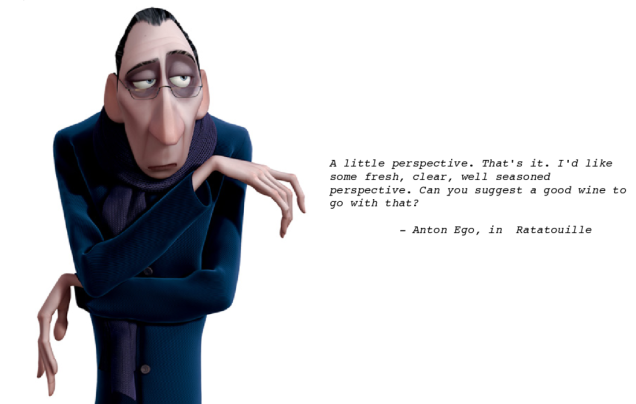
Joan pointed out that culture is a way of thinking, or cognition, or perspective. As an example, I’d like to share two failures of cultural expectations from my personal experience.

Ratatouille Anton Ego Perspective Quote

At a con once, I wanted to get a book signed by an American author. I happened to know from their online presence that the author is an introvert. Even though we were both at a public place where introverted authors and panelists often don a more outgoing persona than they do in private, as another introvert I wanted to make sure I’d be especially considerate. However, quite without intending to I tripped over a distinctly Finnish quirk.

One of the big unspoken assumptions in the Finnish culture is that silence isn’t a negative. (Erik and I have both written about it for instance here, here, and here.) In essence, how I understand it, silence means space, and space means respect to other people.

Accordingly, at the abovementioned autograph session, when it came my turn I said my hellos, presented the author with my book, and waited silently. It wasn’t until the author asked me “Did you read it?” that I realised they expected me to say something else. And I had thought I was being courteous not to burden them with yet another dose of chitchat on a weekend full of being “on” at a busy con. I can’t remember for sure, since it was a kind of a deer in the headlights moment for me, but I think I was able to stutter my way to an exit without actually breaking into a run. In any case, not terribly smooth on my part.

I’ve also had a previously friendly person walk away from me when, in the middle of a presentation, I (I’m guessing “merely”) nodded to them to acknowledge their presence and silently continued to listen to the speaker (I’m guessing instead of starting a conversation with the friendly person). Although it’s been years, I still find that an utterly, completely, and thoroughly puzzling reaction.

Over the years, I’ve built a store of strategies and stock exchanges I can pull out if needed, but it’s been hard to try and perform—for it is essentially a performance—in a way that feels unnatural and at times even rude to me. Even after 10+ years, I still can’t bring myself to commit to it wholeheartedly. I suspect I’ll always be the odd, quiet one in Anglo-American contexts, but that’s my background and temperament.

So: yes, cultural assumptions and perspectives are difficult to convey, whether in writing or otherwise. Adding surface details to a fictional culture is easy, and it can be a fantastic tool for both creating distance from the everyday world and deepening the invented one. I love seeing glimpses of the practicalities that fictional characters deal with; I would find—and have found—stories seriously lacking without them. Never, though, should the surface glitter be where invention on the part of author ends; that is as unsatisfying as a lack of external cultural markers.

Being a truly exceptional author has, for me, come to mean not only the ability to create layered, nuanced worlds (or convey the complexities of everyday life in historical fiction). In addition, skilled authors I enjoy the most are able to avoid massive infodumps and to suggest underlying cultural values subtly, as inseparable part of narration and dialogue. And that’s a very challenging thing to do. It sometimes takes me more than one read-through to feel I’m beginning to understand a story. Then again, worthwhile things often are the most difficult ones.

Image via The Autodidactic Hacker

In Live and Active Cultures we talk about cultures and cultural differences.

Race in Antiquity: The Question

“What race were the ancient Greeks and Romans?”

It sounds like a simple question that ought to have a straightforward answer, but both the question and its answer are far more complicated than they appear. In this and some upcoming posts, I’ll dig into the topic to explore what we know, what we don’t know, and what we mean by race in the ancient Mediterranean world.

Part 1: The Question

“What race were the ancient Greeks and Romans?”

As simple as it may sound, almost every word in this question hides layers of assumptions. It assumes that race is a valid category for describing human beings, and is equally applicable to ancient societies as to modern ones. It assumes that we can reconstruct ancient demographic information in some comprehensive way. It assumes that “Ancient Greeks and Romans” are definable groups of people, and that we know who we mean by that designation.

These are not trivial issues, and I’ll take them up in future posts, but today I want to address an even more fundamental and persistent assumption: that the racial identity of the ancient Greeks and Romans matters.

Now, I am an ancient historian and a geek. I’ve spent my entire life, both at work and at leisure, being told by people that the things I care about don’t matter. (The title of my field, “ancient history,” is even used as a synonym for “irrelevant.”) That’s never stopped me from trying to figure things out and it shouldn’t stop us from thinking about race in antiquity, but it should make us step back and ask: Why do we want to know?

When we ask questions about the race of ancient peoples, we are not posing these questions in a vacuum. There is, in fact, a long history of people arguing about the answer, and if we don’t understand their reasoning and motivations we may fall into the same traps and make the same mistakes that they did.

We can start around 1500 CE when the Western concept of race was taking on its modern contours. Variations in physical and genetic features—from skin color to blood type—are part of the reality of human biology, but the belief that these features can be used to divide humanity into distinct and meaningful categories, along more or less the terms we recognize today, was a product of European imperialism and colonialism. The European powers that were busy conquering and colonizing the rest of the world had to define themselves as superior to the people they were displacing, exploiting, or massacring. The idea of a “white” race—a superior “white” race, no less—began with the need to justify European activities abroad.

Once Europeans had defined themselves as both white and superior, history had to fall in line. On one hand, the roots of white superiority had to be found in the depths of history; on the other hand, any great accomplishments in history had to become the property of white people. Any evidence that could be interpreted as suggesting that white people had made significant achievements before anyone else were celebrated, such as Piltdown Man, a hoax that got out of hand because it conformed so perfectly to what archaeologists expected: the crucial first steps towards modern humans happened in northwestern Europe. The achievements of non-European peoples were denied or claimed for Europeans wherever possible, like the “dynastic race theory” in Egypt or the assertion that major centers of African civilization like Great Zimbabwe must have been built by white (or white-ish) settlers. Civilizations that could be neither denied nor claimed for whiteness, like those of ancient India, China, and Mesoamerica, were denigrated or dismissed.

European Christian culture had long idolized the civilization of ancient Greece, a habit that went back as far as the Roman Republic. The Romans had had an uneasy relationship with their Greek neighbors and subjects, as they tended to elevate the great literary, artistic, and philosophical works of the classical Greek past while sneering at contemporary Greeks as unworthy of their ancestors. After the fall of the western Roman Empire, as Greek and Latin became learned rather than vernacular languages, Greek and Latin literature collectively acquired an aura of cultural authority. This aura of authority was further supported by the association of Greek and Latin learning with religious authority in the Christian church.

By the imperial age, when European nations were asserting their racial superiority over their colonial subjects and slaves, ancient Greek and Roman civilizations had come to be perceived as the peaks of intellectual, philosophical, and artistic culture. A defense of European superiority therefore required the assertion of a direct link to Greece and Rome. Since race was the accepted currency of identity, that link had to be defined in racial terms. It therefore became essential that the ancient Greeks and Romans should be white.

Various strategies existed for making the argument that the ancient Greeks and Romans were white, but one of the most influential was the Aryan invasion model. According to this model, the Aryans were a primordial superior white race whose origins lay somewhere in northern or northeastern Europe. At various times in history, individual branches of this race would explode outwards, traversing great distances and conquering all the “inferior” peoples in their path, eventually colonizing a swath of Eurasia stretching from England to northern India. These Aryan invaders could be credited with cultural achievements anywhere they went, but most importantly they were hailed as the ancestors of the classical Greeks. Western and northern Europeans who claimed descent from other branches of Aryan settlers could therefore claim an ancestral connection to the glories of Greece and its Roman successors.

It was not enough for the ancient Greeks and Romans to be white. Since Europeans looked back to Greco-Roman culture as a source of authority, those who wanted to validate imperial projects required that the opinions of the great ancient authors should support their sense of racial superiority. Scholars searched ancient texts for passages congenial to the imperialist drive and elevated these as the true beliefs of the Great Thinkers of antiquity. Any passages which expressed a different perspective were dismissed or reinterpreted. Through the centuries of this scholarly activity, the ancient Greeks and Romans became not only “white” but the very founders of white supremacy.

Modern scholarship recognizes that the “Aryan race” was a figment of the imagination (the term “Aryan” is now reserved for certain historical peoples of northern India). Both the ethnic identity of the ancient Greeks and Romans and their opinions about that identity are now seen to be far more complicated issues with no easy answers, but the insights of the past several decades of scholarship are only slowly coming into wider public consciousness. The relics of the racially-determined Aryan invasion model are still all around us, some of them stripped of the most obvious racism of the older scholarship but still grounded in the urge to assert the fundamental whiteness of the ancient Mediterranean.

When we ask questions about the race of the ancient Greeks and Romans, this is the context we must be conscious of. Much older scholarship is suffused with its ideas, and even more recent popular discussions of the subject tend to be unknowingly aligned with the Aryan model.

The mistakes of the Aryan model and other arguments that asserted the whiteness of the ancient Greeks and Romans arose from the desire to make the past reflect the concerns of the present. The past does not exist to make us feel better about ourselves or validate our contemporary politics. This is the assumption we must guard against most carefully in any historical research. If we assume that the Greeks and Romans are a measure of civilization and that any similarities we can find between ourselves and them prove our own worth, our arguments will go hopelessly askew.

Instead, if there is any use in examining Greek and Roman ethnic identity, it is as part of the larger work of history: to help us understand our own society better by giving us useful examples for comparison. We will not prove our own value by showing that the Greeks and Romans were like us, but we may better grasp the complex forces at work in forming our own identities by understanding how they were different from us.

Other posts:

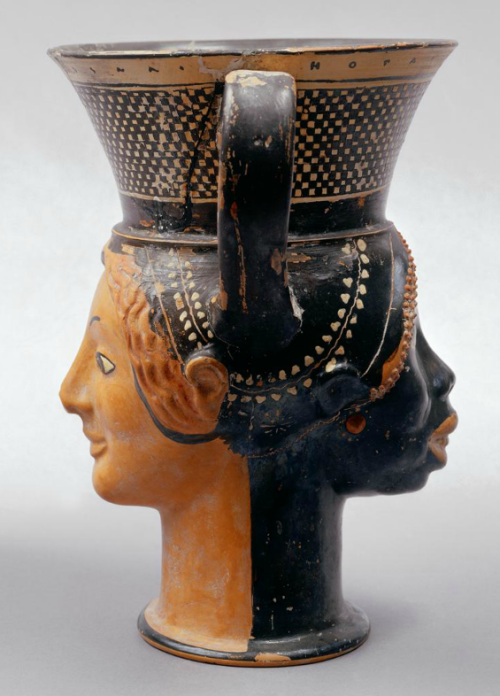
Image: Janifrom kantharos, via People of Color in European Art History (Etruria, currently Villa Giulia; 6th c. BCE; ceramic)

History for Writers is a weekly feature which looks at how history can be a fiction writer’s most useful tool. From worldbuilding to dialogue, history helps you write. Check out the introduction to History for Writers here.
Secondary Characters in Love

I realized something recently.

There are lot of books, movies, television series, and so on about people falling in love, or whose main characters end up in a relationship. (No, that’s not the thing I realized.) Mulder and Scully. Lizzie and Darcy. Aragorn and Arwen. For a lot of people, these pairings are a big deal. Fans of these works love watching the characters fall in love (or arguing endlessly on the internet about it) and creators tease us with will-they-or-won’t-they flirtation and big payoff wedding days.

All of this is perfectly fine, but it’s not for me. I don’t mind that Mulder and Scully end up together, but that was never what I watched X Files for. I love Pride and Prejudice for the witty dialogue, expertly crafted story, and deliciously wicked satires of social pretension, not for the Darcy-Bennet nuptials.

Now here’s the thing I realized: even though I have no investment in main character romances, I adore secondary character romances. I love watching side and background characters fall in love and get down to happily-ever-after-ing. I don’t care one way or another if Phryne Fisher and Jack Robinson end up together, but I’m all in for Dot and Hugh. To me, the climax of Pride and Prejudice is not when Mr. Darcy proposes (for the second time) to Elizabeth Bennet, but when Mr. Bingley proposes to Jane Bennet.

I think there are some reasons for this. Side characters’ romances are not generally made to carry the same dramatic weight as main characters’. That means they don’t usually get saddled with tedious will-they-or-won’t-they teases or artificial roadblocks to “build drama.” More often they get to be sweet, silly, stories of love. In longer-form works, like television series, secondary characters also often get to make progress in their romance, moving on from flirtation to dating to marriage to wedded life while main characters tend to get stuck in stasis.

Then again, maybe I just love secondary characters.

Anybody else feel this way? Or am I just peculiar?

Image: Jane and Charles via Giphy

In Character is an occasional feature looking at some of our favorite characters from written works and media to see what drives them, what makes them work, and what makes us love them so much.

Three Favorite Jane Austen Screen Adaptations

July 18, 2017, marked the 200th anniversary of the death of Jane Austen, my favorite (deceased) author.

JASNA Truth Universally Acknowledged Book Always Better

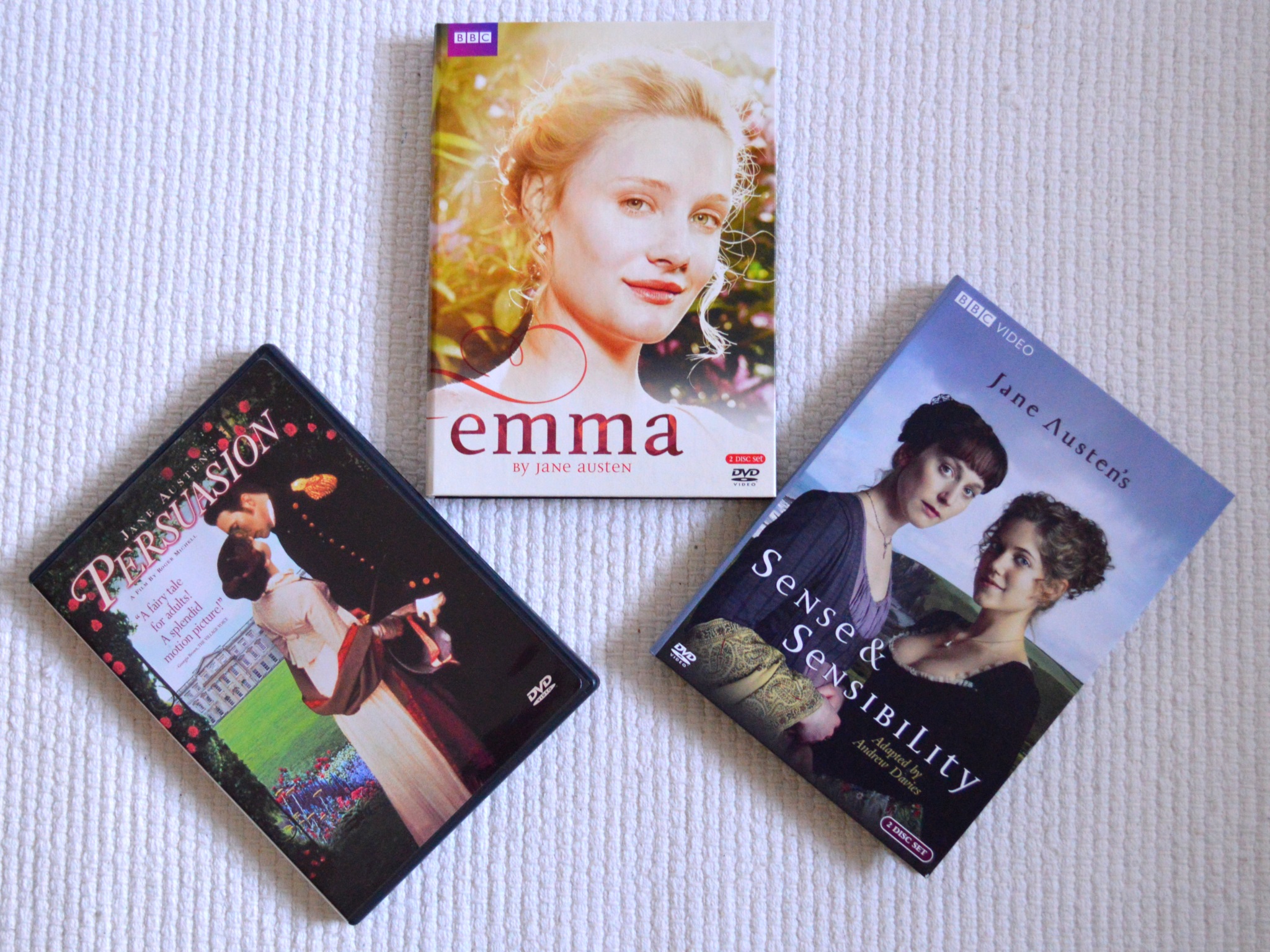
To honor her work, we rewatched all of the screen adaptations that we could easily get our hands on.

Jane Austen Rewatch Owned Adaptations

Here, in short, are three of my absolute favorites. (For links to the complete reviews, visit my post A Jane Austen Rewatch Project for the 200th Anniversary of Her Passing.)

Sense and Sensibility (anonymously published in 1811) is by far my favorite Austen novel, and my favorite adaptation is the Andrew Davies miniseries (directed by John Alexander; 2008). It stars Hattie Morahan and Charity Wakefield as Elinor and Marianne. Both were new to me, but I was familiar with the significant male actors: Dan Stevens (Mr. Edward Ferrars) is in the first few seasons of Downton Abbey, David Morrissey (Colonel Brandon) portrays the confused faux-Doctor in the Doctor Who Christmas special “The Next Doctor”, and Dominic Cooper (Mr. Willoughby) as young Howard Stark scratches science to see if it bleeds in Marvel Cinematic Universe’s Captain America: The First Avenger and Agent Carter (and rules as King Llane Wrynn in the Warcraft movie).

It was a gutsy choice of Davies to begin the series with Willoughby’s explicit seduction of a 15-year-old girl, an event which happens very much off-screen in the novel and most adaptations, but becomes the crux of the plot.

The series does have some issues. For example, the Devonshire “cottage” that the financially strained Dashwood ladies had to accept was turned into a literal cottage instead of a good, solid house from the novel. The events are condensed, sure, but their pace doesn’t feel rushed like in the movie versions. Most of the writing, acting, propping, and costuming are solid to excellent.

Jane Austen Rewatch Three Favorites

Emma (1815) was the fourth and last of Austen’s works to be published during her lifetime, and the Emma miniseries from 2009 (adapted by Sandy Welch, directed by Jim O’Hanlon) outshines the other adaptations. (Unsuprisingly, the miniseries format serves Austen’s nuance much better than the movie length.)

The version has several strengths, starting with excellent casting. Romola Garai stars as Emma Woodhouse, and Jonny Lee Miller (who has more recently – and deservedly – starred as Sherlock Holmes in the series Elementary) as Mr. Knightley. Miller’s is by far the most enjoyable Mr. Knightley performance I’ve seen. Mr. Knightley is often played as rather curt and strict, which I find not just offputting but a mistake.

All major characters are introduced at the beginning of episode 1, which helps people new to Austen. Moreover, this version does the epilogue clearly and succinctly, without massive infodumping. In addition, I immensely enjoy the music, the set dressing, costuming and propping, and other visuals. It’s a thoroughly, thoroughly enjoyable Emma. In fact, if the same team were to make other Austen adaptations, I’d go to great lenghts to see them.

Finally, Persuasion is a novel of pressures, choices, and second chances, posthumously published in 1817. The 1995 movie version of Persuasion is excellent. The screenplay is by Nick Dear, and Roger Mitchell directed Amanda Root as Anne Elliot and Ciarán Hinds as Captain Wentworth. I really like Root’s understated and considerate version of Anne; Hinds works well enough even if a few scenes tend towards hammy.

Although the picture quality is grainy, the soundtrack is nice and there are subtitles (not a given on older DVDs). The props, locations, and costuming are also great. This is my favorite version so far—in an ideal world, of course, we would be due another adaptation.

For links to the complete mini-reviews of these and all of the other adaptations, visit my post A Jane Austen Rewatch Project for the 200th Anniversary of Her Passing.

Images: Book is always better screencap from JASNA website. Both DVD images by Eppu Jensen.

In the Seen on Screen occasional feature, we discuss movies and television shows of interest.

Black Panther Official Trailer

The Black Panther official trailer dropped yesterday and it’s looking mighty shiny:

Marvel Studios’ Black Panther – Official Trailer by Marvel Entertainment

Judging by this trailer and some of the tidbits we saw in the teaser trailer, this might well be the visually most astounding Marvel Cinematic Universe movie to date. (And that’s saying something, since we’ve visited Thor, Loki et al.’s domain and the deep corners of space…) Also, the Wakandan design ethos looks deep—like it rises from a long line of traditional crafts still practiced, and acknowledges the country’s history. Wonderful!

Four months to go.

Hey, look! We found a thing on the internet! We thought it was cool, and wanted to share it with you.

Too Familiar

Cats and alchemy don’t mix.

Since Eppu posted one of my old Away From Reality comics last week, I’ve been reminded of how much fun I had making them. I don’t have the time, energy, or creativity to start up the comic again, but I was inspired to dust off the old Poser and whip up something appropriate to the season.

Image by Erik Jensen

In Making Stuff occasional feature, we share fun arts and crafts done by us and our fellow geeks and nerds.