Tamias

Let me tell you about the word tamias.

Tamias is a word in Ancient Greek. It was the title of the official in charge of the Athenian state treasury. It is related to the verb temnō, which means to cut something up into pieces, especially used of carving meat.

Now, meat was not always easy to come by in ancient Greece. Most people would not have eaten meat on a regular basis, at least not from land animals—bird and fish meat was probably a little easier to come by, but meat from animals like cattle, sheep, goats, and pigs was a rarity. In fact, meat from these animals was almost always consumed as part of a sacrifice. When the ancient Greeks offered an animal to the gods in sacrifice, only a small representative portion of the animal was usually burned for the gods. The rest of the meat was cooked and consumed by the community.

Since sacrifice was a religious act, there were important rules about the procedure. One was that the portions of meat shared out among the participants had to be of equal size. To do otherwise would be to suggest that the blessings of the gods invoked by the ritual should come down unequally. The carver who prepared the meat for cooking therefore had a job that required both expertise and a solemn devotion to the good of the whole community.

When the Athenians were organizing their state and assigning one official to responsible for managing the state finances, it makes sense that they would invoke the image of the old sacrificial carver for an official who would take on a post of such weighty responsibility, but this is not where the saga of tamias ends.

A treasurer’s job is not just to share out funds equitably but also to store and guard valuable goods so they will be available in the future when needed. This is the idea invoked by the scientific name Tamias striatus (literally ‘stripey treasurer’) for this fellow. The chipmunk carries food in its big cheek pouches and stores it for the winter in its burrow.

From food to gold and back to food again: that’s the history of tamias.

Image: Eastern chipmunk, photograph by Cephas via Wikimedia

On, of, and about languages.

A New Doctor with New Best Friends

The new Doctor Who season started this past weekend, on Sunday October 07, 2018. The big thing, of course, is that Jodie Whittaker makes her doctorial debut in season 11! I have some thoughts on it. But first, the official trailers:

Doctor Who: Series 11 Trailer by Doctor Who on YouTube

Doctor Who: Series 11 Trailer #2 by Doctor Who on YouTube

I get chills from both! 😀 Although the music choices for trailer 2 seem a little odd—I suspect I might be missing some cultural references here.

I haven’t seen the first episode yet, so I only have previously shared glimpses, various reports, and other people’s reactions to go by. Reading to the rescue, then! Below are quotes from some of the most interesting writeups I found.

Spoiler warning is in effect! (Also, because some quotes are quite long, I’ll pop the rest behind a cut.)

Read the whole post.

Is the New Doctor Who a WoW Gnome?

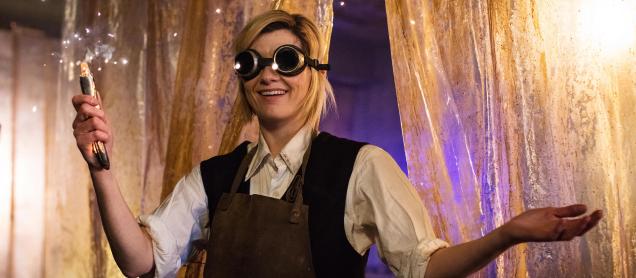
I was browsing some Doctor Who reading on the latest iteration of the Doctor herself when I saw this photo of Jodie Whittaker in costume:

TV Guide BBC Studios Sophie Mutevelian 13th Doctor Who 2018

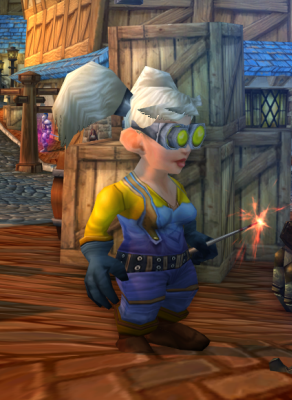
The new Doctor Who is– a WoW gnome?!?

LiveJournal Cindy Love Is in the Air FGnome Cropped

😀

Images: Jodie Whittaker as the Doctor by Sophie Mutevelian / BBC Studios 2018 via TV Guide. World of Warcraft screencap cropped from one by Cindy on LiveJournal.

Some things are just too silly not to share!

A Pumpkin Primer

I grew up with pumpkins. As a child I picked them myself from our neighborhood farm or from my mother’s garden. We carved jack-o’-lanterns for Halloween and had pumpkin pie for Thanksgiving dessert. While pumpkins are native to North America and are widely grown here, the popularity of “pumpkin spice” products (which typically contain no actual pumpkin) and the spread of Halloween traditions from the United States have led to pumpkins becoming more available elsewhere in the world. So, for those of you who may have encountered pumpkins for the first time in recent years and been somewhat at loss for what to do with them, here’s a short introduction from someone who grew up with them.

About pumpkins

Pumpkins are a variety of winter squash. In American English, “pumpkin” typically refers to large, orange or yellow squashes with vertical ribs. In other regions, the word applies to winter squashes more widely. Pumpkins tend to be sweeter than other varieties of winter squash, but for most cooking purposes, you can substitute one kind of winter squash for any other.

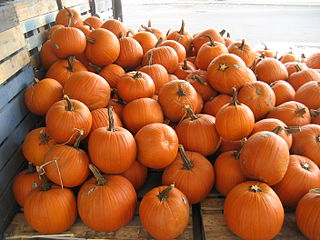
Pumpkins grow on sprawling vines on the ground. Some varieties are bred to grow larger than others, but you will usually find pumpkins sold in four sizes for three different purposes: decorative (large), carving, sugar, and decorative (small).

Decorative

Either small enough to fit in your palm or gigantic monsters, these pumpkins are just meant for autumnal decoration around the house or on your front steps. The small ones are too small to carve, while the big ones are often irregularly shaped, having slumped under their own weight while growing. Neither is particularly good for cooking, but you’re welcome to try and see what you come up with.

Carving

Early migrants from the British Isles brought their traditions of carving lanterns out of various root vegetables to their colonies on the coast of North America, where they learned to grow the native squashes from the indigenous peoples. Pumpkins soon became the favored vegetable for the fall custom.

The classic jack-o’-lantern pumpkins are about the size of your head or larger. Their flesh tends to be stringy, watery, and not very good for cooking.
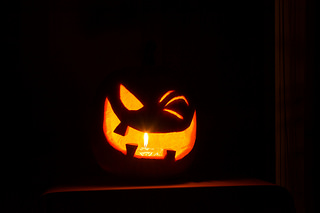
To carve a jack-o’-lantern, start by setting the pumpkin on a flat surface and deciding which side will make the best face. (Pumpkins are often a little lopsided with one half larger or more rounded the other, because of how they lie on the ground while growing.) Next sketch out a face you like with a pencil, marker, or just by making shallow cuts with the tip of a knife.

When you are satisfied with the face, cut the top off in a circle large enough to get your hand in comfortably. It’s a good idea to cut a small diamond-shaped notch half into the top and half into the body of the pumpkin to help you line up the top correctly when putting it back on. Scoop out the seeds and strings from the interior with a large spoon. (Save the seeds if you want to roast them; there’s not much use for the stringy bits.) Scrape away a bit of the flesh on the bottom to make a stable base for the candle.

Carve out the face with a small, sharp knife. In accordance with the principle of “measure twice, cut once,” it’s a good idea to start cutting out the holes a little smaller than you marked them, since you can make them bigger as you go, but not smaller. Once you have all your holes cut through the wall of the pumpkin, cut back the flesh from the inside to widen the holes and allow more light through. It can also help to scrape away at the flesh on the inner surface to make it thinner. (Basically, wherever you have cut through the pumpkin should be wider on the inside than on the outside.)

Take the carved jack-o’-lantern into a darkened room and shine flashlight down through the open top to see how the light comes through and whether there are any places where you need to cut away more of the flesh to get the effect you want. When ready to display, light a tea light or other small candle and put it inside the pumpkin (on a small dish, if you want easier cleanup or worry about the candle burning down), put the top back on, and enjoy!

Once carved, a jack-o’-lantern will only be at its best for a few days, a week at most. Then, as the flesh dries, it will start to shrivel and crumple in on itself. If you want yours to look its best, carve no more than a week before Halloween (or whenever you want to display it).

Sugar

Sugar pumpkins are roughly the size of your head or a little smaller. They are grown to have the best flavor and consistency.

You can peel a raw pumpkin with a sturdy paring knife and cut the flesh into chunks to boil or steam, but I find the best way to prepare pumpkin for cooking is to roast it in halves.

Snap or cut off the stem and split a pumpkin vertically with a small sharp knife. Scoop out the seeds and strings. Save the seeds if you want to roast them. Lay the pumpkin halves cut side up in a shallow baking pan lined with foil or baking parchment. Roast at 400 F / 200 C for 30-45 minutes or until the flesh is soft and the halves no longer hold their shape. (You can also steam pumpkin by setting the halves cut side down in a baking dish with a little water in the bottom.) Let the pumpkin cool until safe to handle. The skin will peel easily away from the flesh, though you may need to cut around the split edges with the tip of a knife. Puree the flesh.

Roasting pumpkin seeds is easy. Separate the seeds from the strings, toss the seeds with a little vegetable oil and salt, spread them out in a pan, and roast them at 400 F / 200 C for about 15 minutes or until they are a nice golden brown. They make a good crunchy snack.

Once you have your roasted pumpkin, here are a couple of my favorite recipes for using it.

New England pumpkin pie

One pumpkin will yield about two pies with this recipe

Ingredients

  • 1 unbaked pie shell
  • 3 eggs
  • ½ teaspoon salt
  • 1/2 cup / 1 dl brown sugar
  • 1 cup / 2 dl milk (soy and almond substitutes work fine)
  • 1 ½ cups / 3 ½ dl roasted pumpkin
  • 2 teaspoons cinnamon
  • 1 teaspoon ginger
  • ½ teaspoon nutmeg

Directions

  1. Preheat oven to 475 F / 250 C.
  2. Prepare the pie shell.
  3. Beat the eggs lightly.
  4. Add the salt, brown sugar and milk and mix well.
  5. Add the pumpkin and spices and mix well.
  6. Pour the mixture into the pie shell.
  7. Bake at 475 F / 250 C for 15 minutes.
  8. Reduce heat to 325 F / 150 C and continue to bake for another 45 minutes or until the filling is well set.
  9. Let cool and serve with whipped cream, or serve warm with vanilla ice cream.

Pumpkin apple beef stew

Ingredients

  • 2 tablespoons flour
  • A pinch of salt
  • A pinch of pepper
  • 1 tablespoon butter
  • 1 pound / ½ kilo stew beef
  • 1 onion
  • 2 potatoes
  • 4 carrots
  • 2 large apples
  • Pureed flesh of one pumpkin
  • 2 cups / 5 dl beef stock
  • 1 cup / 2 dl dark beer

Directions

  1. Blend the flour, salt and pepper in a bowl.
  2. Cut the beef into cubes and roll them in the flour mixture.
  3. Melt the butter in the bottom of a large, heavy pot and brown the beef cubes.
  4. Roughly chop the onion. Peel and roughly chop the carrots and potatoes. Core, peel, and roughly chop the apples. Add them all to the pot.
  5. Add the pumpkin, stock, and beer to the pot.
  6. Let simmer over low heat for two hours or until the beef is soft and the root vegetables thoroughly cooked through.

Happy fall!

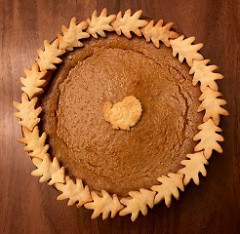
Images: Pumpkins, photography by Infrogmation via Wikimedia. Winking Halloween pumpkin inside – 2014-10-31, photograph by Tim Evans via Flickr. Pumpkin pie, photograph by distopiandreamgirl via Flickr.

How It Happens is an occasional feature looking at the inner workings of various creative efforts.

A Round of Dwarf-ish Music

We haven’t talked about music lately. Time to fix it!

One of the new allied races in Battle for Azeroth, the latest World of Warcraft expansion, is Dark Iron Dwarves. (Note: I don’t think there’s much actual info as of yet, but people have been gathering mentions at a Wowhead thread.)

As I’ve mentioned before, female Dwarves are my absolute favorite race / gender combo to play in WoW, so I’m going to want at least one. 🙂 Consequently, my WoW thoughts have revolved heavily enough around Dwarves to push into the real life in the form of music befitting these mountain-dwellers.

Below are some of my current most favorite Dwarf-ish pieces, whether originally something quite different or composed specifically with Dwarves in mind.

An instrumental Nordic folk-based melody:

Dufwa via Hedningarna – Topic on YouTube

A Dwarven melody from a computer game I know nothing about:

The Dwarven Nobles – Dragon Age: Origins Soundtrack via allaboutVGmusic on YouTube

An Icelandic folk song with something to do with a (or more than one?) bigger bird (maybe crows, jackdaws, ravens, rooks, or the like):

Krummavísur – Voces Thules via hahaigotanidea on YouTube

Performed by the group Voces Thules. Wow! Also this next song is by the same group:

Voces Thules – Varizk ér Ok Varizk ér via Vikingskog on YouTube

Commenter EkErilaz added the Icelandic lyrics and an English translation:

“Beware! Beware! For the wind blows high. Blood will rain down on men’s bared bodies. Point and edge will share all men’s inheritance, now that the sword-age cuts sharply upon us.”

To my mind, the lyrics are very reminiscent of Vikings or Anglo-Saxons, but I could also see them applying to a fantasy race in WoW. (After all, the game is called World of Warcraft.)

Another, a very different type of instrumental:

Dwarf Mining Music – Dwarf Mining Town by Brandon Fiechter on YouTube

You can definitely get the mining vibe!

This version of the old Christmas carol “Masters in This Hall” from the album A Feast of Songs by Barry and Beth Hall also reminds me of Dwarves because of the steady rhythm and low key.

A Feast of Songs – Masters in This Hall via supermusic141 on YouTube

The next is a bit special. A music-heavy version of The Lord of the Rings was produced by the Finnish theater company Ryhmäteatteri in 1988 and 1989. Bilbo’s song “I Sit Beside the Fire and Think” from The Fellowship of the Ring, book 2, chapter III (“The Ring Goes South”) was turned into a song for the play, and it’s wonderfully meditative and solemn.

Tulen ääressä istun via Crypticevangelist on YouTube

The lyrics were originally translated into the Finnish version (Taru sormusten herrasta) by Panu Pekkanen; for the play they were slightly modified. The melody was composed by Toni Edelmann and sung by Timo Torikka.

This next piece was made by Simon Swerwer for the 2012 computer game Dwarf Fortress:

Simon Swerwer – The Tankard Basher by Simon Swerwer on YouTube

Awesome!

Lastly, Neil Finn’s “Song of the Lonely Mountain” (the end credits song for Hobbit: An Unexpected Journey) because of the bittersweetness, melancholy, and—just perhaps—glimmer of hope that comes through.

Song of the Lonely Mountain by Neil Finn on YouTube

Anything you’d like to add? Please do!

This post has been edited to correct a typo.

Of Dice and Dragons is an occasional feature about games and gaming.

A Lego Porg

Wow – there’s now an official Lego porg.

LEGO Porg Oct 2018

“Features authentic detailing, an opening mouth and flapping wings.

“Also includes a display stand with decorative fact plaque and an extra porg mini build.

“Porg without stand stands over 7” (19cm) high.

“Display stand measures approx. 2” (6cm) high and 1” (3cm) deep, and over 4” (11cm) wide.

“Relive fun porg adventures from Star Wars: The Last Jedi.”

Otherwise it sounds fine and dandy, but does anyone else get an odd vibe from “fun porg adventures”—like being roasted by Chewbacca?!? The marketing department didn’t quite succeed with this particular copy.

Other than that, this almost makes me wish I’d kept my old Legos. Almost—it’s a little too specialized to use inventively in other builds.

Found via File 770.

Hey, look! We found a thing on the internet! We thought it was cool, and wanted to share it with you.

Representation Chart: Marvel Cinematic Universe, Phase 2

We all know that the representation of people of different genders and races is imbalanced in popular media, but sometimes putting it into visual form can help make the imbalance clear. Here’s a chart of the Phase 2 movies of Marvel’s Cinematic Universe (Iron Man 3; Thor: The Dark World; Captain America: The Winter Soldier; Guardians of the Galaxy; Avengers: Age of Ultron; Ant-Man).

Characters included

  • Iron Man 3: Tony Stark / Iron Man, Aldrich Kilian, Happy Hogan, Trevor Slattery, President Ellis, Savin, Harley Keener, Vice President Rodriguez, Maya Hansen, Pepper Potts, Brandt, Colonel Rhodes / War Machine, Yinsen
  • Thor: The Dark World: Thor, Loki, Odin, Malekith, Fandral, Volstagg, Erik Selvig, Ian, Jane Foster, Sif, Frigga, Darcy Lewis, Heimdall, Korath, Algrim, Hogun
  • Captain America: The Winter Soldier: Steve Rogers / Captain America, Alexander Pierce, Bucky Barnes / Winter Soldier, Rumlow, Agent Sitwell, Arnim Zola, Rollins, American World Security Councilor, Senator Stern, Batroc, Natasha Romanoff / Black Widow, Maria Hill, Sharon Carter / Agent 13, Peggy Carter, British World Security Councilor, Nick Fury, Sam Wilson / Falcon, Indian World Security Councilor, Chinese World Security Councilor
  • Guardians of the Galaxy: Peter Quill / Star-Lord, Ronan, Yondu Udonta, Dey, The Collector, Kraglin, Saal, Nebula, Nova Prime, Bereet, Carina, Gamora, Drax
  • Avengers: Age of Ultron (new characters): Bruce Banner / Hulk, Clint Barton / Hawkeye, Pietro Maximoff / Quicksliver, Baron Strucker, Dr. List, Ulysses Klaue, Vision, Wanda Maximoff / Scarlet Witch, Laura Barton, Dr. Helen Cho
  • Ant-Man: Scott Lang / Ant-Man, Hank Pym, Darren Cross / Yellowjacket, Paxton, Luis, Kurt, Mitchell Carson, Hope van Dyne, Cassie Lang, Maggie Lang, Dave, Gale

Rules

In the interests of clarity, here’s the rules I’m following for who to include and where to place them:

  • I only count characters portrayed by an actor who appears in person on screen in more or less recognizable form (i.e. performances that are entirely CG, prosthetic, puppet, or voice do not count).
  • The judgment of which characters are significant enough to include is unavoidably subjective, but I generally include characters who have on-screen dialogue, who appear in more than one scene, and who are named on-screen (including nicknames, code names, etc.)
  • For human characters that can be reasonably clearly identified, I use the race and gender of the character.
  • For non-human characters or characters whose identity cannot be clearly determined, I use the race and gender of the actor.
  • I use four simplified categories for race and two for gender. Because human variety is much more complicated and diverse than this, there will inevitably be examples that don’t fit. I put such cases where they seem least inappropriate, or, if no existing option is adequate, give them their own separate categories.
  • “White” and “Black” are as conventionally defined in modern Western society. “Asian” means East, Central, or South Asian. “Indigenous” encompasses Native Americans, Polynesians, Indigenous Australians, and other indigenous peoples from around the world.
  • There are many ethnic and gender categories that are relevant to questions of representation that are not covered here. There are also other kinds of diversity, including sexuality, language, disability, etc. that are equally important for representation that are not covered here. A schematic view like this can never be perfect, but it is a place to start.

Corrections and suggestions welcome.

In the Seen on Screen occasional feature, we discuss movies and television shows of interest.

Visual Inspiration: Photovoltaic Facades

Solar power technologies are advanced enough that they are increasingly being integrated into buildings during construction, not just added onto existing ones. For example, there’s a way to make thin enough, light-weight enough, and transparent enough solar cells to embed them into windows. Some cells even have color, which makes inventive facades a definite possibility!

Below are some colorful glass facades and/or windows, some actually photovoltaic, others made from regular glass or other sun control materials, to illustrate just a few possibilities SFF creators might want to consider.


SwissTech Convention Center in Ecublens, Switzerland

Using dye-sensitized solar cells or DSSC (also known as Grätzel cells), the world’s first multicolored solar facade was built at Ecole Polytechnique Fédérale de Lausanne (EPFL) in Switzerland. Although the technology is 30 years old already, the building is only from 2014.

EPLF Chris Blaser Facade External

EPLF Chris Blaser Facade Internal


Biochemistry building at The University of Oxford in Oxford, UK

The facade is made up of glass fins that emulate the colors of the historic buildings surrounding it.

Flickr Andy Matthews UOxford Biochemistry


Clapham Manor Primary School in London, UK

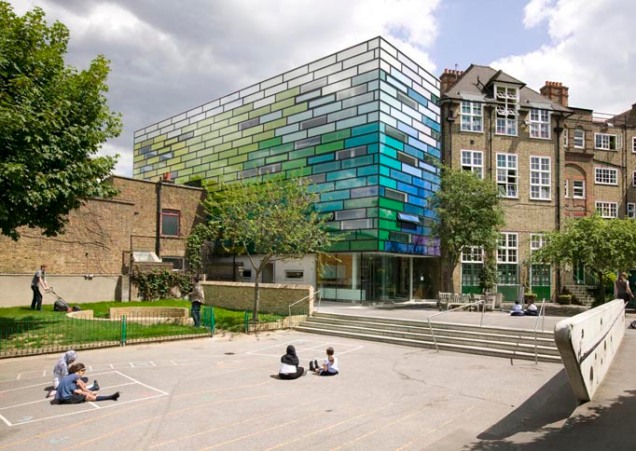
A new wing added to an existing Victorian school. No solar glass as far as I can tell, but the combinations of solid and fritted, on one hand, and clear and colored glass, on the other, allow for some environmental control.

de Rijke Marsh Morgan Clapham-Manor-Primary_04


Environmental education center El Captivador in Alicante, Spain

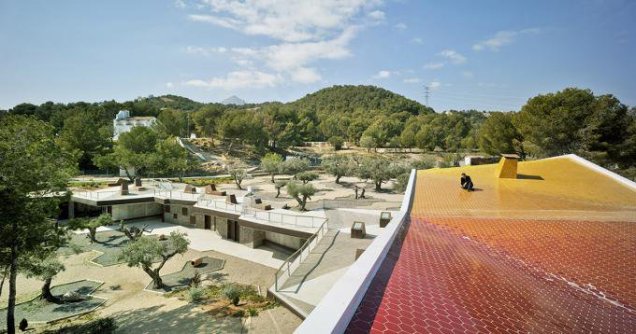
Designed by CrystalZoo, the roof tiles of the sustainably built environmental education center flow from bright reds via oranges to yellows.

Twitter CrystalZoo El Captivador


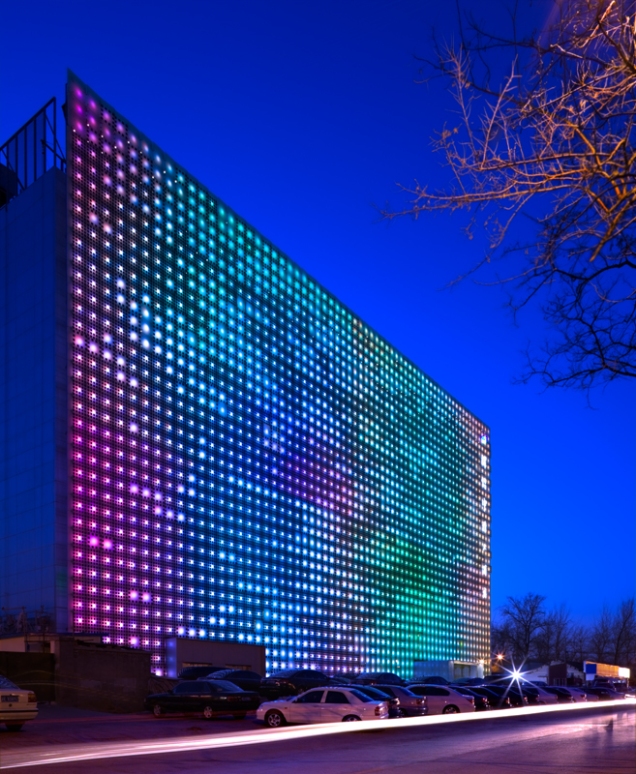
Xicui entertainment complex in Beijing, China

GreenPix, a photovoltaic Zero Energy Media Wall, built for the Xicui entertainment center before the 2008 Beijing olympics, was the largest color LED display in the world at the time.

GreenPix 00_08(c)SimoneGiostra-ARUP-Ruogu


Gare de Perpignan in Perpignan, France

An atrium with semi-translucent photovoltaic ceiling panels plus regular colorful glass (as far as I can tell).

Wikipedia Projet_BIPV_-_Gare_TGV_de_Perpignan


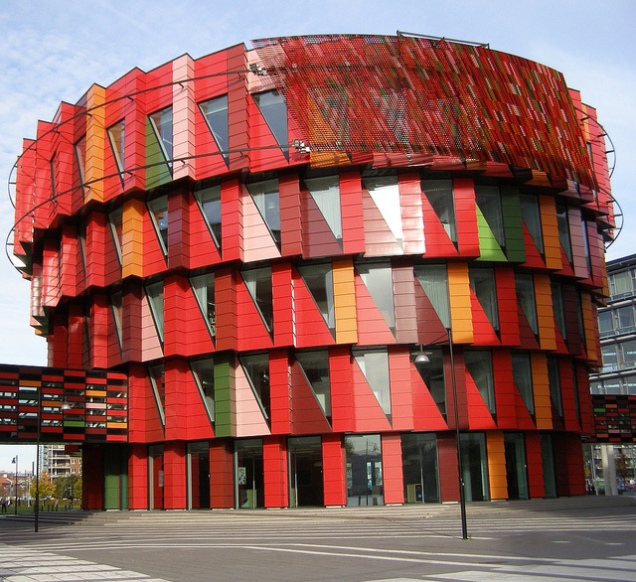
Kuggen building, Chalmers tekniska högskola in Gothenburg, Sweden

Designed by Winngårdh Arkitektkontor for the Chalmers University of Technology, Kuggen has a movable sunscreen and six floors, each shielding the floor below.

Flickr magro_kr Chalmers Kuggen


At the moment, it seems that next to cost, fairly low efficiency is the biggest problem with building-integrated photovoltaics. (Although, the efficiency problem might soon be solved.) Fortunately, both are something that SFF writers can easily deal with. 🙂

Images: External EPLF facade by Chris Blaser via Flickr, internal EPLF facade by RDR_FernandoGuerra via Flickr. Biochemistry building at U of Oxford by Andy Matthews on Flickr (CC BY-NC-ND 2.0). Clapham Manor school by Jonas Lencer / Philip Marsh Alex de Rijke via de Rijke Marsh Morgan. El Captivador by CrystalZoo on Twitter. GreenPix by Simone Giostra & Partners. Gare de Perpignan by Laurent Lacombe / Issolsa via Wikipedia (CC BY-SA 3.0). Kuggen by magro_kr on Flickr (CC BY-NC-ND 2.0).

The Visual Inspiration occasional feature pulls the unusual from our world to inspire design, story-telling, and worldbuilding. If stuff like this already exists, what else could we imagine?

“At Least It Made You Feel Something”

I have a rant.

There is one phrase I hate to hear more than any other from authors, scriptwriters, game designers, and other creative people: “At least it made you feel something.” It is a phrase that is sometimes trotted out when audiences voice hurt, anger, or annoyance over how a story that they were emotionally invested in turned out, and it is a load of crap.

We all understand that no story is going to satisfy all audiences. Good stories move us, and sometimes they move us to tears or to rage. Some people want stories to leave them angry or sad, and that’s as legitimate as wanting a story to leave you smiling. But a good story should not leave you hurt or annoyed.

There are good ways for creators to respond to upset audiences (which, I note, is not the same as responding to trolls—that’s a different game altogether). They can say: “I’m sorry, I’ll try to learn from this experience and do a better job in the future.” They can say: “This was the story I wanted to tell, but clearly it wasn’t the story you wanted to hear, so you should find a different story.” They can say: “I think this story matters and I don’t care that you didn’t like it.” All of these are appropriate responses. They are honest and respect the validity of peoples’ feelings, even the ones we don’t share. Even no response at all is perfectly acceptable; no creator owes their audience any engagement they don’t feel like giving.

But if a creator does choose to respond to criticism, “At least it made you feel something” is no kind of response at all. What’s wrong with it?

It sets the bar absurdly low

Good stories make us feel things, but that doesn’t mean that it doesn’t matter what a story makes us feel as long as it makes us feel something. To put it another way: if I kicked you in the shins, it would definitely make you feel something, but you would be perfectly justified in saying that that wasn’t the feeling you wanted.

It dismisses criticism

Criticism is legitimate. People have a right to have opinions about your story, whether you agree with them or not. Simply dismissing all criticism with “It made you feel something” denies that what your audience feels is just as relevant as how strongly they feel it.

It is self-congratulatory at best, selfish at worst

Reacting to an audience’s complaints with “It made you feel something” is a reach-around self-compliment. Even worse is if you actually take satisfaction in your ability to make others feel bad.

It betrays a lack of belief in the merits of the story

“It made you feel something” is close kin to “There’s no such thing as bad publicity.” In a social media world, creators may think that making their audience angry enough post online tirades about their work is the cheapest advertising they can get, but it is also a signal to the audience that the creators don’t care enough about their work or don’t have enough confidence in it to sell it on its own merits.

Stories often make us feel things. That is a huge part of why we read, watch, and play them. To open a book, watch a movie, or play a game is to entrust your feelings to another person for a time, and we have every right to speak up when we feel that our trust has been abused.

If what I feel about your story is hurt that you killed my favorite character, frustrated by the direction of the plot, or annoyed that you railroaded me into playing a villain, you don’t have to agree with me. You don’t have to take any account of my feelings at all if you don’t want to. But don’t waste my time with: “At least it made you feel something.”

Here endeth the rant.

Here there be opinions!

Quotes: To End That Was to End Their History, Their Present, Their Future

“All that was left of a person’s life was recorded on paper, in annals, in almanacs, in the physical items they produced. To end that was to end their history, their present, their future.”

– Aster Grey in An Unkindness of Ghosts by Rivers Solomon

…Which is why the attitudes and words of those writing our world’s history matter; why social sciences, humanities, and languages matter (and not just STEM); why diversity, inclusion, and empathy matter.

Solomon, Rivers. An Unkindness of Ghosts. Brooklyn, NY: Akashic Books, 2017, p. 327.

Serving exactly what it sounds like, the Quotes feature excerpts other people’s thoughts.