Turning Vinegar and Lobster Shells into Sustainable Bioplastic

Four Master’s students from the Royal College of Art and Imperial College, London, UK, have created a bioplastic from chitin combined with vinegar. This sustainable plastic can be manipulated to produce items of varying stiffness, flexibility, thickness, and translucence by adjusting the ratios of the base ingredients.

Instagram Shellworks Variety of Material Properties

Instagram Shellworks Bags Bubblewrap

Apparently, the material can also be turned back into the original bioplastic solution.

Shellworks is Ed Jones, Insiya Jafferjee, Amir Afshar, and Andrew Edwards. Their work is still at prototype stage, but it sounds like there is a potential for increasingly (if not utterly and entirely) recyclable, non-toxic plastic here. Sounds awesome!

Visit the Shellworks website or Instagram for more.

Found via Colossal.

Images: Variety of Material Properties by Shellworks on Instagram. Bags and bubblewrap by Shellworks on Instagram.

Out There is an occasional feature highlighting intriguing art, spaces, places, phenomena, flora, and fauna.

Wine and Sheep for a Princess

Administrative records from the Persian Empire preserve some evidence of a lady of the royal court gathering resources, probably in preparation for a feast:

A message to Yamaksheda, the wine carrier, from Pharnaces: Issue 200 marrish [about 2,000 liters] of wine to Princess Artystone. By the king’s order.

First month of the nineteenth year [March or April, 503 BCE]. Ansukka wrote the text. Mazara conveyed the message.

– Persepolis Fortification Texts (published) 1795

A message to Harriena, the herdsman, from Pharnaces: King Darius commanded me in these words: “Issue 100 sheep from my estate to my daughter, Princess Artystone.”

Now Pharnaces says: “As the king commanded me, I command you: Issue 100 sheep to Princess Artystone as the king ordered.”

First month of the nineteenth year [March or April, 503 BCE]. Ansukka wrote the text. Mazara conveyed the message.

– Persepolis Fortification Texts (collated) 6754

(My own translations.)

We can learn some interesting things from this evidence.

For one thing, it gives us a sense of how the Persian imperial bureaucracy worked. There were higher officials like Pharnaces who were responsible for overseeing the distribution of goods, scribes like Ansukka, messengers like Mazara, and lower officials in charge of particular categories of goods. Messages like these directed those who were lower down in the hierarchy to issue certain quantities of goods while at the same time keeping a record of what had been issued and where it came from.

Secondly, this is evidence for the scale on which elite Persian women could command economic resources. 2,000 liters of wine and 100 sheep cost no small amount of labor to produce. Artystone could, with her father’s consent, draw on the fruits of all that labor.

And finally: it looks like Artystone really know how to throw a party.

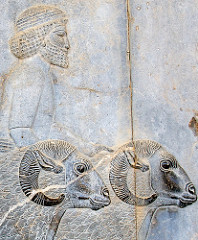
Image: Tribute bearer with rams, photograph by A. Davey via Flickr (Persepolis Apadana staircase; c. 518 BCE; stone relief). CC BY 2.0

History for Writers is a weekly feature which looks at how history can be a fiction writer’s most useful tool. From worldbuilding to dialogue, history helps you write. Check out the introduction to History for Writers here.

Celebrating International Women’s Day with a Captain Marvel Viewing

March 08 is International Women’s Day. Very appropriately, we are celebrating by going to see Captain Marvel!

IMDB Captain Marvel Eyes Horizontal

I’m hoping it’ll be as awesome as the trailers look!

To the people complaining that this version of Marvel is too political and therefore massively off-putting, I have only one thing to say.

(Long post warning.)

Read the whole post.

Rating: Murdoch Mysteries, Season 6

It’s another season of Murdoch for us to rewatch and rate. This one flies high at the beginning, then crashes and burns at the end. Here’s our take:

  1. “Murdoch Air” – 10
  2. “Winston’s Lost Night” – 6.5
  3. “Murdoch on the Corner” – 8
  4. “A Study in Sherlock” – 7
  5. “Murdoch au Naturel” – 7.5
  6. “Murdoch and the Cloud of Doom” – 6.5
  7. “The Ghost of Queen’s Park” – 6
  8. “Murdoch in Ladies’ Wear” – 2.5
  9. “Victoria Cross” – 5.5
  10. “Twisted Sisters” – 3.5
  11. “Lovers in a Murderous Time” – 3
  12. “Crime and Punishment” – 0
  13. “The Murdoch Trap” – 0

This is a remarkable season of Murdoch Mysteries, ranging from the very best the show has to offer to the very worst. The average for this season is only 5.1, which is the lowest yet for a season of Murdoch, but the average is deceptive since this season is half good-to-brilliant and half disappointing-at-best with not a lot falling in the middle range. It’s an odd roller coaster of a season, and, like all roller coasters, it eventually ends at the bottom.

That bottom is pretty darned low. “Crime and Punishment” and “The Murdoch Trap,” both rating a solid 0, make up a two-parter in which two of our least favorite things get combined: overly clever serial killers who get away with everything and artificial barriers thrown up by writers to squeeze more drama out of romantic angst. Darcy Garland, the multi-season speed bump to the blossoming relationship between Detective Murdoch and Doctor Ogden, suffers a character assassination this season as he goes from being reasonable and charming to being obstreperous and capricious, all for the writers’ increasingly desperate ploys to keep Murdoch and Ogden apart as long as possible. Rather than offer us something truly new and original on tv—reasonable adults dealing with complicated emotions with compassion, self-awareness, and generosity—the writers fall back on one of the most worn-out tropes of mystery fiction: have the offending interloper murdered by a genius serial killer who frames the detective. These are two episodes we will never be watching again.

But what a joy of an episode we get to start the season off with! “Murdoch Air” earns its full 10 rating with a thrilling opening, some great character moments, the return of the beloved James Pendrick, a dash of international intrigue courtesy of Myers and Clegg, and an exhilarating ending that has Murdoch soaring over Niagara Falls years before the Wright brothers got airborne. “Murdoch Air” has a little bit of everything that makes Murdoch so delightful.

There are a lot of other good episodes in the first half of the season, too, bringing us young Winston Churchill boozing around Toronto, a Sherlock Holmes impersonator with a mystery of his own to solve, an introduction to the turn-of-the-century nudist movement, and a poison-gas terrorist. On the other hand, you can skip the second half of the season and not miss much.

How did you like this season of Murdoch? Was the final two-parter right up your alley? Not thrilled by the airborne first episode? Let us know!

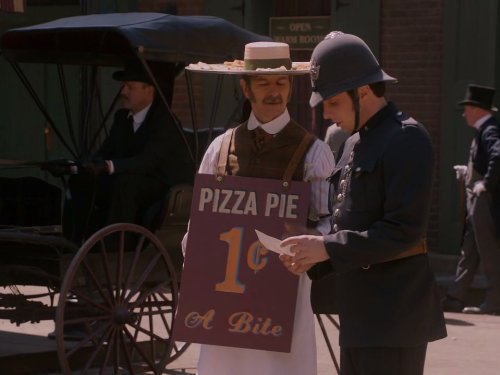
Image: Constable Crabtree trying pizza, from Murdoch Mysteries via IMDb.

In the Seen on Screen occasional feature, we discuss movies and television shows of interest.

Quotes: You Can Be Warm and Vulnerable with People You Trust

Some power reading on gender and power, especially at Anglo-American financial companies:

“My Kleiner colleagues said that I sucked the air out of the room, that I ‘wasn’t the warmest person.’ Now [after leaving] I’m told the opposite. I’ve thought a lot about how I was accused of being cold and unlikeable at Kleiner. Looking back, maybe I was. But it wasn’t because I’m a cold person. It was because I needed to have my guard up all the time. You can be warm and vulnerable with people you trust, not with those who you know are trying to keep you down.”

– Ellen Pao

Current Reading Reset

I can attest from personal experience, even if not in the same environment.

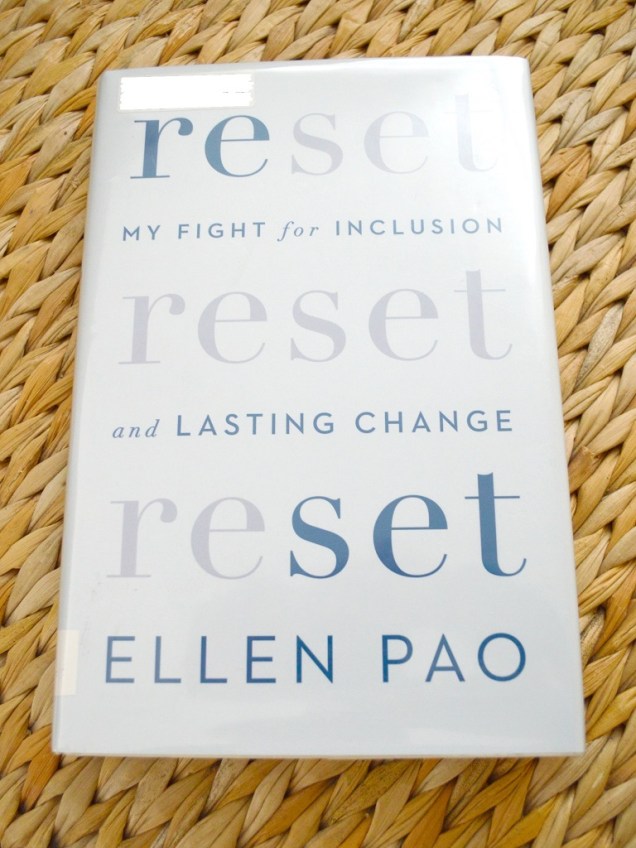
Pao, Ellen. Reset: My Fight for Inclusion and Lasting Change. New York: Spegel & Grau, 2017, p. 259.

Image by Eppu Jensen

Serving exactly what it sounds like, the Quotes feature excerpts other people’s thoughts.

An Updated Game of Thrones Hotel Made of Snow and Ice

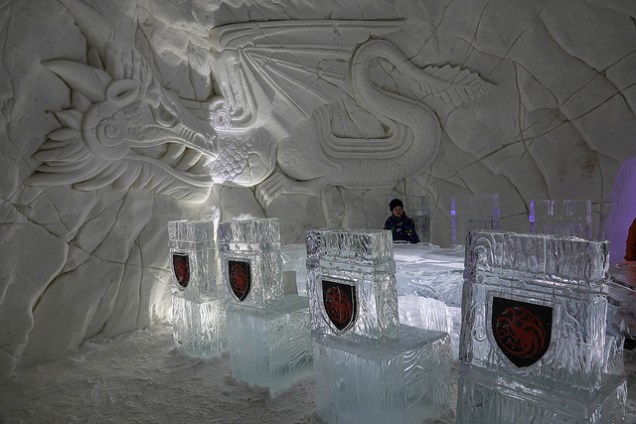
The Snow Village hotel in Kittilä in Lapland, Finland (which I blogged about last year), updated its Game of Thrones scenery for the 2018-2019 season.

Flickr Timo Kytta GoT Dining Room

As previously, they’re collaborating with HBO Nordic. This year’s snow and ice sculptures cover seasons 1-7 of the GoT tv series.
Instagram Snow Village Baratheon Bedroom

Instagram Snow Village Three-eyed Raven

Like their previous GoT creation, it looks absolutely amazing! Check out more and/or follow Snow Village on Instagram, Twitter, or Facebook.

Images: Dining room by Timo Kyttä on Flickr (CC BY-NC-ND 2.0). Baratheon bedroom via Snow Village on Instagram. Three-eyed raven via Snow Village on Instagram.

Out There is an occasional feature highlighting intriguing art, spaces, places, phenomena, flora, and fauna.

Some Random Thoughts on Aquaman

We were late to see Aquaman, but here, finally, are some random thoughts in no particular order.

Spoiler warning very much in effect!

IMDb Aquaman Comic-Con Poster

  • First of all: visually, it was a feast! In the theater while waiting for the movie to start, Erik mentioned he’d read somewhere someone say that Aquaman will change the way movies are expected to look for this generation the same way (I assume the original) Star Wars did for previous generations. I’d fully believe it: so many different effects and environments, all polished off to a regal shine (if you’ll pardon me for being corny for a bit). I’d also say this: while the SW prequels attempted to shower the audience with rich sets and visuals, they ultimately just didn’t reach the level of breathtaking; Aquaman (and Moana, Rogue One, and SW:XIII) actually succeeded.
  • The character Tom Curry (played by Temuera Morrison), the lighthouse keeper, looked Polynesian and sounded like a Kiwi. For a character who’s supposed to be a Mainer that was a bit of a whiplash. Then again, the world is more international these days than ever before.
  • Speaking of Maine and lighthouses, even I could tell there were too few trees in the “Maine” scenes. It looks like they were filmed in Newfoundland, so that would explain it. Other than that, the supposedly northern locations looked at least plausible—the rocky coast looks just right, in fact—so a plus for that. (I’m the kind of northener who happens to care whether my home is misrepresented or not.)
  • I’ve never read the comics, so I have no idea which plot elements came from where; I can’t comment from that point of view. (Literally, what I knew is Raj from The Big Bang Theory saying “Aquaman sucks!”) With that caveat, at first I was merely amused by the mixing of the Atlantean and Arthurian legends, but they kinda made it work. The antagonist’s father-son-tragedy-as-backstory was unfortunately tiresome, but at least it was given to black people, plus Yahya Abdul-Mateen II really rocked as Manta. (I’m so sick of seeing middle-aged white men wrangling with son guilt. Hey Leverage—I’m talking about you especially!)
  • The Tom-Atlanna romance was seemingly set up exatly like the dime-a-dozen action movies that have come before: man meets woman, she blows his mind with her awesomeness, they fall in love only to have him lose her In Order to Have Feelings(TM). Thankfully, Aquaman not only didn’t follow the trope through, it subverted parts of it: instead of dying, Queen Atlanna thoroughly wiped the deck with the team sent to bring her back to Atlantis (while he protected their child, Arthur, having correctly determined that her enhanced abilities would allow the family to survive—I just LOVE smart, self-confident, genuine, non-egotistical men). After the attack, Atlanna decided she’d better return voluntarily to protect Tom and Arthur, and subsequently was reported to have been sacrificed to a Verifiable Monster of the Deep, again making it look like the plot fridged her to give Tom the Official Permission to Wallow, but no—towards the end, we find out she not only survived, but carved a haven for herself and joined Princess Mera and Arthur in their quest for the super trident.
  • In the same vein, the Mera-Arthur romance was foreseeable and dull. At least the movie gave her the initiative unlike so many prior Hollywood stories.
  • Surprisingly, I didn’t mind Nicole Kidman as Atlanna.
  • Hairwise, surprisingly many characters kept their long hair loose even underwater. I would’ve thought it would be in the way too much, at least for the guards and other fighters. Mera’s hair was too red for my taste (The Little Mermaid, anyone?), but Vulko (played by Willem Dafoe) had quite a cute man bun/thing.
  • Overall, I felt that characters didn’t fare that well, unfortunately. Apart from Atlanna and Mera, I can’t remember any other women having more than a line, if that, except for the Fisherman Princess (and that’s really pushing it, too). Why is is that the only women being shown as active, rounded-out people instead of plot-relevant placeholders* are royalty? Not to forget the many mer-men who barely got defined as individuals. The creators clearly made a choice to focus on the story and visuals instead of characters. I’d rather see great characters AND great story, preferably with knock-out visuals, too; that’s why I love Black Panther so much.
  • I found the five underwater kingdoms that separated from the original Atlantean culture quite cliched, flat, and underdeveloped. Looks like developing the visuals took precedence indeed.
  • And wow—the Verifiable Monster of the Deep was monstrous!
  • And whatever else you might say, Aquaman really was epic. That said, some of the power poses approached ridiculous, but I suppose that happens easily when adapting superhero comics.
  • The final fight between Manta plus his goons and Mera plus Aquaman happened in a small seaside town in the Mediterranean, and it was inventive and not too predictable. However, we last see Manta plunging into the water from a cliff, bouncing off the rocks in the process. Now, one of my pet peeves is when a protagonist survives repeated and super violent hits, shakes, car crashes, what have you, because no matter how well a human body may be armored, your brain can still whiplash inside your skull, and that, as I understand, is really the life-threatening aspect of being hit too hard on the head. I thought that was it for Manta after his plunge and felt pleased Aquaman avoided yet another trope, but no—in a stinger, we see him drag himself to the shore. Argh!

Did you see Aquaman? What did you think?

Image: Aquaman Comic-Con poster via IMDb.

*) The delightful term plot-relevant placeholder is from a review by Liz Bourke—thank you!

In the Seen on Screen occasional feature, we discuss movies and television shows of interest.

2-Hour Fan-Made Pokémon Musical Online

Any Pokémon fans here? This might be of interest.

In 2016, a group of dedicated fans in Finland created a musical based on Pokémon games, toured the country, and uploaded a two-hour video of the live performance online:

“Valitsen sinut! -musikaali (I Choose You! The Musical) is an entirely fan-made musical based on Pokémon games Red, Blue and Yellow, as well as the first season of the anime. Behind the project there is a volunteer team of 50 people, and the musical toured Finland in 2016, the 20th anniversary of Pokémon.

“We’re not affiliated with Nintendo or Pokémon Company in any way. No one was paid for the project, and our crowdfunding was used fully for creating the musical.”

Valitsen sinut! -musikaali on YouTube

The performance is entirely in Finnish, but English subtitles are available on YouTube.

So far, I haven’t seen more than a few minutes from the beginning. Looks like the performers were really motivated, though, and enjoyed themselves. Really cool. I’ll have to carve time to see the whole. Mahtavaa!

In the Seen on Screen occasional feature, we discuss movies and television shows of interest.

I Miss Episodes

I turned 40 last year, and I think it’s starting to affect me: I’m beginning to feel the urge to rant about kids these days and how everything was better when I was young. So be warned, there is some curmudgeonliness ahead, but I do have a point here.

I’ve been thinking lately about why I find a lot of contemporary tv so unsatisfying. It’s not that tv shows are bad now. It’s been aptly said that we live in a golden age of television. Freed from the constraints of syndication and network time slots, modern shows have dared to tell bigger, more complicated stories. The proliferation of cable channels and online services producing their own original content has meant a chance for a wider range of productions, from big-budget crowd-winners to oddball side projects. All of this is to the good.

At the same time, we’ve lost something in the modern approach to tv-making: episodes. It used to be that a season of a tv show was one or two dozen short stories, each told over the course of an hour or half hour (or twenty to forty minutes, on commercial television). Nowadays, a season of television is a ten-hour movie with arbitrary breaks for theme music. Stories are not told in an episode but slosh over to the next hour or two before there’s any resolution; meanwhile, another story has started going at the same time and continues to slosh forward on its own. Every tv drama has now become a soap opera.

I miss shows that had actual episodes, each a story unto itself with a beginning, rising action, climax, and denouement all in one sitting. As much as that format could sometimes be limiting, it also had its artistic virtues. It forced the action to move along at a brisk pace. It created a sense of urgency that shaped the storytelling. There was a feeling of satisfaction that came with watching the problem of the episode be resolved. Modern shows tend to wallow in characters’ unresolved feelings, pad their running time with filler, and dive down narrative dead ends, much of which would have been cut short in properly episodic television.

Of course, lack of satisfaction is the point. Now that we can stream any show we want any time we want, the economic pressures have changed. Rather than keep us coming back every week to see more commercials, the business imperative of tv is now to keep us from clicking away to another streaming service. While new content models have freed tv from some artistic constraints, they have imposed new ones that are just as limiting. It is now tv’s job to never give us satisfying endings lest we wander off to do something else.

I do appreciate tv shows that have continuity and ongoing stories. I wouldn’t want to go back to the days when the end of an episode meant a complete reset back to status quo ante, but continuity can coexist with episodes. Shows of the 1990s like Star Trek: Deep Space Nine, Babylon 5, X-Files, and Stargate pulled it off. In these shows, episodes mostly told self-contained stories, but they also remembered what had happened in previous episodes. Characters grew and changed, major plot twists had ongoing consequences, and big multi-season arcs played out a piece at a time, and yet when the credits rolled at the end of an episode, you still had the satisfaction of a resolution.

I wish we had more shows like that these days.

Here there be opinions!

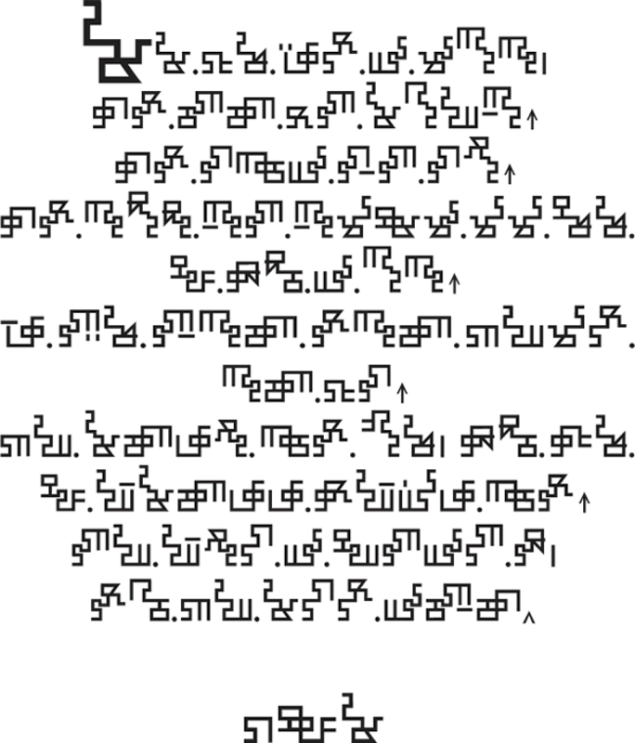
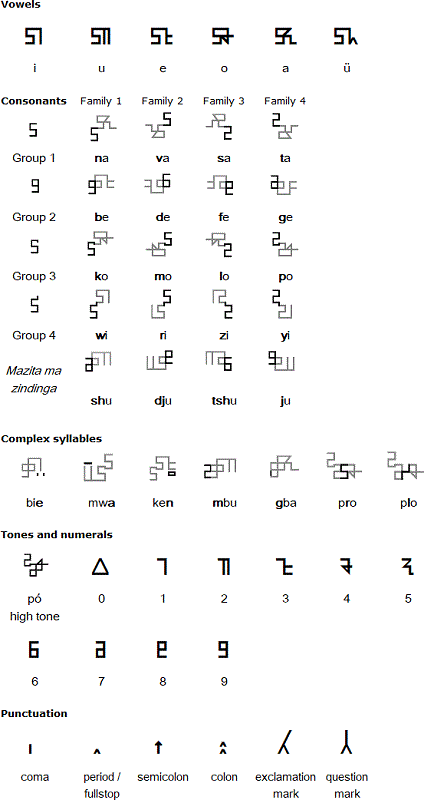
An Example of the Infinite Possibilities of Writing Systems: Mandombe

I recently came across Endangered Alphabets, a Vermont-based nonprofit organization engaged in “preserving endangered cultures by using their writing systems to create artwork and educational materials”.

An article in Colossal pulled several examples from the Endangered database. The most striking of them, I thought, was Mandombe. It was created about 40 years ago by David Wabeladio Payi. His work was influenced by the look of a brick wall and a wish to connect the direction a shape pointed with pronunciation.

Endangered Alphabets Mandombe-script-example Sm

Apparently, Mandombe is based on consonant and vowel graphemes, but they are organized into syllabic blocks (like written Korean) instead of word-length units.

Endangered Alphabets Mandombe Script Table Sm

Today, Mandombe is taught in Angola, the Republic of the Congo, the Democratic Republic of the Congo, France, and Brussels.

Wikipedia Mandombe Book Sm

Isn’t it fascinating?

P.S. Did you know that the United Nations declared 2019 The Year of Indigenous Languages (IY2019) in order to raise awareness of the thousands of languages that are in danger of disappearing? Also, go ahead and visit the gallery or atlas at Endangered Alphabets for even more eye candy!

Images: script sample and table via Endangered Alphabets. Mandombe book via Wikipedia.

The Visual Inspiration occasional feature pulls the unusual from our world to inspire design, story-telling, and worldbuilding. If stuff like this already exists, what else could we imagine?