Living Vicariously Through Social Media: Exact Opposites Cats

Seriously, this is amazing: a pair of cats. One black, the other white. One has a blue left eye and a green right eye, the other a green left eye and a blue right eye.

Twitter Land of Cuteness Exact Opposites Cats

Granted, this is the Internet, and Photoshop is a thing. (And please note I didn’t intend to post this as an April Fool’s joke. As far as I know it isn’t, but as I said, this is from the Internet and who really knows.)

However, even if it were edited, it’s still a damn awesome photo. I immediately thought of a magic-user’s familiar or some such special pet. Wouldn’t cats like these be just astounding?

Found via Land of Cuteness on Twitter.

Out There is an occasional feature highlighting intriguing art, spaces, places, phenomena, flora, and fauna.

Teaching in a Pandemic 3: Grades Mean Nothing

(Read previous entries here and here.)

So far, it’s going okay. I have started posting introductions and discussion questions for the blocks of content that my students will be covering for the rest of the spring. Across all my classes, there will be a total of twelve blocks for students to read and respond to. Prepping one block takes me about two solid days of work. I have posted five so far, with seven left to go. Allowing time for housework, fresh air, cooking, and other essential things, I’m probably looking at between two and three weeks more of work to get everything online. Then I’ll be spending the rest of April grading assignments as they come in and keeping an eye of the discussion forums.

Students have started engaging in discussion already. Only a few so far, but that’s understandable. I know everyone is busy right now and it’s going to take people time to get used to new ways of doing things. Responses have been productive. Students are engaging with the ideas I want them to engage with and showing that they have done the new readings and can relate them to ideas we discussed earlier in the semester. That’s as much as I feel I can ask of them right now.

I’m holding virtual meetings with my classes this week via Zoom (videoconferencing service). Not to teach anything new, just to check in with them, go over the procedure for the rest of the semester, and answer their questions. I’ve let everyone know that these meetings are entirely optional, and there will be no negative consequences if they don’t join in. I hope a lot of them will show anyway. I miss seeing them, and I’d like to know that they’re okay.

The big question hanging over all of this is: what will happen to this semester’s grades? As I mentioned last time, the university administration is considering the possibility of shifting to a pass/fail system for this semester, or of giving students the option to individually take courses as pass/fail. Nothing is certain yet, but clarity will hopefully come soon. I’m divided on whether I think it’s a good idea or not. On one hand, there is no way to treat this semester like an ordinary spring or to imagine that the grades students get at the end of it are really comparable to their grades form other semesters. A lot of my students are in difficult situations right now, and going pass/fail might take a burden off their shoulders. On the other hand, implementing such a big change on the fly is going to be a mess, and I worry about people falling through the cracks in a system that none of us have had time to think through and shake the bugs out of.

You see, the secret truth about teaching is: grades mean nothing. Or at least nothing much. A grade is never anything more than your professor’s best attempt to convey to you how well they think you have understood what they were trying to get you to see, and there is no objective way of measuring that. Even in disciplines that have clear right and wrong answers, the decision about what questions to ask is still fraught with human subjectivity. Good and conscientious professors will try to use their grades as a way of communicating honestly with you about what you have accomplished during your time in their class, but the whole thing is an eggshell balanced on top of a rickety shack built on quicksand. You don’t have to stir the sand much before everything breaks.

Let’s hope we don’t break things too badly and we can find a way of doing right by our students.

Image by Erik Jensen

How It Happens is an occasional feature looking at the inner workings of various creative efforts.

Quotes: I Don’t Like You

Before there was the tweet, there was the epigram. The Roman poet Martial was an expert at this art form of highly-condensed snark. Here are a few of his best bits (my own translations):

I don’t like you, Sabidius, and I don’t know why.

All I know is: I don’t like you.

– Martial, Epigrams 1.32


You ask what I get from my farm in Nomentum, Linus?

This is what I get: not seeing you.

– Martial, Epigrams 2.38


Zoilus, why are you soiling the bathtub by washing your ass in it?

If you really want to make it filthy, go soak your head!

– Martial, Epigrams 2.42


Serving exactly what it sounds like, the Quotes feature excerpts other people’s thoughts.

Quotes: People Will Fight for the Idea of Decency

This quote from Kameron Hurley’s The Light Brigade seems pretty apt for the covid-19 pandemic in the west:

“[Companies] started losing when they forgot how to be decent. People will fight for the idea of decency. They will fight for someone who treats them like people. They fight for beliefs far longer and harder than out of fear.”

– Dietz in Kameron Hurley’s The Light Brigade

So let’s treat each other as people. Because we’re in this together; health care experts don’t talk about herd immunity without reason.

Because we’re only in the beginning of it; even the most optimistic models don’t predict the peak to occur very soon.

And because we’re social critters, descendants of people who liked other people despite their origin or color or dance moves or whatnot. We’re here because we like doing things together. (And I realize how funny that may sound coming from a huge introvert such as myself, but there it is.) At each individual’s preferred amount of togetherness, but together nevertheless.

Hurley, Kameron. The Light Brigade. New York: Saga Press, 2019, p. 141-142.

Serving exactly what it sounds like, the Quotes feature excerpts other people’s thoughts.

Teaching in a Pandemic 2: Students Are Stressed Enough Already

(Read my last entry here.)

Just a day after my last post, the university administration announced that all classes are going online for the rest of the semester, so I have spent much of the past week figuring out how that’s going to work. I started with a few basic principles and worked my way on from there. Here’s what I started from:

  1. Everything sucks right now, and it probably sucks worse for my students than it does for me. I want them to have a meaningful educational experience, but I don’t want to add to the burden of what they’re already dealing with.
  2. Different students are dealing with very different situations right now. Some of them are relatively safe and calm; their lives have not changed much. Others are back in the midst of bad or stressful home lives from which college was an escape. Some of them have plenty of time and technology on their hands; others are lucky to get a few hours to themselves and have a dodgy cellphone connection to the outside world at best. My course needs to work for all of these students.
  3. My students are good students. They want to put in the work that I am asking of them and do well. If they are struggling right now, it is a reflection of their circumstances and the failures of the larger governmental, social, and educational infrastructure they live within, not of their willingness or ability to learn.

Putting these basics together, I have made the following decisions about my courses:

  1. I will not require anyone to be available at any particular time. I will miss our face-to-face interactions in the classroom, but trying to recreate that experience online is doomed to fail and will only put unnecessary stress on my already stressed students.
  2. I will not require any work that depends on having a stable internet connection and plenty of bandwidth. As long as people can get online occasionally, that should be enough.
  3. I will not hold anyone to more stringent due dates than are absolutely necessary for me to be able to fully and thoughtfully review their work before giving grades.

From these fundamentals, I have decided how my online courses will work.

Instead of the rest of the semester being divided into class days with their own readings and assignments, I have divided the remaining content into large blocks organized around a common theme. Each block represents a week or so of what we would have done in class. Students can now do the readings on their own time, and I am writing short introductions (covering the ideas I would have been introducing in class discussion) with broad, open-ended discussion questions attached. These discussion questions are posted online as discussion threads on Canvas (our course management website). Between now and the end of the semester, I am asking every student to make at least two comments in the discussions for each block. Participating in the discussion threads is counted as part of the attendance and participation grade for the course.

In addition to the discussions in the blocks, students have most of the same writing assignments that were scheduled before we moved online, but I am shifting their due dates to the end of the semester, so that everyone can get their work done at their own pace. I have dropped a few assignments that seemed overly burdensome: those that involved library research (because, even though there’s a lot you can do online these days, it seemed like too much pressure), or visiting museums (because, I mean, duh).

These changes have meant rearranging the grading standards for some courses, which is tricky, but I’ve tried to make sure everyone still has plenty of opportunities of getting good grades. The university administration has made some vague noises about shifting courses to pass/fail grading for this semester, but no decision has been made yet. On the one hand, going to pass/fail would make my job a lot easier—I could give most of my students their course grades right now. On the other hand, some of my students have been putting in a lot of time and effort, and it would be sad not to be able to reward them with the grades they’ve earned. Well, we’ll see what comes of it.

I can’t say with any honesty that I know how the rest of this spring is going to go. We’re all making it up as we go along. I have confidence in my students. They are strong, smart, and hard-working, and I want to see every one of them come out of this experience okay.

Image by Erik Jensen

How It Happens is an occasional feature looking at the inner workings of various creative efforts.

A Rich Anglo-Saxon Burial Chamber Found in Essex

A new-ish Anglo-Saxon burial chamber found at Prittlewell in Southend-on-Sea, Essex, in southern England has all of the markings of a valuable find, both in terms of quality and quantity of the grave goods and of historical significance.

The male body was placed within a wooden coffin in a timber room. The burial most likely dates to the late 6th century (575-605 CE). It was first discovered in 2003 in remarkably good condition.

MOLA Prittlewell Burial Chamber Drawing

Artefacts from the burial were studied at Museum of London Archaeology (MOLA), and the most impressive items are now on permanent display at Southend Central Museum in Southend-on-Sea. MOLA has also created an interactive website for the find.

Just some of the items discovered include a gold belt buckle, two Frankish gold coins, a beautiful sword, iron-bound buckets, a huge metal cauldron, latticed glass beakers, a tall iron candelabrum, a folding iron stool, a basin and a flagon made from copper alloy, a silver spoon, a painted wooden box, and an Anglo-Saxon lyre.

MOLA Prittlewell Blue Glass Decorated Beaker

Incidentally, the wooden box is so far the only surviving example of painted Anglo-Saxon woodwork!

MOLA Prittlewell Painted Wooden Box

MOLA The Guardian Prittlewell Gold Copper Item Collage

There are two interesting implications for the burial. Firstly, two gold foil crosses were likely placed on the body’s eyes. If the burial can indeed be placed at its earliest possible date, it makes the connection to Christianity remarkable because it would predate Augustine’s mission to convert the British in 597. A royal connection has been surmised (Seaxa, a younger brother of king Sæbert of Essex, whose mother Ricula was Æthelbert of Kent’s sister) but not confirmed.

(King Æthelbert of Kent married a Merovingian Christian princess called Bertha in 580, so Roman Christianity was known to Anglo-Saxons to some degree by the end of the 6th century, but to my knowledge we had previously not known of other converts outside their court prior to 600.)

Secondly, although Essex has earlier been seen as an Anglo-Saxon backwater of sorts, this rich burial chamber suggests otherwise. Indeed, some of the luxury items come from the near-by continental Europe (the Frankish gold coins), but others have much more far-reaching origins (the Byzantine or Syrian copper alloy flagon, for example).

Having studied Anglo-Saxons myself and witnessed Erik’s research on the side, I keep being amazed at how much paraphernalia is extant from the Roman period and early middle ages onwards. Not only that, but how much of it is still being discovered! If you tour any of the major museums of Roman history in Germany, for example, you will see massive (massive!) amounts of metalwork, gold, silver, glass, and pottery. And what’s on display doesn’t even account for the remnants in storage.

People from old cultures had as large incentives as we do today to dress up and surround themselves with ornate household goods—after all, we are humans who like their stuff, right? Their ability to do so naturally depended on the resources available in the area and era, and—despite what most of us seem to have been taught—early history is full of times when our predecessors were able to produce items on a massive scale and the richest in those societies did have the wherewithal to go all out.

Like the Staffordshire helmet, the Prittlewell burial will be of immense importance to our understanding of Anglo-Saxon history and culture. I’m so delighted it was found!

Images by MOLA; collage of the gold and copper alloy items by MOLA via The Guardian.

Out There is an occasional feature highlighting intriguing art, spaces, places, phenomena, flora, and fauna.

Teaching in a Pandemic 1: Nobody Knows Anything

I’ve decided to use this space to chronicle my experience teaching college classes during the covid-19 pandemic. I can’t promise how interesting this will be to anyone else, but here’s a glimpse inside the process.

We’re still in the first few days of the officially-declared pandemic, and nobody knows anything right now. The federal response in the US has been just about useless. Actions at the state and local level have been more coherent, but we still don’t really know what the next few weeks or months are going to look like. Will we be stuck at home? Limiting our social contacts? Returning to business as usual? Lining up for tests? Hunkering down under quarantine?

The university has not been much help either. Classes have been canceled for a week, in addition to spring break, but no one knows what comes next. We’ve been told to prepare for possibly teaching our classes online. Or not. Or only for a few weeks. Maybe. They’ll tell us later. Maybe.

Now, I don’t envy the administrators who have to make the call about whether to massively disrupt thousands of people’s plans for the next two months or to put those same thousands of people at risk of contracting and spreading a deadly virus. I understand why they’re hesitant to make a decision at this point, but it really isn’t possible to make any plans when I have no idea what I should actually be planning for.

In the absence of any clear direction from the top, I’m thinking of making a decision on my own. I’m thinking that I will plan for all my courses to run online for the rest of the semester. Then, if in-person classes do resume, I’ll make them optional, because I know some of my students have personal or family health concerns, and I don’t ever want to put anyone in a position of choosing between their grades and their or their relatives’ health.

The big problem is: how, exactly, do I do that? I have some colleagues who have taught online and done it very well, but their experiences don’t exactly translate: those were planned online courses that they had months to prepare for, and every student knew what they were signing up for. That’s a long way from cobbling together half a course on two weeks’ notice for students who weren’t planning on taking an online course. I have no idea what kind of technology my students have available to them or what their own living situations right now allow in terms of time and resources, and I have never even thought about teaching online until a few days ago.

The one good thing to emerge so far from this confusion is that I have had to spend some time thinking very seriously about what I want students to get out of my classes, so that I can focus any online teaching on those elements. It’s been a useful exercise. Of course, I have spent plenty of time already thinking about what students should take away from my classes (I’m an ancient historian—having to explain to other people why my field is worth studying is an occupational hazard), but I’ve never tried to distill half a course to its fundamental essence before.

I’m teaching three different courses this spring: Classical Tradition (a broad history of the art and literature of ancient Greece and Rome), History of Rome (from the foundation of the city to the end of the western empire), and Roman Law (an intensive course on legal reasoning—mostly using Frier’s casebook on delict, for those of you who know what that means). Classical Tradition is an introductory-level course mostly for non-majors, History of Rome is a mid-level course with a mix of majors and non-majors, and Roman Law is an advanced course mostly for majors, especially those in the pre-legal track.

We’ve already covered more than half the material for each course. From what’s left, I’ve tried to extract the most important questions I want my students to grapple with:

Classical Tradition: Why did new religious movements, like Christianity, the cult of Isis, Mithraism, and Islam, emerge out of the context of the Roman imperial frontier? Why did some of these movements thrive while others foundered? How did the followers of these movements engage with, repurpose, challenge, or reject the artistic and literary legacy of Greece and Rome?

History of Rome: How did the Roman Empire reach some level of stability in the second century CE? Why did that stability fail in the third century, and why couldn’t it be recovered afterward? What choices did people living in, at the edge of, and outside the empire make in response to these changes?

Roman Law: What’s the most effective way of getting away with murder if your weapon of choice is a live bear?

Okay, I’m kidding about that last one, but not by much—that is exactly the kind of bizarre hypothetical that we often argue over in class. Hard cases, as they say, make bad law, but weird cases are the ones that really show you how the logic of the law works and where its limits lie.

A little more prosaically,

Roman Law: How did the Roman jurists try to construct a logically consistent set of rules that could cope with the vagaries and inconsistencies of Roman society?

Now all I have to do is figure out how to give my students some meaningful way of engaging with these questions online instead of in guided classroom discussions.

I’ll check in later and let you know how it goes.

Image by Erik Jensen

How It Happens is an occasional feature looking at the inner workings of various creative efforts.

Second and Last Black Widow Trailer

Under two months to go to the Black Widow movie, and we have a second trailer.

Marvel Studios’ Black Widow | Final Trailer by Marvel Entertainment on YouTube

There are a few more clues of the Taskmaster character. He apparently has taken over the Red Room and somehow brainwashed / controlled a number (a class?) of Widows. Nat is shown connecting with her first found family, with some amusingly (and painfully) familiar bickering at the dining table. Since trailers always lie, I’m hesitant to call the writing good on the basis of what we’ve seen so far, but I’m cautiosly optimistic. Just, please, let it not be utter crap (like so many female-lead superhero movies of yore have been).

Otherwise, from the filming or type of action shown, somehow I get a similar wibe as Winter Soldier. As that’s one of my favorite MCU stories, this is a good thing. 🙂 Also, I’ll be glad to see northern European neoclassical cityscapes; it reminds me of home.

Black Widow opens May 01, 2020.

Hey, look! We found a thing on the internet! We thought it was cool, and wanted to share it with you.

LightSail 2 Spacecraft Is Successfully Driven by Solar Sails

Have you guys heard of the LightSail project?

The Planetary Society LightSail 2 Australia New Guinea

Run by The Planetary Society (the world’s largest private non-profit space organization), LightSail is a crowdfunded project that successfully launched a solar sail driven spacecraft into Earth orbit in June 2019 in an effort to lower the cost of space exploration.

While not the first spacecraft to successfully use solar sails, LightSail 2 has managed to slow down the deterioration of its orbit and on occasion to reverse drag created by the atmosphere and correct course. Indeed: one of the mission’s functions is doubling as a probe of far-atmospheric thickness.

LightSail 2 deployed its solar sail in July 2019, and has been sending data down to Earth since then. Access the LightSail project page or LightSail 2 mission control for some interesting browsing.

Really cool, isn’t it?

Image: Australia and New Guinea from LightSail 2 by The Planetary Society (CC BY-NC 3.0)

Out There is an occasional feature highlighting intriguing art, spaces, places, phenomena, flora, and fauna.

The Vivid Colors of the Dome of the Rock

We often picture history in muted terms, at least in the West. We think of the white marble statues of Greece and Rome, the gray stone of medieval castles, the dull brown cloth of historical costumes. It can be hard to remember how much color has been lost to age, weathering, even deliberate destruction. (A few useful examples here and here.) For an alternative view, it helps to look at examples that go far back in history but have been maintained and restored. One good example is the Dome of the Rock in Jerusalem.

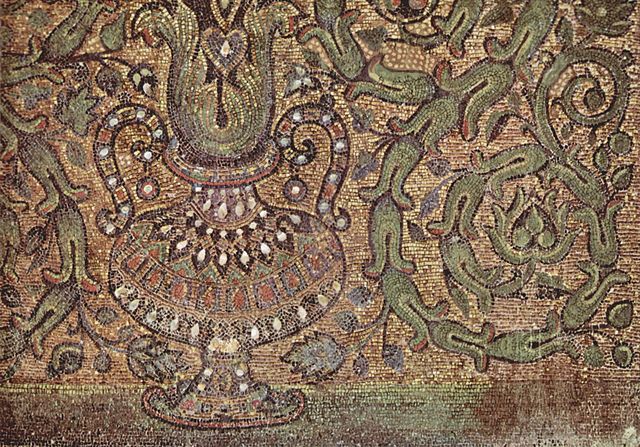
Originally completed in 692 CE, the shrine has continued to be an important Islamic site ever since. Its original design was colorful, and in the following centuries it was elaborated with tiles, mosaics, and metalwork. Several major restoration projects in the past several centuries have kept the colors vibrant. While individual details of the decor may not go back to the original construction, the overall effect gives us a sense of how richly colorful the built environment of the past could have been.

Tiled exterior wall of the Dome of the Rock, photograph by Godot13 via Wikimedia (Jerusalem; construction 692, tiles restored 1552; glazed tile; tiles by the workshop of Abdullah Tabrizi)


Interior mosaic, photograph by the Yorck Project via Wikimedia (Jerusalem; originally 692, later restored; glass, mother of pearl, and stone mosaic)


Dome interior, photograph by Virtutepetens via Wikimedia (Jerusalem; originally 692, later restored; metal and enamel)


The Dome of the Rock was a monument that was meant to make a statement. Other buildings of the time were not necessarily so dizzyingly colorful, but the shrine preserves a variety of visual culture we have very few other examples of. Even if nothing else exactly like it was ever built, many buildings once existed with just as bright an array of colors that are now long gone. When imagining what places in the past might have looked like, or when imagining new worlds inspired by them, remember that gray stone and white plaster are not the only options.

History for Writers looks at how history can be a fiction writer’s most useful tool. From worldbuilding to dialogue, history helps you write.