Quotes: A Human Being with Hope Can Continue on Far Longer

In The Light Brigade, what I consider her most mature work yet, Kameron Hurley gives her protagonist Dietz this monologue about hope’s role in shaping human behavior:

“There’s a huge mental release in knowing there is an end to pain. A human being with hope can continue on far longer than one without. Did you know those who are mildly depressed see the world more accurately? Yet they don’t live as long as optimists. Aren’t as successful. It turns out that being able to perceive actual reality has very little long-term benefit. It’s those who believe in something larger than themselves who thrive. We all seem to need a little bit of delusion to function in the world. That belief can be about anything, too. Could be a god, a corporation, a society, like our various militaries instill. A sense of belonging. Could be national pride. Or the desire to make the world a better place. Or see the world burn. Personal or political. But … something bigger. Something greater.”

– Dietz in Kameron Hurley’s The Light Brigade

We’re six to seven months into the covid-19 pandemic, depending on your definition of the epidemic start date in the western world. I could use some mental release right about now, and I know I’m not alone.

Alas, as far as we know, nothing specific is in the pipe to be released very soon. But there is hope!

Obi-Wan Patience

The good news is that by all accounts SARS-CoV-2 will respond to a vaccine. The bad news is that we need to wait and be patient, stay home as much as possible; and when we cannot, keep a safe distance, practice good sneezing hygiene, wear masks, and wash our hands.

Star Wars Stay on Target

Stay on target. Stay safe. We will prevail.

Hurley, Kameron. The Light Brigade. New York: Saga Press, 2019, p. 116.

Images: Obi-Wan Patience via Giphy. Stay on Target via Giphy.

Serving exactly what it sounds like, the Quotes feature excerpts other people’s thoughts.

A Bird in the Hand

The fall is coming, and for a lot of us this fall will be bringing anxiety and stress. So, for a moment of relaxation, enjoy this scene of hunting wildfowl in the marshes, from the tomb of Nebamun, a scribe who lived around 1350 BCE in Egypt.

Hunting scene from the tomb of Nebamun, photograph by Marcus Cyron via Wikimedia (currently British Museum, London; c. 1350 BCE; paint on plaster)

And for added joy, just look at that cat! Have you ever seen a cat so happy as when it has two birds in its claws and a third in its teeth?

Out There is an occasional feature highlighting intriguing art, spaces, places, phenomena, flora, and fauna.

The Royal Huntress Owl Quilt

This magnificent quilt is not exactly new anymore, but it’s still very much worth sharing.

At the Houston International Quilt Market & Festival in 2018, “The Royal Huntress” quilt by Karlee Porter won third place in the alternative techniques category.

Sulky Karlee Porter The Royal Huntress

Just look at the incredible detailing in this closeup:

Sulky Karlee Porter The Royal Huntress Detail

Apparently it took over 450 hours to make, and no wonder. The meticulous piecing, incredibly detailed quilting and multiple accents all serve a purpose in the overall design. Serious kudos!

As an image, it kind of reminds me of druids in World of Warcraft. It’s also the kind of sewing I’d like to do; to be quite honest, though, I know I don’t have the skill nor patience. Especially the latter. 🙂

Found via Sulky blog.

This post has been edited.

In Making Stuff occasional feature, we share fun arts and crafts done by us and our fellow geeks and nerds.

Aiming for Alpha Centauri with Light-driven Nanocraft

Some people say we’re living through a golden age of science fiction and fantasy, and I for one agree. I’d also argue that we’re living through a golden age of science and exploration, especially of space.

Breakthrough Starshot is a new-to-me initiative whose aim is to “demonstrate proof of concept for ultra-fast light-driven nanocrafts, and lay the foundations for a first launch to Alpha Centauri within the next generation.”

Breakthrough Starshot Light-driven Art image3

Alpha Centauri would be reachable within a reasonable timeframe if unmanned space flight could reach 20 % of the speed of light. Ultra-light craft with solar sails could, they calculate, reach and fly by the system in just over 20 years.

The Breakthrough Initiatives were founded in 2015 by Yuri and Julia Milner to “explore the Universe, seek scientific evidence of life beyond Earth, and encourage public debate from a planetary perspective.”

Judging by their News section, however, Breakthrough Listen—which is “a $100 million program of astronomical observations in search of evidence of intelligent life beyond Earth” directed from UC Berkeley—is currently producing the most interesting results.

The board of Breakthrough Initiatives consists of three people as of this writing: Stephen Hawking, Mark Zuckerberg (yes, of the Facebook reputation), and Yuri Milner (an Israeli-Russian physicist, entrepreneur, and capitalist).

I must say that the initiative sounded more exciting to me prior to checking who the board are. Then again, who knows—after all, SpaceX has had its share of successes despite having essentially started as a millionnaire pet project. At least the Breakthrough Listen data is supposed to be open to the public.

Found via Helsingin Sanomat (NB. Finnish only).

This post has been edited for clarity.

Out There is an occasional feature highlighting intriguing art, spaces, places, phenomena, flora, and fauna.

Second Trailer for Wonder Woman 1984

A new trailer for Wonder Woman 1984 is out:

Wonder Woman 1984 – Official Main Trailer by Warner Bros. Pictures on YouTube

I don’t know about you, but for me the most delightful thing in the trailer was the quick glimpse of young Diana running into an arena with other amazons. She was an absolute joy in the first movie!

Pedro Pascal, the actor for the male antagonist Max Lord, does a very good job—I’m repulsed by the character already; I just hope the performance isn’t too huge a hock of ham. I’ve only seen Pascal in Kingsman: The Golden Circle (plus a smattering of smaller roles in a variety of tv series), so I don’t have much to go by.

Robin Wright and Connie Nielsen reprise their roles; that’s lovely. I did complain, if you remember, that Antiope should be bought back when I was writing about the first trailer. I hope she doesn’t just get shunted into a mere flashback.

What we can tell of Kristen Wiig’s performance looks good, too; I’ve seen her in Ghostbusters and The Martian and enjoyed her voice acting (e.g. How to Train Your Dragon and the Despicable Me series); here’s hoping the trailer doesn’t lie in this respect.

I’m also delighted that Patty Jenkins has been given the chance to write the story and screenplay, not just direct. Here’s hoping she can make 1980s more interesting and less cringe-worthy than when I went through it!

According to IMBD, WW1984 is now set to release October 02, 2020. We’ll see whether the pandemic eats up this premier, too…

Hey, look! We found a thing on the internet! We thought it was cool, and wanted to share it with you.

Arcanus, Miles Arcanus

The Roman fort at Vindolanda in northern Britain, established in the first century CE close to where Hadrian’s Wall would later be built, has yielded an amazing variety of documents written on wooden tablets. These sorts of tablets were used for everyday writing in parts of the Roman world for things like personal letters and shopping lists. I’ve talked about a couple of the finds from Vindolanda before (here and here), but today I’ll turn to one of the more perplexing finds from the site.

Vindolanda tablet 162 is a small strip of wood with two words on it: MILES ARCANU[S]. Miles is clear enough: it means ‘soldier,’ which you would have found plenty of in Vindolanda. Arcanus is more of a puzzle. It can be a personal name, although it’s not common, and it could have been the name of a soldier stationed at Vindolanda. The usual word order in that case, though, would be Arcanus miles, ‘Arcanus, the soldier.’ But as a word on its own, arcanus means ‘secret’ or ‘hidden.’ The clearest reading of this tablet is: ‘Secret soldier.’

What is a secret soldier? The answer may lie in a mention from the Roman historian Ammianus Marcellinus in his Res Gestae, written in the fourth century CE, referring a group in Britain called the areani. The word areani is itself a puzzle: it exists in no other recorded Latin text. It would seem to mean ‘people of the bare lands’ or possibly ‘people of the sheepfolds,’ and might be a reference to people who lived in the wilderness near the Roman frontier. One widely (though not universally) accepted suggestion, however, is that areani is a medieval scribe’s mistake for arcani, ‘secret ones.’

As for who these secret ones were, Ammianus gives us a pretty clear idea:

Their duty was, by hastening far and near, to keep our generals informed of disturbances among nearby tribes.

– Ammianus Marcellinus, Res Gestae 28.8.3

(My own translations)

This account pictures the arcani/areani as scouts or spies who operated outside the frontiers to gather intelligence on potential military threats. One product of their work may also be preserved at Vindolanda, a fragmentary tablet which seems to preserve a piece of a report on the fighting capabilities of the native Britons:

the Britons are naked [or lacking armor?]. They have lots of cavalry. The cavalry do not use swords. The Brits do not take position to throw javelins.

– Tabulae Vindolandenses 164

We don’t know how widely the arcani existed in the Roman Empire, at least as an organized group. They are documented only in Britain and might have been a peculiarity of that frontier. One of Rome’s weaknesses as a world power was a lack of any centralized gathering of intelligence on the frontier and foreign peoples, and the emperors were often poorly informed as to what was happening at the edges of their empires. On the local level, though, Roman commanders on many parts of the frontier made use of scouts and patrols to keep an eye on the border regions that fell under their purview.

If this kind of scouting is what the Miles arcanus text refers to, why would the text itself have been written? Surely it isn’t a very sly spy who carries around a tablet saying: “I’m a spy.”

The dangers that this particular secret soldier faced, though, did not necessarily all come from the British side of the border. Roman soldiers on frontier patrol had a habit of abusing their power for personal gain, roughing up the locals and shaking down merchants. Another fragmentary letter from Vindolanda appears to be the draft of a complaint from a merchant to the provincial governor about just this sort of bad behavior by a soldier (the beginning is damaged, so we know less than we would like about the event in question):

… he beat me further until I would either declare my goods worthless or else pour them away…. I beg your mercy not to allow me, an innocent man from abroad, about whose honesty you may inquire, to have been bloodied with rods like a criminal.

– Tabulae Vindolandenses 344

Under such conditions, someone whose business required them to travel around beyond the frontier, probably blending in with the locals, but also report back regularly to a fort full of Roman soldiers, might be well advised to carry around something to prove that he was who he said he was: a spy for Rome.

Image by Erik Jensen

History for Writers looks at how history can be a fiction writer’s most useful tool. From worldbuilding to dialogue, history helps you write.

Quotes: I Like to Get Lost in a World

I’ve been struggling to put to words why I usually don’t like reading short fiction that much. Sean Guynes hit the spot exactly and succinctly:

“As a rule, I don’t particularly like short fiction. Before the gasps of heresy overtake me, let me explain: I like big stories, I like to get lost in a world, to become part of the milieu of characters the author is bringing to life. Short stories can offer this and many novels don’t.” [emphasis original]

– Sean Guynes at Tor.com

Bingo. I know that excellent short stories, novelettes, or novellas do exist. Indeed, I have read them, and even own some of the latter. It’s just that often there isn’t enough space to start appreciating the nuances of the world (or characters, especially) in shorter fiction.

At times, of course, it’s just a plain lack of skill on the part of an author, but that’s a whole another story.

Guynes, Sean. “The Wind’s Twelve Quarters, Part I: Le Guin’s Early Stories and Germinative Tales.” Tor.com, August 12, 2020.

Serving exactly what it sounds like, the Quotes feature excerpts other people’s thoughts.

Living Vicariously Through Social Media: India-flavored Wonder Woman Cosplay

Isn’t this Wonder Woman cosplay by Deepika Mutyala A-MAZING?!

Deepika Mutyala Wonder Woman Cosplay1

Deepika Mutyala Wonder Woman Cosplay2

Deepika Mutyala Wonder Woman Cosplay3

She’s also posted a behind-the-scenes video on YouTube looking at some aspects of making the costume and the accompanying video; head there if interested.

I can’t believe I haven’t run into this before…! However that happened, I’m glad I did finally see it. What a fantastic team effort.

Images: unknown, found via Afua Richarsson on Twitter.

In Making Stuff occasional feature, we share fun arts and crafts done by us and our fellow geeks and nerds.

Doricha: Mastering the Art of Cosmopolitanism

There is little we can say for sure about the life of Doricha (sixth century BCE, approximately contemporary with the poet Sappho). Most of what we know about her comes from legends and tales that make her larger than life. Even so, those legends in themselves tell us something important about the world of the Mediterranean in the Greek archaic age.
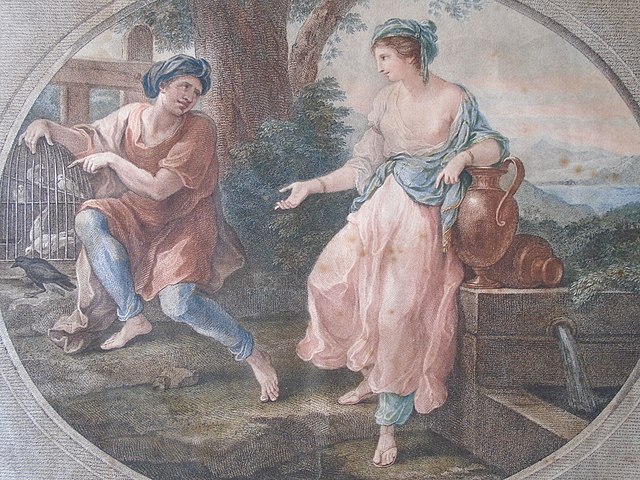
Doricha was a courtesan (hetaira in Greek) who worked in the city of Naucratis in Egypt. Courtesans were a class of sex workers in the ancient world, but unlike lower classes of sex workers, who provided sexual services in return for fairly standard rates of pay, courtesans offered and expected much more. A courtesan would do more than have sex with a client (although that was part of what she offered); she offered companionship, conversation, artistic performance, and social grace. What she received in return was often not so clearly specified. It could include money, but also gifts of jewelry, clothing, furniture, and food. She might enjoy a house paid for by a client, or even live with him long term. Courtesans often had ongoing relationships with a select few clients, and part of their work was to build the illusion of a purely romantic and emotional relationship around what was at base an economic transaction of pay for services. This was demanding work, and not everyone could do it well. A successful courtesan had to cultivate an aura of mystery and glamour. At the same time, courtesans were exposed to all the same pressures and dangers that women offering sex in exchange for money have always faced in male-dominated societies. Yet for some women, those who were lucky and who were good at their jobs, work as a courtesan offered a path to personal independence and financial security that few other women in the Greek world could claim.

Doricha was both lucky and good at her job. Originally from Thrace, she arrived in Naucratis as a slave being put to sex work by her owner, a Greek merchant from Samos named Xanthes. While working in Naucratis, she met Charaxus, brother of the poet Sappho, who was trading wine from the family’s home on Lesbos to Egypt. Charaxus was so smitten with Doricha that he bought her freedom from Xanthes. (When he got home, Sappho had some choice things to say about how he had spent the family’s hard-earned money on his business trip, bits of which survive in some of the fragments of her poems.) She then chose to remain in Naucratis and keep working as a free woman the trade she had begun as a slave. She became so successful that at the end of her life she wanted to leave a lasting memorial of her wealth. According to a story told by Herodotus, she spent one tenth of her fortune to make a massive pile of iron roasting spits and deposited them at Delphi, the site of the famous oracle, where Herodotus reports that they were still to be seen in his day. (Herodotus, Histories 2.135)

Like other courtesans, she cultivated an intriguing persona to appeal to her clients. This persona included an alias, Rhodopis, meaning rosy-cheeked in Greek, by which name she is better known. (It was not unusual for ancient courtesans to use aliases, for all the same reasons that women today performing as strippers or porn stars do.) This mysterious persona influenced how her life was told and retold in later generations, and a number of folktales became attached to her story. One claims that while she was a slave in Samos, the fable-writer Aesop was at the same time a slave in the same household. While this one is not impossible, the coincidence stretches belief (and it is not even certain among scholars today that Aesop was ever a real person). Other stories are attached to Doricha’s later life and are even more unbelievable.

One popular tale is the earliest known version of the Cinderella story:

They say that one day, when Rhodopis was bathing, an eagle snatched her sandal from her serving maid and carried it away to Memphis. There the king was administering justice in the open air and the eagle, flying over his head, dropped the sandal in his lap. The king, moved by the beauty of the sandal and the extraordinary nature of the event, sent all through the country to find out whose it was. She was found in Naucratis and conducted to the king, who made her his wife.
– Strabo, Geography 17.1.33

(My own translation)

Another popular myth among Greeks held that one of the three great pyramids at Giza was Doricha’s tomb, built for her by the king after her death. (Herodotus correctly points out that this story was impossible as the pyramid actually belonged to the king Mycerinus, who ruled Egypt some two thousand years before Doricha ever got there, but he also documents that it was a tale widely known among Greeks. Herodotus 2.134) Doricha’s life was one that seemed fabulous, bordering on the mythic. Some of that wonder is down to Doricha herself, who certainly seems like she would have been an interesting person to know, but the tales about Doricha also reflect the wider Greek experience in Naucratis.

In Doricha’s day, Naucratis was a newly-founded Greek colony, and a unique one. Over the course of the archaic age (roughly 750-480 BCE), Greek cities founded numerous colonies around the shores of the Mediterranean and Black Seas. Some of these colonies were large settlements devoted to controlling farmland and producing food, which was a scarce resource back home in Greece, and some colonies either began with or in time acquired a military might that was able to dominate and subjugate the local peoples, but not all colonies were of that kind. Many were small, fairly humble trading posts or Greek immigrant neighborhoods already busy foreign cities and ports. In these colonies, good relations with local people as hosts and trading partners were essential. Naucratis was in some respects like these trading colonies, and one of its important functions was as the official port of trade for Greeks in Egypt. (Herodotus 2.178-9)

Naucratis was also different. It was the only foreign settlement in Egypt officially sanctioned by indigenous kings, and it had begun not as a trading post but as a settlement of Greek and Carian mercenaries in Egyptian service. The kings of Egypt found the Aegean world to be useful recruiting ground for professional soldiers. Greece had all the qualities that powerful states have historically looked for to find mercenaries: it was poor, politically disorganized, and wracked by violence. The result was a large population of experienced fighters who had no stable home or livelihood. Naucratis became not only a place where Greek merchants could bring goods that were in demand in Egypt, like iron, wine, and olive oil, but also a place where Greek soldiers who fell on hard times could go to find ready employment in the Egyptian army.

For the Greeks, Naucratis was the gateway to Egypt and to the possibility of striking it rich, whether as a courtesan, merchant, or mercenary. The tales told about Doricha reflect this sense that Naucratis was a place where amazing things could happen, where one could imagine starting out as a slave and ending up the rich and beloved consort of the king. Most people who came to Naucratis, of course, never had such success, but Doricha is evidence of what was possible there for the talented and lucky. While her story may have been exaggerated over time, it is clear that she managed an enviable rise from low status to exceptional wealth.

Opportunities of this kind were available in the Greek colonies for those lucky enough and determined enough to make the most of them, but making it big in a place like Naucratis required one skill above all: the ability to work across cultural boundaries. Doricha was originally from Thrace. She made her name by serving Greek merchants in Egypt, and at the end of her life she proudly proclaimed her success by making a dedication in the international sanctuary at Delphi, a place frequented not only Greeks but by people of many cultures around the Aegean and eastern Mediterranean. The legends about her life imagine her becoming the beloved of the Egyptian king and being commemorated with an Egyptian tomb. All of the other merchants and mercenaries who sought their fortune in Naucratis had to negotiate similar boundaries. Doricha’s life is an example of what could be achieved by those who mastered the art of cosmopolitanism.

Image: “The Beautiful Rhodope in Love with Aesop” via Wikimedia (1780; engraving by Bartolozzi after a painting by Angelica Kauffman)

History for Writers looks at how history can be a fiction writer’s most useful tool. From worldbuilding to dialogue, history helps you write.