Writing Prophecies

Prophecies are a staple of fantasy fiction, and for good reason: they are a convenient way of providing the heroes with information to get the plot moving while also imparting an aura of ominous mystique. How do you write a good prophecy for your story or game? Let’s start by looking at how prophecies worked in historical cultures.

Nearly every people in history has believed in some way of communicating with supernatural forces in order to gain special knowledge or insight, but the methods, purposes, and results of that communication could vary widely from culture to culture. By “prophecy” we usually mean something more particular: statements about specific future events which impart the necessary knowledge for the recipient to avert, influence, or at least cope with the effects of those events. Numerous cultures in history believed in some way of gaining these kinds of insights.

The problem that historical oracles faced, of course, was that predicting the future doesn’t actually work. The priestesses at Delphi or the authors of the Sibylline Books at Rome had no special insight into the future any more the authors of modern horoscopes and fortune cookies do. Nevertheless, many people believed in the power prophecy. The Histories by Herodotus, a work which makes frequent references to oracles, gives a useful view of the ways in which people coped with the unreliability of prophecy.

Reasonable guesswork. Prophets may not have special knowledge of the future, but they can make reasonable guesses about what is likely to happen, the same as anyone else. When the small Greek city of Miletus led a rebellion against the powerful Persian Empire, it didn’t take much special foreknowledge to predict that things were going to go badly for Miletus. The Delphic oracle produced this prophecy: “Miletus, you who scheme at evil deeds, will be a feast and splendid gifts for many. Your wives will wash the feet of long-haired men. Strangers will tend my shrine at Didyma.” (Herodotus, Histories 6.19, my own translations) This prophecy turned out to be true, but plenty of other Greeks claiming no connection to the gods also knew that things were going to go badly for Miletus, and so refused to join the revolt.

Vagueness. The standard dodge for prophets from Delphi to Nostradamus is to give an answer vague and cryptic enough that it will seem to suit whatever actually happens. The most famous example is perhaps the Delphic oracle’s response to the Lydian king Croesus, who asked whether he should invade Persia. The oracle replied that by doing so, Croesus would destroy a great empire, neglecting to mention which empire would be destroyed. As it happened, Croesus’ attack on Persia led to the Persian conquest of Lydia, but if things had gone the other way, the oracle would still have been right. (Herodotus 1.53)

Unspecificity. Some prophecies, like the one given to Croesus about his war with Persia, gave vague information about a specific event; others gave detailed information without specifying what event it related to. For example, a little-known Athenian seer named Lysistratus predicted that “The women of Colias will cook with oars,” which came true when wreckage from the naval battle of Salamis washed up on Cape Colias and was used as firewood by the locals. (Herodotus 8.96) This prophecy is unambiguous about what will happen, but says nothing about when or why. Colias was downstream of an important harbor and shipping channel; it was not hard to predict that wreckage from some significant event would wash up there and be salvaged sooner or later.

Selection bias. People tend to remember things that confirm their beliefs and forget things that don’t. People who believed in the power of oracles accordingly tended to remember prophecies that turned out to be true or could be interpreted to be true. Almost all the historical prophecies we have recorded were written down only after they had apparently come true. A number of recorded prophecies from the Delphic oracle begin with the word “But,” suggesting that some preceding part of the oracle has been left out, possibly because it turned out to be wrong or not relevant, such as in another Delphic reply to Croesus: “But when a mule becomes the king of the Medes, then flee, soft-footed Lydian, by the pebbly Hermus, and do not be ashamed to be a coward.” (Herodotus 1.55) This part of the prophecy was interpreted after the fact to refer to the Persian king Cyrus, whose ancestry was both Persian and Median, analogous to a mule, which is the progeny of a horse and a donkey.

Intrigue. Sometimes prophecies were manipulated in order to achieve the results some party wanted. It was an open secret that the priests at Delphi could be bribed to give particular answers. Other oracles and seers were no doubt similarly open to influence. The Alcmaeonid family of Athens were known to have bribed the Delphic priests to encourage the Spartans to help them against their rivals in Athens. (Herodotus 5.63) Another kind of manipulation is exemplified by Onomacritus, a collector of oracles who tried to encourage the Persian king Xerxes to invade Greece by sharing only those prophecies in his collection that seemed positive for him and hiding any that seemed negative. (Herodotus 7.6)

Now, as an author with full control over the world of your imagination, you don’t have to resort to any of these dodges. If you want your ancient prophecies to come true, then they will. The problem with prophecies in fiction, though, is they risk undermining the agency of the main characters. If prophecies predict the threat or its resolution too reliably or in too much detail, opportunities for drama are lost. If your work is for a game or some other setting where other people will have input to the plot, you can bet your dice that as soon as you hand them a prophecy they will try to exploit, invalidate, or weasel out of it in some way.

Uncertainty is a source of drama. When your audience already knows how everything is going to end, it’s harder to keep them interested in the story. Prophecies risk diminishing drama by introducing too much certainty. How do you keep the uncertainty in a story when there’s a prophecy involved? The techniques mentioned above are a good place to start because they serve the same function for a different reason: historical prophets had to keep uncertainty in their predictions because they didn’t actually know what was going to happen. You can use the same ideas in order to avoid tipping your hand too much to your audience or players.

Reasonable guesswork. If an in-story prophecy confirms something your heroes already suspect or adds useful detail to a picture that was already becoming clear, it can add impulse to the plot without dominating it. Conversely, a prophecy that doesn’t provide answers but spurs your heroes to ask important questions can be a good way to get things moving.

Vagueness and unspecificity. Both these techniques are good ways of keeping a prophecy from overwhelming the agency of your characters. If the prophecy refers to a specific event but doesn’t give clear details about it, or gives a clear prediction without specifying when, why, or how it will come about, there’s more room for your characters to work around it.

Selection bias. Lean in to the fact that prophecies can be wrong. If your characters (or their players) are aware that prophecies are unreliable or only seem true after the fact, their doubts about the truth or usefulness of the prophecy they’ve received can be a good source of drama.

Intrigue. There’s even more drama to be mined out of the fact that a prophecy might have been tampered with or invented, or that an authentic prophecy might have been delivered to your characters in such a way as to influence their understanding of it. Such puzzles open up interesting possibilities for side plots and interactions with antagonists.

As an author, the future is in your hands, a power that historical prophets never had. Still, you can learn from their examples how to make your prophecies sufficiently portentous without overwhelming your characters and plot.

History for Writers looks at how history can be a fiction writer’s most useful tool. From worldbuilding to dialogue, history helps you write.

Trailer for Jurassic World Dominion

Good grief! Either I haven’t been paying attention, or there really is a whole slew of SFFnal trailers out in the past month for me to blog about and comment on. Here we go…

The end cap for the dinosaur park franchise(s), Jurassic World Dominion, puts together characters from the original trilogy and the sequel trilogy. And dinos, of course:

Jurassic World Dominion | Trailer 2 [4K] by Jurassic World on YouTube

I was surprised to learn the movie takes place four years after the preceding one; it will be interesting to see how the writing team will have figured humans and dinosaurs might coexist. It will also be very nice to see some of the older characters, and I hope there will be less time spent on my least favorite faces and more on the nicer ones.

There is, however, one thing I will NEVER want to see again: high heels that stay glued to the female protagonist’s feet while she’s running through the jungle. Oh, hello?! Yuckkk!

At this writing, Jurassic World Dominion will be released on June 10, 2022 in the U.S.

Hey, look! We found a thing on the internet! We thought it was cool, and wanted to share it with you.

Living in the Science-Fictional Now: Photos from Another Planet Are Trivial

One of the astounding things about living right now is the sheer amount of scientific knowledge and technical skills humanity has gained in the past 100 years or so alone.

These days it’s trivial, for example, to get high-quality photos from a neighboring planet brought to your personal device.

(Ok, it’s not truly trivial in the strictest sense since so many steps and technologies are involved, but at the same time: Photos. From another planet. Automatically delivered. Via the Internet. Which many (if not most) of us in the West have casual access to. Pretty much daily! So yes. Trivial.)

Specifically, I’m talking about the Persevererance Imgage Bot on Twitter. It’s a project by computer engineer Niraj Sanghvi. He has automated image tweeting mostly from NASA/JPL-Caltech sources for an impressive, ever-growing collection.

The photos are purely functional, of course, helping the rover to operate, but some are also quite interesting as photographs. Below are some recent favorite shots.

Twitter PersevereImgBot Rock and Sand
Twitter PersevereImgBot Hilly Landscape
Twitter PersevereImgBot SkyCam and Stars
Twitter PersevereImgBot Smooth Sand

(Click on the image source links below to find more about each photo.)

As a bonus, here’s a short video of a Martian solar eclipse by the moon Phobos taken by Perseverance:

NASA’s Perseverance Rover Sees Solar Eclipse on Mars by NASA Jet Propulsion Laboratory on YouTube

Cool. Cool, cool, cool. 🙂

Images by NASA/JPL-Caltech/ASU via PersevereImgBot on Twitter: Rock and sand. Hilly landscape. SkyCam with stars. Smooth sand.

Out There is an occasional feature highlighting intriguing art, spaces, places, phenomena, flora, and fauna.

Dwarven Windwalker Monk Transmog Tweak

Besides the Blood Elf subtlety rogue transmog update I already shared, I’ve also tweaked my Dwarven windwalker monk’s mog for Shadowlands. This new look is more sombre and subdued in color as befits the expansion’s theme.

Shadowlands F Dwarf Windwalker Monk Transmog

As before, the head and shirt slots are hidden and the bracers aren’t visible. I also retained the two fist weapons mogs (Silithid Claw).

The update is built around the Bronzebeard Heritage Armor set. Since I tend to find the pre-made sets often a bit lifeless, however, I only used the shoulders, chest, hands, and feet, and filled out my new transmog with Dignitary’s Traveling Cloak, Stygian Belt, and Harvester’s Court Leggings. I was suprised how well the diamond-patterned quilting in the Revendreth pants fit with the diamonds in the Bronzebeard shoulders, and the red in the belt exactly matches the pants.

Finally, I added some red tattoos (Gryphon pattern) to match the pants color and the detailing on the shoulders.

If interested, you can have a look at the set in Wowhead’s Dressing Room.

Image: World of Warcraft screencap

Of Dice and Dragons is an occasional feature about games and gaming.

Quotes: No Man’s Faculties Could Be Developed without an Extensive Acquaintance with Books

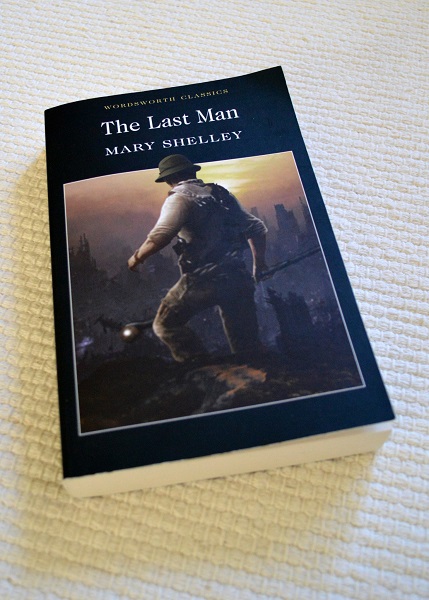
Mary Wollstonecraft Shelley’s speculative work The Last Man starts very much like a run-of-the-mill regency-era novel with its three-book structure. You even start to wonder whether much of interest is ever going to happen.

And then a plague hits. Book three, especially, where people drop off like flies, felt rather grim even before living through a pandemic myself. (I read it a few years ago.)

Shelley The Last Man

Since the plague aspect is a little too on the nose, I’m going to skip all of that for now. Instead, below is what the protagonist thought about reading:

“I felt convinced that however it might have been in former times, in the present stage of the world, no man’s faculties could be developed, no man’s moral principle be enlarged and liberal, without an extensive acquaintance with books. To me they stood in the place of an active career, of ambition, and those palpable excitements necessary to the multitude.”


– Lionel Verney in Mary Shelley’s The Last Man

Sounds astonishingly like Mr. Darcy’s line about a truly accomplished woman who must improve “her mind by extensive reading” in Jane Austen’s Pride and Prejudice, doesn’t it? It must’ve been very much in the air in the early 19th century.

If you’re interested, a free e-version of The Last Man is available on Project Gutenberg.

Shelley, Mary. The Last Man. Ware, Hertfordshire: Wordsworth, 2004 [originally published 1826], p. 124.

Image by Eppu Jensen

Serving exactly what it sounds like, the Quotes feature excerpts other people’s thoughts.

Venthyr Shaman Transmog

I’ll admit, Venthyr is not one of my favorite covenants. The gothic vampire vibe just doesn’t do it for me. But when I saw that the Venthyr mail set has candles on the shoulders, I knew I had to have it for my Tauren shaman.

Here’s a transmog set based around those shoulders. For obvious reasons, I call the set Playing with Fire.

Image: Screenshot from World of Warcraft

Of Dice and Dragons is an occasional feature about games and gaming.

DIY Wheelchair Spoke Covers with Crocheted Solar System

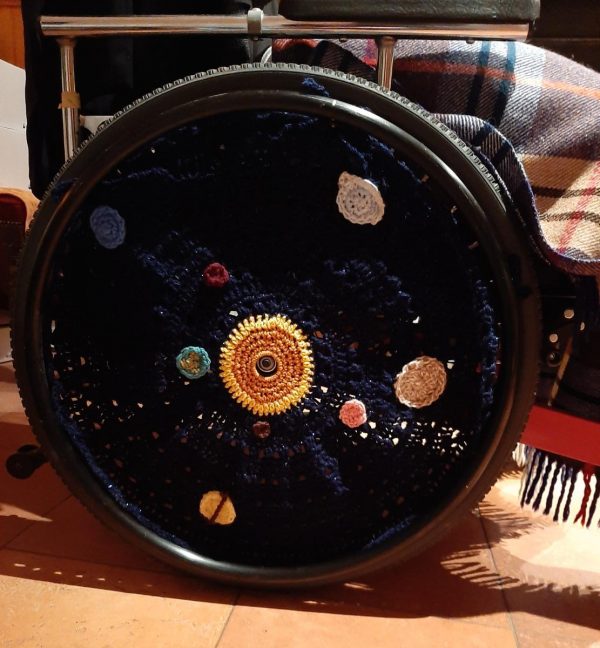
Caoileann O’Mahony crocheted some wheelchair spoke covers and blogged the instructions for the Glasgow in 2024 Worldcon bid. This isn’t your sleepy granny square crochet, though, oh no; O’Mahoney also made little planet appliques and turned the spoke guards into a model of our solar system.

O'Mahoney Wheelchair Spoke Covers w Solar System

And round and round it goes. I like the color selection (although I wish the photo were a little clearer). Saturn and Uranus even have their rings. How cool is that?!

Found via File 770.

Image by Caoileann O’Mahony at Glasgow in 2024

In Making Stuff occasional feature, we share fun arts and crafts done by us and our fellow geeks and nerds.

Azerothvision Song Contest: Shadowlands

Have you ever asked yourself: “I wonder what it would be like if there were a Eurovision-style song contest in Azeroth?” No? Just us? Well, okay then.

If you’re not familiar with the Eurovision Song Contest, it’s an annual competition in which countries around Europe (and a few beyond) present songs in a wide variety of styles and genres. It’s good for inventive songs, wild stage shows, and good-spirited competition among nations. What if we had the same thing in the lands of World of Warcraft? Here are our ideas of what songs might represent the various realms and lands of the Shadowlands.

Oribos – La Forza by Elina Nechayeva (Estonia, 2018)

Elina Nechayeva – La Forza – Estonia – LIVE – Grand Final – Eurovision 2018 by Eurovision Song Contest on YouTube

An ethereal, soaring, operatic melody from Estonia in 2018 befitting the mystical city surrounded by The Inbetween. (Probably helps if you like opera.)

In English, the Italian lyrics start something like “You know in the night for me / There is a star / It lights up my way / For eternity / It is my guide / In the immensity / That never leaves me” (someone else’s translation). Very apt!

Bastion – Visionary Dream by Sopho Khalvashi (Georgia, 2007)

Visionary Dream, Sopho Khalvashi, Georgia, Eurovision 2007 via OkazakiYoko on YouTube

Georgia’s Eurovision contribution from 2007 is a hypnotic song. Among its lyrics: “I will fly away / To reach the heights I’ve ever dreamed / Beneath the sun / No sense of time and space.” Sounds like Bastion to us.

Maldraxxus – Hard Rock Hallelujah by Lordi (Finland, 2006)

Lordi – Hard Rock Hallelujah (Finland) 2006 Eurovision Song Contest Winner by Eurovision Song Contest on YouTube

Finland won in 2006 with this hard rock song. It’s got monsters, pyrotechnics, and a head-banging beat. What else could you hope for from the Necrolords of Maldraxxus?

Ardenweald – Spirit in the Sky by KEiiNO (Norway, 2019)

KEiiNO – Spirit In The Sky – Norway 🇳🇴 – Official Music Video – Eurovision 2019 by Eurovision Song Contest on YouTube

Norway’s song from 2019 has a magical fairy-tale feel and features a yoik performance evoking the spirits of the northern lights. It feels like something the Night Fae of Ardenweald would be into.

Revendreth – It’s My Life by Cezar (Romania, 2013)

Cezar – It’s My Life (Romania) – LIVE – 2013 Semi-Final (2) by Eurovision Song Contest on YouTube

In 2013, Romania blessed us with this levitating falsetto vampire drama king. If that’s not right for the Venthyr of Revendreth, I don’t know what could be.

The Maw – Hatrið mun sigra by Hatari (Iceland, 2019)

Content note: The Icelandic group Hatari is described on the official Eurovision site as “Award-winning, anti-capitalist, BDSM, techno-dystopian, performance art collective”. The music pretty much matches that description—in English, the song name apparently translates “hate will prevail”. Be warned.

Iceland – LIVE – Hatari – Hatrið mun sigra – Grand Final – Eurovision 2019 by Eurovision Song Contest on YouTube

The lyrics start with “The revelry was unrestrained / The hangover is endless / Life is meaningless / The void will get us all” (someone else’s translation), and the stage show includes chains and spikes. Yep; as bleak as playing through The Maw.

Torghast – Warrior by Nina Sublatti (Georgia, 2015)

Nina Sublatti – Warrior (Georgia) – LIVE at Eurovision 2015 Grand Final by Eurovision Song Contest on YouTube

Representing Georgia for the 2015 contest we find another Eurovision song where the lyrics and stage show seem to fit WoW uncannily well (Sublatti’s outfit certainly does!) and certainly suit the desolation of Torghast.

Korthia – Higher Ground by Rasmussen (Denmark, 2018)

Rasmussen – Higher Ground – Denmark – Official Video – Eurovision 2018 by Eurovision Song Contest on YouTube

A pensive Danish song from 2018 about departures and the potential of either victory, failure, or passing seems appropriate for Korthia.

Zereth Mortis – Sanomi by Urban Trad (Belgium, 2003)

Eurovision 2003 22 Belgium *Urban Trad* *Sanomi* 16:9 HQ via 2000ESC2003 on YouTube

The Belgian entry from 2003 is sung in an imaginary language and also has a bit of an otherworldly quality to it, making it the perfect song for Zereth Mortis.

Finally, as an honorable mention, if there is a Eurovision song for the Shadowlands expansion as a whole, it’s Sweden’s Heroes from 2015.

Shadowlands – Heroes by Måns Zelmerlöw (Sweden, 2015)

Måns Zelmerlöw – Heroes (Official Video) by Warner Music Sweden on YouTube

Any favorites among these or other Eurovision songs, or suggestions for additional WoW zone pairings? Do share!

P.S. The 2022 Eurovision Song Contest semifinals are finished, and the final is held this Saturday, May 14, in Turin, Italy, should you want to follow along.

Of Dice and Dragons is an occasional feature about games and gaming.

Roman Leather Toy Mouse from Vindolanda

The Roman fort at Vindolanda near Hadrian’s Wall in Britain has been a source of many remarkable finds. The unusual conditions at the site preserved many examples of the kinds of organic material that usually disappears to decay, including wood, textiles, and leather. When the onset of the covid-19 pandemic delayed the start of the excavation season, researchers at Vindolanda used the time to reexamine some leather scraps that had been turned up in earlier seasons and came across an unexpected find: a toy mouse!

Toy mouse, image via Vindolanda Charitable Trust (Vindolanda; 1st-2nd c. CE; leather)

The mouse is cut from a flat scrap of leather and has markings on the body to indicate eyes and fur. Mice would have been a common sight around the fort and the nearby village, a constant nuisance to a community that depended on stored grain to survive through the winter. Since we know there were families and children in and around the fort, this mouse might have been a child’s toy. Or perhaps it was made to be slipped into some unsuspecting legionary’s bedroll for a practical joke. Whatever the original intent for this mouse, it’s still cute two thousand years later!

History for Writers looks at how history can be a fiction writer’s most useful tool. From worldbuilding to dialogue, history helps you write.

Living Vicariously Through Social Media: Polar Bears Taking Over Abandoned Buildings

In September 2021, Photographer Dmitry Kokh visited the currently unoccupied Kolyuchin Island in the Chukchi Sea between Russia and Alaska, and documented some of the wildlife there. A bunch of polar bears seem to have settled in the abandoned buildings of a former Russian weather station.

Colossal Dmitry Kokh Kolyuchin Island Three Polar Bears

You can see the bears casually stroll in between the houses, and apparently even spend time inside the buildings, often peeking out of the glassless windows. Astounding!

See more of Kokh’s photos at his site or in Colossal.

Image by Dmitry Kokh via Colossal

Out There is an occasional feature highlighting intriguing art, spaces, places, phenomena, flora, and fauna.