Kadri Liik shared on Twitter some of her family history of using mines to dye fabric for colorful folk skirts in western Estonia in 1930s.
Strictly speaking, of course, it’s not mines themselves that were used in dyeing, but the picric acid in them. Russian World War I battleship Slava sank in 1917 between Muhu island and mainland Estonia, only 12 years after putting to sea.
Estonians scrapped the ship in the early 1930s. During that process, picric acid was extracted and put to use. According to Encyclopaedia Britannica, picric acid was first used in dyeing in 1849, initially of silk. In Muhu, it was apparently used with wool.
The bright yellow derived from picric acid was locally known as mine yellow (miinikollane). Below is the Muhu skirt made from scratch by Liik’s grandmother or great aunt in 1930s:
Apparently, Muhu skirts enjoyed such popularity that older women might be doing their everyday chores in them as late as the 1960s.
It’s quite striking, isn’t it? It seems that some of these traditional patterns survive, either in traditionally woven textiles or as prints on modern fabrics, which is fabulous. I’m not sure I’d like to know exactly how the picric was extracted in the 30s, though…!
Are your fantasy characters in the market for a loaf of bread? A new suit of armor? A mercenary army? Then it’s time to think about how people in your world buy and sell things. Of course, the beauty of fantasy is that you can do anything. Do you want to write a world where the common currency is bolts of silk and songs of youth? Go for it! But if you want your world to be more grounded in the familiar, coins stamped out of gold and silver are both historically accurate and staples of the genre.
Gold and silver are both relatively soft metals that were easy to work using pre-modern technology. They are unreactive and resistant to corrosion, so coins will not lose weight over time and use. They are also metals that are rare and highly valued for creating objects of beauty and prestige, which gives coins struck from these metals intrinsic value not dependent on confidence in the state that issued them, unlike modern paper money. Gold and sliver coins were worth something no matter where you carried them, even if just to be melted down as bullion.
In the modern economy, with prices driven by industrial demand and market speculation, the relative values of gold and silver can vary widely. In pre-modern times, the values of these metals was more stable, shaped by the productivity of mining and refining on one hand and cultural demand on the other. Geological research has found that silver and gold ores occur naturally at a ratio of about 19 to 1, which is to say that for every 19 grams of silver in the earth waiting to be dug up, there is about 1 gram of gold. Ancient mining techniques were of limited efficiency, however, and it is likely that the ratio of metals actually put into use was closer to 10 to 1. Where we are able to compare the historical values of gold and silver coins in use by the same culture, we tend to find them falling within these brackets: one gold coin was typically worth 10 to 20 times its weight in silver coins. Bear in mind also that gold has about twice the density of silver, so a gold coin will weigh about double what a silver coin of the same size weighs. When gold and silver coins are struck at the same size, that means that we would expect one gold coin to have a value of anywhere from 20 to 40 silver coins.
Assigning an actual value to an individual coin is a trickier proposition. Pre-industrial economies are hard to compare directly with the modern world. Some things are much cheaper in real terms for us today than for our ancestors, like clothes and books; others are much more expensive, like labor. We rarely have good, comprehensive evidence for what a given amount of money could buy in any historical context (and when we do, it is often hard to tell whether the values and prices quoted are realistic or an expression of what someone in authority thought things ought to be worth).
In many cases, our best way of estimating the worth of a coin is to put it in terms of daily wages for a soldier. Military pay was a pressing matter of state finance that was important to get right—you definitely don’t want to forget to pay the people hanging around your castle with swords. That leaves us with reasonably good evidence for soldiers’ pay in many historical contexts (of course, not all soldiers are paid in money).
Gold coins are classic standbys for fantasy currency, but historically gold was too valuable for everyday use. The value of any specific coin depended on its weight, with heavier coins naturally worth more, but even a small gold coin was typically worth a great deal. Examples like the Persian daric or the Roman aureus had a value of approximately a month’s wages for a soldier or a skilled crafter. Most people in their daily lives would never even have seen a gold coin, let alone had occasion to spend one.
Silver was the standard metal for coinage in most places and times. Silver, like gold, could be minted at whatever weight the issuing state wanted, from large, high-value coins to tiny small change. Often, however, the basic silver coin in circulation, like an Athenian drachma or an early Islamic dirham, amounted to about a soldier’s daily wage.
The difference in value between gold and silver helps explain why gold coinage was rarely debased (issued at lower purity by mixing precious and base metals or applying a precious coating over a base metal core), but silver sometimes was. Gold coins were used for major state expenses and usually only came into the hands of people who could cause real trouble if they felt stiffed; silver was used for routine purchases and changed hands among people with limited recourse except to treat their debased coins as being worth less than face value.
Now, if you remember your classic Dungeons and Dragons coin charts, you may be wondering “What about platinum, electrum, and copper?” All of those metals do appear in pre-modern coinage, but they all have their limitations.
Platinum is extremely rare and hard to work by pre-industrial means. At least in the eastern hemisphere, it was not identified as a distinct metal until the 1500s. There is some evidence that metalworkers in pre-Columbian South America created alloys of platinum and gold, but the process is poorly understood, and they weren’t making coins with it. Traces of platinum are found in some ancient and medieval gold coins, but only as impurities not refined out of the metal. Moneyers in any pre-industrial world are unlikely to have the technology to deliberately produce platinum coins, and even if they did, the expensive and labor-intensive process would make it impractical.
Electrum is an alloy of gold and silver, either naturally occurring or produced by smelting. Some early coins were minted out of electrum, but a problem arose: because the ratio of gold to silver in a particular batch of electrum coins could vary, it was hard to be confident of its real value. Too much silver in the mix, and people might be reluctant to accept a coin at its stated value; too much gold, and it would be more profitable to melt coins down for their bullion value than to spend them. Most monetary systems moved away from electrum to pure gold and silver for the sake of stability.
Copper, usually in alloyed form like bronze or brass, was used for low-value coinage in many places. These coins could be useful for paying wages to ordinary workers or buying everyday goods like a mug of ale or a loaf of bread. Since copper is a much more common metal than silver or gold, its intrinsic worth was much less by weight. As a result, for copper alloy coins to have enough worth to be useful, they had to either be made much larger and heavier than contemporary silver and gold coins or else be issued at a face value significantly higher than their worth as raw metal. Most states that issued copper alloy coinage chose the latter route, making their copper coinage essentially a token whose value was guaranteed by the state’s promise to accept it at the issued value for taxes and fees rather than its metal content. For this reason, copper alloy coinage rarely circulated beyond the reach of the state that originally issued it, while gold and silver were useful as international means of exchange.
As always, you have the flexibility in building your own worlds to make the money work however you want, but for historical verisimilitude you can’t beat gold and silver for your coinage.
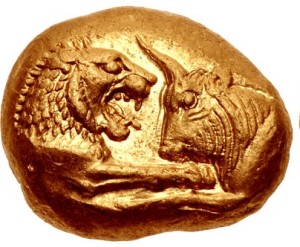
Image: Lydian gold Croessid, obverse, photograph by Classical Numismatics Group via Wikimedia (minted Sardis; 564-539 BCE; gold)
History for Writers looks at how history can be a fiction writer’s most useful tool. From worldbuilding to dialogue, history helps you write.
Obi-Wan Kenobi, a live action series with six episodes, is nearly here.
Apparently, the series is supposed to gap the pain of Ewan McGregor’s young Obi-Wan and the hope of Alec Guinness’ old Obi-Wan. That makes for an unusual angle to approach a Star Wars story from, and the first Disney+ series I have any interest in seeing.
At this writing, Obi-Wan begins streaming on Disney+ on May 27, 2022. So soon! (It was supposed to be May 25, 2022, the 45th anniversary of the release of the original Star Wars, but apparently something something—publishing is weird, and tv publishing doubly so.)
Hey, look! We found a thing on the internet! We thought it was cool, and wanted to share it with you.
Tv shows or movies with an ensemble cast will nearly always have a man as de facto main character. (Studios, networks, and advertisers have apparently not yet caught on to the fact that people who aren’t 18-35-year-old white men also watch tv and go to the movies.) These obligatory protagonists come in a few different varieties. Here’s a spotter’s guide for some of the major types (mind you, more than a few characters cross the lines from one category to another).
Captain Competence
James Kirk from Star Trekvia IMDb; Gil Grissom from CSI via CSI Fandom; Gregory House from Housevia IMDb
He’s better than everyone at everything. He always has the right answer. While other characters may have their particular areas of expertise, he’s always the one to solve the real problem. To be frank, the only reason there are other people on the show is so that he has someone to be better than.
The Fixer-Upper
Nate Ford from Leverage via IMDb; Mal from Firefly via IMDb; Jeff Winger from Community via IMDb
He’s a damaged, bitter, broken man, but that doesn’t stop him from being the center of attention. Expect the women in the cast to do a lot of emotional work for him, such as holding his hand while he cries, calming him down when he lashes out, and making excuses for him to the people he hurts. He may pull himself together over time. Then again, he may not.
The Overgrown Child
Phil Dunfy from Modern Family via IMDb; Castle from Castlevia IMDb; Jake Peralta from Brooklyn 99 via IMDb
This guy just never grew up. He lives his adult life with the blissful joy of a child, which would be fine except that it also means he never takes responsibility for anything, is clueless about how his actions affect the people around him, and gets pouty and petty when things don’t go his way. The women in his life usually fall into the role of surrogate mother, saying “no” to his worst ideas and cleaning up his messes when he does them anyway.
The Plot-Jacker
Peter Quill (and Gamora) from Guardians of the Galaxy via IMDb; Emmet (and Wild Style) from The Lego Movie via IMDb; Owen (and Claire) from Jurassic Worldvia IMDb
(Also known as the “Chris Pratt Special.”) There’s a female character in the cast who not only has the knowledge, skills, and background to be the hero of the story, but also has a good reason to take on the mission or challenge the big bad. Then this guy wanders in out of nowhere and takes over, doing better by sheer guts and grit than she did with all her knowledge and skill. Expect her to fall into his arms at the end.
If you spot any of these types in the wild, you know what to expect.
In Character is an occasional feature looking at some of our favorite characters from written works and media to see what drives them, what makes them work, and what makes us love them so much.
The James Webb space telescope, launched into orbit at the end of December 2021, is going through some mirror alignment steps. A test image was taken, and it shows the astounding potential of the telescope in space imaging. Take a look:
Not only does the focal point star stand out conspicuously, you can see other stars and galaxies(!) in the background.
“While some of the largest ground-based telescopes on Earth use segmented primary mirrors, Webb is the first telescope in space to use such a design. The 21-foot, 4-inch (6.5-meter) primary mirror – much too big to fit inside a rocket fairing – is made up of 18 hexagonal, beryllium mirror segments. It had to be folded up for launch and then unfolded in space before each mirror was adjusted – to within nanometers – to form a single mirror surface. […]
“Webb is the world’s premier space science observatory and once fully operational, will help solve mysteries in our solar system, look beyond to distant worlds around other stars, and probe the mysterious structures and origins of our universe and our place in it.”
I don’t need to be a STEM person to be delighted at the progress!
It was time to re-do some of my World of Warcraft transmogs. Among others, I updated my Blood Elf rogue’s look. I still like her previous shadow concept mog a lot, so this update was more a teeny tweak than a grand change.
Her chest remains mogged to Ghostclaw Tunic, but I updated her legs to Jadefire Pants and hid her belt. Then I dinked around with her weapons and ended up with Enchanted Azsharite Felbane Dagger as a partner to the ever-gorgeous Ethereum Phase Blade.
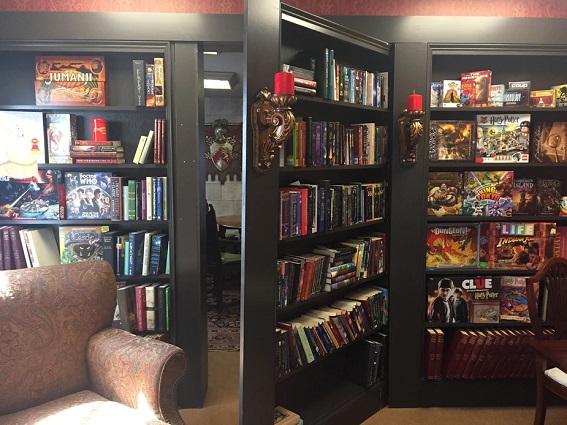
The house is Victorian, built circa 1891, and located in Simsbury, Connecticut. Before the covid pandemic, Natcharian and her crew organized various book-themed events: author talks, writing classes, poetry slams, summer camps, book clubs, D&D game nights, tea or cocktail parties, live murder mysteries, even escape rooms.
The door into the gaming den opens when you pull a candle sconce attached to the bookcase:
The new secret room is papered with stone-block-look wallpaper and equipped with various furnishings that nod towards medieval castles: a round table with ornate wood chairs, a small suit of armor in the corner, and wall textiles, for example.
I’m flabbergasted that she was able to source so much of the furnishings second hand. I mean, who has a miniature suit of armor just lying around until you decide to sell it off on Craigslist?
The results are well worth the effort, and surely will be enjoyed by all event visitors. For more images, visit her site, or, should you prefer to watch a video about the build process instead, you can see it on YouTube.
The Roman orator Quintilian has a thing or two to say about making jokes at the expense of groups of people:
I have already noted, when talking of jokes, how unworthy it is to go after someone’s circumstances in life, and there is no call for nastiness against classes, ethnicities, or nations, either.
Quintilian, The Institute of Oratory 11.1.86
(My own translation)
Now, Quintilian is specifically speaking here about how to comport oneself as an advocate in court, and he goes on to say that if your opponent comes from a group whose moral qualities might seem dubious to a Roman jury, like soldiers or tax farmers, it may sometimes be appropriate to make a joke at their expense. His advice is tactical, not moral: this is how you sway a jury and win your case. Still, it’s good advice in general that “just joking” about people’s ethnicities, origins, or life circumstances is not a great way to get people on your side, in ancient Rome or today.
Serving exactly what it sounds like, the Quotes feature excerpts other people’s thoughts.
The release date for the next movie in the Marvel Cinematic Universe is approaching. Here is the second official trailer for Doctor Strange in the Multiverse of Madness:
To me, the creepiest thing in the trailer is the mention of a repeating dream Strange says he’s having. Brr, merely the thought is hair-raising. (Not to mention that I can’t even think of the kinds of nightmares you might have if your reality had shifted to a multiverse of possibilities. Anyway.) Apparently MoM is the first MCU film to be released under the horror genre, so that sounds appropriate.
The trailer looks as astounding as all of the MCU movies do; indeed, technical accomplishments have never been Marvel’s weakness. Where it might fall is the story. I don’t recognize the writing team for MoM at all: Michael Waldron (who’s apparently written the Loki series) and Jade Halley Bartlett (with a total of four credits to her name in IMDB).
Another aspect I’m completely ignorant of is superhero America Chavez, played in MoM by Xochitl Gomez, who will be introduced in this film. I’ve sometimes wondered whether I’d be enjoying the MCU more had I read Marvel’s superhero comics as a kid instead of the mutant ones, but it hasn’t been a big deal so far. In phase four, however, as the stories are moving further away from the biggest names and most popular heroes, it might make a difference.
I’m also ambivalent towards the director Sam Raimi. His Spider-Man trilogy certainly faded from my memory soon enough. MoM is also Raimi’s first film in nine years. I have to wonder whether directing is like riding a bicycle—will he be able to handle the reins of a massive production again?
Apparently the events will also tie in with the series Loki and WandaVision. As I haven’t seen either, I hope any links will be clear enough anyway. I guess we will see. It’ll surely be nice to see more of Wong (Benedict Wong) and Dr. Christine Palmer (Rachel McAdams).
The release day for MoM is still listed as May 06, 2022.
Hey, look! We found a thing on the internet! We thought it was cool, and wanted to share it with you.










 Co-Geeking
._Heavy_series._Sardes_mint.jpg)

You must be logged in to post a comment.