At this writing, there are only a limited selection of classes to try: death knight, druid, hunter, priest, and rogue. In addition, the new race / class combo, Dracthyr evoker, is available for preview. Excitement! Below are some thoughts from the point of view of my main toon, a balance druid.
On one hand, there still isn’t quite enough information available. For example, on the Druid Tree, I’d like to pick Frenzied Regeneration, but the description doesn’t say whether it’ll pop you into bear form immediately upon use, which would make it less useable for me. (I assume it does, but the button doesn’t say.)
It’s great, however, that you can elect to skip certain spells. For example, I’ve never taken to Typhoon or Cyclone; they’ve always felt awkward and unconducive to my playing preferences or our joint style when Erik and I play together.
So, assuming that I’ll skip a number of lower-tree talents due to personal preferences, I’m having a hard time assigning enough points to reach the 20 required level. If this tree configuration is retained for the release, I’ll just have to hold my nose, pick talents I’d rather skip, and just not drag them onto my action bars.
On the other hand, I love that a balance druid gets more healing spells than is available in Shadowlands. When we play our druids together, we have quite a bit of staying power. I used to play a healer when we raided, but when it’s just the two of us it’s more beneficial to have a tank + dps combo. At times, though, I could use a bit more heals—the tanks are more than fine—and now I’m going to get it. Yay!
In the Balance Tree, it’s especially delightful that we can choose Convoke the Spirits, a Shadowlands covenant ability. A huge surprise was that they’re moving one of my favorite spells, Fury of Elune, to an end-tree position.
What remains to be seen is how the spells and talents become available as you progress, but so far it doesn’t look too awful. 🙂
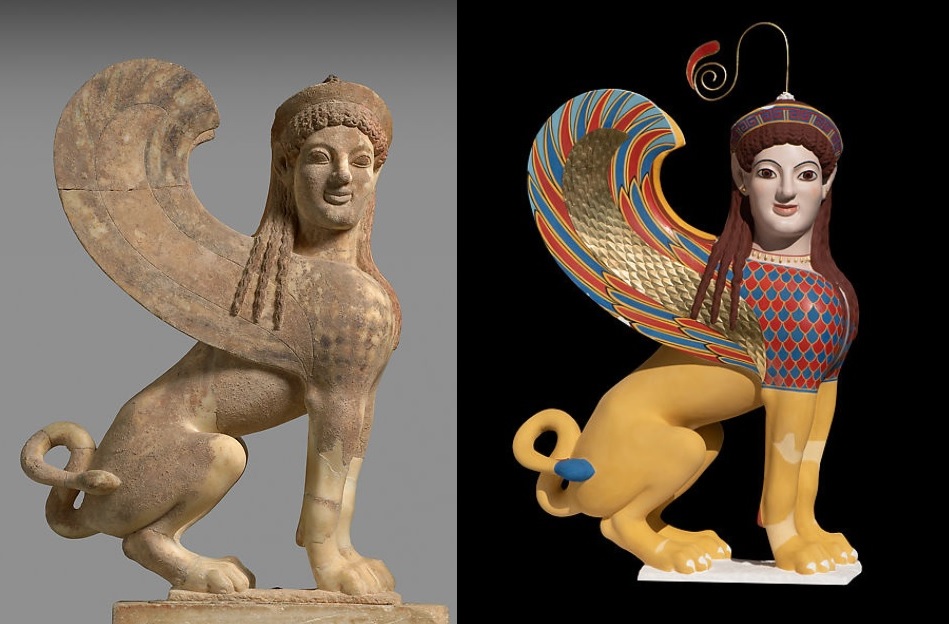
The Metropolitan Museum of Art in New York has a fascinating new exhibit featuring reconstructions of some ancient works of art that show how they might have originally looked when they were still painted in bright colors. Sadly, I’m on the wrong side of the Atlantic now to go and check it out myself, but there’s an excellent online gallery of examples. Here’s a comparison of one original sculpture with its reconstruction to give you an idea of how amazing the work is.
Sphinx finial, original and reconstruction via Metropolitan Museum of Art (Originally Athens, currently Metropolitan Museum of Art, New York; c. 530 BCE; marble. Reconstruction by Vinzenz Brinkmann)
It’s always wonderful to get a chance to glimpse what the ancient world may have looked like when it wasn’t yet ancient.
Out There is an occasional feature highlighting intriguing art, spaces, places, phenomena, flora, and fauna.
Ruins and abandoned places are often seen as plain and boring. Granted, the color of untreated, inexpensive rock (which the majority of surviving buildings tend to be made from) often isn’t anything to write home about. But in our fiction, ruined areas don’t need to be austere and grim. You can even find real-life ruins in a variety of styles for inspiration.
For example, houses in Herculaneum famously featured colorful mosaics and painted murals. In addition, paint was generously applied elsewhere, like these pillars and external wall from House of the Relief of Telephus show:
It’s not always humans who have applied the color onto the ruins either. At the ancient Maya site called Bonampak or Ak’e, in the Chiapas area, Mexico, strikingly orange lichen is taking over building facades:
In Dutch photographer Roman Robroek’s shots we can see that a ruin definitely need not be grey, blocky, and boring. Partly overrun by nature could mean an almost orderly takeover, like in the photo of a Gothic-style former chapel built at the end of 19th century, below:
Beautiful, brightly colored arches among rubble from the childhood house of Lebanese singer Fairuz (who was born in 1934) in Beirut form a striking contrast to the greenery outside:
Finally, a still strikingly turquoise—if peeling—underside of a round staircase:
It vaguely reminds me of peacock feathers! I wish the photographer gave us a little more information about the history of this place. Browse more via Colossal or at Robroek’s website.
Since they exist in real life, I would be delighted to read about vibrantly colored and visually striking abandoned places in my genre fiction, too.
Covering canals with something to slow water evaporation is a no-brainer, right? (Or should be.) How about making those covers be solar panels for a two-fer—as apparently is already happening in India—now, that’s outright ingenious.
(Incidently, I can recommend Paolo Bacigalupi’s novel The Water Knife from 2015, in which water rights and covered canals feature strongly. In case you’re interested in that sort of fiction.)
Carved gravestones with images and short poems celebrating the deceased were common in the ancient world, but it wasn’t just people who got them. This one commemorates a pig who apparently died in some kind of traffic accident. Like other Greek epitaphs, this one is phrased in the first person, as if the pig were narrating its own story.
A little pig, everyone’s friend, a young quadruped, I lie here, after leaving behind the land of Dalmatia to be offered as a gift. I walked through Dyrrachium and Apollonia in my longing, and passed through the whole earth alone untouched. Now, by the violence of wheels, I have left the sunlight behind. I longed to see Emathia and the phallic chariot, but now I lie here, and my debt to death is cleared.
Supplementum Epigraphicum Graecarum 25:711
(My own translation)
The story seems to be that a pig was bought somewhere in Dalmatia (the Balkans) and driven overland toward the plain of Emathia in Macedonia (west of modern-day Thessaloniki), to be offered as a sacrifice in a festival for Dionysus (which often involved a large decorated phallus carried in a procession). The stone was found in Edessa, a city right at the edge of Emathia, and it seems that here the poor pig got run over by a cart.
It’s certainly unusual for an animal to have a gravestone like this. There was a custom of writing joke epitaphs for animals, but few people went to the expense of actually getting them carved in stone. Perhaps this pig was special, or perhaps the gravestone represents a kind of substitute for the religious act of sacrifice that was no longer possible once the pig was killed on the road.
Whatever the case may be, that was clearly some pig.
Image: Copy of pig stela, photograph by Philipp Pilhofer via Wikimedia (Edessa; 2-3 c. CE; carved stone)
Out There is an occasional feature highlighting intriguing art, spaces, places, phenomena, flora, and fauna.
Jane Foster wielding Mjölnir will be something to see! I have no idea of the comic book storylines, so I can’t say how the tidbits we see compare to those—I have literally no idea—but the main antagonist, Gorr, seems musty and uninspired. We’ll see if that’s just that trailers always lie.
I do find the realm with a fancy, floating (although quite open) city interesting, and all of the other sets, props, costumes, and effects are handsome, as usual. Since this is another Thor movie co-written and directed by Taika Waititi, I’m inclined to see it in the theater.
Thor: Love and Thunder is set to debut on July 08, 2022, in the U.S.
Hey, look! We found a thing on the internet! We thought it was cool, and wanted to share it with you.
Atlantis is not a myth. And I don’t mean it’s real, either. Atlantis is something neither mythic nor real: it’s fiction.
Atlantis is an old Greek story, but not all old stories are myths. Myths are stories passed down and retold over time as part of a culture’s collective tradition. They have no identifiable author and no original, canonical form. Every version of a mythic story is a retelling of something older and usually already familiar to its audience. The stories of the Trojan War, for example, are myths. They were part of the common oral tradition of ancient Greece, reimagined in particular versions by the Homeric poets, Athenian dramatists, the Roman poet Virgil, and countless other storytellers and artists in the ancient Mediterranean and beyond. Every version of the story represents just one person’s imagination playing with existing ideas, characters, and motifs.
Modern attempts to find some truth behind the story of Atlantis often approach it as if it were a myth, something from deep in Greek history with an unrecovered truth behind it. It isn’t. There is no myth of Atlantis, no long tradition of reinterpreting a shared narrative like the tradition of the Trojan War. Stories about Atlantis appear in only two ancient texts, Timaeus and Critias, both written by Plato.
Plato was a philosopher who liked to create thought experiments and fictional stories to illustrate his ideas. He told a story about people chained up in a cave watching shadows on a wall to describe minds unenlightened by philosophy. He imagined a magic ring that made its wearer invisible as a way of talking about how people behave when they have the power to do what they want without fear of consequences. He made an analogy between the human soul and a charioteer trying to manage unruly horses. None of these stories were myths; they were invented to get philosophical ideas across. There was no deep oral tradition about people trapped in a cave. Plato just made it up.
Atlantis is the same. Plato made up a story about an ancient rival to Athens as a vehicle for philosophical discussions about law, society, and human nature. There is no deeper history behind Atlantis. No writer or artist before Plato had ever depicted the city; no one after him told any stories about it either. Some later authors discussed Plato’s Atlantis story and its meaning, but no one in antiquity independently told their own story of Atlantis the way that Greek poets and playwrights created their own versions of the Trojan War. Folks today looking for some historical reality behind Atlantis are missing the point just as much as if they were to go looking for an actual cave with people chained up watching shadows.
Now, this does not mean that Plato’s imaginary city has no connection to the real world. When people make up fictional stories, they often draw on actual things they know about. When Tolkien invented Middle Earth, he based the Shire on his childhood memories of the English countryside, the Dead Marshes on the horrific battlefields of the Great War, and the Riders of Rohan on his knowledge of early English history and legend. Elements of the real world found their way into Tolkien’s imaginary world, but these do not make Middle Earth real. You could go out and explore English villages and country pubs, even the very same ones that Tolkien knew from his youth, but that doesn’t mean you’ve found the Shire.
The same is true of Plato’s Atlantis. When Plato was imagining his fictional city, he probably drew on details of the world and history that he knew. Plato described Atlantis as the home of a powerful empire based in a circular city with concentric rings of land and sea that was ultimately destroyed by earthquakes. The idea of a powerful empire was not much of a reach for an Athenian; in the century before Plato, Athens had fought against the expansion of the Persian Empire before becoming an imperialist power itself. The idea of a city with a circular plan suited Plato’s philosophical allegory, but it might also have been suggested by real-world settlements he had seen or heard about (possibly translated through the imagination of other Greeks, such as Herodotus’ rather fantastical description of the city of Ecbatana). The idea of concentric harbors may have been suggested by the island of Thera (modern Santorini), which has a core island nearly surrounded by outer islands. The Greek world in Plato’s day had plenty of experience with earthquakes, landslides, and coastal floods from which he could imagine a land sinking beneath the water. Given Greek trade connections with the eastern Mediterranean, he may well have also heard flood myths from the Levant or Mesopotamia that he drew on for his tale of destruction. While Plato’s fictional Atlantis may have drawn on some preexisting real or mythic features for its details, that does not mean there is any more substance to the story. Thera is not the “real” Atlantis any more than a house with a green door is the “real” Bag End. We can’t use the Atlantis story to learn anything about actual history any more than we can learn the history of England from Tolkien.
Our desire to find a truth behind a myth can lead us to dismiss the intelligence and creativity of people in the past. Ancient people were just as complicated and imaginative as we are. Every story we tell does not have some shadowy reality behind it; sometimes we just make stuff up. So did they. In the case of Atlantis, we’re not even dealing with a mythic tradition handed down from previous generations. It’s fiction. Plato just made it up. There is no reality to find behind the story. There isn’t even a myth behind it.
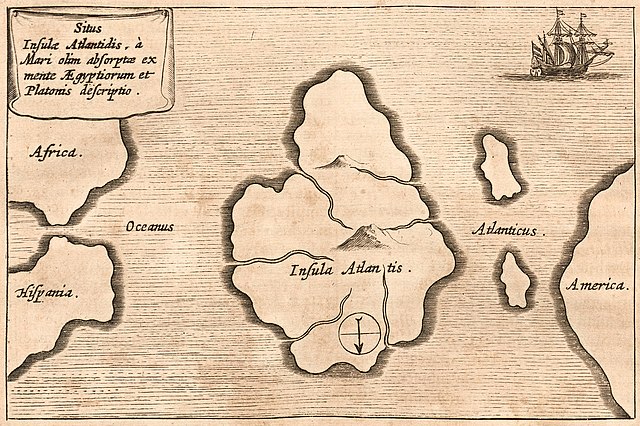
Image: Fictive map of Atlantis from Mundus Subterraneusvia Wikimedia (1664; engraving; by Athanasius Kircher)
History for Writers looks at how history can be a fiction writer’s most useful tool. From worldbuilding to dialogue, history helps you write.
“There is a particular kind of character in SFF. You know her. She’s smart and tough, determined, decisive, and she can kick the collective arses of any takers. She comes in a few varieties—in better stories she’s an Alanna of Trebond or a Brienne of Tarth, with depth and history and more than one dimension; in weaker ones she’s an empty Strong Female Character™ who has no real contribution to the plot other than Being Awesome While Female—but either way it’s her prowess at fighting, particularly against men, that sets her apart. […]
“Instead, I wrote a woman, Kalina, with a chronic illness who couldn’t fight to save her life. Literally. I wrote a book in which the main characters’ problems couldn’t be solved by the strategic and entertaining use of violence even if they had the skills to deploy, and I did it purposefully. I did it in part in response to my own sewing test.
“Let me explain.
“The sewing test is failed when a book deploys a lazy code to tell me how much better, more interesting, more deserving, the female character is than those silly other women by making a point of having her hate sewing or embroidery or [insert other feminine-coded activity or trait of your choice—but you wouldn’t believe how often it’s sewing]. These days, if a book does this, I’m out. It’s not just lazy, it’s not just a cliché, it’s a statement by the author that I’m expected to cheer on one woman by disparaging the rest of them. […]
“Basically, there’s a nasty underbelly to over-reliance on this very limited model of ‘strength’, and it’s rooted in the same insidious patriarchal BS that gave us the old style women-as-objects-to-be-rescued stories: here are traits which are traditionally coded as masculine, which you have been taught are more valuable than traits which are coded as feminine. See how you should cheer on this woman because she’s different and better than those other women, who are weak and shallow and worthless. Reward her for those traits, and punish those who lack them.”
author Sam Hawke at Fantasy Book Cafe blog, 2019
Hawke is perfectly right, if you ask me. As awesome as ass-kicking women are, other ways of being awesome exist and should be recognized more widely. Because the variety of life skills to be excelled in is much, much wider than merely physical prowess, fighting skill, or attitude.
Moreover, as we all know, there are situations where the application of know-how or just the right tool will create such a better outcome than anything else that at best it’s not even fair to compare them. Why should genre literature forget these skills when women stand in the protagonists’ shoes?
I’m going to be adopting the phrase “being awesome while female” for all kinds of amazing things that women do. It’s just that awesome. 🙂
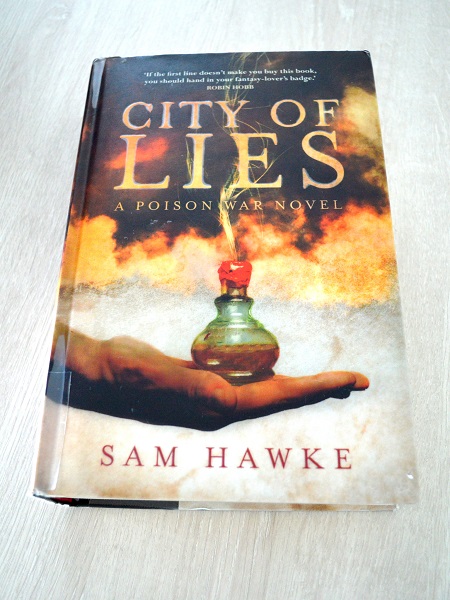
P.S. I just read City of Lies, Hawke’s book with the female protagonist who has a chronic illness. I thoroughly enjoyed her strategic and entertaining use of her brain—and ditto for the male protagonists, Kalina’s brother and his best friend.
Image by Eppu Jensen
Serving exactly what it sounds like, the Quotes feature excerpts other people’s thoughts.
Apart from the Empire’s hunt for Obi-Wan, most of the plot seems to revolve around interpersonal conflict. (Those of you who have started watching already may be able to fill us in on this!) There seems also to be an introduction of the first true female antagonist of the franchise. (I don’t count Captain Phasma, as she didn’t get nearly enough screentime.)
Obi-Wan Kenobi was released on May 27, 2022.
Hey, look! We found a thing on the internet! We thought it was cool, and wanted to share it with you.
Ukraine has been at war for 105 days now. That’s 15 long, grueling weeks. (Also the length of Finland’s Winter War with the USSR, which is why the number is significant to me.)
Russia’s craven attack (despite the incompetence it seems to have been implemented with) did change the world, albeit a bit differently than intended. Ukraine, Moldova, and Georgia have submitted their applications to join the EU.* There’s an unprecedented feeling and showing of solidarity towards Ukraine in Europe. Russia—and especially their petty, piddling thing of a presidential figure—is becoming something of a pariah at least in the Euro-American world. Furthermore, Finland and Sweden are joining NATO, ditching their long-cherished military independence.**
That’s in the first three months. Much like the beginning of the covid-19 pandemic, it’s felt three times as long. Unfortunately, I’m afraid this conflict will be a matter of years. Sigh.
World, any time you want to return to duller times is okay by me.
*) Getting even a membership candidate status isn’t simple, though, so this isn’t happening soon.
**) And thanks to Turkey’s pretentions of power-playing, this isn’t going to be as much of an open-and-shut case as we thought, either. Ohwell. I do believe Finland’s and Sweden’s NATO membership will happen eventually.







 Co-Geeking


You must be logged in to post a comment.