A Peek into Color Gothic Aesthetics

I was browsing a ren faire board the other day for research. Someone there was asking for inspiration and advice, saying they usually dress “quite gothic”, which I somehow misread as “white gothic”.

That would be really interesting, I thought, and wanted to check whether it’s a thing… And of course it is! Known as white goth or ice goth: instead of the ubiquitous black, dressing only (or mostly) in white, but spiky or moody, sometimes puffy or lacy or ruffly, too.

Then I poked around some more. I already knew that various flavors of goth aesthetic exist, of course, but I was specifically interested in color-based ones. Apart from red and purple goth, less immediately obvious colors such as pastel goth (especially pink goth looks big), blue, and green goth do seem to exist. Yellow, orange, and brown goth seem marginal (with varying levels of recognition), but there doesn’t seem to be gold, silver, or bronze goth, per se.

Color Goth Styles Mashup

The most intriguing find, I think, emerged from my yellow goth search. There seems to be some interest in dressing styles inspired by bugs, including bees. One seller on Etsy even used both the word bee and goth in their sweater description. (Personally, I couldn’t call that sweater goth style, but you do you.) Below is a bee-inspired ensemble by EJ on Pinterest that the user labeled as “yellow Y2K goth outfit”:

Pinterest EJ Yellow Y2K Goth Outfit

So, there’s bee goth now? Bee core? (Buzz core???)

Live and learn!

Images: Mashup by Eppu Jensen: red and black outfits by hystericb0y on Tumblr; purple goth by sabikuma on tiktok, found via peri on Pinterest; blue goth by dogmaz on Tumblr; green goth via Yasmin on Pinterest; white goth via Mabel Manley on Pinterest. Yellow Y2K goth outfit (bee goth) by EJ on Pinterest.

Living Vicariously Through Social Media: Red Lights in the Vatican

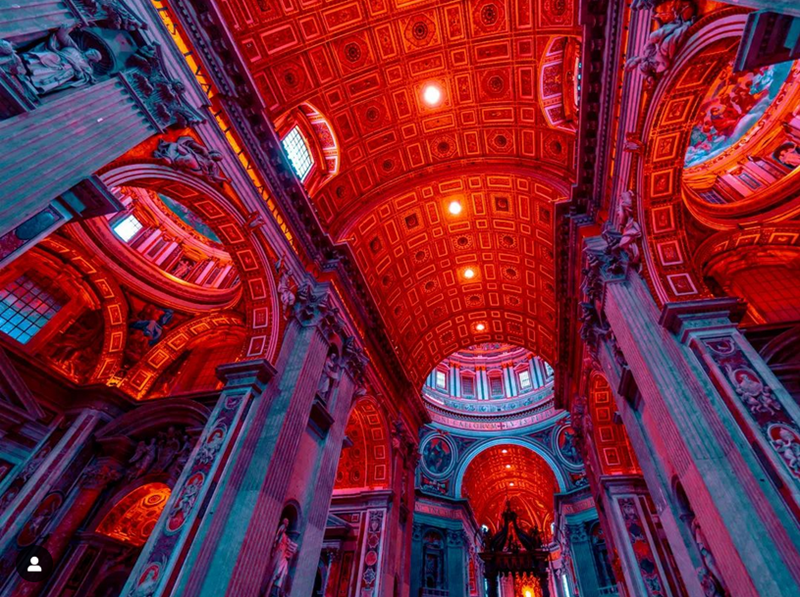
In his work, video director, photographer, and art director Aishy plays with color and light. One of his most striking projects is the Red Lights: Vatican series. Interior views from St. Peter’s Basilica in Vatican City become striking and very different from their everyday state.

Instagram Aishy St Peters Basilica Dome

Aishy’s work is often described as having a sci-fi or cyberpunk flair. However, what his Vatican photos remind me of is how ancient Mediterranean statues and buildings in their original state were not the bland off-white or grey we currently know, but vibrantly painted.

Instagram Aishy St Peters Basilica Vault

And to get back to the cyberpunk idea: wouldn’t it be more interesting—or at the very least less ubiquitous—if your next dystopia were not visually mostly black or grey, but eyeball-bustingly garish in color? Surely that could also be quite dystopic, right?

There are some specific examples I can think of. The throne room in Star Wars: Episode VIII – The Last Jedi, for starters, looks magnificently arresting. I’m just a little tired of red (or the combination of red and black). Sure, it’s a strong color often linked to strong emotions, but it tends to be overused. How about orange instead, like the Las Vegas of Blade Runner 2049? Or in Jupiter Ascending? Perhaps purple, turquoise, or chartreuse?

Just tone down the use of those ever-present blacks and greys, thanks.

(As a sidenote, the ancestry festival in Star Wars: Episode IX – The Rise of Skywalker delighted me for its happy colors, even if the planet itself was another desert.)

Images by Aishy via Instagram: Dome. Vaulted ceiling.

Visual Inspiration: Living Root Bridges

Living root bridges are an ingenious type of suspension bridge shaped from plant roots. They are common in the southern part of the Indian state of Meghalaya (in the northeast of the country), home for some of the wettest locations on Earth.

Flickr Roman Korzh Double Decker

The Khasi and Jaintia communities who inhabit the region needed a low-cost way to cross the valleys and gorges in the rainforest during monsoon season. Living root bridges are sturdy and easy to build—albeit time-consuming—and apparently they withstand flash flooding and storm surges quite well.

Flickr Ashwin Kumar Double Decker Living Root Bridge

The building process is described by Zinara Rathnayake for BBC Future as follows:

“Building these bridges takes decades of work. It begins with planting a sapling of Ficus elastica – a tree that grows abundantly in the subtropical terrain of Meghalaya – in a good crossing place along the riverbank. First the trees develop large buttressing roots and then, after about a decade, the maturing trees sprout secondary aerial roots from further up. These aerial roots have a degree of elasticity, and tend to join and grow together to form stable structures.

“In a method perfected over centuries, the Khasi bridge builders weave aerial roots onto a bamboo or another wooden scaffolding, wheedle them across the river and finally implant them on the opposite bank. Over time, the roots shorten, thicken and produce offshoots called daughter roots, which are also trained over the river. The builders intertwine these roots with one another or with branches and trunks of the same or another fig tree. They merge by a process called anastomosis – where branching systems like leaf vessels, tendrils and aerial roots naturally fuse together – and weave into a dense frame-like structure. Sometimes, the Khasi builders use stones to cover the gaps in root structures. This network of roots matures over time to bear loads; some bridges can hold up to 50 people at once.”

Flickr Roman Korzh Living Root Bridge

Despite not having the capacity of bridges built entirely from man-made materials, the capabilities of living root bridges are nothing to sneeze at in the kinds of difficult terrains they’re used for. For example, the longest living root bridge is the Rangthylliang bridge at 50+ meters long. That kind of length makes for plenty of potential for similar live-plant-based bridges in speculative gaming campaigns or stories, from ad hoc methods of river crossing for an army or a group of refugees (with the help of plant-growth spells) to permanent structures for local communities.

Living bridges can also last for many hundreds of years in ideal conditions. Even if the oldest currently existing bridges were “merely” from the 1800s, it’s clear that that kind of longevity wouldn’t be possible without community building and traditions passed on and cherished. I.e., the structures solve a concrete problem in a way that both suits and takes advantage of local conditions. We humans tend to be smart like that. 🙂

Images: Double decker by roman korzh via Flickr (CC BY-NC-ND 2.0). Second double decker by Ashwin Kumar via Flickr (CC BY-SA 2.0). Closeup of stone walkway by roman korzh via Flickr (CC BY-NC-ND 2.0).

Visual Inspiration: Late Babylonian Clay Map

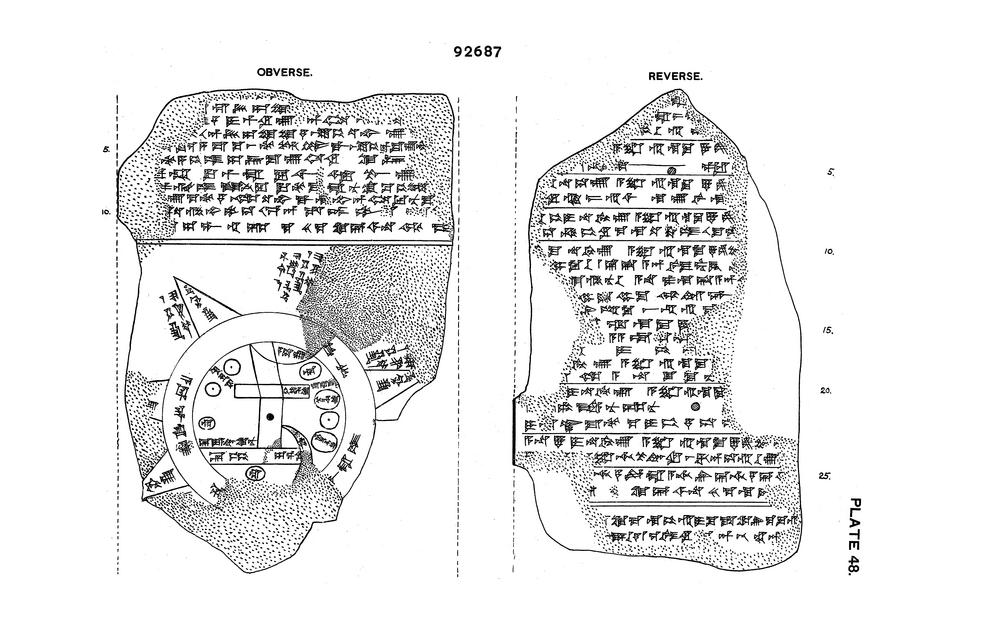
Recently I ran into this Late Babylonian map of the world on a clay tablet from the British Museum:

BM Late Babylonian World Map
The Map of the World, Late Babylonian (found Abu Habba (Sippar), currently British Museum; c. 6th c. BCE; clay)

The map shows the world as a disc surrounded by the circular “Bitter River”. Babylon is marked as a rectangle, the river Euphrates flows south in the middle, and small circles show cities or districts.

The curator’s comment in the BM catalog says that according to the tablet it was copied from an earlier one. Clearly there was an established practice by 6th c. BCE—this object is quite recent in Mesopotamian terms, after all.

Obviously, the map was meant to be more conceptual than realistic. However, there are many notes (and even some time / linear measurements) which make it more usable. (Please visit BM and read the item description; it’s quite fascinating.)

BM Late Babylonian World Map Drawn Plate
The Map of the World, Late Babylonian (found Abu Habba (Sippar), currently British Museum; c. 6th c. BCE; drawing of clay tablet)

What an intriguing map, isn’t it?

As the fragment is approximately 12 by 8 cm (approx. 3″ x 5″), it’s believable that it could’ve easily been transported if desired. Which makes it quite plausible that intrepid adventurers in a story or role-playing campaign in a similar setting could carry around maps made in the same style. There could quite well be professional mapmakers and a developed cartography for your world, even if writing doesn’t happen on sheets of paper as we know it.

Images: The Trustees of the British Museum (CC BY-NC-SA 4.0)

Visual Inspiration: Indian Black Narrowmouth Frog

The Indian black narrowmouth frog (Melanobatrachus indicus) is a vulnerable species endemic to wet evergreen forests in southern India.

Wikimedia Davidvraju Melanobatrachus indicus

Not much is known about them outside of academia and/or research circles (and I’m currently too sick to start combing through more in-depth sources). They seem to be quite small, though. And how cute are those tiny blue polka dots! And its face, too! At least this individual looks so smart it could easily be the model for a dungeon boss for a computer game.

Image by Davidvraju via Wikimedia Commons (CC BY-SA 4.0)

Living Vicariously Through Social Media: Ringneck Snakes

I’m not a great friend of cold-blooded critters in general. The ringneck snake (Diadophis punctatus), however, does fall close enough to my sense of cute to bring up. Especially the juveniles—soooo small!

Flickr Tony Iwane Pacific Ringneck Snake

Even the adult ringnecks are quite small and slender, about 21-36 cm (8″-14″) long. The belly and underside are bright yellow, orange, or red, and there often is a ring of the same color around the neck. The 14 non-poisonous subspecies are found in much of the United States, central Mexico, and south-eastern Canada in a wide variety of habitats.

Apparently, the coloring can also shift along the length of the body, like on the prairie ringneck snake in the photo below.

Flickr Peter Paplanus Prairie Ringneck Snake

This type would be especially handsome as a ginormous fantasy version, perhaps even as a rideable creature, a little like the sandworms on Dune or oliphaunts in The Lord of the Rings with war-towers on their backs.

Images: Pacific ringneck snake by Tony Iwane on Flickr (CC BY-NC 2.0). Prairie ringneck snake by Peter Paplanus on Flickr (CC BY 2.0).

Visual Inspiration: Greater Blue-Eared Starling

The greater blue-eared glossy-starling (Lamprotornis chalybaeus) is a common bird in parts of Africa. It’s as handsome as handsome gets—absolutely gorgeous!

iNaturalist petermcintyre Greater Blue-eared Starling

This stunning starling breeds in a band of land stretching from Senegal in the west coast all the way east to Ethiopia, and south again through eastern Africa to northeastern South Africa, northern Botswana, southern Namibia, and northern Angola. They live in subtropical forests, savanna, and shrublands.

I’ve always found the English name starling lovely—certainly lovelier than the Finnish one (kottarainen)—but the looks of the common starling haven’t, sadly, quite lived up to the name in my mind. Now, the greater blue-eared starling is quite something else! It would be so remarkable to see a turquoise-blue murmuration in a fantasy production, wouldn’t it?

Found via Herps and Birds on Tumblr.

Image by petermcintyre via iNaturalist (CC BY-NC 4.0)

Greenhouses Fill the Almería Peninsula in Southern Spain

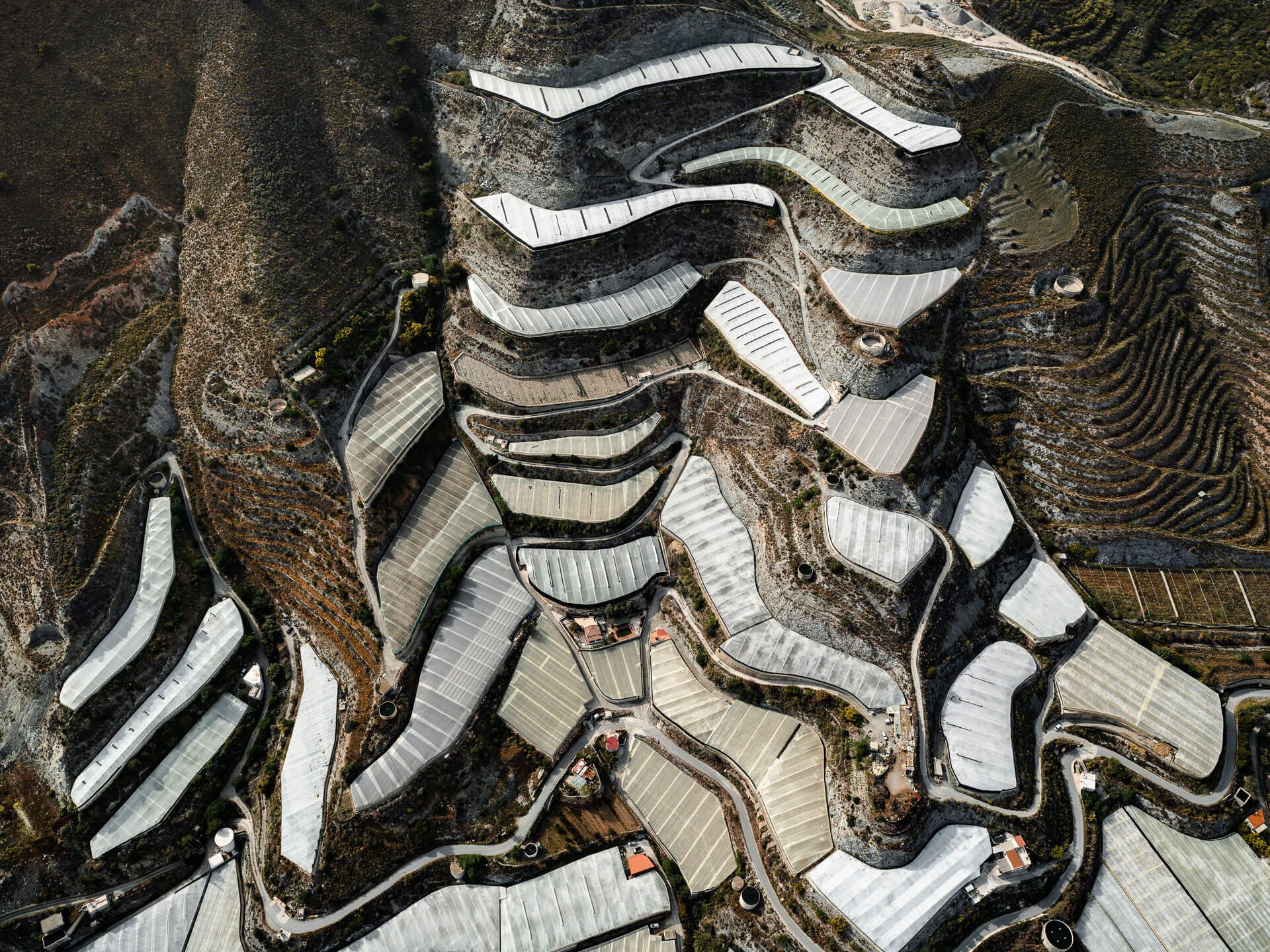
Aerial photographer Tom Hegen documents the extensive impact of human presence on earth and the traces we leave behind. His Greenhouse Series II deals with the Almería peninsula in southern Spain, where most of the available land—both flatland and ridges—is covered with greenhouses.

Tom Hegen Greenhouse Series II 09
Tom Hegen Greenhouse Series II 04

The stunning scenery reminds me of a tightly-built agricultural area or East Asia’s terraced rice fields, if the crops were all white, or perhaps snowy fields separated by hedges.

While I have some admiration for the productivity (30 times higher than average European farmland, apparently) and efficient land use, the accompanying plastic waste and pollution are unacceptable and unsustainable.

However, I could easily imagine seeing something like this on a not-quite-terraformed world in the Alien movies, for example, or one of the more dystopic locations in the Star Wars franchise.

Found via Colossal.

Images by Tom Hegen

Visual Inspiration pulls the unusual from our world to inspire design, story-telling, and worldbuilding. If stuff like this already exists, what else could we imagine?

Visual Inspiration: Whiskered Treeswifts

Whiskered treeswifts (Hemiprocne comata) live in various subtropical or tropical forests in Southeast Asia.

Macaulay Library David Cathy Cook Whiskered Treeswift

They remind me of swallows, but are more colorful. Especially the combination of grey plus blue in the wings and back appeals to me.

Setting personal color preferences aside, wouldn’t it be so much more interesting to read a secondary world fantasy story with, say, messenger birds that look like whiskered treeswifts rather than the uninspired and unoriginal corvids?

Yes, corvids are AMAZING birds, but they’re used EVERYWHERE. Could they not be replaced by something else in a fantasy story? Or at least made vibrantly colored?

Image by David and Cathy Cook via The Cornell Lab of Ornithology, Macaulay Library

The Visual Inspiration occasional feature pulls the unusual from our world to inspire design, story-telling, and worldbuilding. If stuff like this already exists, what else could we imagine?

Visual Inspiration: Steller’s Sea Eagle

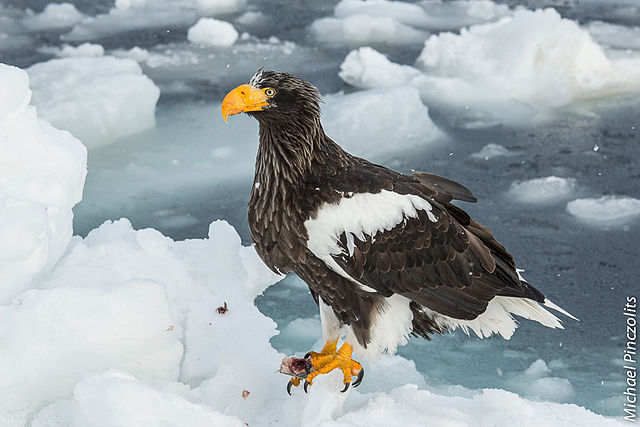
Here’s a bird of prey with a different look. The Steller’s sea eagle has white bands at the front of its wings, on its legs, and on its tail. It also has a short, thick yellow-orange beak.

Steller’s sea eagle at rest on ice, photograph by Michael Pinczlits via Wikimedia

The normal range of this eagle is along the coasts of northeast Asia from the arctic to Japan, but in recent years there have been sightings as far away as Texas and Nova Scotia.

Steller’s sea eagle hunting, photograph by Julie Edgley via Wikimedia

I’d love to see more birds like this in media, not just the usual suspects like the bald eagle and red-tailed hawk.

Visual Inspiration pulls the unusual from our world to inspire design, story-telling, and worldbuilding. If stuff like this already exists, what else could we imagine?