Quotes: Finns Were on Intimate Terms with Winter

After the Finnish centennial in 2017, I’ve been reading outside my usual periods of Finnish history, including on the Finnish Winter War (1939-1940, for 105 days against the USSR).

It’s easy for a modern Finn—at least this modern Finn—to get tired of reading endless takes, almost exclusively by foreigners, condemning the horribleness of the Finnish winter. Like in this excerpt from a book on the Winter War:

“One of the main factors that enabled the Finns to destroy forces much larger than their own was surely rooted in the differing psychologies of the men engaged on either side. To the Finnish soldier, the cold, the snow, the forest, the long hours of darkness were all factors that could be turned to his advantage. To say that the Finns were on intimate terms with winter is to voice an understatement. In Finland winter is the fact of life, and all else—the economy, the culture, the national psychology—is colored by, or derived from, that single overriding reality. The relationship between the Finns and winter constitutes something of a contradiction. On the one hand, winter makes life harsh and lonely and something crude. It is this aspect of living with winter, the cumulative effect of endless subarctic nights, the unearthly silences of the winter landscape, the harsh and marginal quality of rural life, that imparts to the Finnish character that dour and brooding quality that is so hard for foreigners to penetrate.”

– William Trotter, A Frozen Hell: The Russo-Finnish Winter War of 1939-1940 [original emphasis]

It is true that we stayed poor quite long and urbanised quite fast, pretty much during my parents’ generation, so it’s easy for me to lose perspective. Even as late as 1950s (I believe) it wasn’t unheard of for more remote farms not to have electricity. And our winters are undoubtedly long and dark compared to even central Europe, not to mention the Mediterranean and further south.

What bugs me, though, is that people seem to expect conditions like Siberia or Greenland. Hate to disappoint you, but our climate is greatly tempered by the Gulf stream and it isn’t that different from, say, New England. Another detail I’d like foreigners to really learn is that less than half of the country is arctic, and that means the rest is not. The southern coast is, in fact, part of the temperate broadleaf forest zone which covers most of central Europe, Britain, southern Scandinavia, and southern Russia.

I do grant that the Finnish character hasn’t caught up with the technological development, at least not yet: in general terms, we still tend towards melancholy despite now having world-class cities, transportation, and tech.

Trotter, William R. A Frozen Hell: The Russo-Finnish Winter War of 1939-1940. Chapel Hill, NC: Algonquin Books of Chapel Hill, 1991, p. 144.

Serving exactly what it sounds like, the Quotes feature excerpts other people’s thoughts.
Quotes: Willful and Obstinate Little Country

After the Finnish centennial in 2017, I’ve been reading outside my usual periods of Finnish history a little, including on the Finnish Winter War (1939-1940, for 105 days against the USSR).

In November 1939, just before hostilities broke out, a Finnish delegation met with the Soviets in Moscow to discuss land transfers and other concessions Russians demanded from Finland. The following tidbit is reportedly from the delegation’s last meeting with Stalin and Molotov.

“But after an hour of futile discussion it was obvious to everyone that the whole business had come to a dead end. Each side bade farewell to the other. Since the Finnish delegates were clearly just as upset by this outcome as the Russians, the final meeting ended with remarkably little display of animosity by anyone. The actual parting, in fact, was almost jovial. Molotov waived and said, ‘Au revoir!’ and Stalin shook hands all around and wished the Finns ‘all the best’. Then he went off to confer with his generals about how best to subdue this willful and obstinate little country.”

– William Trotter, A Frozen Hell: The Russo-Finnish Winter War of 1939-1940

It’s not clear whether “willful and obstinate little country” is Stalin’s phrasing or Trotter’s. I like it nevertheless—it tells you a very important thing of the Finnish character: as we say, a strong will takes you through a grey stone. 🙂 Or, in this case, it slows down a massive army significantly enough to retain the country’s independence, which none of the other small Baltic states were able to do.

Trotter, William R. A Frozen Hell: The Russo-Finnish Winter War of 1939-1940. Chapel Hill, NC: Algonquin Books of Chapel Hill, 1991, p. 18.

Serving exactly what it sounds like, the Quotes feature excerpts other people’s thoughts.
Happy New Year 2019!

2018 was a tough one for us, but it’s almost done now—phew!

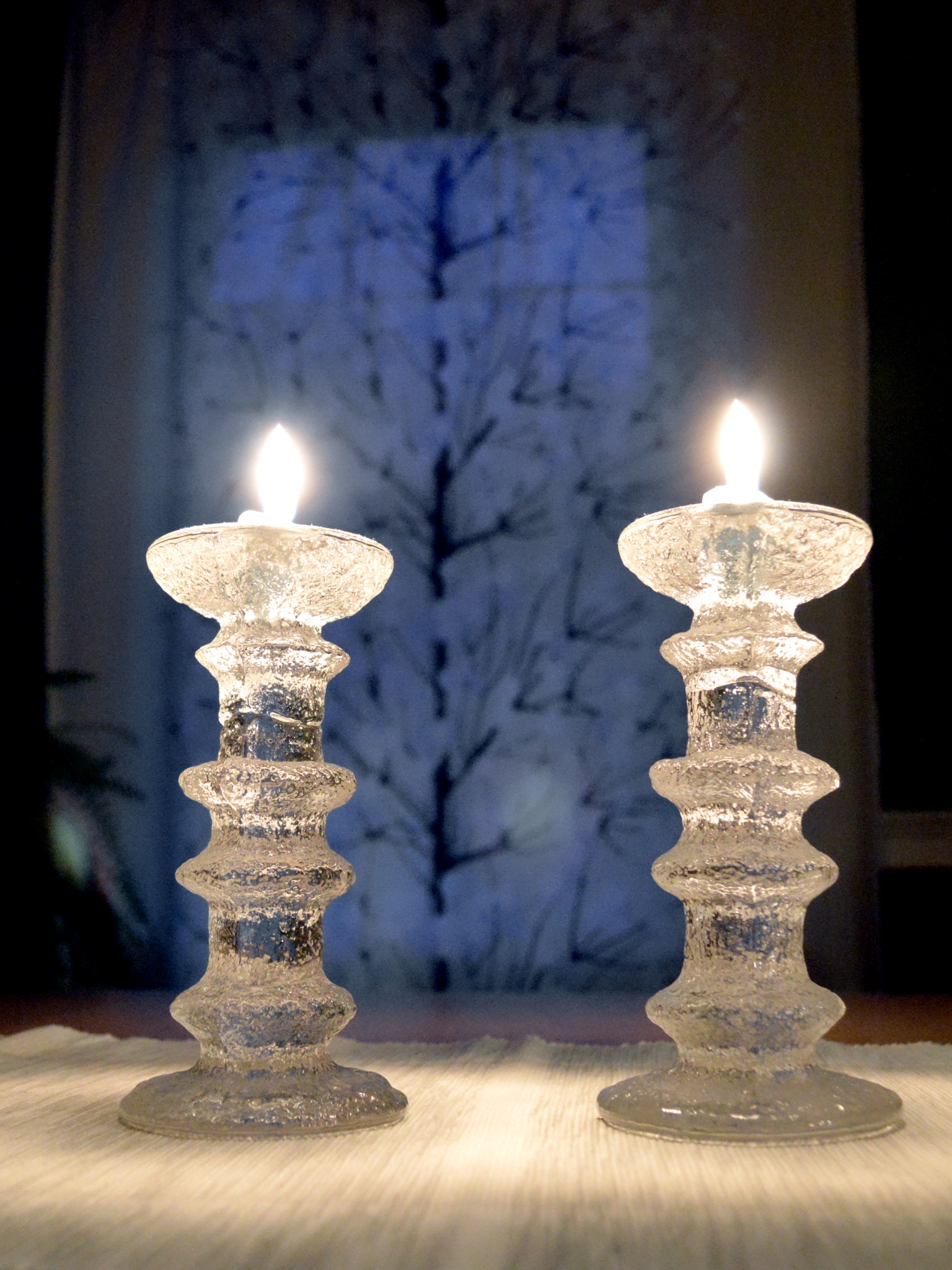
Two Candles for FIN Independence

May 2019 simply be better for you in any way you’d like to define it.

I’d like to finish with a quote from Executive Director and diversity educator Shay Stewart Bouley‏:

“Centering yourself and treating yourself with the love you give to others allows you to be in the work and have a healthy perspective. Less reactionary. I can extend grace when I’m well. I can see what’s real and what’s not.”

Stay safe.

Image by Eppu Jensen

Announcements from your hosts.

Quotes: [It’s] the Small Things … That Become Precious

“It’s the large things in life that drive us, that we measure ourselves by; but it’s the small things, the daily things that–that become precious to us.”

– Rowan in Rosemary Kirstein’s The Outskirter’s Secret

As I get older, I see more and more truth in this trite-sounding idea. Or you could say that it’s yet another way of putting the concept that life happens in the cracks of bigger things or while waiting for something grand to happen.

Kirstein, Rosemary. The Outskirter’s Secret. New York: Del Ray, 1992, p. 132.

Serving exactly what it sounds like, the Quotes feature excerpts other people’s thoughts.

Quotes: If Anyone Hated Me and I Hated Them

As you may know, speakers of Modern English are struggling to find a non-clunky and commonly accepted gender-neutral third person singular pronoun to replace the generic use of he or she.

The issue’s been periodically debated for decades, really, but lately the calls seem to have gained more urgency. There are many contenders, among them e / em / eir and ze / hir / hir.

Singular they may be gaining some ground, or at least growing in popularity here in the U.S. I’ve seen references to a long history of using they in that manner, but these references usually give no examples. (Maybe I just haven’t been reading the better articles? Also, one sometimes wonders why the British use of one has fallen out in other world Englishes.)

In any case, as an Anglo-Saxonist, it’s beyond my era and/or expertise. Nevertheless, I’m curious about any early examples. Here’s the oldest I’ve noticed so far, from a 1938 Hercule Poirot novel:

“Pilar said gravely: ‘If I had an enemy—if anyone hated me and I hated them—then I would cut my enemy’s throat like this….’”

– Agatha Christie: Hercule Poirot’s Christmas, p. 18 (original emphasis)

This example is great, because it’s clear and unquestionable. I’m pretty sure there are a few singular theys in Jane Austen’s novels, but I can’t remember where. Maybe it’s the perfect time for a re-read. 🙂

Christie, Agatha. Hercule Poirot’s Christmas. New York, NY: Black Dog & Leventhal, 1938.

Serving exactly what it sounds like, the Quotes feature excerpts other people’s thoughts.

Quotes: To End That Was to End Their History, Their Present, Their Future

“All that was left of a person’s life was recorded on paper, in annals, in almanacs, in the physical items they produced. To end that was to end their history, their present, their future.”

– Aster Grey in An Unkindness of Ghosts by Rivers Solomon

…Which is why the attitudes and words of those writing our world’s history matter; why social sciences, humanities, and languages matter (and not just STEM); why diversity, inclusion, and empathy matter.

Solomon, Rivers. An Unkindness of Ghosts. Brooklyn, NY: Akashic Books, 2017, p. 327.

Serving exactly what it sounds like, the Quotes feature excerpts other people’s thoughts.

A Way of Talking Which is Spoiled and Full of Errors

I cannot support those who make the grave mistake of thinking that a way of talking which is spoiled and full of errors, which revels in the looseness of its words, or frolics with childish expressions, or swells up with bombast, or tosses around inane sayings, or adorns itself with blossoms that fall if lightly shaken, or treats outrageous things as sublime, or runs mad under the name of free speech, will be most pleasing to the crowds.

Quintillian, The Institute of Oratory 12.10.73

(My own translation)

September is upon us, and as students head back to school, one can hear everywhere the clucking of tongues about kids these days who don’t know how to talk proper any more and say all kinds of weird and outrageous things. Thus it has ever been, all the way back two thousand years to the first-century CE Roman orator Quintillian, and before.

The kids are fine, everybody. They always have been. They always will be.

YOLO.

Serving exactly what it sounds like, the Quotes feature excerpts other people’s thoughts.

Quotes: Hating Didn’t Change Things

“Hating didn’t change things. The world went on regardless, far beyond the feeble lives of humankind. People could change only if they changed what lay in themselves.”

– Mai in Spirit Gate by Kate Elliott

I’ve been thinking of emotions this summer, especially negative ones. Partly it stemmed from having had to enforce my personal boundaries against an insistent violator and the outcomes from that, partly from the upsurge of racist and hateful behavior in the U.S.

I know hatred can feel like a driving force, but I also know how draining it is to live with such a strong emotion long term. I suppose in the end the universal “too much” rule of thumb applies: too much of one thing at the expense of others will lead to atrophy, both on small and large scale.

Elliott, Kate. Spirit Gate. New York, NY: Tor, 2006, p. 434.

Serving exactly what it sounds like, the Quotes feature excerpts other people’s thoughts.

Quotes: Trail Goes Down Between Two Hills

“[T]he Pima of Central Arizona have historically embedded in their landscape the stories, histories, and lessons of their way of life and culture. Thus, the Pima, when they wish to remind someone of their past, or of a lesson they would like that person to remember, make what seem to white people abstract references to locations on their territory, such as ‘Trail Goes Down between Two Hills.’ The target of their comments, however, will know what they mean.”

– Matthew Barlow, Griffintown: Memory and Identity in an Irish Diaspora Neighbourhood, 11

Historian Matthew Barlow here cites the work of anthropologist Keith Basso on how memory can be embedded in a landscape to explain how the Irish-Catholic population of Montreal imbued the working-class neighborhood of Griffintown with meanings important to their identity as Irish-Canadians, such that even after the neighborhood was redeveloped, Irish-Montrealers could invoke generations worth of memories by reference to churches, pubs, streets, and other landmarks.

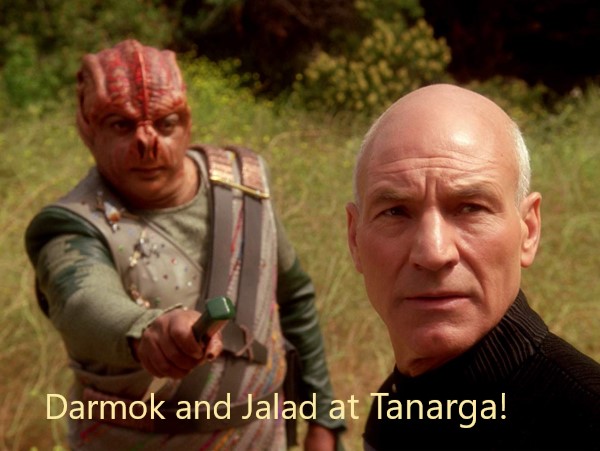
It’s a fascinating way of thinking about how we relate the landscape we live in, but, of course, the first thing I thought of was:

Image: Still from Star Trek: The Next Generation episode “Darmok” via IMDb, text added by Erik Jensen

Serving exactly what it sounds like, the Quotes feature excerpts other people’s thoughts.