Ok, thinking about it a little longer than half a second, it’s not surprising that there are a number of dragon designs for fireplaces and stoves for both indoors and out, in addition to firepits, fireplace screens, and andirons.
This particular one must be custom work and as such, it cannot be inexpensive. But, dang, is it handsome or what?
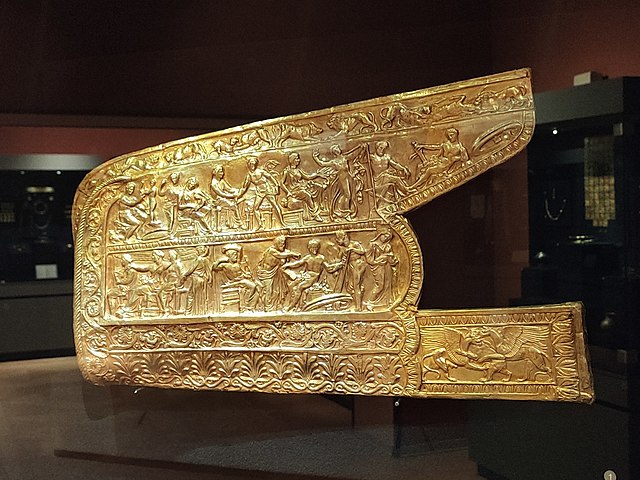
Here’s a beautiful work of art. This is a golden decorative panel from a gorytos, a combination quiver and bowcase that was used widely among ancient peoples of the steppes and the Iranian plateau. This example was found in Melitopol in southeastern Ukraine.
Gorytos, photograph by VoidWanderer via Wikimedia (found Melitopol, currently Kyiv; 4th c. BCE; gold)
Scythian artisans were expert metalworkers, and the Scythian elite valued high-quality metalwork, especially in gold, as emblems of status. This panel was made by Greek crafters serving the Scythian market. The central panel shows scenes from the life of Achilles, a Greek hero whose legends were sometimes associated with Scythia and whose warrior prowess was appealing to Scythian tastes. The outer panels feature decorative scenes of animals hunting, a popular motif in Scythian metalwork.
This piece is not just a beautiful work of art, it’s also an example of how art and artisans in antiquity crossed boundaries and bridged cultures.
Out There highlights intriguing art, places, phenomena, flora, and fauna.
Whiskered treeswifts (Hemiprocne comata) live in various subtropical or tropical forests in Southeast Asia.
They remind me of swallows, but are more colorful. Especially the combination of grey plus blue in the wings and back appeals to me.
Setting personal color preferences aside, wouldn’t it be so much more interesting to read a secondary world fantasy story with, say, messenger birds that look like whiskered treeswifts rather than the uninspired and unoriginal corvids?
Yes, corvids are AMAZING birds, but they’re used EVERYWHERE. Could they not be replaced by something else in a fantasy story? Or at least made vibrantly colored?
The Visual Inspiration occasional feature pulls the unusual from our world to inspire design, story-telling, and worldbuilding. If stuff like this already exists, what else could we imagine?
“The protostar itself is hidden from view within the ‘neck’ of this hourglass shape. An edge-on protoplanetary disk is seen as a dark line across the middle of the neck. Light from the protostar leaks above and below this disk, illuminating cavities within the surrounding gas and dust. “The region’s most prevalent features, the clouds colored blue and orange in this representative-color infrared image, outline cavities created as material shoots away from the protostar and collides with surrounding matter. The colors themselves are due to layers of dust between Webb and the clouds. The blue areas are where the dust is thinnest. The thicker the layer of dust, the less blue light is able to escape, creating pockets of orange.”
Wow. It’s really stunning, isn’t it?
Considering how much incredible data the James Webb has already gotten in its first year (and I’m not even properly following its work), I cannot conceive how much more it’ll provide in its decade-long planned mission.
There’s an interesting character in this scene from a Classic Maya vase. In the main scene, an aged underworld god is enjoying the company of a bevy of young women, but below him a rabbit scribe is keeping its eyes out and its ears perked while taking notes.
Scene from the “Princeton Vase” via Princeton University Art Museum (found Nakbe, Guatemala, currently Princeton Art Museum; 670-705 CE; ceramic with painted stucco)
None of the rabbits I’ve ever known in my life have been so practical!
Out There highlights intriguing art, places, phenomena, flora, and fauna.
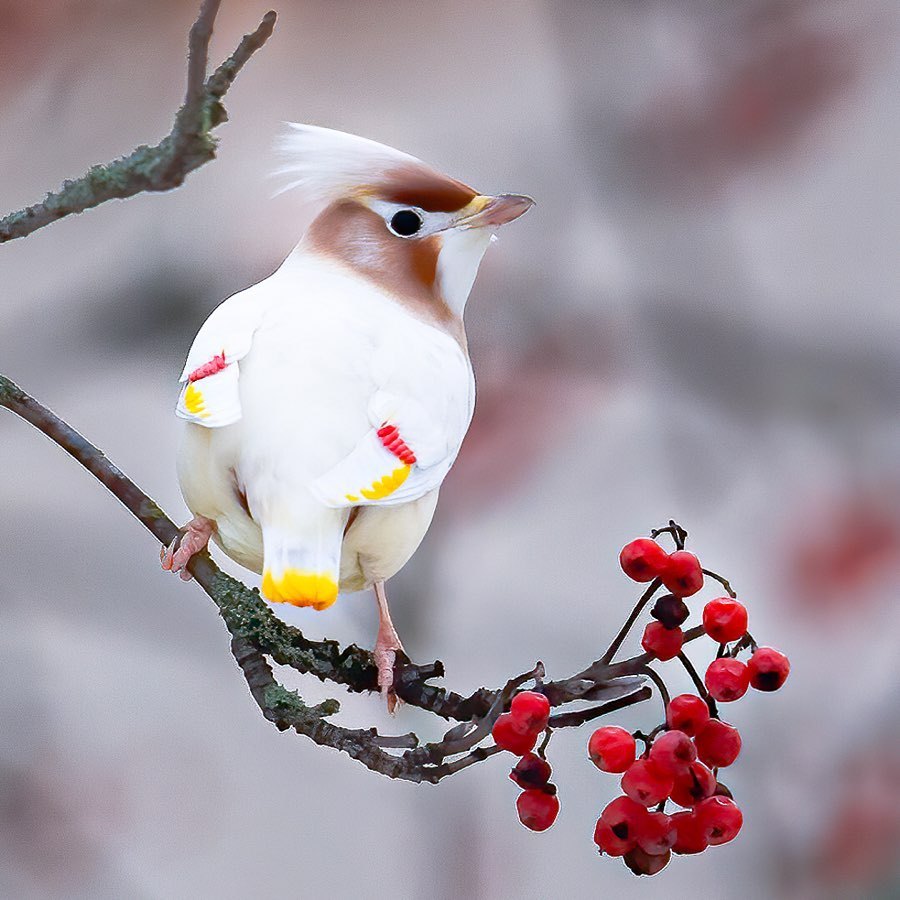
Leucism or pigmentation loss results in partial coloring in individuals, like this amazing Bohemian waxwing:
Very striking, isn’t it! A white waxwing would catch your eye anyway, but the red and yellow wing and tail tips are the truly arresting parts. Wow.
I just can’t but wonder how well one would do in nature. In northern Fennoscandia it would be okay in the winter, because even with the climate change the northern Nordic areas get snow, but summer might be tough.
The Astronomy Photographer of the Year contest is hosted by National Maritime Museum, part of the Royal Museums Greenwich in Britain. In 2022, the competition was run for the 14th time. This shortlisted photo by Alexander Stepanenko didn’t win the award for auroae, as astounding as it is:
Stepanenko’s shot was taken in Murmansk, Murmansk Oblast, Russia, and was highly commended by the jury.
Spectacular, isn’t it? As a Finn who grew up two hours south of the Arctic Circle, I’ve seen my share of northern lights, but never this, hm, I guess curvy is the right word. I know they undulate and can therefore make fancier shapes; I’ve only managed to see them fairly linear, though, or curving over quite a large swath of the sky, just like I haven’t seen any purple or yellow ones myself.
Come to think of it, there is a thin lining of white and purple at the right edge of this aurora. Wow! Is it any wonder that natural scenes like these have lead the earlier hominids and humans to think of magic and gods?
Image by Alexander Stepanenko, found via Colossal.
Out There highlights intriguing art, places, phenomena, flora, and fauna.
Flying cars have been dreamed of as long as cars have been around. If certain projects or companies are to be believed, flying cars will actually become available soon. For certain values of soon, anyway, and for certain values of car.
Current designs are as varied as the propulsion technologies and terminologies: flying cars, hovercars, gyrocopters, passenger drones, quadcopters, VTOL aircraft, eVTOL, maglev cars, personal air vehicles… Whatever you call them, aircraft that look less like airplanes and more like other small personal vehicles do seem be closer than ever to everyday reality.
For example, Volocopter’s air taxis have been demonstrated in Singapore (2019). The Dutch PAL-V Liberty gyroplane has not only test flown (2012) but also been approved for road use in Europe (2022). The AirCar by Klein Vision (pictured above) has completed a test flight between two cities(!) in Slovakia (2021) and received a certificate of airworthiness from the Slovak Transport Authority (2022). Reportedly, recent projects are also ongoing in Turkey and China. And, related to flying cars, a smart city and tourist destination being built in northwestern Saudi Arabia—dubbed Neom—has been planned for rail traffic and air taxis according to some reports.
Now, I’d assume all of the above is predicated on plentiful energy. How P*tin’s attempted extortion of Europe’s energy market (which has wider ripple effects, I’m sure) affects the development of flying cars will remain uncertain for some time yet.
I have to say, if flying cars do become common enough to be relatively easily available, I am tempted to get a pilot’s license (whatever kind might be required)—if I’m not too old by that time. (Planes are too high a hurdle, but small personal vehicles might just do for me.)
As a linguist, though, I’m mostly engaged with the question of a handy everyday name. That, too, is likely to be wrangled over at least as much as the technology side of their development.
Now that it’s cold again in the northern hemisphere, it doesn’t feel wrong to post about this phenomemon.
I discovered that in March 2022, storms in Sahara threw a lot of dust into the atmosphere, and winds carried it hundreds of miles away. Here’s a photo from a ski resort in the French Pyrenees, where the slopes were covered with a layer of reddish sand:
An amazing sight, isn’t it?
Although, as someone who’s grown up using sand and gravel on snow to stop motion, I do have to wonder at one thing: how on earth are you able to ski down these slopes?
(Being the wrong kind of Master of Science, I can only guess it has to do with the skier’s weight pushing the skis below the surface of the snow, therefore escaping the sand friction and still enabling skiing, but I don’t know.)
It’s a common misconception that the further you go in history, the poorer the materials and decorations used were. Materials were simpler, yes; complex metal alloys, synthetic textile fibres, or clean rooms, for example, were a long way in the future.
But the more we study extant material remains, the clearer it is that humans have always appreciated beauty in their surroundings and—if they possessed the means—decorated both themselves and their everyday environment. Case in point: Minoan mugs from ca. 1,500 BCE.
Mugs in similar shapes can easily be found in modern tea shops, even if we don’t use exactly the same decorative motifs in the same combinations or colors anymore.
What’s also fascinating is that the handles are exquisitely formed, with just about exactly the same range of variations you can find nowadays. These people clearly knew how to make a practical and pretty mug.







 Co-Geeking

You must be logged in to post a comment.