(A super-short recap of his post: the song Bara bada bastu, ‘Just having a sauna’, despite representing Sweden, is in fact performed by the Finnish comedy group KAJ. As a result of KAJ’s popularity, Swedes and Finns are finding a new spirit of Eurovision togetherness, and it has also brought some international recognition to the little-known Swedish-speaking minority in Finland.)
Here, as a companion post, is a listing of cultural references in KAJs song and in the performance.
I’m pulling some of this from my own experience growing up in Finland, but others from online commentary, or my Swedish-Finnish friends’ stories. This list is, therefore, likely not to be complete. Additions are very welcome!
KAJ—which rhymes with the English word guy—is made up of Kevin Holmström, Axel Åhman, and Jakob Norrgård, who all originally hail from Vörå, Ostrobothnia, Finland. The idea behind the song is to gently poke fun at how Swedes view Finns and our culture. Here we go! 🙂
Bara bada bastu by KAJ is the song representing Sweden in the Eurovision Song Contest 2025, and it’s been shaking things up in Sweden, Finland, and the Eurovision bubble as a whole. If you haven’t been following the run-up to Eurovision 2025, you may not know the story of Bara bada bastu and why it matters so much to so many people. Here’s a short introduction to get you caught up.
Finland, Sweden, and Swedish-speaking Finns
Finland and Sweden have a long and complicated history, grounded in the fact that what is today Finland was conquered by Sweden in the Middle Ages and ruled as part of the Swedish kingdom for centuries. Until recently, Finland was largely a poor and undeveloped area compared with metropolitan Sweden. The elite in Finland were traditionally Swedish transplants or had close social ties to Sweden. As a result, the typical Finnish stereotype of a Swede is a stuck-up, rich dandy, while the Swedish stereotype of a Finn is an uncultured, violent drunk. It is an old joke in Finland to say (of a hockey game, or some other equally serious contest) “I don’t care who wins as long as Sweden loses.”
Relations are not purely hostile. The two countries also have a history of cooperation and mutual support. Sweden supported Finland’s self-defense against and recovery from Russian invasion in World War II, and it has long been a commonplace that Finland is Sweden’s first line of defense. Despite this solidarity, there is still a lingering antagonism. When Finland and Sweden joined NATO in response to Russian aggression in Ukraine, it was important to both sides that they join together. It was also important to Finns that Finland was accepted into the alliance first.
Caught in the midst of this sibling rivalry are the Swedish-speaking Finns. Finland has a minority population who speak Swedish as their mother tongue, mostly concentrated in the cities in the south and along the western coast and islands. They make up about five percent of the population. Some are descended from the old Swedish aristocracy, but most of them these days are just ordinary folks, not much different from other Finns. Because of this population and Finland’s historical ties to Sweden, Swedish is the second official language in Finland, and Finnish-speakers are required to learn Swedish in school (just as Swedish-speakers are required to learn Finnish). Many Finnish-speaking Finns resent this language requirement, and some turn that resentment against their Swedish-speaking neighbors. Swedish-speaking Finns are stereotyped in much the same way as Swedes: rich, snobby, and stuck-up. While Swedish-speaking Finns are subject to this sort of low-level resentment and caricaturing at home, they are practically invisible to the rest of the world. Even in Sweden, not everyone knows that some of their Finnish neighbors speak Swedish as their first language.
The Eurovision Song Contest
Leaving aside the world of frosty Finns and snooty Swedes for a moment, let me introduce you to the next thing you need to know about: the Eurovision Song Contest. The Eurovision Song Contest (commonly just called Eurovision) is an annual multinational extravaganza in which countries from around Europe and beyond (G’day, Australia!) compete in putting on musical performances. The exact format and rules have changed frequently since the contest was first held in 1956, but if you’re not up on Eurovision, here are the essentials you need to know.
Every participating country sends one stage act with a song (not longer than three minutes).
Every country chooses its competing act in whatever way it likes. Many production and performance teams are international, and while at least some members of the overall team usually come from the country they are representing, nothing requires the artists appearing onstage to come from or be in any way connected with that country. (Write this down! It’ll be important later!)
The participating acts compete against one another in two semifinals. The viewing audience votes a set number of acts from each semifinal into the four-hour grand final, where they join a small set of acts from countries who get an automatic place by paying the major costs of the broadcast (currently: France, Germany, Italy, Spain, and the United Kingdom).
After all the acts have performed in the grand final, two sets of votes are collated. In each participating country, a jury made up of music industry professionals awards points to their top ten favorite songs. The top song gets 12 points, the second 10, and rest from 8 down to 1. The viewing audience in each country also gets to vote on their favorite songs, with points awarded in the same way. (Neither juries nor audience are allowed to vote for their own country.)
The points are announced onstage in dramatic fashion, and the country with the most combined points wins.
Traditionally, the winning country each year hosts the next year’s contest, although exceptions are sometimes made (such as in 2023, when Ukraine won the contest, but because of the ongoing war, the runner-up, United Kingdom, stepped in as host).
The Eurovision Song Contest has been a venue for good-spirited competition between nations, using music to foster both national pride and international solidarity in much the same way the Olympic Games use sports. It has also created its own subculture with traditions, factions, customs, and quirks of its own.
One of the long-running truisms of Eurovision is that juries and audiences tend to favor different kinds of songs. Conventional wisdom says that juries like serious songs that demonstrate artistic virtuosity and range, while audiences like wacky stage hijinks, fun gimmicks, and a danceable beat. Neither assumption is entirely borne out by the voting results, but Eurovision acts often try to court one set of votes or the other. The way points are divided often means that a song that would have won on the strength of audience votes doesn’t win because the juries favor something else, sometimes to ire of some fans who feel their favorite was cheated.
Finland has traditionally done quite poorly in Eurovision. The country has only one win to its credit, 2006, when the monster metal band Lordi unexpectedly pulled off a win in what is seen as the audience rebelling against a contest they felt had grown stale with too much bland, predictable pop music.
Finland has become a semi-reliable source of audaciously weird contributions to Eurovision, most of which fall absolutely flat in the voting results, but which appeal to some parts of the audience by standing out against a background of highly-polished pop.
Sweden, on the other hand, is a Eurovision powerhouse, with a current total of seven wins to its credit. Highly-polished pop is Sweden’s Eurovision bread and butter, and they pull it off better than most other countries, earning frequent recognition from juries. Sweden is home to a major pop music industry, and Swedish composers, lyricists, and choreographers are frequently found working on other countries’ Eurovision entries.
Recent Eurovision history
With the stage set, we turn to the recent history of the Eurovision Song Contest to see how these deeply-rooted forces have played out to lead us to this year.
In 2012, the Eurovision Song Contest was hosted in Azerbaijan and won by the Swedish singer Loreen with her song Euphoria. While Euphoria leaned a little to the weird side for Sweden, it was still highly produced and sung in English, making it easy for an international audience to follow. Euphoria swept both the audience and the juries.
Sweden took home the trophy again just three years later in 2015, when Austria was hosting. The singer Måns Zelmerlöw won with his song Heroes. Like the usual Swedish entry, Heroes was an immaculate pop anthem with a clever stage show, but it caught the heart of Europe. While Italy and Russia did better in the audience vote, Heroes soared with the juries, and Måns’s telegenic charisma won over even those fans who didn’t place Sweden first.
The next year, 2016, Sweden hosted the contest. Måns returned to the stage not just as a performer but as co-host of the festivities along with comedian Petra Mede. The 2016 show was carried off brilliantly and established Måns as not just a beloved past winner but one of the contemporary faces of the contest. He reappeared in several following contests as part of the general entertainment and the interval acts that fill up time while votes are counted. (2016 also gave us Peace Peace, Love Love, a loving parody of the contest itself, performed by Petra and Måns.)
In the following years, Finland and Sweden continued their usual patterns. Swedish songs routinely scored well with juries, and Finland’s songs occasionally excited some fans while mostly ending up near the bottom of the vote tallies. Then came Käärijä.
Finland chooses its Eurovision act with a televised national contest called Uuden Musiikin Kilpailu (New Music Contest, abbreviated UMK). In 2023, a young Finnish rapper/singer known as Käärijä had a runaway victory at UMK with his song Cha Cha Cha and quickly became a sensation among Eurovision fans. Cha Cha Cha was a challenging song: unabashedly weird, sung in Finnish rather than internationally-friendly English, and reflecting in complicated ways on Finnish alcohol and dance culture, but something about it spoke to a wide and adoring audience in Europe.
Sweden selects its competitor with Melodifestivalen (Melody Festival, casually known as Melfest or Mello), a multi-week tournament of songs which finally crowns a winner after several rounds. In 2023, Loreen returned to Eurovision by winning Melfest with Tattoo, a smooth jury-pleasing vocal performance.
Going into Eurovision 2023 (hosted in the United Kingdom on behalf of Ukraine), Finland was in the strange position of audience favorite. The outpouring of fan love for Käärijä and Cha Cha Cha was unheard-of in Finland’s Eurovision history. It quickly became clear that Tattoo was also gathering momentum. In the final voting tally, Finland came out way ahead with the audience, but the juries showed Finland much less love and delivered the victory to Sweden.
The 2023 contest felt like an encapsulation of the Finland-Sweden relationship: Finland the scrappy, weird underdog went up against Sweden the polished, practiced former winner, and the juries swung for Sweden. In the days after the contest there was a lot of resentment from Eurovision fans who felt the juries had cheated Käärijä of a win and the audience of their favorite. Finns felt deflated, and losing to Sweden rankled especially hard. Unkind things were said. In time, tempers cooled, and Finns and Swedes got back to the usual routine of quiet mutual disdain.
The 2024 contest, hosted again by Sweden, did what it could to soothe tempers. The Swedish hosts (Petra Mede again and actress Malin Åkerman) had plenty of self-deprecating jokes about Sweden’s Eurovision obsession, and Käärijä himself performed in one interval act.
It was a turbulent contest, however. Protesters demonstrated against Israel’s participation, and there were rumors about the Israeli delegation at the contest harassing other performers. The biggest cause of discontent, however, was when the Dutch performer, Joost Klein, an audience favorite and one of the leading contenders for victory, was suddenly booted from the contest after an altercation with a camera operator. The details of the incident are murky, but it was widely seen as an overreaction by Eurovision’s governing body. The live audience at the event was vocal with its displeasure, and in the aftermath many Finns enjoyed some schadenfreude at Sweden’s expense.
When do we get to the sauna brothers?
We’re almost there! I promise!
Finally we come to 2025. This year, Finland selected Erika Vikman’s Ich komme (I’m coming) to represent the country. Ich komme is a pumping, upbeat song celebrating a woman’s sexual desire. Sexiness is no stranger to the Eurovision stage, but it traditionally caters to the male gaze. Ich komme, though plenty sexy, is very clear in being about a woman’s own joy in her body and does it without disparaging men, either, a novelty for Eurovision. After UMK, Ich komme gathered some positive buzz, and, while probably not a winner, looks like it may do well at the contest.
And then came this year’s Melfest. As usual, it was a smörgåsbord of well-known Swedish pop music talent, but the star attraction was the return of Måns Zelmerlöw. Måns competed with Revolution, another highly-polished pop anthem in the same spirit as his winning Heroes.
Other great names in Swedish music filled the roster, including John Lundvik, a former Eurovision contestant who came close to winning in 2019. And then there was KAJ.
KAJ is a Finnish comedy group made up of three Swedish-speaking Finns from one of the smaller municipalities on Finland’s west coast. The group takes its name from the first letters of its performers’ names: Kevin, Axel, and Jakob. Although they were locally popular, they were not well known even on the national stage, and were practically unheard-of outside of Finland. KAJ was invited to join Melfest by one of the festival’s producers, and the trio figured it might be a good way to increase their name recognition and maybe score a few more gigs in Sweden but without much hope of anything more. KAJ joined the contest with Bara bada bastu (Just having a sauna), a light-hearted but sincere tribute to the joys of relaxing in sauna after a long day, performed in their own regional dialect of Finland Swedish. KAJ and Måns went up against each other in one of the last rounds of the competition and both passed through to the final.
KAJ stood out from the other performers in the final. Surrounded by media-sexy pop stars and their slickly-produced English-language international hits, the performers in KAJ were self-consciously nerdy, unfashionably authentic, and the only contestants so gauche, so outré, so utterly unsophisticated as to show up to the Swedish song-selection contest and sing in Swedish! Yet the audience loved them! When the votes were counted (Melfest uses a voting system similar to Eurovision’s), it came down to KAJ and Måns. It felt like Käärijä and Loreen all over again: the weird, provincial Finnish nobodies singing a niche but heartfelt little song in their own language up against Eurovision royalty with a whole national pop music industry behind him belting out a focus-group-perfect anthem in English.
And then the impossible happened: KAJ won! The juries broke just barely in Måns’s favor, but the Swedish audience went for KAJ by a million votes, giving KAJ the most audience votes in Melfest history! In this year’s Eurovision Song Contest, Sweden will be represented by a little-known humor group from Finland!
(Måns was less than gracious about his loss. One might have forgiven him for a few unguarded comments in the heat of emotion after a tense contest, but in the weeks since the Melfest final Måns’s wife has announced a divorce with allegations of abuse and drug use that have tarnished Måns’s reputation. Many Swedes are relieved that he will not be representing them on the international stage, especially not with the bitter aftertaste of 2024’s contest.)
The effects of the win have been remarkable to witness. Coming after the rancor of 2023 and chaos of 2024, Swedes and Finns are finding a new spirit of Eurovision togetherness. KAJ’s win has gone some way to patch over old resentments and break down timeworn stereotypes. It has also brought some international recognition to the little-known Swedish-speaking minority in Finland.
This year’s Eurovision Song Contest will be held in Switzerland in the middle of May. We will see what the rest of Europe makes of Ich komme and Bara bada bastu. At this moment, the boys in the sauna are running strong for the top spot, and if they win, then for once Finns will be just as happy for Sweden’s victory as the Swedes are.
An occasional feature on music and sound-related notions.
In Finland, May the first is known as vappu (Finnish) or as vappen (Finnish Swedish), and it is one of the four biggest holidays in the country. Sometimes it’s translated into English as Walpurgis night (as opposed to May Day). I’d always just shrugged my way past that weird translation until I ran into the history of vappu: the phrase comes from Saint Walburh’s Day.
Saint Walburh was an English nun, missionary, and abbess in the 8th century. She was a part of Saint Boniface’s famous mission to German lands beyond the old Rhine-Danube frontier. The tidbit on Walburh below comes from Kathleen Herbert’s work:
“For example, St. Walburh trained at Wimborne in Dorset, then went with her two brothers to join the German mission. She became abbess of the double monastery of Heidensheim, which had a distinguished scholarly record. Her feast day is May 1st, so in her district the rites of Spring become traditionally celebrated as Walpurgisnacht. This is not a sarcastic joke but a tribute to her power, ranking her locally with such mighty ones as St. Michael and St. John the Baptist.”
– Kathleen Herbert, Peace-Weavers & Shield-Maidens: Women in Early English Society
Clearly Saint Boniface is the more prominent character of the two in history, but it’s intriguing to me that Saint Walburh’s name is still, well over a thousand years after her death, attached to a spring festival celebrated on the day of her canonization. (Granted, it helps that May Day had long been celebrated as one of the transition points in the yearly cycle; cf. Beltane).
So, in a minor way, even though we mostly don’t care or remember in the middle of everyday hullabaloo, we keep passing her name to future generations. That’s more than Saint Boniface can boast in Finland.
I sometimes wonder how much else in our culture that’s passed on without remark has similar hidden histories. I suspect more than we’d imagine.
Anyway. Hyvää vappua! Glada vappen! Happy May Day!
Herbert, Kathleen. Peace-Weavers & Shield-Maidens: Women in Early English Society. Anglo-Saxon Books, 2013, p. 44.
In Live and Active Cultures we talk about cultures and cultural differences.
Daisugi is a forestry management technique reminiscent of pollarding and bonsai that produces straight logs without killing the tree. Developed some 600-500 years ago in Japan, it’s still being used to harvest sustainable, durable logs.
Basically, some of the top shoots are pruned so that they’ll grow straight up, and the shoots only are collected when they reach the desired height. It’s not a fast method, as it takes decades to be able to produce logs, but reportedly they come out stronger, more flexible, and knot-free. And the tree stays alive.
Also, the daisugi-managed cedars make amazing shapes in the woods! They would be so interesting in a speculative or fantasy story—or any story, really. Below are a few examples.
Just another example of how ingenious we people are in manipulating our environment. 🙂
Casey (otherwise known as hot.glue.burns on Instagram) made a Native American variant of Captain America’s costume for the 2019 San Diego Comic-Con. And the cosplay is both inventive and gorgeous!
“I originally brainstormed this costume in late 2015, but I really started rolling on production this last year, once I committed to this years SDCC… My main goal was to make a Native American variant of a fan-favorite character. I was immediately drawn to Captain America because of everything he symbolizes as basically the poster boy of a nation. To me it was the perfect parallel. And once I visualized the red and white bone breastplate on my abdomen, I knew this was something I had to see through.
“A lot of old school leather work with the awl! The majority of the armor was made from a base of 6mm EVA foam with 3 oz deer hide glued over it. The pieces were then stitched together with sinew or leather lace. Using this technique allowed me to form curves and build the necessary bulk of the armor pieces while also getting the suede textures I was looking for. And a whole lot of beading!”
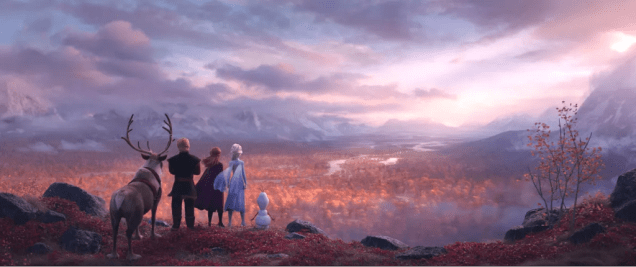
Today is the premier for the animated sequel Frozen II here in the U.S. Unlike most Di$ney princess movies*, I will be seeing this one during its theatrical release for a particular reason.
In the story, Anna and Elsa et al. travel to the north and meet a people resembling the Sámi. For their research and inspiration, the Walt Disney Animation Studios not only talked with Sámi people but actually signed an agreement with the Sámi to do it in a respectful, collaborative way.
The Sámi are the only indigenous people within the European Union area. They currently live in the northern reaches of Norway, Sweden, and Finland, and the Kola Peninsula in northwestern Russia.
Disney even invited some members of the Sámi Parliaments to U.S. to see the movie at the world premier, meet some of the makers, and tour the animation studio.
The most exciting part for my linguist brain is that the studio will record and release a version dubbed in Northern Sámi, the largest of the Sámi languages. The voice actors are drawn mainly from Sweden and Norway, among them the acclaimed Sámi musician Mari Boine, but also one Finn. (Yay!)
While it’s true they aren’t very numerous these days (partly thanks to racial, linguistic, and cultural discrimination), the Sámi do exist and do have a living culture. (Just check out the music scene for one incredibly vibrant aspect—yoik comes almost in all styles now!) I grew up two hours south of the Arctic Circle, and the Sámi were my classmates, neighbors, and teachers. For me it’s delightful that Disney took the time to research, listen, and respectfully pay homage to people I grew up with.
Undoubtedly I will also enjoy scenery that reminds me of trips to Lapland even if the first reports say the northern mountains look too young and rugged to be based on the fells on the Finnish side of the border. 🙂
*) The only other exception is Moana, which was also produced in cooperation with indigenous peoples.
Images: Per-Olof Nutti, Aili Keskitalo, Åsa Larsson Blind, and Tiina Sanila-Aikio with their daughters at the world premier of Frozen II by Siv Eli Vuolab / Sámediggi via Yle. Three members of the northern herder tribe from Frozen II via Yle. View overlooking a northern valley from Frozen IIvia Yle.
In Live and Active Cultures we talk about cultures and cultural differences.
“These ingenious creations were built up from the lake bed by piling layers of mud, decaying vegetation and reeds. This was a great way of recycling waste from the capital city Tenochtitlan. Each garden was framed and held together by wooden poles bound by reeds and then anchored to the lake floor with finely pruned willow trees. The Aztecs also dredged mud from the base of the canals which both kept the waterways clear and rejuvenate [sic] the nutrient levels in the gardens.”
Apparently the chinampas were separated by channels, and canoes were used for transport. In addition to food crops and flowers grown, fish and birds drawn to the chinampas were caught for food as well.
What an incredibly smart feature to engineer! It also strikes me as a fantastic (no pun intended), pragmatic thing to adapt into a SFFnal world.
The Visual Inspiration occasional feature pulls the unusual from our world to inspire design, story-telling, and worldbuilding. If stuff like this already exists, what else could we imagine?
After the Finnish centennial in 2017, I’ve been reading outside my usual periods of Finnish history a little, including on the Finnish Winter War (1939-1940, for 105 days against the USSR). Here’s another tidbit that caught my attention:
“Finns know how to listen to the stillness in the great forest; for them it is never absolutely silent, and they can read considerable information about their environment from the sounds of which outsiders are not even aware. Finns, in short, can adapt to their environment because they feel a part of it.”
– William Trotter, A Frozen Hell: The Russo-Finnish Winter War of 1939-1940
I know people who love water, to be on and in the water, whether a lake or an ocean. I don’t. It’s nice to look at or splash in now and then, don’t get me wrong, but I don’t adore it.
I’m in love with woods.
I need trees to feel whole and at peace, and preferably wild instead of planted and pruned trees. Whether in the cool, clear incandescence of summer nights, or wet, loamy autumn rain, or the crisp, brisk dark of winter, or, finally, the unhurried, budding, green spring, Finnish woods are dear to me.
Trotter, William R. A Frozen Hell: The Russo-Finnish Winter War of 1939-1940. Chapel Hill, NC: Algonquin Books of Chapel Hill, 1991, p. 145.
Serving exactly what it sounds like, the Quotes feature excerpts other people’s thoughts.
After the Finnish centennial in 2017, I’ve been reading outside my usual periods of Finnish history, including on the Finnish Winter War (1939-1940, for 105 days against the USSR).
It’s easy for a modern Finn—at least this modern Finn—to get tired of reading endless takes, almost exclusively by foreigners, condemning the horribleness of the Finnish winter. Like in this excerpt from a book on the Winter War:
“One of the main factors that enabled the Finns to destroy forces much larger than their own was surely rooted in the differing psychologies of the men engaged on either side. To the Finnish soldier, the cold, the snow, the forest, the long hours of darkness were all factors that could be turned to his advantage. To say that the Finns were on intimate terms with winter is to voice an understatement. In Finland winter is the fact of life, and all else—the economy, the culture, the national psychology—is colored by, or derived from, that single overriding reality. The relationship between the Finns and winter constitutes something of a contradiction. On the one hand, winter makes life harsh and lonely and something crude. It is this aspect of living with winter, the cumulative effect of endless subarctic nights, the unearthly silences of the winter landscape, the harsh and marginal quality of rural life, that imparts to the Finnish character that dour and brooding quality that is so hard for foreigners to penetrate.”
– William Trotter, A Frozen Hell: The Russo-Finnish Winter War of 1939-1940 [original emphasis]
It is true that we stayed poor quite long and urbanised quite fast, pretty much during my parents’ generation, so it’s easy for me to lose perspective. Even as late as 1950s (I believe) it wasn’t unheard of for more remote farms not to have electricity. And our winters are undoubtedly long and dark compared to even central Europe, not to mention the Mediterranean and further south.
What bugs me, though, is that people seem to expect conditions like Siberia or Greenland. Hate to disappoint you, but our climate is greatly tempered by the Gulf stream and it isn’t that different from, say, New England. Another detail I’d like foreigners to really learn is that less than half of the country is arctic, and that means the rest is not. The southern coast is, in fact, part of the temperate broadleaf forest zone which covers most of central Europe, Britain, southern Scandinavia, and southern Russia.
I do grant that the Finnish character hasn’t caught up with the technological development, at least not yet: in general terms, we still tend towards melancholy despite now having world-class cities, transportation, and tech.
Trotter, William R. A Frozen Hell: The Russo-Finnish Winter War of 1939-1940. Chapel Hill, NC: Algonquin Books of Chapel Hill, 1991, p. 144.
Serving exactly what it sounds like, the Quotes feature excerpts other people’s thoughts.
In the U.S., and indeed more widely in the Anglo-American world, Meriwether Lewis and William Clarke are known for their two-year expedition of the Louisiana territory (purchased from France in 1803) and the land beyond the “great rock mountains” in the west.
Less commonly remembered in cursory mentions is the extent of Lewis and Clarke’s interactions with local Native Americans. (Apart from Sacagawea, who is known at least in the U.S.) The whites didn’t just exchange gifts or talk about trade or clash with the local population; they received invaluable help and information (like when the expedition wintered with the Mandan people in present-day North Dakota).
Now it seems that western historians need to re-evaluate that extent.
According to The Jefferson Watch, cartographers have identified at least ten places in the journals of Lewis and Clarke where the captains talk about the maps by Native American hosts to help them figure out the lay of the land.
Christopher Steinke, at the time a graduate student at the University of New Mexico, found one of those maps at the archives of the Bibliothèque nationale de France (BnF) in Paris. It was drawn by Inquidanécharo, a chief of the Arikara (in French, Ricara), who was apparently also known as Too Né.
“The Bibliothèque nationale de France contains a hitherto unnoticed map attributed to Inquidanécharo, a Ricara chief. Lewis and Clark knew him as Too Né, an Arikara village leader who accompanied them upriver to the Mandan and Hidatsa villages in 1804. The map, which Too Né showed to playwright and artist William Dunlap when he visited Washington in 1806, is the most detailed surviving Indian representation of the Great Plains from this period. It invites scholars to reorient early American exploration and cartography from indigenous perspectives. Too Né interpreted his map as a work of history and cartography and situated the American explorers in the historical and religious landscape of the Arikara people.”
In “Here is My Country”, Steinke outlines some of the main features of Inquidanécharo’s map, and recounts some history surrounding it. He also lists a few other Native American maps from the eighteenth and early nineteenth centuries.
What most struck me, though, is that Native American maps seem to have contained more information than just geographical details—they also depicted cultural connections and ethnographical information.
I knew Native Americans used symbols and pictograms, and had to have—like people everywhere—a way of talking about and remembering locations outside their immediate surroundings. I had no idea, however, that Native American cartography was as polished or wide-reaching as it was (a hint for the Finnish school system), let alone that their maps might still be extant. Fascinating!





 Co-Geeking

You must be logged in to post a comment.