Nitocris’ Vengeance

Here’s a story told by the Greek historian Herodotus about an ancient queen of Egypt, as told to him by the Egyptian priests he was interviewing about their country’s history:

The priests read out from a papyrus scroll the names of three-hundred and thirty kings. In all these generations there were eighteen Ethiopians and one Egyptian woman; the rest were Egyptian men. The woman’s name was Nitocris… They said that she avenged her brother. The Egyptians had killed him when he was their king and then given the kingship to her, so she slaughtered many Egyptians by a trick to avenge him. She had an underground chamber built and invited those Egyptians whom she knew to be most guilty of her brother’s death on the pretense of an inaugural feast, although she was actually planning something else. As they were feasting, she had the river let in to flood the chamber through a great hidden channel.

– Herodotus, Histories 2.100

My own translation

Like Herodotus’ other stories about Egypt, this shows an interesting mix of actual historical knowledge with folklore, probably both Egyptian and Greek.

It is very difficult to verify the number of kings Herodotus’ interviewees listed for him. Earlier Egyptian records of kings have survived only in very fragmentary forms and later writings about Egyptian history, even those by Egyptians, tended to rely on Herodotus. When Egyptian dynasties recorded the reigns of their kings, they had as much incentive as an other politicians to exaggerate some things and erase others. When Herodotus was traveling in Egypt, the country was under Persian rule and not particularly happy about it. The priests that Herodotus talked to had their own reasons to encourage a certain view of Egyptian history.

Nevertheless, in rough terms, 330 is a reasonable estimate of the number of kings who had ruled in Egypt over 3,000 years. The priests’ count also includes a number of “Ethiopian” kings, who correspond to the Twenty-Fifth Dynasty, when Egypt was conquered and ruled by Nubians for about a hundred years between the mid-eighth and mid-seventh centuries BCE.

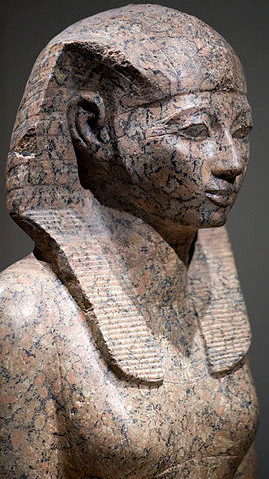
That leaves Nitocris herself. The name may be a garbled form of a very early king who had otherwise been forgotten about by Herodotus’ time. We now know from ancient inscriptions that more than one woman ruled Egypt, whether as regents for their sons or as pharaoh themselves. The most famous of these female pharaohs is Hatshepsut, who ruled from 1478 to 1458 BCE, just over a thousand years before Herodotus visited Egypt. The “underground chamber” mentioned in the story may be a distorted recollection of Hatshepsut’s mortuary temple, which was built partially into the side of a cliff and which is surrounded by the underground tombs of later pharaohs who chose to be buried at the same site (now known as the Valley of the Kings).

Hatshepsut’s successor, Thuthmosis III, had her name stricken from monuments and her public statues destroyed—not necessarily out of any personal animosity, but simply because the existence of a female predecessor may have threatened the legitimacy of his own and his descendants’ reign. The erasure of her public memory, though, may have opened room for some of the more outlandish and dramatic elements of her legend to grow (and may explain the loss of her name).

At the same time, the themes of family chaos, murder, and revenge that run through this story are very much in tune with Greek mythology. Whether Herodotus invented them or the priests enlivened the tale, they seem calculated to appeal to a Greek audience. There may well be some of both: the priests may have adapted their native oral tradition to better suit their Greek interviewer, while Herodotus may have amplified the familiar elements of the story as he retold the story for his Greek readers.

It may best for us to see the story of Nitocris as a kind of collaborative Greco-Egyptian historical fiction.

Image: Portrait statue of Hatshepsut, photograph by Rob Koopman via Wikimedia (Rijksmuseum van Oudheden, Leiden; granite; c. 1450 BCE)

History for Writers is a weekly feature which looks at how history can be a fiction writer’s most useful tool. From worldbuilding to dialogue, history helps you write. Check out the introduction to History for Writers here.

A Little Droid Love for Star Wars Day

When a droid meets a droid…

Star Wars inspired crochet patterns by Luvbug026 via Etsy

Sometimes they feel a special connection…

BB8 and R2-D2 romance t-shirt via Teepublic

And that leads to…

R2-D2 and BB8 wedding cake topper by SpecialDesignForYou via Etsy

Now, personally, I always thought of R2-D2 as a precocious kid. When I saw The Force Awakens, BB8 seemed more like a very smart dog. But, hey, if other people want to see them as friends and soulmates, who am I to argue?

Happy Star Wars Day, everyone! May the Fourth be with you!

In Character is an occasional feature looking at some of our favorite characters from written works and media to see what drives them, what makes them work, and what makes us love them so much.

Roman Ducky, You’re the One…

You make the caldarium oh so fun.

Roman ducky, I sing of arms and you!

This cute little fellow wearing a legionary’s helmet and lorica segmentata armor comes from the British Museum shop, where you can also find his Egyptian, samurai, Viking, and Greek god pals.

Bathing was important in Roman culture, not just for personal cleanliness but as a social activity. Friends would meet at the baths to exercise, swim in the large cold pools, or relax in the hot pools. Some Roman baths had steam rooms similar to the Finnish sauna. Even at the farthest edge of the empire, Roman forts along Hadrian’s Wall in northern Britain had bathhouses. Many were built with sophisticated under-floor heating to keep them toasty even in the winter.

One crucial piece of bathing technology the Romans, lacked, however, was the rubber duck. They never knew what they were missing.

Hey, look! We found a thing on the internet! We thought it was cool, and wanted to share it with you.

Rating: Leverage, Season 2

We’ve been rewatching and rating Leverage and we’ve got season 2 under our belts now. (For more on how our rating system works, see here, which also covers season 1 of Leverage.) Here’s our take on the season.

Leverage, season 2

  1. “The Beantown Bailout” – 5.5
  2. “The Tap-Out Job” – 2.5
  3. “The Order 23 Job” – 6
  4. “The Fairy Godparents Job” – 4.5
  5. “The Three Days of the Hunter Job” – 8
  6. “The Top Hat Job” – 2
  7. “The Two Live Crew Job” – 8
  8. “The Ice Man Job” – 8
  9. “The Lost Heir Job” – 7
  10. “The Runway Job” – 5.5
  11. “The Bottle Job” – 5.5
  12. “The Zanzibar Marketplace Job” – 4
  13. “The Future Job” – 7
  14. “The Three Strikes Job” – 8
  15. “The Maltese Falcon Job” – 4

This season is a lot of highs and lows. Several weak episodes are balanced out by a number of strong ones. The average for the season is 5.7, which is respectable but a step down from season 1, which averaged just under 6. The show was finding its footing this season and striking out in some new directions, which sometimes paid off but other times just fell flat.

We have a four-way tie for the best episode, all at a solid 8. In “The Three Days of the Hunter Job” the team manufactures a government conspiracy in order to discredit a ruthless reporter. In “The Two Live Crew Job,” they compete with another team (featuring Wil Wheaton as a pain-in-the-ass hacker!) to steal a priceless painting. In “The Ice Man Job,” Hardison, the hacker, gets in over his head while trying to show that he can get out from behind the computer and do an in-person grift, and the rest of the team has to improvise a heist around him to get him out. In “The Three Strikes Job,” the whole team get in over their head as they get tangled up in a larger plot involving the mob, the FBI, and a corrupt mayor. All of these episodes play with the heist/con formula in interesting ways and give the actors a chance to stretch their wings and tackle something new. In these episodes, we really see the creative team’s willingness to tinker with the mechanics of the procedural format pay off well.

The lesser episodes of the season also show attempts to vary the formula, but they don’t come off as well. The worst of the season is “The Top Hat Job,” at only 2. In this episode, the heist is pretty simple and most of the screentime is taken up by the team’s distraction event: Nate, the most mediocre and uninteresting character on the team, putting on a mediocre and uninteresting magic show.

Any Leverage fans out there want to weigh in? Got a different pick for the best or worst episodes of the season? Let us know in the comments!

Image: Leverage cast via IMDb

In the Seen on Screen occasional feature, we discuss movies and television shows of interest.

Keep Out

The image above is a papyrus sign found near an ancient temple complex at Saqqara, Egypt. The original is 36 cm (a little more than a foot) wide. The text is in Greek and reads:

By order of Peukestes:

No entry.

This is a sacred enclosure.

My own translation

What does this sign mean and why was it posted in Greek somewhere near an Egyptian temple?

The name Peukestes helps us towards an answer. There is one important Peukestes we know from the sources with a connection to Egypt. In 332 BCE, Alexander the Great arrived in Egypt with his Greek and Macedonian army. The Egyptian people had lived unhappily under the rule of the Persian empire for generations and they greeted the newcomers as liberators. When Alexander moved on the next year to continue his conquest of Persia, he left Egypt under the charge of two of his commanders, Balakros and Peukestes. (Arrian, Anabasis of Alexander 3.5.5)

The Greeks and Macedonians of Alexander’s army had Egyptian good will on their side and they did not want to lose it. At the same time, Egypt and its great monuments were a source of endless fascination to foreign visitors in antiquity, just as much as today, and not all foreigners knew how to behave with respect. Centuries earlier, Greek mercenaries in the service of the Egyptian pharaohs had carved graffiti into the stones of ancient temples. Balakros and Peukestes, trying to hold onto a valuable province through the turmoil of liberation, certainly did not want any of that going on.

The sign was probably originally posted outside of the temple complex at Saqqara as a warning to any Greek troops indulging in a bit of sight-seeing that they had better be on their best behavior, including staying out of places that were sacred to their Egyptian friends.

Multicultural and cross-religious encounters are nothing new in the world. People have been thinking about the problem of how to get along peacefully with those whose ways of life are different from ours for thousands of years. Respecting other peoples’ religious traditions isn’t just polite, it’s sound policy.

Reference for the papyrus: Eric G. Turner, “A Commander-in-Chief’s Order from Saqqara,” Journal of Egyptian Archaeology 60 (1974): 239-42.

History for Writers is a weekly feature which looks at how history can be a fiction writer’s most useful tool. From worldbuilding to dialogue, history helps you write. Check out the introduction to History for Writers here.

History Doesn’t Look Historical

It’s an unavoidable fact that when we look at historical artifacts, we’re looking at things that are many years old, sometimes centuries or millennia. Physical objects, even those made of enduring materials like metal or stone, are changed by the processes of time. Exposure to light, moisture, changing temperatures, air pollution, wind, water, and other effects works changes on artifacts that can range from subtle to drastic. Our sense of what history looks like is shaped by things that no longer look like what they were when they were first being made, admired, and used by people in their daily lives.

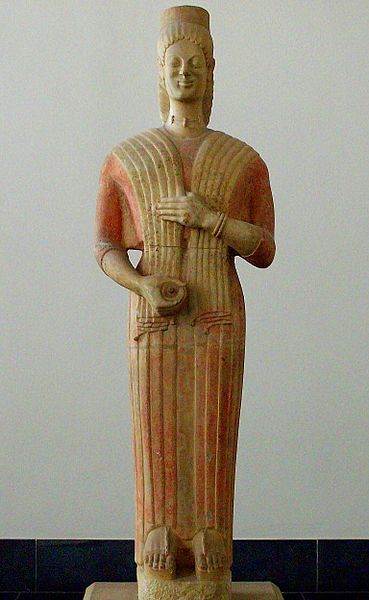
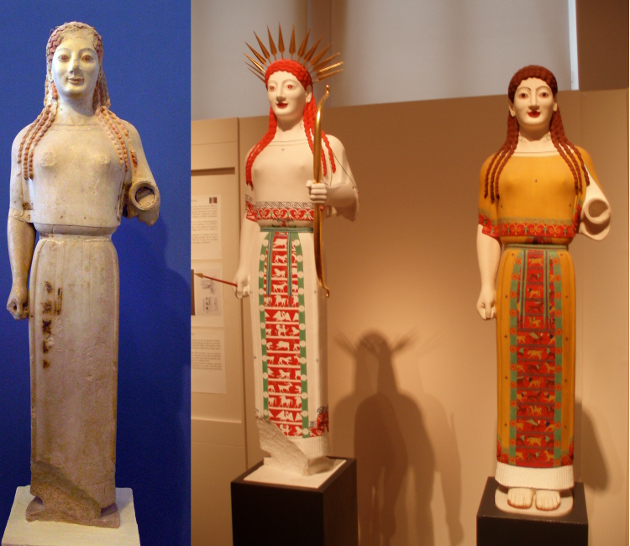
Take, for example, the sculptures and architecture of ancient Greece. Our perception of ancient Greek art is shaped by the white marble statues and temples that remain today, but the originals were not white. We know from ancient descriptions and a few pieces with surviving traces of paint that the stone buildings and sculptures of ancient Greece were brightly colored.

Examples like this statue of a woman, with traces of paint on her dress, suggest what such a statue might have originally looked like.

Statue of a woman (kore), photograph by Nemracc via Wikimedia (Keratea, Greece, currently Pergamon Museum, Berlin; 580-560 BCE; marble)

Evidence like this makes it possible to attempt to reconstruct what statues of this type looked like when first created. The two reconstructions on the right here offer two possible interpretations of what the original, on the left, may have looked like when it was new.

Statue of a woman (kore) and two reconstructions, composite of photographs by Marsyas, via Wikimedia (original: Acropolis, Athens; c. 530 BCE; marble; reconstructions: Acropolis Museum, Athens)

The striking colors of the past are not just a phenomenon of ancient Greece. At Stirling Castle, in Scotland, a recent restoration project has brought back the original rich yellow color of the walls of the medieval great hall, which was determined from traces of ochre mixed with the remains of the lime wash applied to the stone. You can see the striking contrast between the restored great hall in the background and the bare stone of the buildings in front.

Stirling Castle, photograph by dun_deagh via Flickr (Stirling, Scotland; c. 1500-1600; stone and lime wash)

Studying history requires an act of imagination. Just as we have to imagine ancient monuments are artifacts new and fresh, not as the worn-out relics we see today, we also have to imagine peoples of the past as vibrant, complicated, living societies, not the stilted, dry facts of textbooks. Fiction has a great value to the student of history, as it helps us imagine ourselves into the lives of people different from ourselves. Our history is always somebody else’s daily life.

History for Writers is a weekly feature which looks at how history can be a fiction writer’s most useful tool. From worldbuilding to dialogue, history helps you write. Check out the introduction to History for Writers here.

Rating: Leverage, Season 1

We like to watch tv together and we enjoy rewatching the best episodes of series we’ve seen before, but how do you remember which episodes were worth seeing again and which to skip? We came up with a solution to that problem: now when we watch a series, we rate each episode. Each of us gives each episode a rating from 0 to 5, like this:

  • 0 – Terrible, I never want to see it again.
  • 1 – Pretty bad, but had a few redeeming features
  • 2 – Not awful, but kind of lacking
  • 3 – Decent, solid, nothing special
  • 4 – Pretty good
  • 5 – Awesome!

(We also sometimes give half-points, so a 3.5 might be for an episode that is a little better than average.) Then we add our scores together to get a total rating from 0 to 10. We note this score down on a slip of paper that we keep with our discs. (We like to watch shows on disc. We’re old-fashioned like that.)

We often end up giving the same rating to an episode, so a rating of 6 usually means we both gave it a 3. Part of the fun of watching and rating is chatting about the episode afterwards to see how we both felt about it.

Now when we go back to rewatch a show we can decide what kind of mood we’re in. If we want to plow through everything—good, bad, and indifferent—we can. If we want to just skip the worst episodes, we can watch everything that rated above a 2. If we want only the good stuff, we can stick to 6 and above. If we only want the highlights, we can go for 8 and up. (Or straight to the tens.)

We recently finished rewatching and rating the first season of Leverage, an adventure/comedy show about a gang of thieves and con artists who decide to go straight(-ish) and start using their skills to take on wealthy criminals and evil corporations. Here’s how we felt about season 1.

The average of the ratings this season’s episodes is just under 6, which is respectable and pretty solid for the first season of a show.

The highest rating this season was an 8, for which two episodes tied. The first was the pilot, ep. 1 “The Nigerian Job,” about how the team all comes together for revenge on a corrupt executive who used them to steal a rival company’s plans and them sold them out. The other was ep. 8, “The Mile High Job,” in which the team stumbles into an attempted murder on an airplane and has to improvise their way through to keep the target safe. Both of these episodes give all of the characters plenty of time to shine and throw lots of interesting problems in their way for them to solve.

Our lowest-rated episode this season was only a 3, ep. 11 “The Juror #6 Job,” in which Parker, the team’s not-exactly-social thief, finds herself doing jury duty under one of her aliases. We found the case uninspiring and the character interactions a little icky.

Our full ratings:

Leverage, season 1

  1. “The Nigerian Job” – 8
  2. “The Homecoming Job” – 6
  3. “The Two Horse Job” – 7
  4. “The Miracle Job” – 5
  5. “The Bank Shot Job” – 5.5
  6. “The Stork Job” – 4.5
  7. “The Wedding Job” – 5
  8. “The Mile High Job” – 8
  9. “The Snow Job” – 6
  10. “The 12-Step Job” – 7.5
  11. “The Juror #6 Job” – 3
  12. “The First David Job” – 5
  13. “The Second David Job” – 7

Any Leverage fans out there want to weigh in? Got a different pick for the best or worst episodes of the season? Let us know in the comments!

In the Seen on Screen occasional feature, we discuss movies and television shows of interest.

Bad Day at the Office, 257 BCE

Being in middle management sucks. You’re stuck between unreasonable bosses and uncooperative workers. If you’ve ever been in that position, you might have some sympathy with Panakestor, the overseer of a farm in Ptolemaic Egypt some of whose daily correspondence has been preserved on papyrus in the desert climate.

Between 323 and 30 BCE, Egypt was ruled by the Ptolemies, descendants of one of Alexander the Great’s generals. Ruling from Alexandria on the coast, the Greek-speaking Ptolemies depended on a large class of local administrators and subordinates to deal with the Egyptian-speaking population. Some of these subordinates were immigrants from Greece or other regions around the Aegean Sea; others were native Egyptians who saw opportunities working for the new regime. Panakestor was a Carian, from southwestern Anatolia (modern-day Turkey). He oversaw an estate near a town called Philadelphia belonging to Apollonius, a big shot in Alexandria who owned many such estates around Egypt.

The original agreement between Apollonius and the Egyptian farmers who worked his land was simple: at harvest time, they would hand over one third of their crop as rent and keep two thirds for themselves. In 257, however, Apollonius decided he wanted to change the system, even though it was very late in the season and almost harvest time anyway. Now he wanted the farmers to estimate the value of their crop at the beginning of the growing season and pay a portion of that as rent up front. This new arrangement would be good for Apollonius as he could guarantee his income, but if the crops failed the whole risk would be on the farmers.

Apollonius sent out a message ordering Panakestor to put the new system in place. Panakestor did his best, but soon wrote back explaining that things were not going well. Apollonius then sent out an impatient second memo:

[To Panakestor] from Apollonius. I was astounded at your negligence that you have written nothing, either about the estimation or about the harvest of the grain. Write to me now how each matter stands.

– PSI (Papiri della Societa Italiana) 5.502

(My own translations)

Panakestor wrote back giving fuller details of the problem. His letter also survives:

Continue reading

How to Helsinki: Finnish Summer

“Kesätie” = Summer Road

Worldcon is in Helsinki this year. As a Finnish-American couple, we are very excited about this! In the coming months, we’d like to offer some practical advice about visiting Finland to our fellow fans who are considering going to the event but haven’t had experience with Finland and Finns before.

Erik here. There is something special about the summertime in Finland and if you haven’t experienced it before, you have a lot to look forward to. If you’re not used to the summer at high latitudes, though, you should know what to expect. Here are some things to keep in mind:

  • The Finnish summer is a time of light. In northern parts of the country near midsummer, the sun is in the sky all night long and there’s no visible difference between midnight and noon. In Helsinki in August, although the sun does set for a few hours, it doesn’t get darker than twilight. Expect to see a lot of sun.
  • Unless it rains, which can happen a lot. There’s an old joke: “The Finnish summer may be short, but at least it doesn’t snow much.” Summer weather can be changeable, from cold, raw, and rainy to clear and hot. Be prepared for all possibilities.
  • If you’re not accustomed to the light summer nights, they can mess with your body clock (especially when piled on top of jet lag). You may find it easy to lose track of time without the changing light to cue your body to feel hungry or tired. Keep an eye on the time and make sure you’re eating and sleeping regularly.
  • If you’re like me, the light nights may also make it hard for you to sleep. Most hotels in Finland will have light-blocking curtains, but you may also want to consider a sleep mask. (I find melatonin very helpful for regulating my sleep as well.)
  • With the light nights, it cal also be easy to lose track of time if you have an appointment to make or shopping to do. Many Finnish shops and restaurants are not open as long as Americans may be used to, and they may have different hours in the summer (including some that have very limited weekend hours). It’s always a good idea to check store hours ahead of time.
  • Summer is also mosquito and tick season. If you’re going to the woods (which you definitely should, if you have the chance), make sure you protect yourself well with long, loose, light clothing and bug spray.
Finnish summer night
  • Despite these warnings, the Finnish summer is magical. There is really nothing to compare with the light, quiet summer nights. If you have the opportunity, go for a late-night walk. You’ll be glad you did.
  • Speaking of magical, don’t miss out on Finnish ice cream. Ice cream kiosks pop up all around in the summertime where you can get a cone or ice cream bar. Finns make good ice cream, and a lot of it is low-lactose or lactose-free (look for “VL” / “vähälaktoosinen” or “laktoositon”), and/or gluten-free (“GL” or “gluteeniton”).

I hope you enjoy seeing Finland in the summer. It is one of the best times to visit the country. It is also one of the best times for meeting Finns. The summer is a relief from the cold, dark winter and, at least for some people, it can have an effect on temperament. Characteristically dour, taciturn Finns can become more relaxed and open in the summer sun, even a little goofy. Summer is when this sort of thing happens:

Thunderstruck by Steve’n’Seagulls (LIVE) by Steve Seagulls

Enjoy it!

Images by Erik and Eppu Jensen

In Live and Active Cultures we talk about cultures and cultural differences.

Random Thoughts on Kong: Skull Island

In no particular order. Spoiler warning in effect.

  • Kong: Skull Island is a much better movie than anything called Kong: Skull Island has any right to be. We went in with pretty low expectations and we were pleasantly surprised.
  • This movie is a fine demonstration of how important good acting is, even in a movie that is mostly about a giant ape smashing stuff. Tom Hiddleston and Samuel L. Jackson stand out, but the entire cast is solid. (After this movie and Avengers, I’m going to say yes to any movie that includes Hiddleston and Jackson squaring off.)
  • Kong very smartly avoids two of the major tropes for what happens when modern white westerners encounter native cultures. One is the Heart of Darkness / Apocalypse Now trope: the westerner goes out of control and loses his sense of humanity. The other is the Dances With Wolves / Avatar trope: the westerner “goes native” and becomes a better native than the natives. In Kong (despite the ways the movie plays with Heart of Darkness and Apocalypse Now), the newcomers and natives achieve mutual understanding and respect while still remaining who they are.
  • The movie is littered with the sorts of characters who always die in this kind of film: the nerdy sidekick who provides occasional comic relief; the soldier who keeps talking about how much he wants to go home; the crazy old man in the wilderness who has information vital for everyone’s survival. Two of these guys are even black. And they all survive to see the end credits.
  • It’s so nice that we have started to see movies that respect that men and women can go through difficult experiences and form close bonds of friendship without automatically becoming romantically attached.
  • It wasn’t a surprise when Deadpool used the post-credits scene for a meta joke, but when big action movies like this start doing it, that might be a sign that the post-credits scene is getting played out.


Additional randomness by Eppu

  • I agree—KSI is an exceptionally good monster movie.
  • I also noticed the presence of several competent black men who weren’t clones of each other and who didn’t die first. (About fricking time!) Now do the same for black women!
  • Speaking of women, it’s really rather pathetic that there are only two female characters with a major speaking role in this movie. Even more pathetic than that, we saw the photographer (played by Brie Larson, whose coat check girl in The Community is fantastic) shoot plenty of film throughout the story, but the biologist (Tian Jing, whom we first saw being awesome in The Great Wall) had hardly anything to do that showcased her expertise. Jing’s character didn’t get an arc, either. Boo.
  • Also seconding the merits of no forced romance.
  • KSI was also brutal, as it should, what with the predators the size of skyscrapers. I hesitate to say “refreshingly brutal” because I don’t find explicit gruesomeness appealing (like Game of Thrones, blech). On the other hand, I’m also quite fed up with sanitized movie violence (Warcraft: The Beginning was particularly ridiculous in this respect). I guess what I’m trying to say really is that, for my taste, KSI danced the line between making the stakes high and turning off the audience expertly.
  • It was nice that Kong got to stay on his island instead of being dragged off.
  • I saw several reviews that praised KSI‘s visuals. I was sceptical—how special can you make a war movie with a giant primate?—but, boy, was I wrong. It. Was. Beautiful. The directing and cinematography (as far as I can tell, being a complete civilian) were fresh and innovative.
  • KSI referred to historical events from the storytelling point of view effectively and efficiently, and the movie was really well styled and propped. The usage of archival film footage, photos, and other visuals was plentiful but not overwhelming, and the invented elements fit in seamlessly. Kudos. (And I don’t even like the 1960s-1970s style!)

Image: Kong: Skull Island poster via IMDb

In the Seen on Screen occasional feature, we discuss movies and television shows of interest.