Now It Is Time to Drink!

If you’re feeling celebratory today, here’s a little verse from the Roman poet Horace to put you in the right mood. Horace was celebrating the defeat of Marcus Antonius in the last phase of the Roman republic’s long-running civil wars of the first century BCE (although, for political reasons, focusing most of his scorn on Antonius’ Egyptian ally, Cleopatra). But you can drink and dance for whatever is making you happy today!

 Now it is time to drink! Now with liberated feet
dance upon the earth! Now the sumptuous
feast of the gods
can be spread, my friends!

Before this, the time was not right to bring the good Caecuban wine
up from the ancient cellars, not while the insane queen
schemed to bring death and ruin
to the Capitol and our state

with her foul throng of thugs,
drunk with vain hopes
of sweet
victory.

– Horace, Odes 1.37.1-12

(My own translation)

Enjoy!

Serving exactly what it sounds like, the Quotes feature excerpts other people’s thoughts.

Rating: Deep Space Nine, Season 2

Star Trek: Deep Space Nine took some time finding its legs, and season 2 is still pretty wobbly. Here’s how we rated this season’s episodes:

  1. “The Homecoming” – 5
  2. “The Circle” – 4.5
  3. “The Siege” – 6
  4. “Invasive Procedures” – 4
  5. “Cardassians” – 2
  6. “Melora” – 2
  7. “Rules of Acquisition” – 3.5
  8. “Necessary Evil” – 5
  9. “Second Sight” – 2
  10. “Sanctuary” – 2.5
  11. “Rivals” – 2.5
  12. “The Alternate” – 1
  13. “Armageddon Game” – 4
  14. “Whispers” – 6
  15. “Paradise” – 1
  16. “Shadowplay” – 5
  17. “Playing God” – 4
  18. “Profit and Loss” – 2
  19. “Blood Oath” – 5
  20. “The Maquis, Part 1” – 4
  21. “The Maquis, Part 2” – 5
  22. “The Wire” – 6.5
  23. “Crossover” – 5
  24. “The Collaborator” – 6
  25. “Tribunal” – 2
  26. “The Jem’Hadar” – 6

In all, not a great second season. The average rating is a meager 3.9, and there are no standout episodes like season 1’s “Duet.” You can tell that the actors were still growing into their roles, and the writers were still figuring out how to balance the optimistic, episodic tradition of Star Trek with the morally complicated ongoing stories they wanted to develop.

We have two episodes at the bottom of the barrel: “The Alternate” and “Paradise,” both rating only a 1. “The Alternate” promises some interesting development for Odo’s backstory when the crew finds remains of a similar being in ancient ruins, but only delivers a bog-standard fathers-and-sons-with-a-bad-relationship story. “Paradise” similarly promises a critique of the Federation’s techno-uptopia when Sisko and O’Brien crash on a planet where their technology doesn’t work, but delivers only a manipulative extremist who loves to give interminable monologues. These may be the most disappointing examples, but a lot of other episodes this season have interesting ideas in them that they can’t manage to do anything good with.

The best episode of the season is “The Wire,” at 6.5. In this episode, we learn more (but less than it seems) about the mysterious Cardassian tailor, Garak. While this episode has its weaknesses, it blossoms in the nuances of Andrew Robinson’s performance as Garak the erstwhile spy, by turns ingratiating, crabby, frightened, playful, and remorseful as he dangles hints of his past life just out of reach of the doctor who is trying to help him cope with a hidden addiction.

But if this season doesn’t have much to offer in the way of great episodes, it does lay a lot of the groundwork for the seasons to come. Important elements of the ongoing narrative are established or developed, like the Maquis resistance movement in the Badlands, the post-occupation chaos of Bajoran politics, the return to Classic Trek‘s “Mirror, Mirror” alternate universe, and the slowly growing menace of the Dominion in the gamma quadrant. Just as importantly, it sets up some of the important character and relationship growth that would become the heart of the series. Doctor Bashir and Chief O’Brien’s friendship first stretches its legs this season, as does Dax’s history with Commander Sisko. Recurring characters like Garak and Rom begin to come into their own.

Season 2 is not the best that Deep Space Nine has to offer, but it lays the foundation for the greatness that is to come.

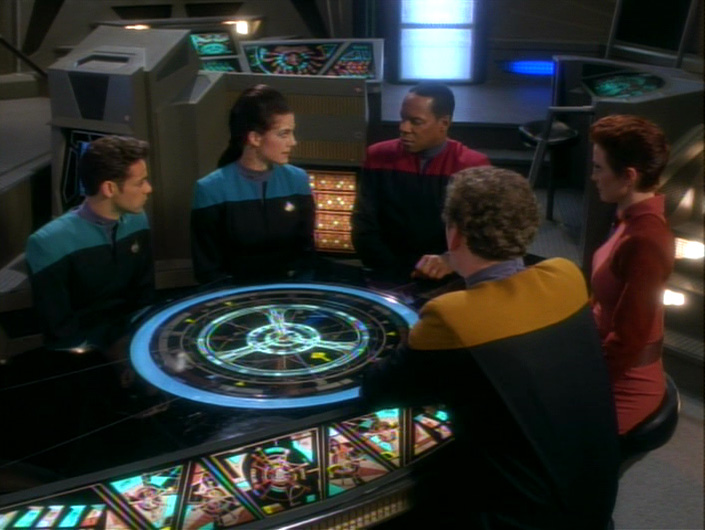
Image: The operations crew at work, from “Playing God” via IMDb

In the Seen on Screen occasional feature, we discuss movies and television shows of interest.

Of Course There’s a Full Moon on Halloween in 2020

There’s no shortage of frightening things in 2020. This is the year that gave us a horrible global pandemic and the stressful new routines of physical distancing that come with it, murder hornets, double hurricanes, the worst economic crash since the Great Depression, locust swarms, and the most agonizingly awful US election cycle in my lifetime, to name only a few. With all of these awful things overwhelming our usual means of coping, it’s natural that people will look for ways of blowing off steam.

Holidays that let us shed some of the usual rules of polite society are one way people can get a break from the stresses of life. “Festivals of reversal,” as they are sometimes called, can be a psychological release as we get to leave ourselves behind for a day and become someone else. Halloween is one of the best examples of such a holiday for much of modern US culture, a day when the normal rules are relaxed, when adults get to be childish and children get to take candy from strangers.

This year, Halloween falls on a Saturday. What’s more, that night will have a full moon providing plenty of light for nighttime revels. In an ordinary year, that combination would set us up for some wild shenanigans on Halloween night. I’d be stocking the candy bowl and keeping an eye out for mischievous young hooligans.

But this is no ordinary year. This year, big parties and nighttime rule-breaking are more than just a neighborhood nuisance; they could spread deadly disease, overwhelm already stressed hospital systems, and leave a death toll in their wake. Halloween 2020 presents a concentrated version of the dilemma that has dogged us all year: the things we need most to psychologically endure this crisis—distraction from the reality around us, uninhibited human contact, an escape from stringent social rules—are the very things that prolong the crisis and make it more deadly.

I sympathize a lot with anyone who feels like they need the little vacation from daily life that Halloween offers, but I’m frightened of the consequences. Stay spooky, everyone, but stay safe, too.

Image: Grinning Halloween lantern by Kim Støvring via Flickr (CC BY 2.0)

Here there be opinions!

How Not to Study Linguistics

The Greek historian Herodotus recounts a tale about a rather dubious experiment in linguistics supposedly carried out by the Egyptian king Psammetichus.

The point of the experiment was to find out what people or nation in the world was the oldest. It was based on the assumption that the oldest culture’s language would be the language that people who had never heard spoken language before would speak. Further, Psammetichus assumed that the invention of this original language could be artificially recreated. The result of these mistaken assumptions is a bit of a comedy of errors. Here’s how Herodotus tells the tale:

When Psammetichus could not find out by inquiry what people were the oldest, he devised the following plan. He took two newborn children at random and gave them to a shepherd to bring up among his flocks, with orders that they be raised in such a way that no one should make any sound in their presence, that they stay in a lonely hut, and that he should regularly bring his goats there so they could drink their fill, and attend to their other needs. He did these things, and Psammetichus commanded him to notify him at once what word first burst forth from the children, once they had left behind the meaningless babble of infants. And it did indeed happen. When the shepherd had been taking care of the children for two years, once when he opened the door of the hut and went in, both of them fell upon him stretching out their hands and crying: “Bekos!” At first, the shepherd took no notice of what he had heard, but when he kept hearing the same word on his repeated visits, he began to pay attention to it. He sent word to the king, and when ordered, brought the children before him. When Psammetichus heard it for himself, he investigated what people called something “bekos,” and from his investigations he learned that it was the Phrygian word for bread. Taking this fact into consideration, the Egyptians acknowledged that the Phrygians are older than they are.

– Herodotus, Histories 2.2

(My own translation)

As should be obvious (and probably was to Herodotus’ audience), the experiment was in fact a failure. When the children exclaimed “bekos” at the shepherd’s arrival, they were not producing an actual word but simply imitating the bleating of his goats, the only sound they had heard another living creature produce. The fact that Psammetichus did not realize this (and had not accounted for it in designing the experiment) makes this whole story a joke at his expense. The punch line of the joke may be a little lost on a modern audience: the Phrygians were a people who lived in inland Anatolia and spoke a language related to Greek. Phrygians were stereotyped by the ancient Greeks as ignorant country bumpkins. For the Egyptians—proud of the antiquity and sophistication of their culture—to be forced to yield the title of “most ancient people” to the Phrygians was a deflation of their cultural pretension.

Although Herodotus claims to have heard this story from Egyptian priests, like more than a few of the stories he tells about Egypt it sounds more Greek than Egyptian. Specifically, it sounds like a Greek joke told at the Egyptians’ expense. Greeks and Egyptians had close and friendly relations in Herodotus’ day, but it was a relationship in which the Greeks were definitely the junior partners. Egyptians liked to celebrate the antiquity and wisdom of their culture, and we can understand if Greeks occasionally got a bit fed up with being looked down on. This story uses language was a way of turning the tables to suggest that not only were the Egyptians not as ancient a culture as they liked to claim, perhaps they were not as wise, either.

On, of, and about languages.

More Silly WoW Battle Pet Names

A while ago Eppu shared some of her best silly names for her battle pets in World of Warcraft. In that same spirit, here are a few of mine. (Be warned: some terrible puns ahead.)

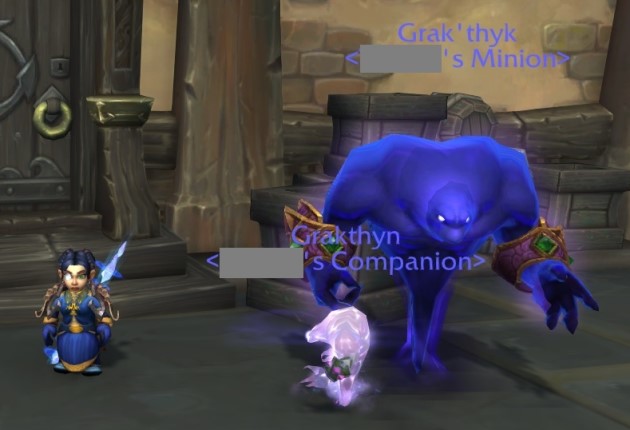
First, let’s start with my Erudite Manafiend, which is name Garkthyn. “What’s so silly about that?” you might be wondering. Well, Grakthyn accompanies my warlock, whose voidwalker is called Grak’thyk. You could say they’ve been through thyk and thyn together. (Don’t worry—it gets worse.)

Male Turkeys (which are the ones who display their fan of tail feathers like this) are called toms, which is all I’m going to say about why mine is named Bombadil.

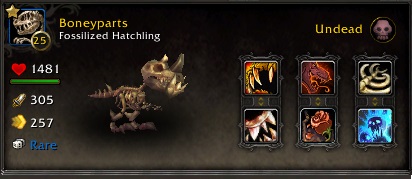
My Fossilized Hatchling is named Boneyparts. (Yes, that’s a Napoleon reference.)

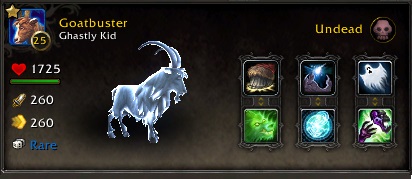
When there’s something strange in the old barn yard, who ya gonna call? Goatbuster! (Ghastly Kid)

My Lurking Owl Kitten is called Hootenanny, because why not?

The Anubisath Idol stands with its hands poised ready to strike. Why else would I call mine Idol Hands?

Some of my pets are named in Finnish. My Sinister Squashling is named Kauhea Kurpitsa, which is Finnish for “horrible pumpkin.”

Another one is Lentokone, my Ancient Nest Guardian. This pet is a mechanical type that can temporarily turn into a flying type. “Lentokone” is the Finnish word for airplane, but litterally it means “flying machine,” which felt appropriate.

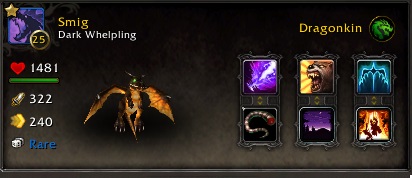
Maybe someday Dark Whelpling will grow up to be another Smaug, but for now it’s just a Smig.

Got any good pet names you want to share?

Of Dice and Dragons is an occasional feature about games and gaming.

A Huron/Wyandot Glengarry Cap

This decorated hat was created by an indigenous North American Huron/Wyandot artisan around 1840. It is made of wool, silk, and moosehair, worked using traditional techniques, but patterned after the Glengarry-style cap of the Scottish highlands and decorated with a Victorian floral motif.

Hats and other decorated objects like this one represent a complex interplay of cultural, artistic, and economic influences. Indigenous artisans from Iroquoian, Wabenaki, and other native nations had long created trade goods intended for exchange with European settlers and adapted to European tastes. In the nineteenth century, indigenous creators took advantage of the growth of a tourist industry around the Great Lakes region to market a broader range of wares combining forms that white customers would recognize and find useful, like this Glengarry cap, with decorative schemes that appealed to Victorian sensibilities while preserving traditional techniques. Such objects were created in a combination of traditional and modern materials, such as moosehair and leather combined with wool, silk, and glass beads.

The creation and sale of these goods—often produced by female artisans—provided both a means of preserving traditional artistic methods and a valuable economic resource to indigenous and First Nations peoples at a time when other opportunities in white-dominated American and Canadian society were hard to find, and indigenous cultures were often suppressed, sometimes violently.

Image: Glengarry-style cap via Metropolitan Museum (Metropolitan Museum, New York; c. 1840; wool, silk, and moosehair; unknown Huron/Wyandot artist)

Out There is an occasional feature highlighting intriguing art, spaces, places, phenomena, flora, and fauna.

Rating: Deep Space Nine, Season 1

With everything that’s going on this past year, we’ve been looking for comfort rewatching, and Star Trek: Deep Space Nine offers a special kind of comfort. While the show was “dark and gritty” by the standards of the 1990s when it came out, it has a Star-Trekian humanity and optimism that we need right now. 2020 makes us appreciate the message of: “We’re all a little messed up, but that doesn’t mean we can’t work together to make things better. The world’s a little messed up, too, and fixing it isn’t easy, but it is possible.”

Here’s how we rated season 1.

  1. “Emissary” – 8.5
  2. “Past Prologue” – 5
  3. “A Man Alone” – 4
  4. “Babel” – 6
  5. “Captive Pursuit” – 4
  6. “Q-Less” – 1.5
  7. “Dax” – 4.5
  8. “The Passengers” – 5
  9. “Move Along Home” – 2
  10. “The Nagus” – 5.5
  11. “Vortex” – 2
  12. “Battle Lines” – 3
  13. “The Storyteller” – 3
  14. “Progress” – 4
  15. “If Wishes Were Horses” – 3.5
  16. “The Forsaken” – 7
  17. “Dramatis Personae” – 4.5
  18. “Duet” – 9
  19. “In the Hands of the Prophets” – 8.5

It’s a rocky start to the series. Despite a strong opening, a strong closing, and some good episodes along the way, the average episode rating is only a pretty weak 4.8. Much of this season is spent establishing the main cast of characters and the unique place of Bajor and its history with the Cardassians in Star Trek‘s universe. Much of what we love about Deep Space Nine—the ongoing story, the relationships among the characters, the recurring cast of side characters—is still just being built here.

The worst episode of the season is “Q-Less” at 1.5, Next Generation‘s omnipotent pain-in-the-ass Q’s lone appearance in DS9. Clearly intended as a bridge to ease TNG fans into the new series, for established DS9 fans like us it just feels pointless and out of place. The shaggy dog story of “Move Along Home” and “Vortex,” an early attempt to develop Odo’s character that is hampered by a truly abysmal guest performance, both rate pretty low as well, at 2.

At the other end of the scale “Emissary,” the premiere, and the finale “In the Hands of the Prophets” are both standouts, at 8.5. “Emissary” does an excellent job introducing us to the main characters and to the world of the station and Bajor, graced with a powerful performance by Avery Brooks as Commander Sisko, still carrying the trauma of losing his wife Jennifer. “In the Hands of the Prophets” adds a new level of complexity to the Bajoran story and introduces some important new recurring characters. One of the great things in DS9 is its villains: the smug Cardassian Gul Dukat and the sanctimonious Bajoran Vedek (later Kai) Winn could have been flat one-note villains in lesser hands, but Marc Alaimo and Louise Fletcher give them a depth and nuance that holds up against the stellar performances by the main cast.

The quality of the acting shines in the season’s best episode as well: “Duet,” at 9. At its heart, it is a fairly simple story as Major Kira tries to prove that a mild-mannered Cardassian filing clerk is actually a wanted war criminal in disguise. Most of the episode is just two people in a room talking to each other, but every moment of that dialogue crackles with energy. In a modern tv landscape where writers think they have to kill off characters, concoct shocking twists, and splurge on special effects to keep viewers interested, “Duet” is a master class in how you write compelling drama.

Another delight of season 1 is seeing some of our favorite side characters in the early stages of their growth. Garak, the mysterious tailor, is intriguing from his first scene, long before his dark history as a secret agent unfolds. We also see Rom and Nog in the early stages of their transformation from bumbling idiot and conniving miscreant to bumbling sweetheart and upstanding Starfleet officer.

Got any favorite memories from DS9‘s first season? Share in the comments!

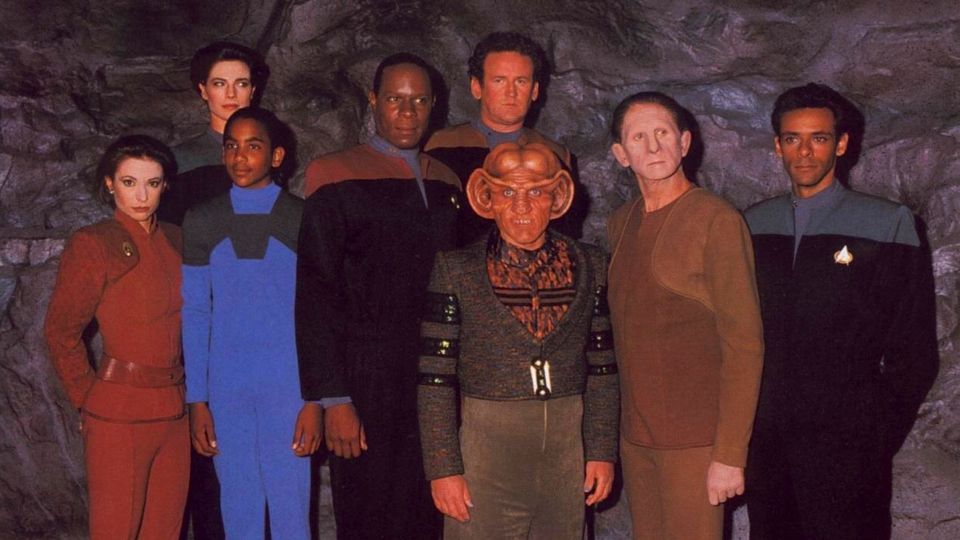
Image: Deep Space Nine season 1 cast via IMDb

In the Seen on Screen occasional feature, we discuss movies and television shows of interest.

Accessibility Ramps at Ancient Greek Sanctuaries

A recent article in the journal Antiquity by archaeologist Debby Sneed argues that some ancient Greek temples were built with ramps to make them more accessible to people with limited mobility.

The argument begins from the observation, already familiar to archaeologists, that some temples had stone ramps leading from ground level up to the sanctuary. While in some places these ramps clearly seem designed to facilitate the movement of carts or chariots as part of religious rituals or the delivery of supplies and offerings, many are too narrow to be explained this way. Nor can these ramps be explained as part of the building process, since they are permanent and built in stone—far more difficult and expensive to construct than the packed earth ramps that would have been used in building—and they reach only to the level where people would have entered the temple, not all the way to the roof where building materials had to reach.

The interesting observation that Sneed adds to the discussion is that the distribution of these ramps is neither universal nor random, but they are particularly associated with temples connected with healing, and especially with temples where the evidence of inscriptions and votive offerings show a special focus on healing afflictions of the legs and other impairments to mobility. This pattern of distribution, while not definitive, does suggest that the ramps were purposely built at these particular sites to make it easier for people who might have difficulty climbing steps to gain access to the temple structures where they could participate in prayers or healing rituals.

Once built, of course, these ramps could well have served other purposes as well, such as making it easier to bring in offerings or supplies such as wood or wine needed for the routine operations of the temple, but this is also true of mobility accommodations today: once there’s a ramp in place, lots of people can use it for lots of different purposes. The planners of these sanctuaries may well have had this kind of multiplicity of functions in mind when building the ramps. Nevertheless, the fact that these ramps tend to appear at healing sanctuaries and not at others does indicate that the particular needs of those temples and their patrons were an important factor in the design.

The study of disability and its accommodation in history is a growing field. Studies like this one show how revisiting familiar evidence with new questions in mind can yield fertile new observations and interpretations.

Sneed’s full article can be read at cambridge.org.

Image: Artist’s reconstruction of the Temple of Asclepius at Epidaurus, Sneed, Debby, “The Architecture of Access: Ramps at Ancient Greek Healing Sanctuaries,” Antiquity (2020): 1-15, 9.

History for Writers looks at how history can be a fiction writer’s most useful tool. From worldbuilding to dialogue, history helps you write.

Visualizing the Roman Emperors

Sometimes, putting information into a visual form helps you make sense of it. I’ve been studying, writing about, and teaching the history of the Roman Empire and its emperors for more than two decades now, but taking my knowledge and making it visual helped me grasp the significance of some of the long-term patterns I’ve know about for so long. In this chart, you can see the stumbling uncertainty of the early empire, the stability of the second century, the chaos of the third century, and the complexity of the late 200s to early 300s.

(It’s a big image; you have been warned!)

Continue reading

The Curious Case of Wikipedia, My Book, and Odoacer’s Mother

I recently had the odd experience of discovering that my book Barbarians in the Greek and Roman World is cited as a source on Wikipedia, and then realizing that it is cited as a source for something the book does not actually say.

The reference is on the page about Odoacer, a “barbarian” king who ruled portions of the Western Roman Empire in the late fifth century CE. Here’s the sentence in which I am cited, at least as it appeared in early September, 2020:

Historian Erik Jensen, avows that Odoacer was born to a Gothic mother and that his father, Edeco, was a Hun.


This sentence cites page 16 of Barbarians in the Greek and Roman World, but here is what page 16 actually says:

Classical ideas about identity […] allowed for fluidity and ambiguity, on both the individual and societal level. The last Roman king, Tarquinius Superbus, is an individual example. Though Superbus was identified as Roman, his father Tarquinius Priscus was an Etruscan, whose own father, Demaratus, was a Greek: in three generations of the same family we find three different ethnic identities. At the other end of Roman history we find Orestes, a provincial Roman who joined Attila’s Huns and later made himself de facto western Roman emperor. He was succeeded by his son Romulus Augustus, the famed “last Roman emperor,” who was soon dethroned by Odoacer, a Goth whose father Edeco had been a Hun.


Do you notice what’s missing? I said nothing at all about Odoacer’s mother.

We know virtually nothing about Odoacer’s mother. Some ancient sources describe her as coming from the Sciri, one of the numerous Germanic-speaking groups who emerged on the eastern Roman frontier in the third and fourth centuries, but, like all too many women in history, she is almost entirely unrecorded in the sources.

Whoever added this sentence to the Wikipedia article made an assumption not supported by my text. It’s an understandable assumption, of course, in a modern context. Modern definitions of ethnicity tend to rely heavily on ancestry and descent. If we know that someone today identifies as, say, Irish, and their father is Lebanese, it’s a fair bet that their mother is Irish, because their Irishness has to come from somewhere. Similarly, if Odoacer was a Goth and his father was a Hun, it may seem natural to assume that he must have gotten his Gothicness from his mother.

But these kinds of assumptions don’t work in the ancient world. While ancestry was an element of ethnic identity in the ancient Mediterranean, it had much less weight than we give it today. And that, in fact, is the entire point of passage cited: we simply cannot assume that one ancient person’s ethnic identity necessarily tells us anything about how their ancestors or their descendants identified themselves.

Now, to be fair, in talking about Odoacer as a Goth and Edeco as a Hun, I was simplifying a far more complicated and tenuous set of scholarly arguments. This is how these figures are identified in some ancient sources, but there are arguments not just about how we should describe Odoacer and Edeco but even about whether we have correctly identified these individuals and their relationship to one another. These questions are particularly vexed both because the surviving primary sources for late Roman history in the West are so fragmentary and because the various groups that emerged on the late Roman frontiers were often loosely defined alliances rather than rigidly established ethnic tribes. Goth and Hun, in particular, were names that were readily adopted by people of many different backgrounds and cannot be assumed to tell us anything about the ancestry of any given individual.

So I’ll accept the blame for simplifying an issue that should not have been simplified and writing a sentence that suggested more certainty than the sources will really sustain. I will try to take this as a lesson for the future to be more careful about the dangers of choosing brevity over clarity. I hope this can also be a cautionary tale for us all: check that your sources actually say what you think they say.

History for Writers looks at how history can be a fiction writer’s most useful tool. From worldbuilding to dialogue, history helps you write.