In our area, there were Episode VII showings pretty much continuously starting from 7 p.m. last night. I was ever so briefly tempted to go from viewing to viewing straight through the night. But no.
No, we didn’t go.* Instead, we’re about to head out to a noon showing. It remains to be seen how many others we’ll have to fight for seats decided to wait till daytime on the official release day.
How early did you see The Force Awakens? Do tell!
*) I think we’re both at that stage where, rather than do something right the moment it’s possible, we prefer to take our creature comforts into consideration. (Especially sleep, much like an old cat. Yay for old cats!)
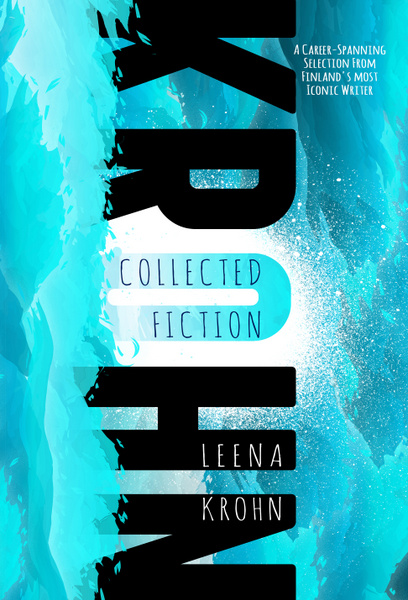
“I also found myself hypnotized by Leena Krohn, a Finnish writer whose collected stories and novels, rendered into English by many different translators, have just been published as a single volume, ‘Leena Krohn: Collected Fiction.’ Broadly speaking, Krohn is a speculative writer; one of the novels in the collection, for example, consists of thirty letters written from an insect city. (‘It is summer and one can look at the flowers face to face.’) Krohn writes like a fantastical Lydia Davis, in short chapters the length of prose poems. Her characters often have a noirish toughness; one, explaining her approach to philosophy, says that when she asks an existential question, ‘life answers. It is generally a long and thorough answer.’”
Helsingin Sanomat, the largest Finnish daily, celebrates the impending Star Wars: Episode VII – The Force Awakens premier with a special piece. Titled Stadi Wars (stadi being a slang name for Helsinki), it shows what the city would look like if the Empire were to attack Helsinki.
What if the Senate Square in Helsinki were attacked by the Empire via Helsingin Sanomat
Apart from photos, video, and 3d-renderings of Imperial transports, Helsingin Sanomat interviewed a member of The Finnish Reserve Officers’ Federation and got his opinion on how the Finnish army would fare against stormtroopers.
Even if you don’t read Finnish, the page is worth a visit for the very cool photos of Imperial walkers and ships set against a modern cityscape.
Images, video and graphics by Boris Stefanov, Uolevi Holmberg, and Petri Salmén via Helsingin Sanomat
In Making Stuff occasional feature, we share fun arts and crafts done by us and our fellow geeks and nerds.
Keeping company to Krohn and Jääskeläinen on the Best of 2015 list “[a]fter a stellar year for the written word” are renowned authors like Ta-Nehisi Coates, Judd Apatow, and Paula Hawkins. Congrats, both!
For a taste of their writing, try Jääskeläinen’s Where the Trains Turn (orig. Missä junat kääntyvät, 2000), published in November 2014 by Tor.com, or Krohn’s Lucilia Illustris, published in December 2015 by Electric Literature.
Or: Some History behind Ostrich Riding, Part 6 of 7
Background: I ran into two historicalimages from California with ostriches used as transportation. That got me wondering about the history of ostrich riding. And that lead me down quite a rabbit hole.
I’ve divided my findings into separate posts (find them with the ostrich riding tag). Warning: serious early history and language nerdery ahead in Serious Academic Voice.
TL;DR – Tracing ostrich riding to a 3rd century BCE tomb find (a statue of Arsinoe II) from Egypt doesn’t hold up. The use of various ostrich products in human material culture dates back thousands of years. A few ancient depictions involve humans handling ostriches; however, extant sources don’t tell us whether ostriches were merely hunted or whether they were also tamed in the ancient world. The most promising source seems to be a description of a magnificent parade put together by Arsinoe II’s husband-brother Ptolemy II. This Grand Procession included eight chariots drawn by pairs of ostriches, and the ostriches may have been ridden by boys in costumes.
I had hoped to find a nice, neat selection of ancient texts putting the Greek word for ‘ostrich’ in context, but even a cursory look reveals that the history of the word strouthos is complex. At best, we can say that there are no immediate red flags either in the original Greek or modern English translations for Arsinoe II’s statue or Ptolemy II’s Grand Procession. The poem Berenice’s Lock was said to contain further evidence of ostriches as mounts in Ptolemaic Egypt after Arsinoe II’s death. Instead, what we seem to have is a case of poetic ambiguity translated with poetic license and taken uncritically as evidence.
Some centuries after Arsinoe II and Ptolemy II, ostrich riding may appear in the Roman Empire. Claims in some secondary sources turn out unverifiable, however. Researching primary sources helps but a little: on one hand, many of these texts either have problematic histories or their authorship or accuracy may be questionable; on the other, ostriches tend to appear in context of fighting in gladiatorial games, not being ridden or raced. Surviving visual art only confirms the appearance of ostriches in hunting and arena scenes the Roman territories, not riding or chariot-pulling. A description in the life of Emperor Firmus comes closest, but Historia Augusta, the source of his life, is considered unreliable.
I’ve been vaguely aware of the Swedish-Finnish movie production The Girl King (Finnish title Tyttökuningas), which is remarkable for having been largely (according to some sources, almost entirely) filmed in Turku, Finland, including the local castle. It’s one week from opening night now, and reviews and interviews are starting to roll out. Yay!
The movie is about Queen Kristina of Sweden (1626-1689), of the Vasa lineage, directed by Finland’s famous Mika Kaurismäki. In the main roles we’ll see Malin Buska, Sarah Gadon (whom I liked in Belle), and Michael Nyqvist (familiar from the Swedish version of The Girl with the Dragon Tattoo series). A description from Kaurismäki’s website says:
“Mika Kaurismäki is currently developing a feature film project about the Swedish Queen Kristina, starring Swedish actress Malin Buska. Set in the 17th century, the film paints a portrait of an extravagant and atypical queen, who was the ruler of her country from the age of seven until her startling abdication at 28.
“The film is scripted by Canadian award-winning screenwriter Michel Marc Bouchard and the cinematography will be by renowned Christopher Doyle (In the Mood for Love, Hero).”
At the time of Kristina’s life, Finland was a part of Sweden, and Turku (Åbo in Swedish) was the oldest and largest city in Finland. The Turku Castle dates from late 13th century, but it was still inhabited and garrisoned at the time; in the modern period, it’s been restored to its Renaissance state, so it’s an appropriate location even though Kristina didn’t actually live there. (Tidbit gleaned from a news article in Yle uutiset: Kristina’s parents visited Turku early in 1626, and it’s said that she was conceived at the Turku Castle.) Also, kuningatar Kristiina has a special place in the Finnish memory because of her efforts to end the 30 years’ war which was hard on Finland, and because she at the suggestion of one of her statesmen (and twice Governor General of Finland), Per Brahe, founded the first Finnish university in 1640.
The official trailer (with Finnish subtitles) is out, and looking gorgeous:
Tyttökuningas (The Girl King) -elokuvan virallinen traileri via LeffatByFSFilm
Frock Flicks has a interview with the costume designer, Marjatta Nissinen, and a review that includes insights into the costuming. There’s also a documentary on the costuming, with background information from Kaurismäki and closeups of some of the outfits in the latter half (Finnish with English subtitles):
As an early history geek who lived in Turku for a number of years, I’m very curious to see The Girl King – for freaking once I get the native advantage in location spotting! 😀
Turku historical mashup, clockwise from top: 1700s-1800s houses at Luostarinmäki; bell tower of the cathedral seen from the river Aura; Vanha Suurtori with empire style and neoclassical houses; closeup of the cathedral bell tower. Center: Turku Castle
But seriously, what I can see of the sets and locations, especially the Renaissance floor of the castle, looks fantastic. Here’s hoping that The Girl King will have a reasonably wide release in the U.S.!
Looks cool and MCU-Captain-y! I’m looking forward to seeing more of my favorites – Cap, Falcon, Black Widow, Sharon Carter / Agent 13. I liked Paul Rudd as Ant-Man, too, and T’Challa / Black Panther looks cool.
Six months to May 2016 sounds very long! Fortunately there’s lots to tide us over.
Hey, look! We found a thing on the internet! We thought it was cool, and wanted to share it with you.
“When we say men, man, manly, manhood, and all the other masculine derivatives, we have in the background of our minds a huge vague crowded picture of the world and all its activities. […] That vast background is full of marching columns of men, of changing lines of men, of long processions of men; of men steering their ships into new seas, exploring unknown mountains, breaking horses, herding cattle, ploughing and sowing and reaping, toiling at the forge and furnace, digging in the mine, building roads and bridges and high cathedrals, managing great businesses, teaching in all the colleges, preaching in all the churches; of men everywhere, doing everything – ‘the world.’
“And when we say women, we think female – the sex.”
– Charlotte Perkins Gilman, Herland
View from a 100 years ago.
Gilman, Charlotte Perkins. Herland. Edited by Kathy Casey. Mineola, NY: Dover, 1998 [originally published 1915], p. 116.






 Co-Geeking
You must be logged in to post a comment.