Daisugi Allows Log Harvesting without Killing the Tree

Daisugi is a forestry management technique reminiscent of pollarding and bonsai that produces straight logs without killing the tree. Developed some 600-500 years ago in Japan, it’s still being used to harvest sustainable, durable logs.

Basically, some of the top shoots are pruned so that they’ll grow straight up, and the shoots only are collected when they reach the desired height. It’s not a fast method, as it takes decades to be able to produce logs, but reportedly they come out stronger, more flexible, and knot-free. And the tree stays alive.

Also, the daisugi-managed cedars make amazing shapes in the woods! They would be so interesting in a speculative or fantasy story—or any story, really. Below are a few examples.

Spoon Tamago Yusuke Narita Long Shot
Spoon Tamago Ai Hirakawa Daisugi in Fall
Wikipedia Bernard Gagnon Ryoan-ji Garden

Just another example of how ingenious we people are in manipulating our environment. 🙂

Found via Good Stuff Happened Today on Tumblr.

Images: Long shot by Yusuke Narita via Spoon & Tamago. In the fall by Ai Hirakawa via Spoon & Tamago. Ryoan-ji garden, Kyoto, Japan by Bernard Gagnon via Wikipedia (CC BY-SA 3.0).

In Live and Active Cultures we talk about cultures and cultural differences.

MacramĂ© Inspiration Photos for Speculative Writers

There are times when my expertise and interests affect my response to the stories I consume. (I’m pretty sure I’m not the only one.) Lately I’ve been noticing the presence or absence of textiles in my media, and how those textiles came to be.

I’m using macramĂ© as an example of a technique that’s not getting much attention—in fact, I’m not sure I’ve ever seen a story using macramĂ© even as a background element—despite its versatility.

For example, in a fantasy world, you don’t always have to have woven or embroidered wall hangings decorating the lord’s hall. You could also have a ginormous macramĂ© room divider like “Ocean”, below, by Bali-based fiber artist Agnes Hansella:

Colossal Agnes Hansella Ocean

Apart from being refreshingly non-Eurocentric (if we consider the earliest records of macramĂ©-style knots coming from Babylonian and Assyrian carvings), large-scale macramĂ© works obviously require a high level of skill to complete, which makes them a perfect option for displaying a character’s wealth and social capital.

And even in smaller sizes, macramé can come in intricate shapes that in no way resemble the 1970s handiwork that may stereotypically come to mind (plant hangers, wall hangings, or cute but perhaps not entirely flawless friendship bracelets).

Etsy TBiaDesign Macrame Wall Shelf

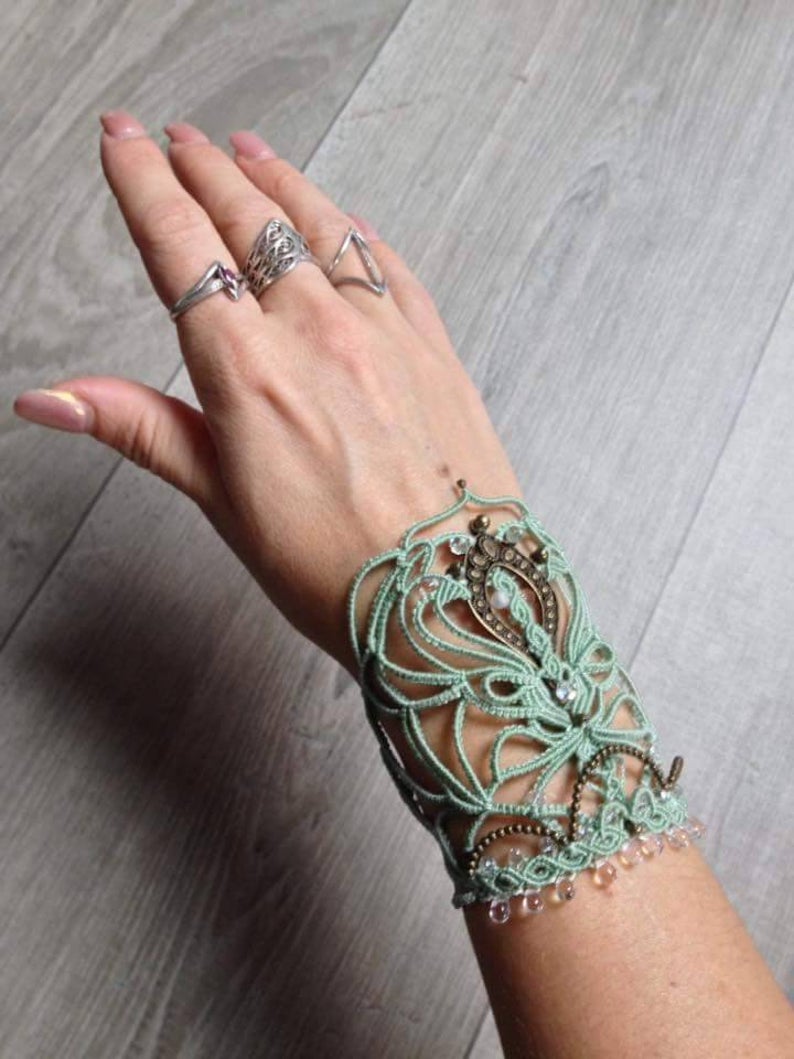
Speaking of small, when writing this blog post I leared that some people make micro macramé, where the working yarn or cord is quite thin. The result is almost lace-like:

Etsy AmeEtTiss Macrame Fillory Cuff

You can make an almost endless range of items with macramé. If you can make cording (like bracelets), you can make anything used for supporting, holding, or edging, for instance like belts, suspenders, bands, animal harnesses (think of ceremonial processions etc.), pulls, straps, or decorative edges.

Macramé also does not need to be made from only unbleached or single color cord; on the contrary, colorful combinations can be quite eye-catching:

Etsy Toni Lasee kitdesignsbykith Green Macrame Belt

If you can make flat surfaces (like wall hangings), you can create items that could also be made from fabric, like table runners, curtains, cushion covers, pouches, or bags.

Pinterest Blue Macrame Bag

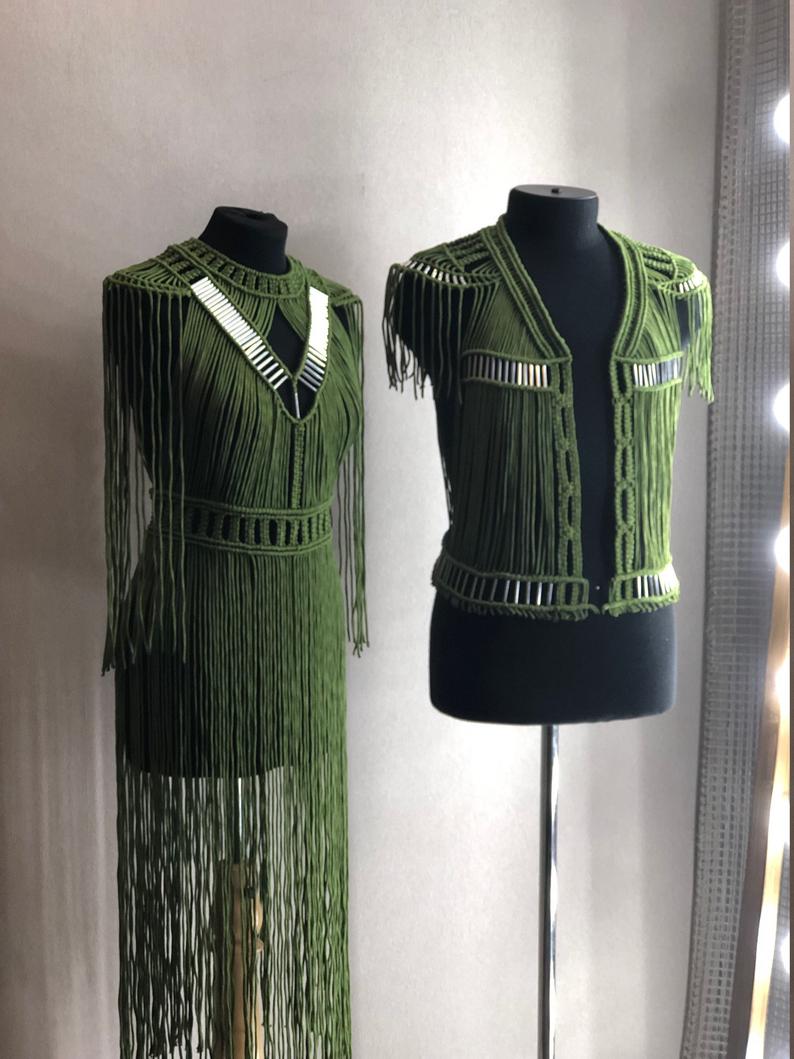
I could also imagine a macramé-style outer garment worn over fabric clothes looking fantastic. Indeed, someone else has had that very thought—check out these outfits promoted as Coachella or Burning Man costumes:

Etsy SeyanaStyle Macrame Vest and Dress

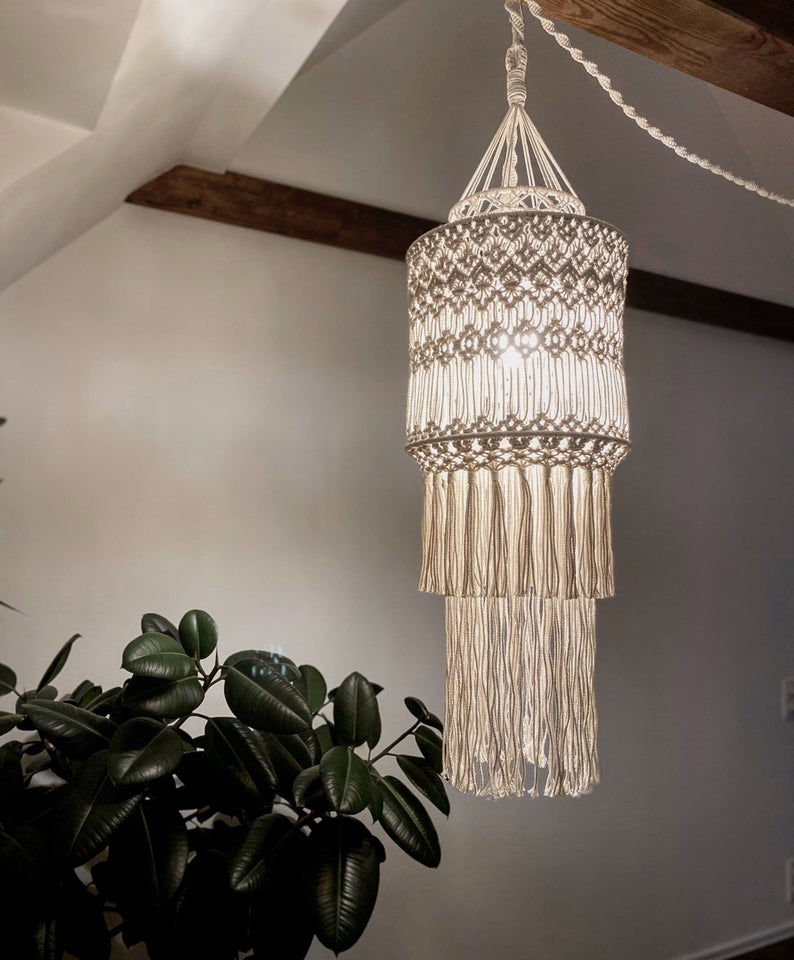
Depending on the type of cord, you could even make more utilitarian household items like chair seats, hammocks, lampshades, or baskets.

Etsy CraftingMode Big Macrame Basket Birch Green
Etsy Irina Kharebava Macrame Lamp Shade

As with all creative work, the maker’s skill and imagination are the limit.

Images: Agnes Hansella via Colossal. Wall shelf by TBiaDesign on Etsy. Lacy cuff by AmeEtTiss on Etsy. Green belt by Toni Lasee at kitdesignsbykith on Etsy. Blue bag with macramé strap via Pinterest. Macrame vests by SeyanaStyle on Etsy. Rectangular basket by Phing Chutima at CraftingMode on Etsy. Lamp shade by Irina Kharebava on Etsy.

Out There is an occasional feature highlighting intriguing art, spaces, places, phenomena, flora, and fauna.

Quotes: Infohistory Is a Mess

Elizabeth Bear’s scifi novel Machine has a succinct sum-up of just some of the problems concerning information retrieval:

“Wait,” I said. “How can information decay?”

“They used to call it bit rot. Servers get taken down, data falls through the cracks and doesn’t get backed up. Physical substrates are destroyed or damaged, or degrade over time—especially the primitive ones. A holographic diamond is very durable but can’t be changed once it’s written to, and magnetic media only lasted a decan or so under ideal conditions.

“And even if the data is preserved somewhere, that somewhere might not be networked. If it’s networked, it might not be indexed. Even if it’s indexed, it might be half the galaxy away and take two or three ans for the file request to get there, be fulfilled, turn around, and come back. And then you might find out that you needed different files entirely.” He huffed with great satisfaction. “Infohistory is a mess.”

– from a discussion between Dr. Brookllyn Jens and the medical librarian AI Mercy in Machine by Elizabeth Bear [original emphasis]

Despite this being from a fictional work, it rings very true. My librarian heart was delighted to read an account that acknowledges not just the physical difficulties of dealing with old media—whatever shape that media might take, from cuneiform to CDs—but also the search-related problems. Metadata, or in case of libraries, the information about the items in the collection, doesn’t feature in stories very often. Also, it is why good reasearch librarians and archivists are worth their weight in gold.

Bear, Elizabeth. Machine. London: Saga Press, 2020, p. 203.

Serving exactly what it sounds like, the Quotes feature excerpts other people’s thoughts.

Trailer for Debris

Has anyone followed news on Debris? It’s a new tv series described to be a bit like Fringe. Here’s a trailer:

DEBRIS | Official Trailer by NBC on YouTube

The story follows two agents, one from MI6 and the other from CIA, who investigate debris—surprise, surprise—from an alien spacecraft falling to Earth.

Debris is set to debut on NBC on March 01, 2021.

Hey, look! We found a thing on the internet! We thought it was cool, and wanted to share it with you.

Living Vicariously Through Social Media: Dracula Parrots

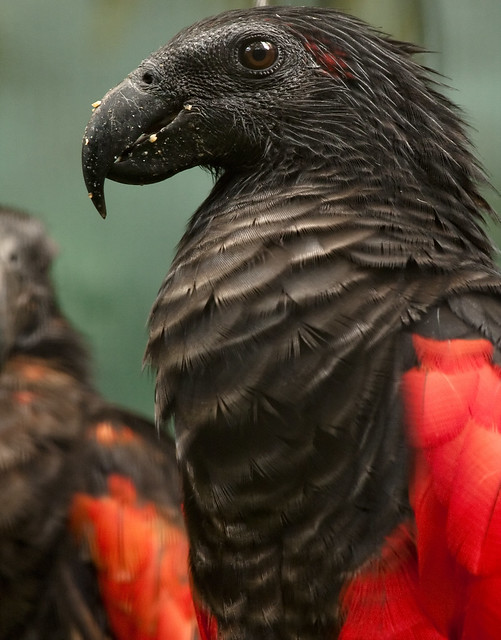
Hey there, handsome—what an amazing coloring these Dracula parrots (Psittrichas fulgidus) have!

Flickr Peter Tan Pesquets Parrot Head Shot

Endemic to New Guinea, they are also known as Pesquet’s parrots, and can be quite sizeable: 46 cm / 18” total length and 700-800 g (24-28 oz) in weight.

Flickr Meen Zhafri Pesquets Parrot Silhouette

Apparently, habitat loss and overhunting have pushed the species into a vulnerable status, and, according to BirdLife International, the population in decreasing.

Flickr Charles Davies Pesquets Parrot in Flight

*sigh* Why can’t we as a species take better care of our nice things? It’s not like we lack the brain power.

Found via Nature & Animals on Twitter. (NB. Seems to require a login in order to see post.)

Images: Head shot by Peter Tan via Flickr (CC BY-SA 2.0). Silhouette by Meen & Zhafri via Flickr (CC BY-NC 2.0) / KL Bird Park, May 2010. In flight by Charles Davies via Flickr (CC BY-NC 2.0).

Out There is an occasional feature highlighting intriguing art, spaces, places, phenomena, flora, and fauna.

A Cappella Computer Sound Effects Uncannily Close to the Original

MayTree is a Korean a cappella group quite popular in Asia. They broke into my consciousness with this amazing short video of Windows sound effects performed by human voices:

windows sound effect (acapella) by MayTree on YouTube

Found via Whatever.

LOL! I just love my fellow nerds—we have an unparalleled dedication and interest in details.

Check out the MayTree YouTube channel for more.

An occasional feature on music and sound-related notions.

Ryan Coogler Is Developing a Wakanda Series for TV

Fantastic news for Wakanda fans! Tor.com reports that “[a]ccording to Deadline, Black Panther director Ryan Coogler has made a 5-year television deal with Disney. His first scheduled project will be a drama set in Wakanda that will be featured on Disney+.”

Flickering Myth Coogler Black Panther Set w Boseman

Apparently developing this series is a part of a broader deal between Coogler’s production company Proximity Media and Disney.

Although we don’t have any other details yet, not even a tentative name, I’m pretty excited. I absolutely loved Black Panther, and as long as he keeps—or is allowed to keep—to that ethos, I have high hopes for the series!

Image via Flickering Myth.

Living Vicariously Through Social Media: Swans in a Winter Wonderland

Reportedly, the Swan Spring wetland park in Ili, Xinjiang, China, has some amazing winter settings. This scene definitely qualifies:

Tumblr F Yeah Chinese Garden Swan Spring Screenshot

I don’t like cold very much, but I do like the look of clean, white snow, and I love blue. This shot is astoundingly beautiful. I’m so sorry I don’t know who filmed the clip this is from.

Here in Massachusetts we have way too much snow for pandemic comfort at the moment. Some of it is pretty, yes, but instead of the graceful swans we have chunky wild turkeys, LOL! Ohwell; at least we’ll get plenty of physical activity by shoveling.

Found via Fuck Yeah Chinese Garden on Tumblr. (Follow the link for a short video.)

Out There is an occasional feature highlighting intriguing art, spaces, places, phenomena, flora, and fauna.

Protagonists with Radical Acceptance Decide to Let Adversity Wash over Them

Fantasy and science fiction author Vida Cruz tackles an aspect in SFF that was new to me: that BIPOC protagonists are often seen by (white, Western) editors and readers as inactive, and why that’s false.

(I’ve written elsewhere a little about teaching myself to read novels in English after I started learning the language in 7th grade, how it’s so effortless to me now because I took the time and trouble then, and how reading mostly Anglo-American literature has shaped my thinking and expectations of stories.)

Cruz’s thread starts here. I’ve unraveled it below:

***

I want to talk about how western editors and readers often mistake protags written by BIPOC as “inactive protagonists.” It’s too common an issue that’s happened to every BIPOC author I know.

Often, our protags are just trying to survive overwhelming odds. Survival is an active choice, you know. Survival is a story. Choosing to be strong in the face of the world ending, even if you can’t blast a wall down to do it, is a choice.

It’s how we live these days.

Western editors, readers, and writers are too married to the three-act structure, to the type of storytelling that is driven by conflict, to that go-getter individualism. Please read more widely out of your comfort zone. A lot of great non-western stories do not hinge on these.

Sometimes I wonder if you’re all so hopped up on the conflict-driven story because that’s exactly how your colonizer ancestors dealt with people different from them. Oops, I said it, sorry not sorry. Yes, even this mindset has roots in colonialism, deal with it.

If you want examples of non-conflict-driven storytelling google the following: kishoutenketsu, johakyu, daisy chain storytelling/wheel spoke storytelling. There was another one whose name I forgot but I will tweet it when I recall it.

Anyway, I think there is a space in literature and beyond for stories about radical acceptance or that have a radical acceptance aesthetic. Accepting the things you cannot change but dealing with them in your own way. No pyrotechnics but plenty of potential for drama.

What you want in a story is drama. Conflict does not necessarily equate to drama. Conflict is driven by two or more forces colliding. If a protagonist decides to let the force wash over them instead, that does not mean the protagonist is inactive.

Once again, I repeat: SURVIVING IS A DECISION. BIPOC based in Western countries do it all the time. Us third worlders do it all the time. But of course if you grew up white in a Western country, being mired in hopeless systems will be hard for you to grasp.

And if you’re a BIPOC author, listen: you may be already as good, if not better, than most of the competition out there. You keep getting rejected not because your story sucks but because white editors do not know how to read your work. Keep trying.

Last but not least, we don’t just need diverse demographics for everything, WE NEED DIVERSE STORIES. Get your colonizer heads out of your asses and seek out other traditions. End rant.

I found the other storytelling structure! It’s called Robleto and is of Nicaraguan origin.

Thank you for coming to my TED Talk.

One last! Another type of story that everyone loves (or pretends not to love) but no one will publish in the west is FLUFF. YES THAT’S RIGHT, FANFICTION FLUFF. SUCK ON THAT.

It has been pointed out several times so I will amend the thread to say: all my points apply for disabled, neurodivergent, and chronically ill protagonists, too. Our way of showing agency is DEFINITELY different from yours so please be mindful of that.

***

For me, the main point Cruz makes is:

“What you want in a story is drama. Conflict does not necessarily equate to drama. Conflict is driven by two or more forces colliding. If a protagonist decides to let the force wash over them instead, that does not mean the protagonist is inactive.”

– Vida Cruz on Twitter

This reminds me of my frustration with the Halle Berry -led SF series Extant (which I referred to in an earlier post). I’ve asked myself whether they really wrote her merely feeling and flailing around or whether it is my misreading. Granted, it was some years ago now, but I don’t think I misinterpreted it; Extant lacked self-awareness or self-examination. (Or perhaps the writers’ room was forced to put out such claptrap by people higher up in the production.)

Possible examples of stories with radical acceptance / survival protagonists that do come to mind include the novels The Sound of Stars by Alechia Dow (Black protag) and Among Others by Jo Walton (disabled protag).

Anything you can think of? Please share! The concept is something I’m still mulling over, so more examples would help.

Also, any suggestions on a concise name for protagonists like this? I’m drawing a blank for the moment.

Story Time is an occasional feature all about stories and story-telling. Whether it’s on the page or on the screen, this is about how stories work and what makes us love the ones we love.

Living Vicariously Through Social Media: An Undersea Roundabout in the Faroe Islands

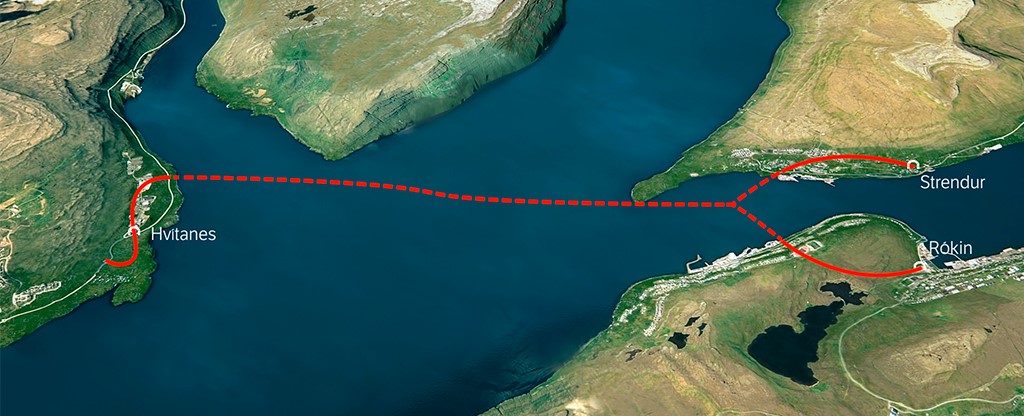
The Faroe Islands—an autonomous region of Denmark—has built bridges and tunnels before to connect the numerous islands or islets and its 50,000-some residents. Never before, however, have they dug an undersea tunnel as deep or as long as the brand-new Eysturoyartunnilin, nor built an undersea roundabout.

Eysturoyartunnil Interior Green

The roundabout is part of a tunnel measuring about 11 km (6.8 miles), the third sub-sea tunnel in the islands. It connects the islands of Streymoy and Eysturoy, and reaches at its deepest 187 meters (roughly 200 yards) below sea level. At this writing the tunnel’s been in use for about a month.

Eysturoyartunnil Map

The roundabout comes with art—sculptures and light effects—designed by the Faroese artist Tróndur Patursson. You can read more about the tunnel at BBC or the P/F Eysturoyar- og Sandoyartunnil project website.

Eysturoyartunnil Interior Blue

Oh, my goodness. It’s obviously not a solution that suits every location, and I assume the cost plus know-how involved can also be a deterrent, but what a feat of engineering and vision it is. This is yet another reason why it’s (pandemic aside) exciting to be living now!

Found via Kristina Háfoss on Twitter.

Images: Map by P/F Eysturoyar- og Sandoyartunnil. Interior images by Estunlar.fo via BBC.

Out There is an occasional feature highlighting intriguing art, spaces, places, phenomena, flora, and fauna.