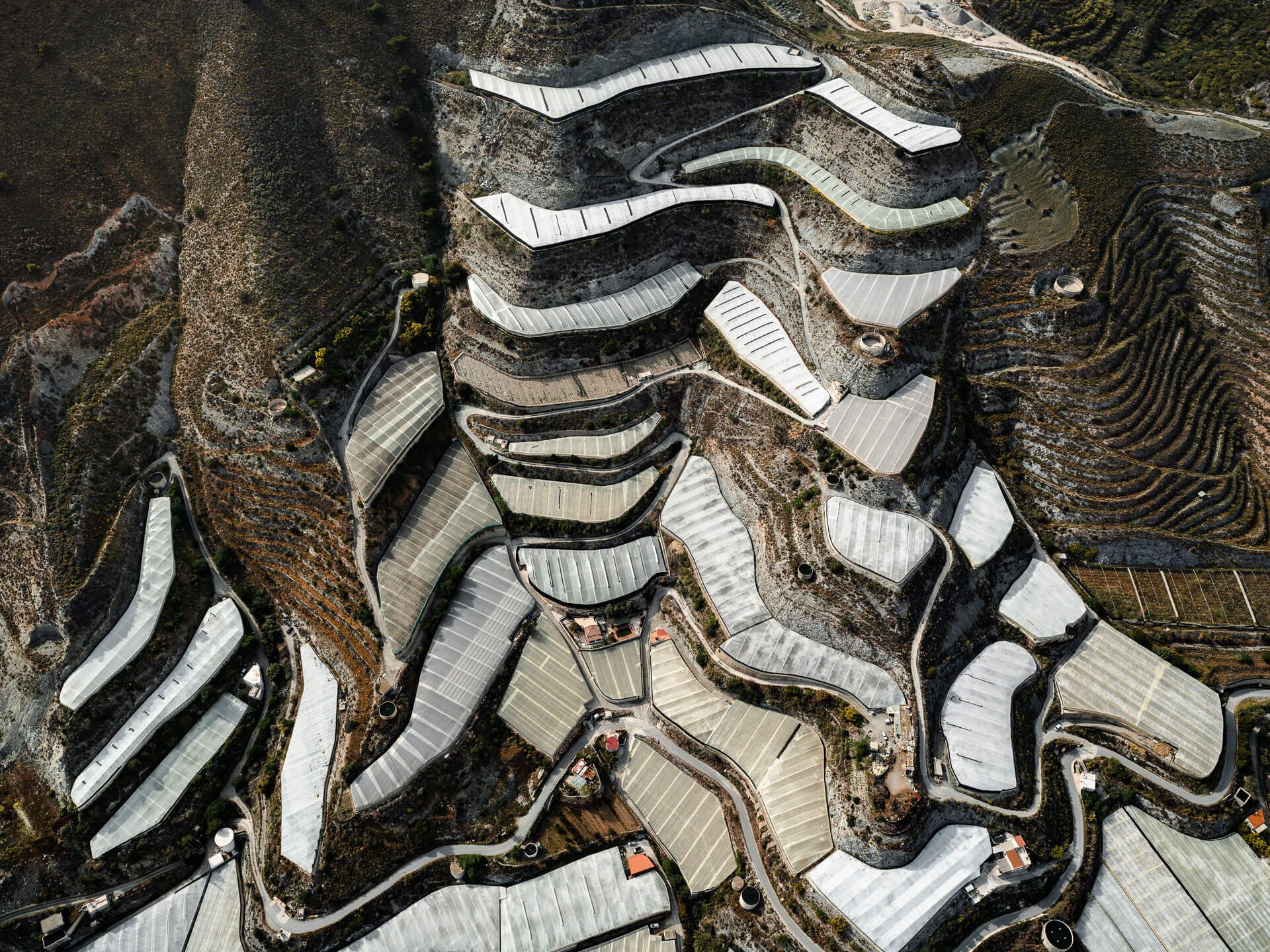
Aerial photographer Tom Hegen documents the extensive impact of human presence on earth and the traces we leave behind. His Greenhouse Series II deals with the Almería peninsula in southern Spain, where most of the available land—both flatland and ridges—is covered with greenhouses.
The stunning scenery reminds me of a tightly-built agricultural area or East Asia’s terraced rice fields, if the crops were all white, or perhaps snowy fields separated by hedges.
While I have some admiration for the productivity (30 times higher than average European farmland, apparently) and efficient land use, the accompanying plastic waste and pollution are unacceptable and unsustainable.
However, I could easily imagine seeing something like this on a not-quite-terraformed world in the Alien movies, for example, or one of the more dystopic locations in the Star Wars franchise.
Visual Inspiration pulls the unusual from our world to inspire design, story-telling, and worldbuilding. If stuff like this already exists, what else could we imagine?
Before you can sew clothes, raw material large enough for the desired use must be obtained. Typical larger materials for clothing include leather, felt, and fabric. Leather is reasonably simple to obtain, and felting is technologically one of the simplest fiber crafts. Before fabric, though, there must be yarn. Spinning is the formation of yarn, and the creation of fabric from yarn happens by weaving or knitting.
Spinning and weaving happen more or less the same way independent of the material—for example, there is broadly speaking little difference in handling wool and flax. The desired quality is ultimately the most important aspect affecting the work.
This post will concentrate on weaving and exclude various looping methods, like twining, nålbinding, knitting, or lacemaking. Also not included are braiding or cording techniques, like fingerweaving, Japanese kumihimo, or tablet weaving.
There are more variations in dyeing depending on the material. This post covers some basic principles of dyeing, and the specifics about plant- or animal-based fibers are returned to in later posts.
Spinning
The process of making yarn by twisting clusters of fibers into a continuous length is called spinning. It starts with a bunch of fibers (roving) from which fibers are continuously pulled, twisting the material all the while between fingers.
Hand spinning by pulling wool out of a roving with the right hand and twisting with the left, photograph by National Rural Knowledge Exchange via Flickr (CC BY 2.0)
There are two directions a spinner can turn the fiber when making yarn, clockwise and counterclockwise. The resulting yarns are typically described as z-twisted or s-twisted.
Characteristics of spun yarn vary according to the material used, fiber length and alignment, quantity of fiber, and degree of twist. Yarn with tight or high degree of twist is typically stronger; conversely, low twist produces softer yarn. The amount of twist can also alter the look of the woven surface. (The modern crepe yarn, for example, is formed by hard twisting or overtwisting, which makes the yarn curlier—also variously described as crinkled, crimped, coiled, kinky, or wavy—and usable in textured weaves like crepe fabrics.) Tighter-twist yarn is easier to handle and unravel than low-twist.
In addition, two or more single strands can be twisted together to make multiple-ply yarn. Adding plies adds to the strength of the yarn, but also to the work required. In weaving, warp yarns tend to be stronger, smoother, more tightly twisted, and more even than weft yarns. In Iron Age Western Finland, for example, while weft was often one-ply, warp was two-ply (two z-spun yarns s-spun together).
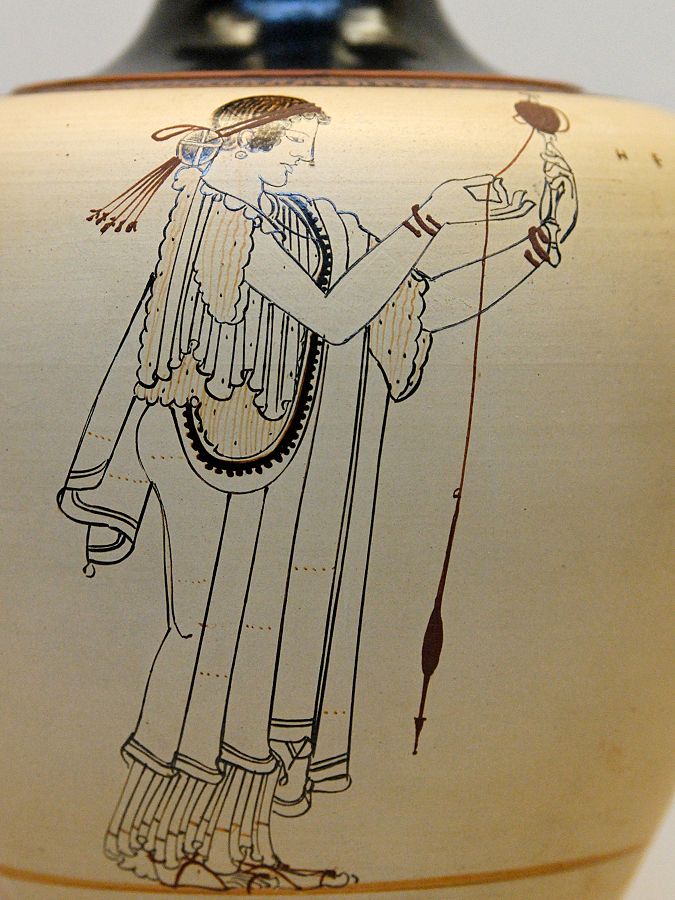
For most of the pre-modern time, hand spindles were the only spinning tool available. A spindle is basically a long thin stick or another similar piece around which the freshly formed yarn can be wound. They are often used with weights (whorls) attached to the bottom to provide more torque and a longer spin time.
Woman spinning via British Museum (Attica; circa 490 BCE; white ground vase)
Spindle spinning is also called drop spinning. Another ancient option is supported spinning, with rolling fibers on the thigh.
Spindle whorls are a common archaeological find type from Neolithic, Bronze Age, and Iron Age sites. The weight of extant spindle whorls varies. Switching whorls might be done to affect yarn thickness and quality (finer yarns require a smaller, lighter whorl, for example). Different eras or cultures might also have their own preferred whorl sizes.
Spindles can be used with a distaff. It’s at its simplest a stick or a board that the unspun fibers are attached to. The spinner feeds material from the distaff with their back hand into the front hand for spinning. Extant distaffs go back at least to the Late Chalcolithic period (the Copper Age), around 7000 to 5000 BCE.
The speed of yarn production by spindle spinning varies according to the quality, gauge, and twist of desired yarn, and—naturally—from spinner to spinner. Plying multiple finished yarns together is faster: it takes about half the time of spinning a one-ply yarn. Andean spinners working with drop spindles on sheep and alpaca fibers spin about 100 meters per hour. Modern hobbyist spindle spinners with modern tools but average skill might manage about 50-100 meters of one-ply yarn per hour, while the seriously experienced ones could reach 150-200 meters per hour.
Dyed roving, wooden spindle with a spindle whorl, and hand-spun yarn, photograph by Kylie via Flickr (CC BY-NC-ND 2.0)
On the other hand, modern reconstructions of garments based on archaeological finds and performed on reconstructed tools seem to involve longer processing times. Some re-enactors estimate spinning speeds of 35-50 meters or 40-60 meters per hour. We can only guess at the speeds Neolithic, Bronze Age, and Iron Age spinners could’ve reached, but 50 m per hour seems a reasonable guesstimate.
Weaving
The origins of weaving are difficult to pin down exactly, but it’s certain humans have also been weaving for thousands of years. At its simplest, weaving means interlacing two strands of material together (with a basic over-some-under-some structure) to form a larger surface.
The earliest cloth was probably netlike. Among the oldest surviving textile fragments, we have for example a piece from Guitarrero Cave in Peru from 12th-11th millennium BCE made from agave or bromeliad leaf fiber (likely twined and not woven). Several woven fabric fragments made from locally sourced oak bast were found from Çatalhöyük in modern Turkey and dated to 6700-6500 BCE. (Bast fibers come from the stem or stalk of the plant, even trees.)
Also at its simplest, weaving can be performed completely with your hands (like in making baskets or simple mats). Certain tools make the work easier and quicker, though.
Weaving takes place on a frame called a loom. The small backstrap loom is an older loom type, still used to make traditional textiles e.g. in Central and South America. In Europe, an upright loom (warp-weighted loom) became dominant until the introduction of the horizontal treadle loom (foot loom). We have evidence of upright looms from Neolithic period onwards (e.g. the Starčevo culture in modern Serbia and Hungary, ca. 6200-4500 BCE). One of the frequent archaeological finds are loom weights. They are tied to the bottom of warp threads on an upright loom to maintain the necessary tension for weaving.
A reconstruction of an upright loom at the Institute for Medieval Archaeology, Bergen, Norway, by A. Davey on Flickr (CC BY-NC-ND 2.0)
A woven surface is made by crossing two sets of yarns (or threads, strings, etc.) at right angles, as opposed to looping like in nålbinding, knitting, or lacemaking. Warp yarns run lengthwise along the fabric, while weft (or filling) yarns travel across from side to side. A weaver begins from one side, brings the filling over to the opposite side, turns the filling around the outermost warp yarn, and returns the weft to the beginning; this back-and-forth sequence is repeated until the fabric is done. The sides where the weft takes a turn, called selvages or selvedges, become neat as a result of the turning.
At its simplest—called plain weave—one weft yarn travels over and under alternating warp threads. On subsequent rows, the pattern shifts: where the filling went under a warp thread on the previous row, it now goes over instead.
To create this offset, the warp needs to be adjusted between each time the filling is passed from one side to the other. This is done by arranging the warp threads into two or more groups (depending on the weave type). For example, in plain weave every even-numbered thread is in group A and every odd-numbered in B. These groups are temporarily held apart, i.e., they are alternatively raised and lowered to create an opening known as a shed through which the weft is passed. A foot loom uses treadles (a kind of pedal) and harnesses (a kind of a frame) to do the raising and lowering; on an upright loom, the sheds are raised and lowered with the help of horizontal rods (shed-rods or heddle rods) holding the thread groups apart. Complex weaves require more sheds, and the weaver must remember the correct sequence of raising and lowering the sheds to produce the desired pattern.
On upright looms, each new row of weft is pressed close to the previous layers with a weaving sword or beater in order to create an even, tight weave. (Modern treadle looms have built-in horizontal beaters that speed up the process considerably.) So, there are four steps to the basic weaving rhythm: the shed is raised, the weft passed through, the shed is closed, and the weft is beaten into place. For example, on the first row, the weaver opens shed A, passes the filling through, closes shed A, and beats the weft in place. On the second row, the weaver opens shed B, passes the filling, closes shed B, and beats again. And so on.
Working takes place downwards on upright looms, which means that fabric forms at the top and is beaten upward (on horizontal looms, finished fabric accumulates towards the weaver). Typically in earlier periods, a specific length for a specific use was planned and executed on upright looms; weaving long stretches to cut down as needed (what we think of as bolts of fabric) is easier on horizontal looms.
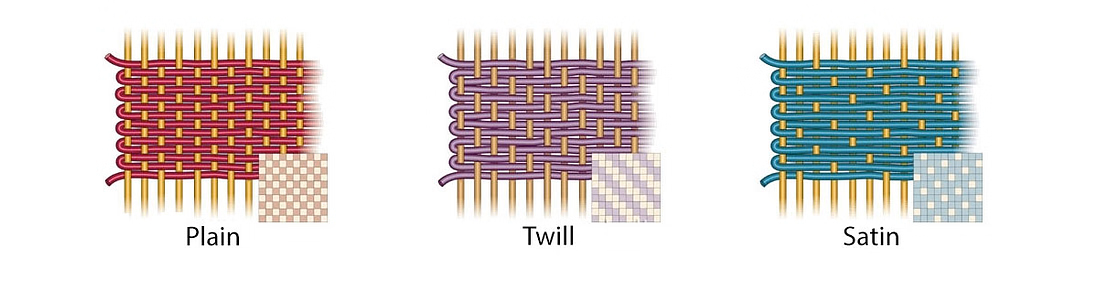
There are three basic weave types: plain weave, twill, and satin weave. (Note that satin does, in fact, refer to a weave and not the material of the fabric. Hence, we talk about cotton, silk, polyester, etc. satin. Sateen is a term sometimes used of cotton satin.)
Plain weaves, also known as tabby or linen weave, are the easiest to make and tend to be strong and hard-wearing.
Twills are also durable and have a higher resistance to tearing than a plain weave. They are characterized by a diagonal line (think jeans, for example). The diagonal is formed by floating the filling over one (or more) warp threads and then sliding it under two (or more) warp threads; with every new row, the pattern is offset, which means very particular shed arrangements. There are several ways of making twill weaves—alternating the number of threads floated over, or the placement or direction of the offset, for example—that can be used to create fabrics with different looks and qualities.
Satins are twill-like, but they don’t have the obvious twill-like diagonals, because they have fewer intersections of warp and weft and a smooth, shiny appearance. This is because the floating yarns skip over a larger number of yarns than in twill and this allows more light to be reflected on the top side of the fabric. They tend to be less durable and snag more easily. Often satins are used for dressier or fancier purposes.
Blue silk satin and grey cotton satin, photograph by Eppu Jensen
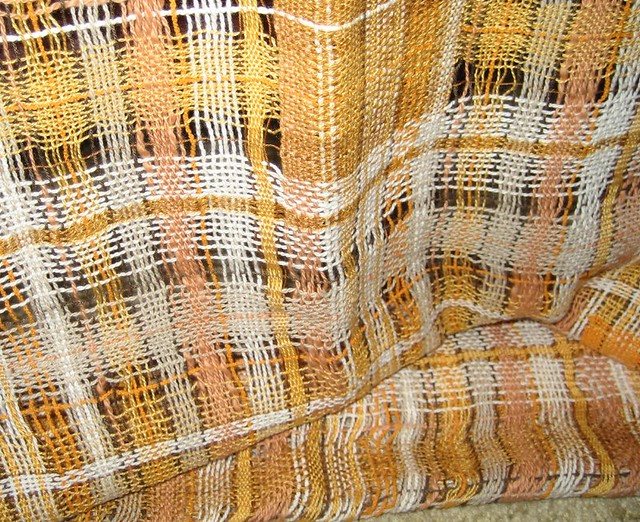
There are several ways besides weaves to customize a fabric for a particular function or look. Variations can be created by combining yarns of different materials, thicknesses, textures, twists, or colors. Sometimes more than one yarn can be bundled together and treated as one. Also the number of warp and weft yarns per centimeter (thread count) affects the look, drape, and feel of fabric.
“Walls” Weaving with texture created by alternating warp and weft thread counts, photograph by Lettuce via Flickr (CC BY-NC-ND 2.0)
Like the speed of hand spinning, the speed of hand weaving depends on a number of factors, including thickness of yarn, complexity of the weave (number of sheds to manage), thread count, and width and length of the finished fabric. Certain Nordic finds indicate that the widths of cloth could vary from 68 to about 140 cm, but indications of greater woven widths have been found elsewhere in Europe and in Central Asia.
At its core, dyeing may sound simple, but in fact it can add to both the textile cost and processing time by a significant factor.
Dyes are extracted by heating the dyestuffs in water, then the dye bath is strained to remove the debris, and finally the fibers to be dyed are immersed, left to soak, and rinsed. Cold dye baths are possible, but they tend to be much slower, so modern instructions almost always give directions for hot baths.
Many natural dyes don’t produce a strong or a long-lasting color (lightfastness, washfastness) on their own, which makes it likely that experimentation with dyes has a millennia-long history. For example, the earliest known use of indigo dye comes from 6000-year-old cotton fabrics from the Preceramic site of Huaca Prieta on the north coast of Peru.
The basics needed for dyeing include equipment for gathering and measuring dyes; containers or vats and strains or sieves for washing and rinsing, for the dye bath, and for storing the dyes themselves; water, soap, and utensils (long spoons or tongs or the like); a heat source; ventilation (for odor or toxicity control); and finally, drying space out of the sun (to avoid premature fading).
Alpaca yarn and various natural dyes set out in bowls for a demonstration in Peru, photograph by Ken Bosma via Flickr (CC BY 2.0)
It’s also possible to dye a piece multiple times with the same dyestuff (overdyeing) or with other colors to deepen or alter the resulting shade. The yarns for one project should preferably be dyed all at once, however, because it’s difficult to get multiple matching color batches using natural dyes. Furthermore, dyeing vats need to be big enough to immerse the material completely and loosely, otherwise the result may be spotty or uneven.
Natural dyes come from grassy and edible plants (roots, stems, leaves, flowers, fruit; including food waste such as onion skins or carrot tops), trees (bark, leaves, needles, nuts, cones), lichens, fungi, and algae. Some dyestuffs even come from the animal kingdom, for example an aphid, Dactylopius coccus, still used for carmine red, or the family Muricidae sea snails, from which royal purple was derived.
Mordants and assists are an optional step. They help fix the dye to the fiber, increase colorfastness, and influence the range of possible colors. Often they deepen the color, but sometimes they mellow it, or tint the result into a greener or browner range. Mordanting can be done prior to dyeing, concurrently, or after dyeing.
There are a variety of different mordants and assists, and different methods to apply them. Mordants and assists can be mineral-based (e.g., alum, iron), plant-based (e.g., tannic acids or tannins like oak gall), or other substances (e.g., lye, ash, ammonia from urine). In the past, toxic mordants like salts of metals such as chrome, copper, tin, or lead were also used in dyeing.
Dyeing can be done almost in any stage of processing: fibers, yarns, finished fabric, or even a finished garment can be dyed. It’s practical to pick a specific stage depending on the intended use and appearance (e.g., a basic saddle cloth vs. an embroidered multi-piece ceremonial suit) or cost and availability of materials (e.g. locally available birch leaves vs. murex sea snails for royal purple).
Dyed unspun fibers in a variety of bright colors from A Year of Colour exhibition by Birmingham Guild of Weavers, Spinners & Dyers, photograph by Charlotte Powell via Flickr (CC BY-NC-ND 2.0)
For instance, two batches of yarn could be dyed different colors, then one used on the warp and the other on the weft, or woven into stripes on a warp of a third color. Cheaper, locally available dyes could also be selected for the majority of a garment and supplemented with embroidery in a yarn dyed with an expensive import dye.
As if there weren’t enough variables already, fibers will take dye in different ways, i.e. the same dye bath will result in a different shade in silk, linen, or wool. Dyes derived from the same plant can also produce different color year by year, or in different doses, or by different dyeing methods.
In practice, it’s often difficult to inspect dyes in an extant archaeological sample, since multiple ways of dyeing can produce the same result. Modern research methods like chromatography and mass spectrometry have started to give intriguing results, though.
A modern dyeing process using natural dyes includes several steps: washing or presoaking fibers; making and straining the dye bath; cooling the bath (for animal fibers); immersing material and reheating the bath (slowly for animal fibers); simmering (plant fibers) and/or letting materials sit while stirring the bath frequently; rinsing; drying.
If dried plant dyestuffs are used, they need to be soaked, sometimes for days, before making the bath. If mordanting or assisting is desired, at minimum it takes half an hour to an hour, but could also add multiple hours to the whole dyeing process. Merely boiling the dye bath might take an hour, as could soaking the fibers in the bath. Cold dyeing (where the dye bath containing the immersed fibers is not reheated) can take several days.
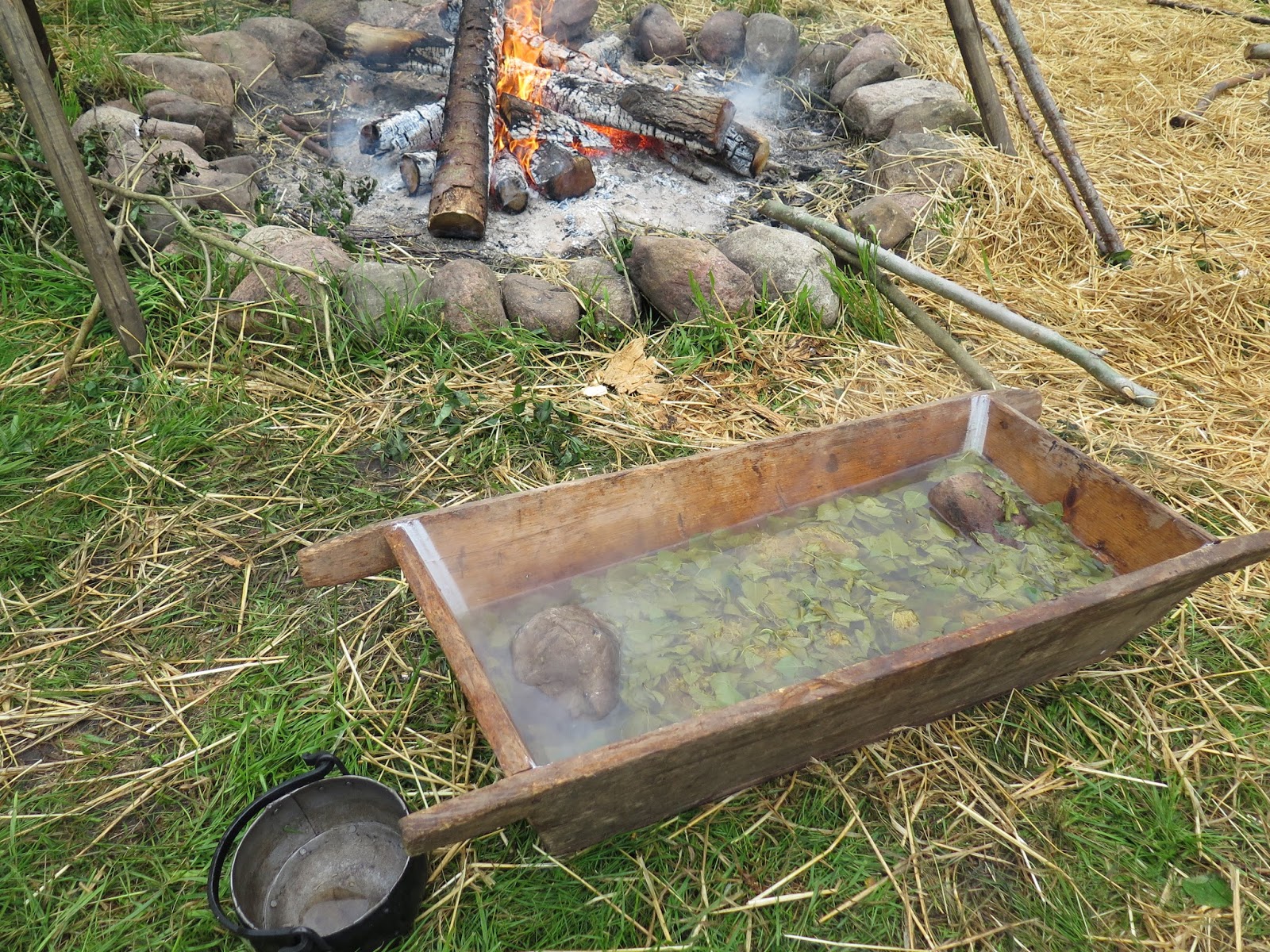
A reconstruction of an Iron Age natural dye bath using birch leaves in a wooden trough heated with hot stones, photograph by Mervi Pasanen
How long dyeing took for Neolithic, Bronze Age, and Iron Age workers is, unfortunately, extremely difficult to estimate. It’s probable that the whole process took days (achieving royal purple certainly did), possibly even weeks, when all steps are considered.
How It Happens looks at the inner workings of various creative efforts.
At least since Tolkien’s Ents smashed up Isengard, the idea of resurgent nature rebelling against those who would destroy it has been a theme in modern fantasy. The idea seems to be a product of modern industrialization and environmentalism. There is no comparable trope in the literature of the ancient Mediterranean, but the idea that humans exist in a relationship with nature that must be properly observed and maintained does find echoes there. The early Roman writer and politician Cato the Elder included this advice in his handbook on farming for those who wanted to cut down trees to clear land:
This is the Roman custom when clearing a stand of trees. With the sacrifice of a pig, use these words: “Whether you are a god or a goddess to whom this wood is sacred, since it is fitting for you to receive the sacrifice of a pig for the clearing of this wood, therefore for these reasons, whether I do it myself or someone does it at my command, let it be correctly done. Therefore with the burnt offering of this pig I pray the correct prayers, so that you may look kindly on me, my family, my household, and my children. For these reasons, therefore, may the burnt offering of this pig be worshipfully made.”
If you wish to plow the ground, make another sacrifice in the same way, adding the words: “for the purpose of doing this work.” As long as the work is ongoing, the same ritual must be done every day in some part of the land. If you miss a day, or if public or family celebrations interrupt the work, you must perform an additional sacrifice.
Cato the Elder, On Agriculture 139-40
(My own translation)
Cato does not elaborate on what might befall a farmer who failed to perform the correct ceremonies. Given what we know of Roman religion, it is more likely that bad luck or a poor harvest was the feared consequence, not angry spirits coming out of the woods to wreak havoc. Still, the idea that interfering with nature is something to be done carefully and with a good purpose is an ancient one.
Serving exactly what it sounds like, the Quotes feature excerpts other people’s thoughts.
Our imaginary wardrobe is made up of four different kinds of material: wool, linen, silk, and leather. Each of these materials has a different origin. Today we consider the time, effort, and resources that went into producing the raw materials for each of these components.
Wool
Wool is processed from animal fleece, most typically sheep. Sheep grow their fleece out year round, and it serves them as insulation against cold, wet, and the hazards of the wild. Wool is traditionally gathered in the spring, so that sheep can have the warm summer months to regrow their coats.
There is no definite rule for how much pastureland it takes to raise sheep. Numbers depend greatly on the quality of the land and how it is managed. Modern farming experience gives us a rule of thumb that one sheep needs at least a hectare of land for a year’s grazing, although in historical conditions, the amount of land needed to raise sheep could have been significantly more.
Modern sheep are the result of millennia of breeding. In the pre-modern world, sheep were smaller, and their wool was lighter in weight and less fine. In some places today there are heirloom breeds similar to sheep of antiquity, such as the North Ronaldsay sheep found today in the Orkney Islands. One North Ronaldsay sheep yields between 1 and 1.5 kilos of fleece in an annual shearing. The shorn fleece loses some weight as it is cleaned and processed in preparation for spinning, from as little as 15 percent to as much as 80 percent.
Linen
Linen fibers are derived from flax, a woody-stemmed plant grown both for its fibers and for its oily seeds. Flax historically has been an important crop in many parts of the world.
Producing flax starts with plowing and sowing. An acre of land was traditionally defined as the amount of land that one farmer with one ox could plow in a day. Since a hectare is approximately two and a half acres, plowing a hectare of land in historic conditions would have taken about two and a half days. After sowing, flax plants take about 100 days to grow from seed to maturity.
Flax plants require deep, rich soil and draw lots of nutrients out of the earth, which means that fields repeatedly planted with flax will become exhausted in a matter of years. Sustainable flax production requires rotating with a less demanding crop and fertilizing to restore nutrients. Depending on fertilizer amounts, modern flax may yield between 4.9 and 7.8 tonnes per hectare. In historical conditions, dependent on animal manure or legume cultivation for soil maintenance, flax yields were unlikely to be as high.
Harvested flax requires extensive preparation to create usable fiber. The processing of flax removes 70-90% of the plant to yield fiber fit for spinning and weaving.
Silk
Silk fibers are derived from the cocoons of insect larvae, primarily the domesticated mulberry silkworm, although other creatures’ fibers have also been used historically. Domesticated silkworms are fed on mulberry leaves until they reach their fourth molt. The worms then spin cocoons by producing a long single filament which they wind around themselves.
It takes about 28 days from when silkworms hatch until they spin their cocoons. During that time, domesticated silkworms require careful tending and feeding, since most of their survival instincts have been bred out of them to make them more suitable for fiber production. They move very little and will not go in search of food if it is not provided for them.
Silkworms feed exclusively on the leaves of the mulberry tree. One mature tree produces enough leaves to feed about ten worms until they are ready to spin. Newly planted mulberry trees have to grow for about 8 months before they start producing leaves. To produce 1 kg of silk thread, 3,000 silkworms consume 104 kg of mulberry leaves, grown by about 300 trees.
Leather
Leather is produced from animal skins. A wide variety of different animals, both wild and domesticated, are used for leather. Domesticated mammals like cattle, sheep, goat, and pig yield most modern leather, although leather can also come from wild animals such as deer, squirrel, and rabbit, as well as non-mammals like ostriches, lizards, and fish.
The amount of leather that comes form one animal depends on the size of the animal and the condition of its hide. In modern leather processing, a typical cow hide yields 4.6 square meters of finished leather, while a sheep hide yields 0.8 square meters. Smaller animals naturally have smaller hides, and hides in poor condition may have to be trimmed smaller to be usable.
Skinning an animal after slaughter is relatively quick, but it is only the first step in leather production. The preparation, preservation, and treating of the hide takes many more steps that may amount to months of labor before the leather is ready to be cut, fitted, and finished.
Images: Woman shearing sheep, from Book of Hours by Jehan de Luc via Wikimedia (currently The Hague; 1524; illumination). “Flax blooms,” photographed by Leonid Kulikov or Mykhailo Kvitka via Wikimedia (currently Fine Arts Museum, Kharkiv; 1893; oil on canvas; by Mykhaylo Berkos). Stamp of Afghanistan showing mulberry branch and silkworms via Wikimedia (1963; postage stamp) (this work is in the public domain under Afghan law). Leatherworking via Wikimedia (1568; woodcut)
How It Happens looks at the inner workings of various creative efforts.
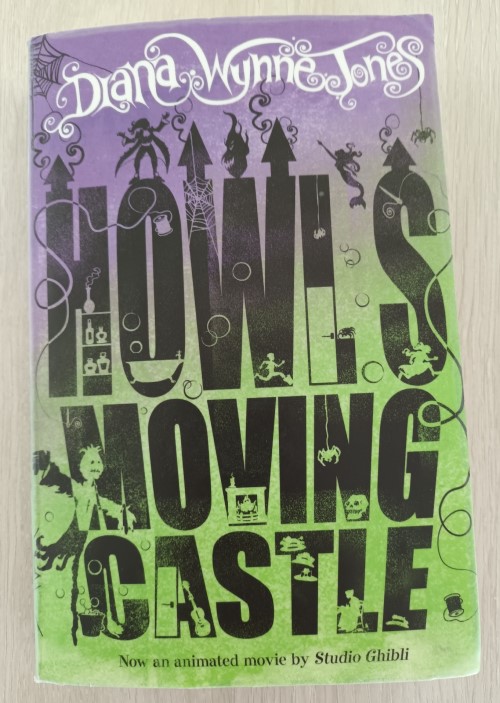
I’ve been looking for cozy, comfortable fantasy reads lately, and I’ve seen several recommendations of Diana Wynne Jones’s Howl’s Moving Castle. Until recently, I had known this name only for the Studio Ghibli animation (which I have never watched either), and I was surprised to discover that it was a novel first. I have read and enjoyed some of Jones’s short stories, so I was hopeful about picking up this novel. Alas, my hopes were soon dashed.
The story follows Sophie, a young hatter who is cursed by the Witch of the Waste to turn into an old woman and to be unable to tell anyone about the curse. Sophie goes in search of someone who can not only break the curse, but recognize that there is a curse to break without her having to tell them. She ends up in the small cottage of the wizard Howl, which is enchanted to look like a mobile castle on the outside. Howl seems to take no notice of Sophie, but his pet fire demon Calcifer recognizes the curse and agrees to help her if she will in turn help him break his contract with Howl, which, for magical reasons, he can’t talk about either. So Sophie settles in as a sort of freelance housekeeper to Howl and his apprentice Michael, while keeping her eyes open for anything she can learn about Howl and Calcifer’s contract.
So far so fairy tale. It’s a strong beginning with a promising cast of characters an interesting set of problems for them to unravel. And then nothing happens. Nothing continues to happen for two-hundred pages, until the last twenty pages when all the plot that didn’t happen in the rest of the novel suddenly comes crashing in like five trains trying to run on the same track at once.
It’s not that the characters don’t do anything for all that time—there are trips to the royal palace, covert visits to sisters, and a jaunt to modern Wales, but none of them make any sense or accomplish anything for the characters. Indeed, most of what the characters do is senseless. Over and over again the novel repeats that Sophie does or says something “without knowing why.” Jones, of course, knows why, and most of these nonsensical acts turn out to be coincidentally relevant in the finale, but far too much of what happens in the story happens because the author is setting up what she thinks is a clever ending, not because it makes sense given what motivates the characters and what they know or think they know at the time.
Indeed, it turns out in the end that Howl knew about Sophie’s curse all along. So did her sisters, not to mention the powerful magic-worker one of her sisters was studying under, and they were all trying to help break the curse. In fact, almost everyone Sophie encounters over the course of the novel knew about her curse and was trying to help her all along, but none of them ever bothered to tell her so. Why not? For no reason I can see other than that it would have broken the dramatic tension before Jones was ready.
Although the story mostly takes place in Howl’s small cottage, I found the atmosphere more stifling than cozy. Howl is an irresponsible jerk who makes everyone around him clean up his messes (both literal and figurative) while he moons over one lady or another. He is moody and mean, given to sulking when he doesn’t get his way, and never shows appreciation for how much work the people around him are doing to keep him afloat. Sophie falls in love with him at the end of the novel, as a fairy tale demands, but for no reason that I can fathom.
The only interesting thing I can point to in the novel is how it cleverly remixes themes and elements from The Wizard of Oz. There is a living scarecrow, a wicked witch in a castle, a humbug of a wizard from our world lost in a fantasy land, and a girl in search of a way back to her familiar life. She even eventually acquires a faithful dog and magical traveling footwear. For all these echoes of Oz, the story never feels like a pastiche or homage; it reimagines and recombines these elements to form an entirely different story. If only that story were any good, it would be an impressive narrative feat.
Howl’s Moving Castle left a bad enough taste in my mouth that I think I’ve been put off Jones for a good while. Maybe someday I’ll give her other works a try, but I need to cleanse my palate a bit first.
Image by Erik Jensen
ICBIHRTB – pronounced ICK-bert-bee – is short for ‘I Can’t Believe I Haven’t Read This Before’. It features book classics that have for some reason escaped our notice thus far.
For the purposes of these posts, we are imagining an outfit that might have been made and worn in many parts of Eurasia or North Africa in the premodern period. Our imaginary wardrobe takes inspiration from a variety of sources, both archaeological and written.
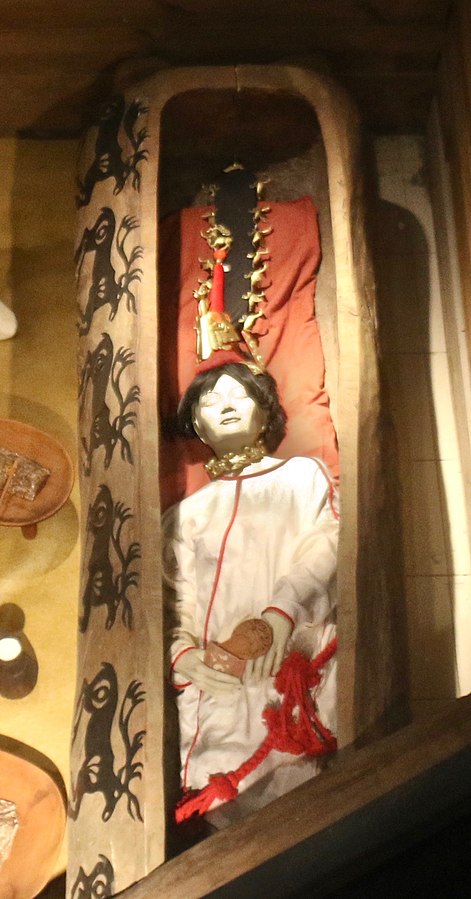
Our oldest piece of inspiration comes from the Altai Mountains in central Asia. In the fifth century BCE, a woman was buried in a tomb on the high Ukok plateau of what is today the Altai Republic in Russian Siberia. The cold, dry climate of the region helped preserve the burial until the late twentieth century when it was discovered and excavated. The woman, popularly known as the Siberian Ice Maiden, was well dressed for her burial, and her clothes were remarkably well preserved. She wore a dress of wool and camel hair, a silk shirt, and thigh-high leather boots, along with a tall headdress made of wood.
Reconstruction of the Ukok woman’s clothing and coffin, photograph by Sue Fleckney via Wikimedia
For our next historical reference, we look to the Vindolanda Tablets, an assortment of documents written on thin sheets of wood found at a Roman fortress near Hadrian’s Wall in northern Britain. Wooden tablets like these were used in antiquity for personal letters, memoranda, and other everyday documents of the kind that rarely survive for very long. These documents were written in the first and second centuries CE, and survived because they were preserved in waterlogged ground around the fortress. Among them we find the household accounts of Roman soldiers and officers detailing what sort of clothes they were spending their money on. A couple of tablets record the business affairs of a man named Gavo. We do not know who he was or what role he played in the life of the fort, but he seems to have supplied a lot of clothing and other textiles. One tablet lists some foodstuffs along with several bedspreads, a cloak, and thirty-eight pounds of wool. (Tabulae Vindolandenses II 192) Another tablet, part of whose text has been lost, listed at least ten cloaks of different types, three tunics, seventeen hooded cloaks, and some number of capes. (Tabulae Vindolandenses II 207) Yet another letter—we don’t know from or to whom—evidently accompanied a gift of underwear, socks, and sandals to some lucky soldier. (Tabulae Vindolandenses II 346)
Reconstruction of a Roman soldier’s dress, photograph by Fabryb13 via Wikimedia
Our last piece of inspiration comes from Egypt in the late antique period, probably the fifth century CE. It is a beautifully preserved tunic made of linen with intricate decorations woven into the fabric in dyed wool. The decorations include flowing vine motifs and depictions of the god Dionysus in surrounded by mythical sea creatures.
We’ve chosen this set of examples to inspire our fictional wardrobe for a few reasons. Between them they span nearly a thousand years of history across Asia, Europe, and North Africa. They come from a wide range of environments, from the cold, arid heights of Central Asia to the hot, dry Egyptian desert to the rainy British Isles. The Ukok woman presents us with the complete outfit of one person; the Egyptian tunic gives us a detailed look at the construction of one garment; and the Vindolanda Tablets help us see individual items of clothing in the context of a larger economic and social world.
Our Example Outfit Described
For the purposes of quantifying necessary raw materials and production time to make a single outfit, we needed a specified set of clothing.
Our imaginary wardrobe starts with a long linen undertunic or short linen underdress. (From the point of view of materials and time required, we consider a dress very roughly equivalent of pants plus a tunic.)
The underlayer is topped by a silk overtunic. For the under- and overtunics, we imagined a simple T-style cut. Many historical tunics use gores at the side and central seams to add comfort, but we’ll try to keep our numbers manageable and stick with a basic design.
In addition, we include leather shoes or boots. Finally, a good-sized, rectangular wool cloak or mantle protects the wearer from elements.
For simplicity’s sake, we postulated a dyed but otherwise unadorned outfit, since the size and amount of decorative banding, embroidery, etc., can vary so widely. Accessories like underwear, wool socks and wool legwraps, hoods and headwear, belts, pouches, bags, and the like were also left out of our example.
How It Happens looks at the inner workings of various creative efforts.












 Co-Geeking


