The Ancient Underground City of Derinkuyu

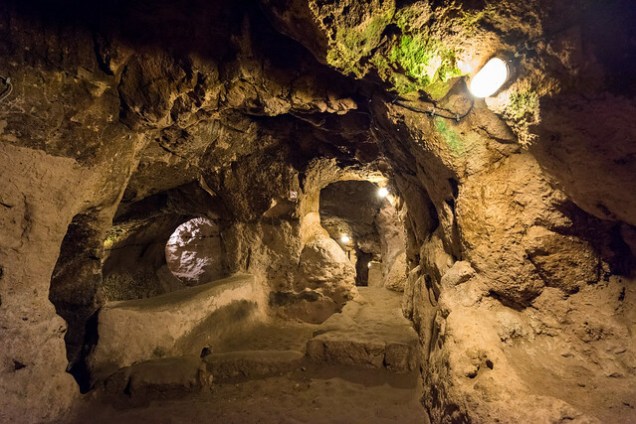
The Derinkuyu (also known as Malakopi) underground city is situated in the historical area of Cappadocia, which is in Central Anatolia in modern-day Turkey. And it’s pretty astounding.

Apparently, underground cities were A Thing thereabouts: according to Wikipedia, there are over 200 of them. Looking at the landscape, it’s no wonder.

Flickr Anthony G Reyes Derinkuyu Pigeon Valley

Much of the rock is easily accessible, i.e., not covered by layers and layers of vegetation, and there are plenty of rock faces to carve into.

The first mentions of underground dwellings in Anatolia come from Xenophon’s Anabasis (c. 370 BCE), but they were probably built much earlier as places of refuge from attacks. Derinkuyu seems to have been in use for millenia: the last recorded use was at least as late as 1909.

According to a tourism site, there are about 600 entrances to the underground Derinkuyu, and some can be closed with a door resembling a mill stone.

Flickr Dan Merino Derinkuyu Stone Doorway

Underground City in Cappadocia

In addition to tunnels and rooms themselves, there are other notable features. There are stairs, ventilation shafts, wells, and storage areas with nooks and crannies of various shapes, including wine troughs.

Underground City in Cappadocia

Flickr Helen Cook Derinkuyu Wine Recepticles

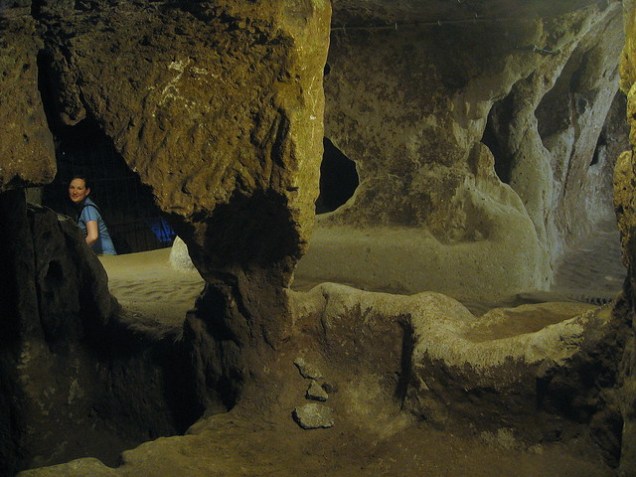
Clearly some areas were left in quite rough shape.

Flickr jyl4032 Derinkuyu Unnamed View

Flickr Patrick Barry Derinkuyu Room w Woman

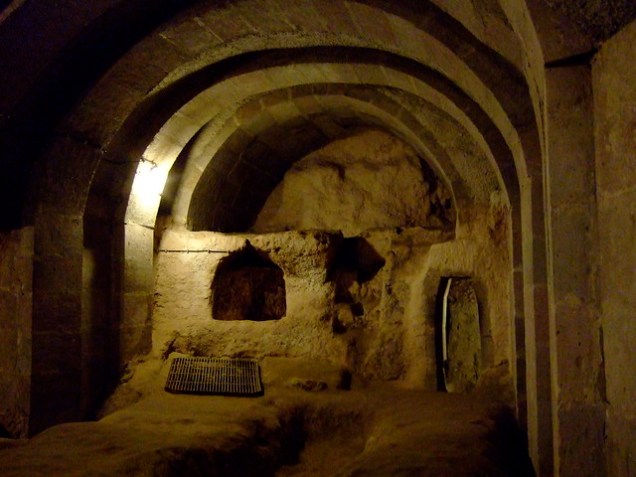
Others were carefully detailed. For example, there is a room with a barrel-vaulted ceiling.

Flickr Takehiko Ono Derinkuyu Vaulted Room

At its largest, Derinkuyu seems to have been able to house 20,000 people and their livestock and supplies.

Found via Ticia Verveer on Twitter.

Images: Cappadocia: Derinkuyu and Pigeon Valley 2015 by Anthony G. Reyes on Flickr (CC BY-ND 2.0). Stone doorway by Dan Merino on Flickr (CC NY-ND 2.0). Stairs down by David Welch on Flickr (CC BY-NC 2.0). Two levels with steps and corridors by David Welch on Flickr (CC BY-NC 2.0). Wine recepticles by Helen Cook on Flickr (CC BY-SA 2.0). Unnamed view of rough corridor by jyl4032 on Flickr (CC BY-ND 2.0). Room with a woman for scale by Patrick Barry on Flickr (CC BY-SA 2.0). Vaulted room by Takehiko Ono on Flickr (CC BY-ND-NC 2.0).

Out There is an occasional feature highlighting intriguing art, spaces, places, phenomena, flora, and fauna.

Building a Castle From the Ground Up

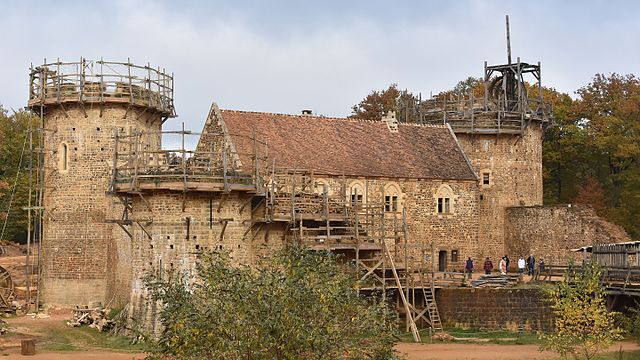
An unusual and ambitious project in experimental archaeology has been under way in France since 1997 and will soon reach completion: the construction of a castle entirely using the technology and techniques available in the thirteenth century.

Castle Guédelon is an attempt to recreate the work of medieval castle construction from the quarrying of stone and cutting of timber to the finishing of the completed structure. The construction materials come from local sources and are brought to the site using only the technology available in the thirteenth century where they are assembled according to plans for a typical small French castle of the period. Laborers on the site even wear recreations of period clothes for a fuller immersion in the historical realities of building.

A full fictional backstory has been created for this castle, conceiving it as the home of a local minor noble. Work is imagined to have begun in 1229, and this imaginary timeline helps guide the details of the plan and its construction. The project is expected to be complete in 2020 (or 1252, in the castle’s imaginary timeline).

The site is open to the public. Revenue from visitors helps finance the construction project. This is an extraordinary piece of experimental archaeology with the potential to provide valuable insights into the practical realities of large building projects in the pre-modern world.

Images: Towers and wall under construction, photograph by Christophe.Finot via Wikimedia. Great hall near completion, photograph by Paul Hermans via Wikimedia. Blacksmith at work, photograph by Francois de Dijon via Wikimedia.

Out There is an occasional feature highlighting intriguing art, spaces, places, phenomena, flora, and fauna.

Random Thoughts on Avengers: Endgame

It took us a while to get to see Avengers: Endgame a second time, but here we finally are. As usual, thoughts in no particular order. Spoiler warnings in effect.


Eppu’s random thoughts

What worked:

  • It was partly what I expected, but only partly. Mostly it was really not at all what I thought it would be. That’s great.
  • So many smaller Marvel characters we’ve glimpsed over the years got brief moments, if not a line or two.
  • A Stan Lee cameo for one more (last?) time.
  • The pacing was quite good; the movie did not feel three hours long. While Avengers: Infinity War felt stuffed to the gills, parts of A:E felt almost meditative. The slow lead down to the final fight (because of course there has to be a big final fight) was especially welcome. I might have wanted to see the post-snap world (not just USA) get more development, but what can you do—the movie is already so long.
  • Jeremy Renner got some very emotional stuff to perform, and he was especially great. Kudos.
  • So much of the dialogue is so funny, especially Ant-Man’s!
  • Captain America’s second elevator scene at the S.H.I.E.L.D. headquarters with H.Y.D.R.A. agents. Thih!
  • At the big final fight, it was great to see several characters—pun fully intended—running the gauntlet with the gauntlet. Teamwork!
  • The women of Marvel got to assemble, too (albeit in one token moment).
  • It was interesting that they kept Thor’s beer belly all the way to the end and specifically didn’t clean him up with Asgardian magic or whatever.

What I absolutely LOVED:

  • How BEAUTIFUL everything looked. I know new special effects have been developed along these 22 movies, and Marvel’s really got them down now. Also, the cinematographer Trent Opaloch did an awesome job again, and the special effects teams seemed to have had more time to work (compared to A:IW).
  • Tony Stark with his daughter—LOVED him in those scenes.
  • Captain America vs. Captain America. *snicker*
  • Professor Hulk’s tete-a-tete with the Ancient One remained verbal after the initial yoinking-out-of-physical-body.
  • Nat and Clint were clearly shown to be good friends, not romantic partners. Same for Nat and Cap.
  • Director Carter. 🙂
  • So many of the men cried at many different points in the story. Because men are not monsters.
  • When Clint came back alone from Vormir, there was literally no dialogue while the rest were trying to come to grips with Nat’s death. Amazing scene, amazing acting!
  • When Professor Hulk first attempted to undo the snap and the rest were wondering whether it worked, Scott Lang went to the window and looked at the birds, absolutely delighted. Great stuff.
  • All of the snap-ashed supers and super groups showing up to stand by Captain America’s side for the final fight. YIBAMBE!
  • Captain America wielding Mjölnir! Aaaaah! I knew he could!
  • Avengers: assemble!
  • Okoye and Shuri! And Pepper Potts in an Iron Suit!
  • Yes, Peter Parker, genuine hugs are really nice.
  • Sam as the new Captain America.
  • That the best, most touching moments weren’t about fisticuffs but people and the relationships between people. Supers are still people, at least in these stories, as are the rest of us.

What I thought wasn’t optimal:

  • The beginning of the movie could have included Captain Marvel’s arrival to the compound.
  • Considering how little time Nebula had in the previous movies, it was odd how much time she had in A:E.
  • As great as it was to see side characters pop up here and there, I miss Maria Hill; she was barely there. (Like Nick Fury, only at Tony’s funeral.) We didn’t see Luis from Ant-Man, either.
  • Hawkeye’s vigilante storyline felt like it was copypasted straight from comics. (I’ve no idea; haven’t read any of those.) As interesting as that might have been, it felt disconnected from everything else tonally and emotionally. I get that that the intent was to have Nat poetically give Clint a chance just like he gave her one, but the integration of the story should’ve been handled better.
  • For such an ensemble movie, it was oddly low in actual team stuff. The main focus and space were on Tony Stark, Captain America, and Thor. Too many moments on those three for an Avengers story, especially when they picked the dudes who already have their own franchises.
  • Speaking of Thor: satisfying hammer-axe action, disappointingly little thunder and lightning.
  • The time-travel plot gimmick felt exactly like that, a gimmick instead of A Rational Plot. Besides, how was Steve able to marry Peggy if doodling with time wasn’t supposed to work that way?
  • What’s this rubbish about barely having Black Panther there?
  • At Stark’s funeral, there was one young dude I didn’t recognize. Apparently he was the young kid from Iron Man 3. O-kay; he wasn’t well integrated at all.
  • Captain Marvel was MASSIVELY underused. What’s the point of having a star player and building up her impact in stingers and trailers if you’re going to bench her for most of the film? Absurd. (I did read a comment online saying that the basic edit of A:E was locked down before Captain Marvel even finished filming. If so, it still doesn’t justify the bad balancing act in the stingers and trailers.)
  • The same also applies to Thor, Doctor Strange, and Scarlet Witch. Doctor Strange had nothing plot-related to do in this film? Really?! You could perhaps argue that acquiring the beer belly might’ve affected Thor’s ability to control lightning; then again, he wasn’t affectected at all by losing an eye in Thor: Ragnarok, so not really. And what on earth was stopping Wanda from either mind controlling Thanos or snapping a bunch of capillaries in his brain!? Marvel really must get its act together and start actually using powerful characters, including the women, as long as they keep insisting on incorporating them into the MCU.
  • Peter Quill got what was coming to him—getting kneed into his privates—for touching someone out of the blue like that, but it didn’t feel satisfactory at all. He needs to have some sense written into him, but this wasn’t the way and I doubt he learned anything.
  • At the very end, Steve’s Old Man Beige(TM) jacket gave me the creeps. Where is it writ that Upon Attaining a Venerable Age, Men Must Wear Beige?!?

What I hated:

  • Thor’s PTSD was a plausible story arc, but done clumsily—too much focus (literally!) was placed on his beer belly, which was played for laughs.
  • Tony Stark may be great with his daughter, but otherwise he’s sill a jerk: asking Pepper a question, then interrupting her in the next breath; all of his needs and wants overriding hers. So, basically, the only time Tony thinks a woman is worthy of respectful treatment is when she’s literally sprung from his own DNA? FFS.
  • If Nebula knew, for her not to have told the Avengers what getting the soulstone requires was nigh on sadistic and not in line with the Nebula the movie spent its beginning establishing. If she merely suspected, it still isn’t in line with the new Nebula. At least she did mention Gamora died on Vormir.
  • You can argue back and forth whether it should’ve been Nat or Clint who got to sacrifice themselves. Since they went the way they did, the fact remains that the writers have now killed two characters for the soulstone, and both are women. It was tiresome already in A:IW (as we see so many dead women in American entertainment which MCU stories are part of—nothing is created in a vacuum). Now they’ve stepped it up (remember how both broken bodies were on display on screen?). The most spot-on comment on this I’ve seen: “’Vormir’ means ‘refrigerator’, right?” Or, in a longer take: “I don’t think anyone involved in making Infinity War understood how viscerally disturbing Gamora’s death was, especially for women in the audience—to be murdered by your abuser in what he claims to be proof of his love, and to have the universe itself validate that proof by giving him what he wants in exchange.” Disgusting.
  • Where was Natasha’s funeral? Why were the men allowed to wallow after losing people, but Pepper got, what, 15 seconds? This stinks of fridging: women die for men to Have Feels.
  • When the women of Marvel got to assemble (albeit in a way that felt forced), they were pretty much stopped there; not even 60 seconds. A:IW had a better all-women fight scene.

What questions I was left with:

  • Um, wasn’t the whole point with Laura and their kids that Clint explicitly wanted to keep ’em off S.H.I.E.L.D.’s radar? (It was mentioned in Avengers: Age of Ultron.) We see him wearing an ankle monitor, which means they’re exposed to at least one agency, possibly many. And he was fine with it??
  • What about phase 4??? Seems like whichever way you look, there’s a lot (a lot!) to explain after A:E, and that doesn’t sound like an easy task.


Erik’s random thoughts

My random thoughts come in two varieties: gripes and cheers.

The gripes:

  • This is a movie trying to do too much. It has too many characters to serve, too many plots to ravel up, too many nostalgia beats to hit, too much narrative debt to pay off. As with Infinity War before it, it is a tribute to the writers and directors that this movie works at all, but it still feels like twenty pounds of story in a ten-pound bag.
  • Given that the movie is overstuffed, it is no surprise that most of my problems with it concern the things it doesn’t have time for. It is perhaps unfair to complain that a movie with several dozen heroes doesn’t spend enough time with some of them, but there a few cases that feel particularly galling. Chief among those is Captain Marvel. After a movie and two stingers building up her potential as a game-changing hero, she barely appears in Endgame. Her most significant contribution to the plot is delivering Tony Stark back to Earth, after which she disappears for most of the rest of the runtime. The movie practically spends more time making excuses for Carol Danvers’s absence than it does explaining the central time heist.
  • The movie’s handling of women in general is pretty awful. They mostly appear as emotional supports to men or in roles so small as to be effectively meaningless. When the female heroes assemble in the midst of the final battle, all they really get to do is pose together before the general melee resumes. The Marvel Cinematic Universe has had a problem with is female characters for the whole decade, yet the fact that the filmmakers evidently thought a quick photo-op in a three-hour movie was good enough is somehow even more enraging than the usual neglect.
  • In a similar vein, it is not nothing that this movie includes the first openly, explicitly gay character in the MCU, and the fact that he is taken seriously as a person, without comment or surprise—and by Captain America, no less—is unequivocally good. At the same time, an unnamed throwaway character in a scene that does not advance the plot and will be easy to edit out in less tolerant markets is about as close to nothing as you can get.
  • There is a reason why the original Avengers movie worked so brilliantly: not only did the movie as a whole have a clear narrative line, but all of the major characters had their own arcs. You could watch it as an Iron Man movie, a Captain America movie, a Hulk movie, a Thor movie, a Black Widow movie, even a Hawkeye movie, and it worked. If Avengers proved that there can be room for six main characters in a movie, Infinty War and Endgame have proved that there isn’t room for several dozen. Tony Stark and Steve Rogers are the only characters who really have narrative throughlines in the movie. Thor and Bruce Banner each get a couple of good scenes, but not enough for a real story. Natasha and Clint have the suggestion of a story without really getting time to develop.
  • Another thing that made Avengers so successful is that, of all the movies Tony Stark has appeared in, Avengers is the one least dominated by his emotional issues. Endgame sadly falls right into line, devoting more screen time to Tony Stark’s feelings than to anything else.

The cheers:

  • While the whole of this movie may be less than the sum of its parts, some of those parts are pretty good. The scene between Nat and Clint on Vormir sticks out in my mind. For the two poor relations of the Avengers, it was a haunting, beautifully-acted performance that showed the depths of their friendship in a way that has only been hinted at before. I could not guess which of them was going to fall, but it was clear that it would be heartbreaking either way.
  • I appreciated that this movie took the time to show us a post-snap world, even if only in a fragmentary way.
  • A lovely, tiny detail of character development: Tony and Pepper’s daughter tells Tony “I love you 3,000.” When recording a message for her, he says: “I love you 3,000.” Not 3,001 or 4,000, but the same number. For once, he doesn’t feel the need to one-up someone.
  • The final battle is a gloriously overloaded superhero rampage. I usually like cinematic fights to have a clear narrative progression, but there is something to be said for the joy of sheer chaos.
  • Many of the callbacks to previous movies were ingeniously done, but I think my favorite is Falcon announcing the arrival of the un-snapped on the battlefield with: “On your left.”
  • Even though it was far too brief and inconsequential, the assembly of the Marvel women was glorious as long as it lasted, and it made the point that the MCU has lots of powerful female characters. Now they just need movies.
  • There were also nice moments sprinkled through the film of women doing things: Nat running the reduced Avengers, Okoye managing the Wakanda branch (and perhaps the whole African division?) of same, Carol Danvers punching through a spaceship (as she is wont to do), and Nebula reconnecting with a previous version of Gamora. They are not enough, but they are good for what they are.
  • On Nebula and Gamora: in one of the few exceptions to women acting primarily as emotional supports to men, the most important relationship that Gamora develops when brought back from the past is with Nebula, not Peter Quill. The movie in fact gives Nebula, a secondary character from a second-string franchise, a surprising amount of screen time and development. At the end of the movie, Gamora and Nebula’s sisterhood is poised to take over as the most important relationship among the Guardians of the Galaxy, while Thor is in position to replace Quill as leader. If this leads to Quill being sidelined from the group or developing as a character into something more than a petulant overgrown child, I support either change.
  • Steve gets to have a life with Peggy. I’ll let other people worry about the time-travel implications—it is the ending they both deserve, and I’m happy with it.
  • Also: we know that Peggy Carter went on to be someone important in S.H.I.E.L.D. (her office door says Director), while Steve Rogers was a national hero whose face had been all over the newsreels. If he wanted to stay out of history’s way in his life with Peggy, he’d have to keep out of the public eye. Conclusion: Peggy Carter was working a high-powered job in the 1950s while Steve Rogers was a stay-at-home husband. I support this idea, and I believe Captain America would support it, too.

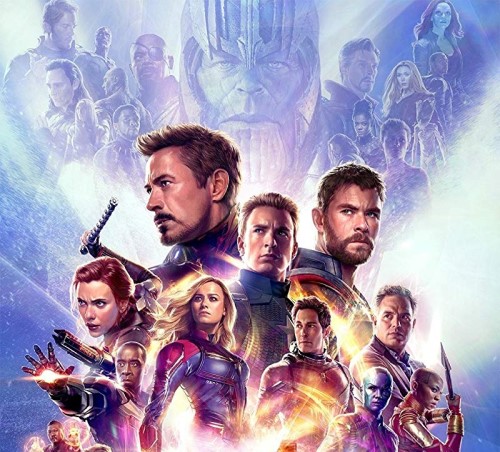
Image: Avengers: Endgame poster via IMDb

In the Seen on Screen occasional feature, we discuss movies and television shows of interest.

Living Vicariously Through Social Media: The Clay Forest in Western Tibet

One of the best things about social media—like the Internet, too—is how many different phenomena you can witness if not first hand then at least in a secondary capacity; way more than would be possible in a regular human lifetime.

Case in point: the Clay Forest is a massive gorge like the Grand Canyon, except it’s located in Western Tibet. Apparently it wasn’t really accessible for Westerners until 2015.

Twitter UrsulaV Clay Forest Canyon
Ursula Vernon on Twitter

Author and illustrator Ursula Vernon posted this and a few other images from Tibet on her Twitter account. Thank you for sharing!

I’m slack-jawed and stunned. Phew!

Out There is an occasional feature highlighting intriguing art, spaces, places, phenomena, flora, and fauna.

Behind the Name: Erebor

Erebor, also known as the Lonely Mountain, is a lost kingdom of the Dwarves in Tolkien’s Hobbit, reclaimed from the dragon Smaug by Thorin Oakenshield and his companions, including Bilbo Baggins the Hobbit, at the end of the story. Since Professor Tolkien was a linguist, and his Middle Earth was first inspired by his desire to create a world and history around his invented languages, it makes sense to ask what inspired him to name this important place Erebor.

The Hobbit itself does not make much use of Tolkien’s linguistic experiments. Most of the places named in the novel have descriptions more than names—the Misty Mountains, the Long Lake, Lake Town. Even the few places with proper names are fairly transparent in their meaning: the town that sits in a dale by the Lonely Mountain is called Dale, and Mirkwood is not too hard to understand as a murky wood. The term Erebor did not appear until The Lord of the Rings. By that point, Tolkien’s constructed languages were well developed and he provided a suitable internal etymology for Erebor as an Elvish translation of Lonely Mountain. Nevertheless, there are some clear real-world referents that we cannot ignore.

The obvious place to start is Erebos, a name from Greek Mythology for both a region of the underworld and a primordial god representing darkness. (Erebos is the original Greek spelling; it is often seen Latinized as Erebus.) To name an underground city cut out of the rock of a mountain, this makes sense as a starting point, but Erebos has an interesting etymology of its own.

Erebos derives from a Proto-Indo-European root *hregwos. (In linguistics, the asterisk indicates words that are not recorded anywhere but have been reconstructed based on related words or other forms.) The Proto-Indo-European language had several different consonants corresponding to the letter h, and the exact pronunciation of them all is a matter of debate, but before an r at the beginning of a word, this h regularly became an e in Greek. The gw sound became a b in Greek (for example, the Greek word basileus, meaning “king” comes from an earlier form gwasireu). Thus *hregwos became the ancient Greek Erebos.

In other branches of the Indo-European family, the same root took different paths. In Sanskrit, it became rájas, which means “dark sky.” In Armenian, it became erek, meaning “evening.” In Gothic, it became rikwis, “darkness.” And in Old Norse, it produced the verb røkkva, which means “to become dark.” Clearly, while Ancient Greek adapted the word to a new meaning, the original meaning had to do with darkness in the sky, not under the earth. The name of Erebor captures a suggestion not just of a place under the earth but also its fate to be assailed by the sky-darkening dragon Smaug.

There is one step further we can go, although it is a tentative one. It involves the Norse myth of Ragnarök, the doom of the gods and the destruction of the world. The word Ragnarök is a compound whose first part, ragna, means the power of the gods (congate with the English word reign). The second element is less certain. Linguists today prefer rök, meaning “fate,” but the early twentieth century when Tolkien was studying, some argued for røkkr, the noun for “twilight” derived from the verb røkkva and ultimately going back to the Proto-Indo-European *hregwos. Tolkien may well have been amused to hint at the chaotic, destructive final battle between the Norse gods in naming the site of the chaotic Battle of the Five Armies which brings Bilbo’s adventure to an end.

Image: Erebor as visualized in Peter Jackson’s Hobbit films, via IMDb

On, of, and about languages.

Blue and White Transmogs for 120

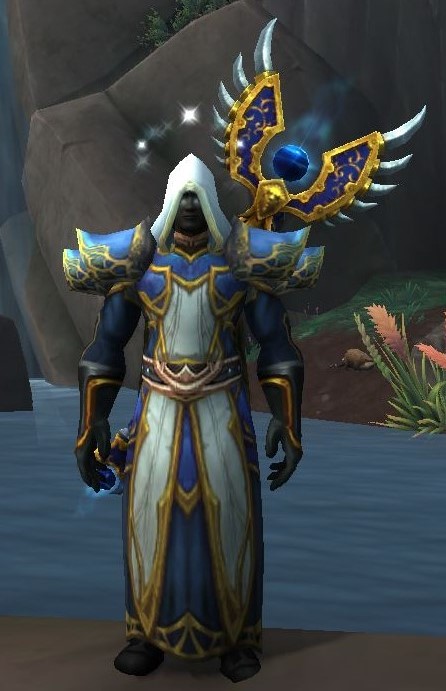
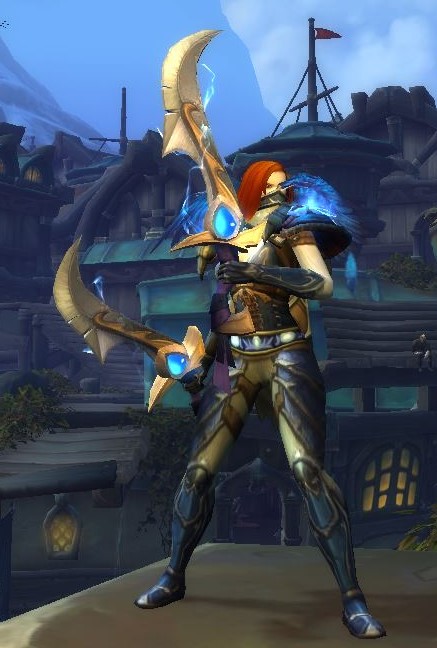
I’m slowly getting all my alts up to 120 and often celebrating with brand new transmogs. My holy priest and outlaw rogue recently made it and, without any particular plan, I ended up giving both of them blue and white transmogs. Here they are for your enjoyment.

My holy priest in his Stargazer’s Perfection outfit.

My outlaw rogue decked out in her Storm-Angel’s Descent look.

Of Dice and Dragons is an occasional feature about games and gaming.

Most Famousest of The Hobbit Soundtrack Covers

Recently we rewatched The Hobbit trilogy, which made me—again—root around looking for Dwarf-ish music. This time, though, I went wider and also included cover versions of melodies from all of the six Peter Jackson movie soundtracks.

Taylor Davis is one of the fabulous violinists out there doing YouTube covers. Here is her “Misty Mountains”:

The Hobbit – Misty Mountains (Dwarven Song) Violins Cover – Taylor Davis on YouTube

Nathan Mills aka Beyond the Guitar’s version of “Misty Mountains” by classical guitar is so lovely:

THE HOBBIT: Misty Mountains – Classical Guitar Cover by BeyondTheGuitar on YouTube

Guitar at its best, hands down.

This orchestral cover medley/remix by Parademics has an impressive range of instruments—I think we spotted an electric guitar in the background in the Ring Wraiths melody towards the end:

The Hobbit | Epic Orchestral Cover by Parademics on YouTube

Albert Chang’s arrangement of “Misty Mountains” incorporates 6 violins, 6 cellos, and a cajon, and shows why underappreciating cellos is a bad idea:

The Hobbit – Misty Mountains Orchestral Cover by sleightlymusical on YouTube

So much depth comes from the deeper-voiced string instruments!

Scott Sutherland’s tuba version is really solemn and somber:

Misty Mountains Cold – The Hobbit (Euphonium and Tuba Cover) by Scott Sutherland Music on YouTube

I have an impression that the tuba family is typically considered a bit silly, at least in the mainstream culture, but it shouldn’t.

The following Lord of the Rings medley also has an incredible cello part:

Lord of The Rings – The Hobbit (Piano/Cello Cover) – ThePianoGuys on YouTube

By ThePianoGuys aka Jon Schmidt, Steven Sharp Nelson, and Al van der Beek, with van der Beek’s arrangement.

Jasmine Thompson’s cover of “I See Fire” from The Desolation of Smaug is as good if not better than the original:

“I See Fire” Ed Sheeran The Hobbit: The Desolation of Smaug – cover by Jasmine Thompson on YouTube

Guitar for Thompson’s cover is by Seye Adelekan.

This gender-flipped version of “Into the West” from The Return of the King is awesome:

Into the West (Cover) – Josh Sahunta & Nicholas Yee on YouTube

Josh Sahunta singing and playing the piano, with Nicholas Yee on the cello.

Finally, being a Finn, I would be remiss not to include this instrumental metal version of the Lord of the Rings theme by Doug Anderson:

Lord of the Rings Theme – Epic Metal Rendition by Doug Anderson on YouTube

Do you have a favorite cover from either The Hobbit or Lord of the Rings? Please share!

An occasional feature on music and sound-related notions.

An Improved Kenobi-Vader Fight for Star Wars A New Hope

Under the moniker FXitinPost, visual effects artist Christopher Clements made an unofficial, improved scene for Star Wars: Episode IV – A New Hope and seamlessly inserted it into the movie. The resulting six-minute clip is all about the final confrontation between Ben Kenobi and Darth Vader, and definitely worth a watch:

Star Wars SC 38 Reimagined by FXitinPost on YouTube

I don’t know whether they had any skill or not, but if Alec Guinness and David Prowse were not competent sword fighers, it’s understandable the scene looks like it does. I have to confess, though, that the clunkiness of the fight has been long bugging me; it also stands out since Lucas retroactively changed so many other scenes. Clements’ version is much more in line with Jedi abilities and includes many intriguing creative choices on how to use the space on the Death Star. Kudos!

In Making Stuff occasional feature, we share fun arts and crafts done by us and our fellow geeks and nerds.

Guest-Friendship

Small-scale societies have ways of dealing with problems that arise within the community, but dealing with the outside world is often a more serious challenge. Small, subsistence-level communities are rarely entirely self-sufficient. Some level of contact with the outside world is useful for trade and joint self-defense, but leaving your home community is risky when you cannot be sure of being safe elsewhere. Within your own village, you may be surrounded by family, neighbors, and people bound to you by mutual bonds of obligation whom you can count on to stand up for your safety and your rights, but once you head out into the wider world, you are alone. If someone attacks you, steals from you, or tries to cheat you in a bargain, who can you look to for help? Different societies have different ways of dealing with this problem, but one useful strategy is known as guest-friendship.

Aspects of guest-friendship are documented in practice in ancient Greece, where the custom was known as xenia, based on the word xenos, which could mean foreigner, stranger, or friend. In the early archaic society described in the Homeric epics, wealthy warrior-nobles—the sort of people represented in the epics by heroes like Odysseus and Menelaus—had faithful retainers to protect them while at home, but traveling with a large retinue was difficult. Since the two major reasons for leaving home were to trade with neighboring communities or to raid them for supplies and slaves, it is understandable that travelers did not always find a warm welcome, even when they came in peace.

To keep themselves safe when away from home, aristocratic families from different communities made agreements of guest-friendship among themselves. These families would provide lodging and food to visiting guest-friends and expect the same when they went traveling themselves, but more importantly guest-friends protected one another. In essence, a guest-friendship was a promise to treat your visitors as if they were members of your own family. That could mean more than just hosting them for a few days. It could also mean standing up for them if they were mistreated or cheated while doing business in your town, even fighting in their defense if they were attacked. In a world without police, courts, or enforceable contracts, where your rights ended at the borders of your home town, these relationships were essential to keeping trade routes and lines of communication open.

In ancient Greece, as in many other places, these relationships were personal, but also hereditary. They could be passed down from generation to generation, sometimes even being revived after lying dormant for many years. Between individuals, guest-friendship could even take precedence over inter-communal hostilities. The Iliad records a battlefield encounter between two heroes, Diomedes and Glaucus, one fighting on the Greek side, the other on the Trojan side. Approaching each other on the field, they shout out challenges and boast about their ancestry and accomplishments, but in doing so, they discover that their grandfathers were guest-friends. Once they realize their connection, Diomedes and Glaucus agree that it would be wrong for them to fight one another. Instead, they exchange armor as a token of friendship and agree to go find other people to fight. (Homer, Iliad 6.119-191)

As a means of ensuring safety for travelers, guest-friendship was unreliable. It depended on mutual personal obligations which could not be enforced on the unwilling. There was no way to prevent the abuse or neglect of the relationship, other than the threat of ending it. As much as Homer’s epics celebrate the uses of guest-friendship among honorable people of good will, they also reflect how precarious such codes of behavior could be when there wasn’t force behind them. While the fairy-tale wanderings of Odysseus are a fantasy version of the dangers of traveling without the protection of familiar customs and norms, the greedy Ithacan suitors eating up Odysseus’ wealth in his absence bring the problems closer to home. Indeed, in Greek myth, the institution of guest-friendship fails at least as often as it succeeds.

Nevertheless, even in later periods of ancient Greek history when legal and diplomatic institutions were better developed, the idea of guest-friendship still had a place. Some aspects of guest-friendship, in a less personal and more formalized way, continued in the role of proxenoi (singular proxenos), who acted as representatives and advocates for outside communities. The Athenian aristocrat and politician Cimon, for example, acted as Sparta’s proxenos in Athens. He hosted Spartan emissaries when they came to Athens and used his influence in Athenian politics to try to make peace between the two cities in the early years of the Peloponnesian War. Like guest-friendship, this role was also often hereditary, passed down through aristocratic family lines from father to son. Guest-friendship itself was even revived as a way of forging relationships across political lines between Greek aristocrats and representatives of the Persian Empire.

The details of ancient Greek guest-friendship are particular to one culture and one time period, but similar relationships—with all their attendant possibilities and problems—existed in many other places and times among small societies lacking strong institutions to keep order. We can find similar patterns of mutual obligation among historical peoples from places as diverse as the Scottish highlands, the Arabian peninsula, and the Pacific islands. Many customs still surviving in the modern industrialized world, such as exchanges of gifts between guests and hosts or the maintaining of multi-generational family friendships, preserve vestiges of practices that were once vital to making it safe tor travel beyond the boundaries of our own homelands.

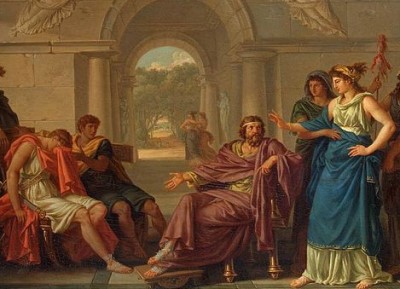
Image: detail from “Helen Recognizing Telemachus, Son of Odysseus” via Wikimedia (Hermitage Museum; 1795; oil on panel; Jean-Jacques Largenée)

History for Writers looks at how history can be a fiction writer’s most useful tool. From worldbuilding to dialogue, history helps you write. Check out the introduction to History for Writers here.

Striking Iron: A New Exhibition at the National Museum of African Art

One of the current exhibits at the National Museum of African Art is “Striking Iron: The Art of African Blacksmiths”. It focuses on blacksmithing in sub-Saharan Africa and features works dating from the 17th century to recent times: not just weapons, but other tools and implements such as musical instruments.

The range and design of shapes is truly impressive. Below are just some of the examples.

Smithsonian African Art Iron Exhibit Ceremonial Knives

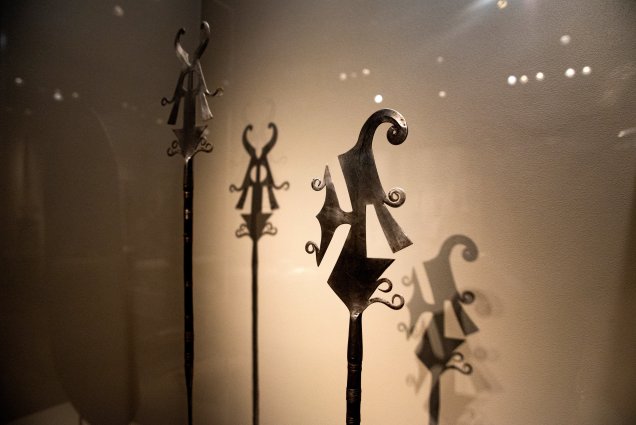
I wasn’t familiar with the concept of rain wands (image below) before. They were planted in the earth with the intention of drawing the life force of the Earth up toward the heavens in order to bring down rain.

Smithsonian African Art Iron Exhibit Rain Wands

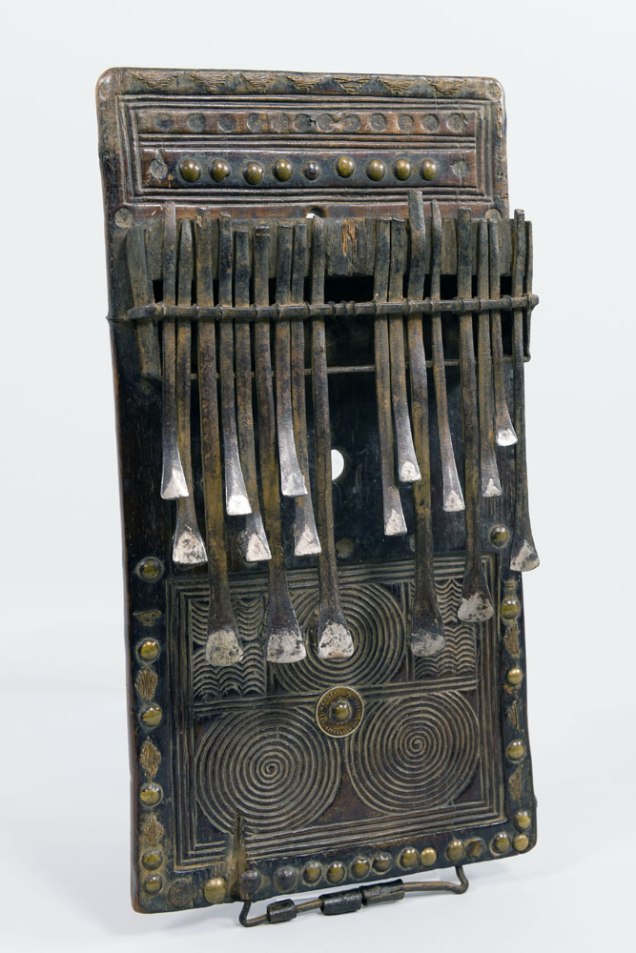
Various kinds of sound instruments are also displayed, including lamellophones.

Smithsonian African Art Iron Exhibit Lamellophone

And, since it’s ironworking, there are weapons.

Smithsonian African Art Iron Exhibit Double-bladed Dagger

I’m especially struck by the multiple elaborate curls of the ceremonial knives and the rain wand in the shape of a three-headed snake. Simply stunning.

The exhibition runs until October 20, 2019.

Found via NPR—make sure to visit the article for more photos!

Images: Ceremonial knives by Olivia Sun for NPR (Democratic Republic of the Congo; 19th century; iron). Rain wands by Olivia Sun for NPR (Nigeria; iron). Lamellophone (chisanji) via Smithsonian (Chokwe artist, Angola; late 19th century; wood and iron). Double-bladed dagger by Olivia Sun for NPR (late 19th-century Sudan; iron, bone, and crocodile skin).