1970s Concept Art of Space Habitats Courtesy of NASA Ames Research Center

In the 1970s, NASA designed potential space habitats in three basic shapes—toroid, Bernal sphere, and cylinder. Artwork depicting some of the plans has now been published in several sizes without copyright restrictions. Here’s the NASA description of the images:

“A couple of space colony summer studies were conducted at NASA Ames in the 1970s. Colonies housing about 10,000 people were designed. A number of artistic renderings of the concepts were made.”

Below are some of my favorites.

A version of cylindrical habitats has since been seen in popular media—Babylon 5, anyone?

NASA Ames Research Ctr AC75-1086 Rick Guidice Cylindrical Interior

The residential buildings look kind of cutely 1970s. (And I say this as a non-fan of the 70s aesthetic!)

NASA Ames Research Ctr AC75-1086-1 Rick Guidice Toroidal Cutaway

Apparently all of these designs were meant for thousands of people: the toroid and spherical stations could house around 10,000 and the cylinder a million. Wow. They certainly did not dream small!

Finally, two images of a Bernal sphere habitat:

NASA Ames Research Ctr AC76-1288 Don Davis Bernal Sphere Construction

NASA Ames Research Ctr AC76-1089 Rick Guidice Bernal Sphere Cutaway

Visit the NASA’s “Space Colony Art from the 1970s” page for more images and links to high-res scans.

Found via The Public Domain Review.

All images courtesy of NASA Ames Research Center: Cylindrical habitat / interior view looking out through large windows (NASA ID number AC75-1086) and toroidal / cutaway view exposing the interior (NASA ID number AC75-1086-1) by Rick Guidice. Bernal sphere / construction crew at work (NASA ID number AC76-1288) by Don Davis. Bernal sphere / cutaway view (NASA ID number AC76-1089) by Rick Guidice.

Out There is an occasional feature highlighting intriguing art, spaces, places, phenomena, flora, and fauna.

Two Black Amazons from 1400s

Oh, goodness! An illumination from a 15th-century French manuscript shows two black Amazons. Have a look:

Le secret de l'histoire naturelle fol 2r Cropped
Le secret de l’histoire naturelle, France, ca. 1480-1485, BnF, Français 22971, fol. 2r; via discarding images on Tumblr.

This image has clearly been cropped and edited. My source, discarding images on Tumblr, says the two women are Amazons but gives no more details.

Being an early history nerd, I did some additional digging. Below is the whole page via Gallica, the digital library for the national library of France (Bibliothèque nationale de France, or BnF).

Le secret de l'histoire naturelle fol 2r Full Page
Le secret de l’histoire naturelle, France, ca. 1480-1485, BnF, Français 22971, fol. 2r.

The full title of the manuscript is Le secret de l’histoire naturelle contenant les merveilles et choses mémorables du monde. It was created between 1401-1500, and is currently stored at BnF. The illumination comes from the first part of the book, which presents the great countries and the great provinces of the old world.

Unfortunately, my French isn’t good enough anymore to be confident in my reading; I can understand a word here and there, but not the whole. However, it does look like the first word below the illumination is Amazon.

I’ve cropped into a separate image the bottom left corner of the illumination with the text following immediately after it:

Le secret de l'histoire naturelle fol 2r Amazons
Le secret de l’histoire naturelle, France, ca. 1480-1485, BnF, Français 22971, fol. 2r; cropped.

I just cannot make out the full spelling of the first word due to the ligatures that squish up the last two or three letters. It definitely looks like it’s inflected, though. The sequence ma definitely follows the capital A, with most likely a z and o further along.

It also looks there’s a sigil marking an abbreviation on top of the o, which was very common in handwritten Medieval documents to mark inflectional endings, among others. (Unless it’s a diacritic like in modern French – were they even used in Medieval French? If so, maybe Amazonye? Amazònye? Amazónye?? Amazônye???)

Anyway, it seems that Amazons are indeed talked about on the same page. The larger block of text above the illumination mentions the word affricà, too. (Again, not sure whether that’s a sigil or diacritic on the final a.)

In any case, if the two women aren’t Amazons, at the very least they are heralds of some sort leading a column of warriors. The image details, like the mi-parti dresses, are really neat, too.

Found via MedievalPOC on Tumblr.

And speaking of MedievalPOC, I’ve found it a truly valuable source for types of art imagery that’s not usually included in the canon from the Middle Ages onwards. The site is sometimes a little too interesting: on several occasions, I’ve spent much longer than intended there, happily chasing intriguing details down the rabbit hole. If you’ve got the time to spare, I wholeheartedly recommend it. 🙂

P.S. You can also follow MedievalPOC on Twitter. Happy browsing!

This post has been edited.

Hey, look! We found a thing on the internet! We thought it was cool, and wanted to share it with you.


Quotes: Trail Goes Down Between Two Hills

“[T]he Pima of Central Arizona have historically embedded in their landscape the stories, histories, and lessons of their way of life and culture. Thus, the Pima, when they wish to remind someone of their past, or of a lesson they would like that person to remember, make what seem to white people abstract references to locations on their territory, such as ‘Trail Goes Down between Two Hills.’ The target of their comments, however, will know what they mean.”

– Matthew Barlow, Griffintown: Memory and Identity in an Irish Diaspora Neighbourhood, 11

Historian Matthew Barlow here cites the work of anthropologist Keith Basso on how memory can be embedded in a landscape to explain how the Irish-Catholic population of Montreal imbued the working-class neighborhood of Griffintown with meanings important to their identity as Irish-Canadians, such that even after the neighborhood was redeveloped, Irish-Montrealers could invoke generations worth of memories by reference to churches, pubs, streets, and other landmarks.

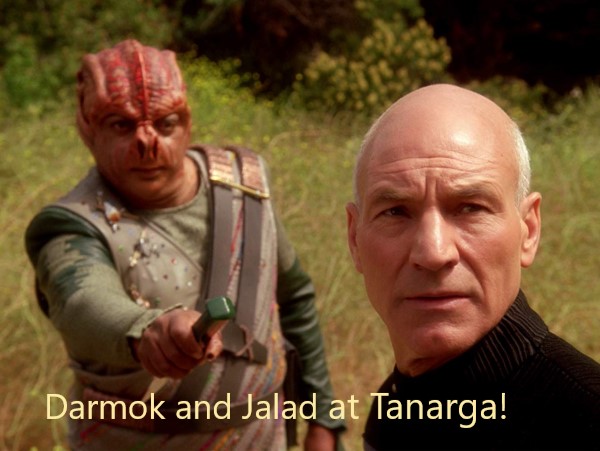
It’s a fascinating way of thinking about how we relate the landscape we live in, but, of course, the first thing I thought of was:

Image: Still from Star Trek: The Next Generation episode “Darmok” via IMDb, text added by Erik Jensen

Serving exactly what it sounds like, the Quotes feature excerpts other people’s thoughts.

Cheddar Man: A European Mesolithic Male with Blue Eyes and Brown Skin

I saw these headers go by earlier this spring, but didn’t really have time to really dive into it until now. Well, better late than never, as they wisely say. 🙂

Despite the name, the Cheddar Man isn’t some silly cheese ad bloke. Instead, he has opened doors to very intriguing discoveries about European population during the later Stone Age.

The remains of an anatomically modern human male from about 10,000 years ago were found near Bristol in Gough’s Cave in Cheddar Gorge, Somerset, England in 1903. Recent DNA analysis of the skeleton—Britain’s oldest (almost) complete one—suggests that he had blue eyes, dark curly or wavy hair, and dark brown to black skin.

Natural History Museum Tom Barnes Cheddar Man Bust Closeup

They also found that the Cheddar Man belonged to the same population as Mesolithic individuals whose bones were recovered from Spain, Luxembourg, and Hungary, usually referred to as western European Mesolithic hunter-gatherers or European early modern humans.

Hannah Devlin at The Guardian writes most aptly:

“The discovery shows that the genes for lighter skin became widespread in European populations far later than originally thought – and that skin colour was not always a proxy for geographic origin in the way it is often seen to be today.

“Tom Booth, an archaeologist at the Natural History Museum who worked on the project, said: ‘It really shows up that these imaginary racial categories that we have are really very modern constructions, or very recent constructions, that really are not applicable to the past at all.’”

A new bust model of Cheddar Man was made by Kennis & Kennis Reconstructions. (See a photo of the previous model made by a team at the University of Manchester here.) They took measurements of the skeleton, scanned the skull, and 3D printed a base for their model. Then they applied certain conventions to shape the face.

I fully confess I’m having a hard time keeping track of the exact timespans and geographical limits of the various Stone Age eras in Eurasia and Africa—what’s paleolithic, mesolithic, or neolithic and where and at what time. But it is so fascinating (and delightful!) that we continue to develop new methods of finding more about our past, and that so many different disciplines seek to understand where we came from and what makes us tick.

Image: closeup of the model of Cheddar Man by Tom Barnes / Channel 4 via Natural History Museum, London