From the grand howdah-backed elephant to the plodding pack pony, from the solitary stallion to the caravan of a thousand camels, animals are often a part of how our characters get around. In previous entries to the travel series we’ve considered small and large groups traveling on foot. This time we bring animals into the mix.
Animals can be useful for travel, but they also bring their own challenges with them. The first thing we need to consider is what kinds of animals are useful for long-distance travel. Then we’ll look at the three main ways of using animals for travel: riding, pack, and draft. Finally, a word on the care and feeding of transport animals. As usual in this series, we are looking at real-world history: no griffins or dragon-drawn chariots. Take the information here and adjust as necessary for whatever setting you happen to be writing.
Aerial view of part of the Great Zimbabwe complex, photograph by Janice Bell via Wikimedia
Great Zimbabwe is a ruined city in Zimbabwe (and in fact has given the modern country its name). Built over centuries beginning in the 9th century, the site was a center of power for the medieval Shona (or Kalanga) kingdom and part of the trade networks that spanned the Indian Ocean. It was abandoned in the 15th century and stands in ruins today, but even in its ruined state it is impressive.
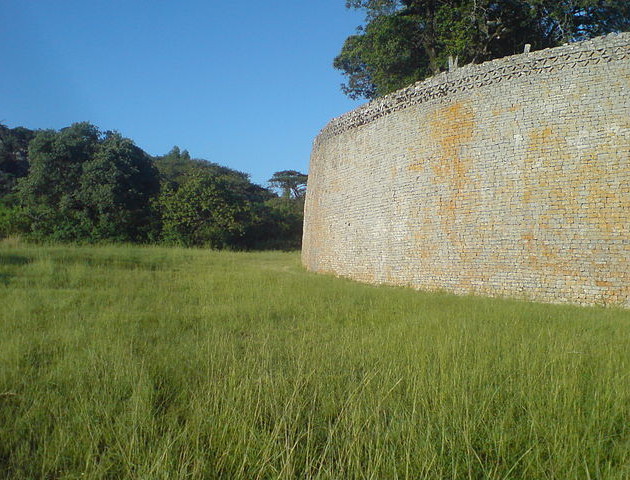
Wall of the great enclosure, photograph by Jens Klinzing via Wikimedia
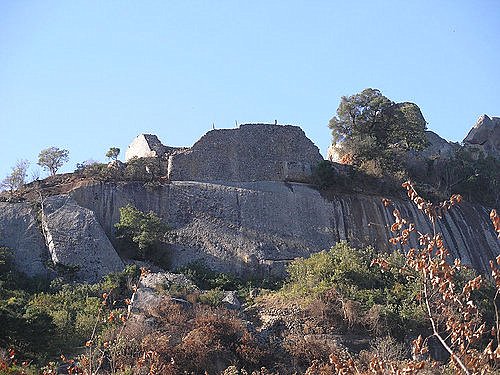
The remains of numerous stone enclosures spread over hundreds of hectares. At its height, Great Zimbabwe may have housed between 15,000 and 20,000 people. The surviving walls reach heights of five meters and are built of stone blocks assembled without mortar. Several different complexes occupy different positions ranging from hills to near the river. The significance of these different complexes remains unclear, but it may indicate that the center of settlement gradually moved over time, away from the more defensible hill sites to the more accessible valley sites, perhaps to better engage with the oceanic trade networks. Ivory and gold were Great Zimbabwe’s major international exports and trade goods from the Arabian peninsula and China have been found at the site.
Interior walkway showing the quality of the stonework via Wikimedia
One noteworthy feature of the enclosures is their shape: neither rectangular nor circular but irregular curved shapes adapted to the forms of the landscape on which they sit.
In the colonial period, popular theories held that the site must have been built by ancient European or Asian colonizers. The biblical Queen of Sheba was often mentioned in connection with the site. Although archaeologists realized as early as the early twentieth century that Great Zimbabwe had been built by Africans, the colonial administration in what was then Rhodesia suppressed any such claim. The assertion that Africans were incapable of building such a complex site and needed European guidance to achieve any level of civilization was key to the justification of imperial domination. Colonial authorities could not tolerate any evidence that Africans were capable of creating sophisticated works of art and architecture on their own.
Part of the hill complex seen from the valley below, photograph by Macvivo via Wikimedia
Thoughts for writers
I have two reasons for sharing a little bit of Great Zimbabwe.
First, it is another example of architecture that does not depend on European examples. When doing our worldbuilding as writers, it is easy to fall back on the things that are familiar: European castles, Egyptian pyramids, Greek temples, and the other things we’ve seen before. Let yourself be inspired by the other amazing things people have built. I’d love to see a city inspired by Great Zimbabwe at its height turn up in a fantasy story, even one not set in an explicitly African-inspired world.
Second, this is another example of how politics can screw up good historical scholarship and so why you need to read broadly and get outside familiar frames of reference. Even today, while the Queen of Sheba is generally left out of it, claims that Great Zimbabwe was built by Arabs or Phoenicians still occasionally creep into popular histories.
History for Writers is a weekly feature which looks at how history can be a fiction writer’s most useful tool. From worldbuilding to dialogue, history helps you write. Check out the introduction to History for Writershere.
History for Writers explores world history to offer ideas and observations of interest to those of us who are in the business of inventing new worlds, cultures, and histories of our own. Here’s where we’ve been in 2015:
History for Writers is a weekly feature which looks at how history can be a fiction writer’s most useful tool. From worldbuilding to dialogue, history helps you write. Check out the introduction to History for Writershere.
Or: Some History behind Ostrich Riding, Part 6 of 7
Background: I ran into two historicalimages from California with ostriches used as transportation. That got me wondering about the history of ostrich riding. And that lead me down quite a rabbit hole.
I’ve divided my findings into separate posts (find them with the ostrich riding tag). Warning: serious early history and language nerdery ahead in Serious Academic Voice.
TL;DR – Tracing ostrich riding to a 3rd century BCE tomb find (a statue of Arsinoe II) from Egypt doesn’t hold up. The use of various ostrich products in human material culture dates back thousands of years. A few ancient depictions involve humans handling ostriches; however, extant sources don’t tell us whether ostriches were merely hunted or whether they were also tamed in the ancient world. The most promising source seems to be a description of a magnificent parade put together by Arsinoe II’s husband-brother Ptolemy II. This Grand Procession included eight chariots drawn by pairs of ostriches, and the ostriches may have been ridden by boys in costumes.
I had hoped to find a nice, neat selection of ancient texts putting the Greek word for ‘ostrich’ in context, but even a cursory look reveals that the history of the word strouthos is complex. At best, we can say that there are no immediate red flags either in the original Greek or modern English translations for Arsinoe II’s statue or Ptolemy II’s Grand Procession. The poem Berenice’s Lock was said to contain further evidence of ostriches as mounts in Ptolemaic Egypt after Arsinoe II’s death. Instead, what we seem to have is a case of poetic ambiguity translated with poetic license and taken uncritically as evidence.
Some centuries after Arsinoe II and Ptolemy II, ostrich riding may appear in the Roman Empire. Claims in some secondary sources turn out unverifiable, however. Researching primary sources helps but a little: on one hand, many of these texts either have problematic histories or their authorship or accuracy may be questionable; on the other, ostriches tend to appear in context of fighting in gladiatorial games, not being ridden or raced. Surviving visual art only confirms the appearance of ostriches in hunting and arena scenes the Roman territories, not riding or chariot-pulling. A description in the life of Emperor Firmus comes closest, but Historia Augusta, the source of his life, is considered unreliable.
From time to time, I get sucked into thinking about the pragmatics of fictional worlds. By that I mean all the mundane details of how people lead their everyday lives, starting from the very basic human (or creature) needs like food, clothing, waste management, and social interaction. Not just who takes care of, say, the laundry and when, but where do they go to do it, how do they get there, what kinds of implements are they expected to bring in themselves and what is shared, how long does it take, what physical motions do they go through, is it a solo activity or a joint effort, and the like.
For me as a visual person, often thinking about everyday activities and movement through spaces tumbles into thinking about what exactly do these various spaces look like. It’s a way to add depth and realism into a story – we are physical beings who love tactile experiences and accumulate all sorts of personal possessions, and if a fictional world ignores that, it makes that world fall flat for me. (Hello, Star Trek!)
The Hunger Games is one of the current ones in my mind because of the approaching Mockingjay – Part 2 premiere and because of an article on Colossal I saw about a World War II era bomb shelter in London that has been turned into an underground farm.
The company running the operation, Growing Underground, produces leafy greens like watercress, basil, coriander, and radish in hydroponic beds lit by LED lamps.
In the The Hunger Games world, the population of District 13 lives in underground bunkers; the above-ground structures were destroyed by the Capitol. In the Mockingjay novel, Collins mentions various spaces like the armory, the laundry, labs, testing ranges, and farms in passing. She describes these spaces mostly just in very generic terms; e.g., the color of the living compartments is white, and we hear of furniture like dressers and conference tables with individual screens, but that’s about the extent of the detail.
Scenes in the movie Mockingjay – Part 1 show the special weapons lab with a shooting range, the hangar, the bunker, and some hospital and apartment rooms, among others, but I don’t think we’ve seen any underground farms of any kind, nor the poultry farm, for example, that was destroyed in the book version of the bombing of 13 by the Capitol.
Clockwise from top: living quarters, cafeteria, and infirmary at District 13. Images via Jabberjays.net.
The Growing Underground photos of their growing beds fit quite well with Collins’s carefully frugal description and the established Hunger Games visual style. So, in my headcanon, even if we haven’t seen them on screen, District 13’s underground hydroponics now look very much like those of Growing Underground.
Out There is an occasional feature highlighting intriguing art, spaces, places, phenomena, flora, and fauna.
Or: Some History behind Ostrich Riding, Part 5 of 7
Background: I ran into two historicalimages from California with ostriches used as transportation. That got me wondering about the history of ostrich riding. And that lead me down quite a rabbit hole.
I’ve divided my findings into separate posts (find them with the ostrich riding tag). Warning: serious early history and language nerdery ahead in Serious Academic Voice.
TL;DR – Tracing ostrich riding to a 3rd century BCE tomb find (a statue of Arsinoe II) from Egypt doesn’t hold up. The use of various ostrich products in human material culture dates back thousands of years. A few ancient depictions involve humans handling ostriches; however, extant sources don’t tell us whether ostriches were merely hunted or whether they were also tamed in the ancient world. The most promising source seems to be a description of a magnificent parade put together by Arsinoe II’s husband-brother Ptolemy II. This Grand Procession included eight chariots drawn by pairs of ostriches, and the ostriches may have been ridden by boys in costumes.
I had hoped to find a nice, neat selection of ancient texts putting the Greek word for ‘ostrich’ in context, but even a cursory look reveals that the history of the word strouthos is complex. At best, we can say that there are no immediate red flags either in the original Greek or modern English translations for Arsinoe II’s statue or Ptolemy II’s Grand Procession. The poem Berenice’s Lock was said to contain further evidence of ostriches as mounts in Ptolemaic Egypt after Arsinoe II’s death. Instead, what we seem to have is a case of poetic ambiguity translated with poetic license and taken uncritically as evidence.
Halloween will soon be upon us. The origins of this holiday are obscure. It is often connected with the Gaelic festival of Samhain, which marked the end of the harvest and the beginning of winter, but Halloween, at least as popularly celebrated today in the US and some other countries, has wider connections. It is an example of a type of holiday found in many cultures: the “feast of fools.”
… Marcus Licinius Crassus would have been the first emperor of Rome instead of Julius Caesar.
Stick with me here.
Alfalfa is a plant in the pea family that resembles clover. It originally comes from south central Asia and was cultivated in the northern parts of the Iranian plateau as animal fodder. Compared with other fodder plants, alfalfa is very high in protein, so it is mostly fed to cattle. It can be given in small amounts to most horse breeds, but in large amounts it causes bloating as horses cannot use the excess protein.
The exception is Nisaean horses, a breed of horse that was developed in northern Persia and bred to feed on alfalfa. These horses were able to absorb the extra protein of alfalfa into their bones, giving them denser, stronger bones than other horses. These dense bones enabled the Nisaean horses to make sudden turns while galloping at high speed that would have broken other horses’ legs and to carry heavier weights than other horses of the ancient world could manage.
Or: Some History behind Ostrich Riding, Part 4 of 7
Background: I ran into two historicalimages from California with ostriches used as transportation. That got me wondering about the history of ostrich riding. And that lead me down quite a rabbit hole.
I’ve divided my findings into separate posts (find them with the ostrich riding tag). Warning: serious early history and language nerdery ahead in Serious Academic Voice.
TL;DR – Tracing ostrich riding to a 3rd century BCE tomb find (a statue of Arsinoe II) from Egypt doesn’t hold up. The use of various ostrich products in human material culture dates back thousands of years. A few ancient depictions involve humans handling ostriches; however, extant sources don’t tell us whether ostriches were merely hunted or whether they were also tamed in the ancient world. The most promising source seems to be a description of a magnificent parade put together by Arsinoe II’s husband-brother Ptolemy II. This Grand Procession included eight chariots drawn by pairs of ostriches, and the ostriches may have been ridden by boys in costumes.
I had hoped to find a nice, neat selection of ancient texts putting the Greek word for ‘ostrich’ in context, but even a cursory look reveals that the history of the word strouthos is complex. At best, we can say that there are no immediate red flags either in the original Greek or modern English translations for Arsinoe II’s statue or Ptolemy II’s Grand Procession.
This is a very, very, very basic introduction to the question of race from a historical perspective. If you’ve studied any world history, human genetics, or even just had your eyes open in the past decade, there’s probably nothing here you don’t already know. Everything I have to say has been said before, so why say it again? I have two reasons.
First, there are some more obscure and complicated things I want to talk about concerning race and history and it would be useful to have some basic points covered for future reference.
Second, there are some people who don’t know the basics of race, even some very intelligent people (even some Supreme Court justices), so it can’t hurt to say these things again.
 From the grand howdah-backed elephant to the plodding pack pony, from the solitary stallion to the caravan of a thousand camels, animals are often a part of how our characters get around. In previous entries to the travel series we’ve considered small and large groups traveling on foot. This time we bring animals into the mix.



 Co-Geeking
#/media/File:A_classical_dictionary_of_Greek_and_Roman_biography...revised.._(1894)_(14779978921).jpg)


