Catch!

War can be a nasty business. It’s no wonder soldiers sometimes enjoy a bit of cheeky humor. This ancient Greek sling bullet was cast with the word DEXAI on it, meaning “Catch!” or “Take that!”

Sling bullet, photograph © Trustees of the British Museum via The British Museum (Athens; 4th c. BCE; lead)

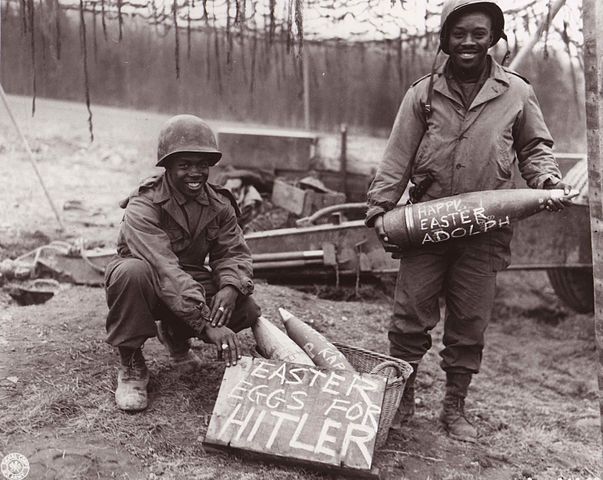
It’s in much the same spirit as these American soldiers in World War II offering “Easter eggs” for Adolf Hitler.

Easter eggs for Hitler, US National Archives via Wikimedia

Some things just don’t change.

History for Writers is a weekly feature which looks at how history can be a fiction writer’s most useful tool. From worldbuilding to dialogue, history helps you write. Check out the introduction to History for Writers here.

Fantasy Religions: Faith and War

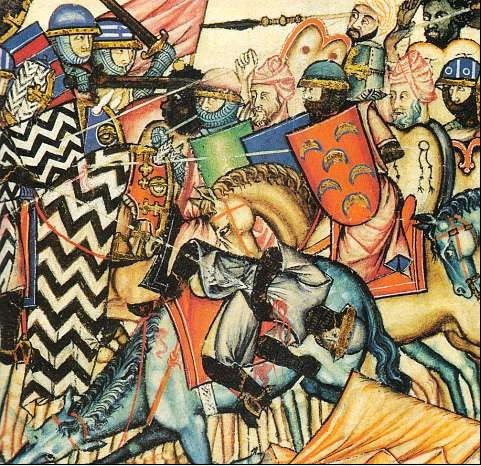
160808ReconquistaReligion often becomes involved when people are in conflict. Many religious traditions provide points of identity around which people can rally when they feel threatened or can offer reassurance and justification to those about to enter combat. Extreme circumstances, like war, have often led people to embrace their own religious traditions (or new ones) more firmly. All of this is undeniably true. Popular history, however, often makes a further claim: that religious differences cause violent conflicts. A careful look at history shows us a different picture. Religious differences have rarely, if ever, caused wars on their own, and where they have been involved in starting hostilities, they have played only a partial role alongside many other forces.

When we look at history, it is easy to find conflicts between people of different faiths, but these are unusual interruptions in a world history that is mostly about people of different faiths getting along reasonably well. Religious differences on their own don’t drive people into conflict. Protestant and Catholic Christians, for example, have been engaged in a bitter conflict in Northern Ireland for most of the past century, but during that time Northern Ireland has been pretty much the only place in the world where Protestants and Catholics have fought a sustained violent conflict. Nor is religion the only thing that separates the sides in Northern Ireland: differences in religion, language, political inclinations, popular culture, and social life are all wrapped up in the thousand-year history of English colonialism in Ireland. Catholic and Protestant denominations in Northern Ireland have provided a structure in which people can organize to pursue their causes and have been markers of identity around which people rally in difficult times, but if all the people of the territory were of the same religion, the conflict there would still have happened. Blaming religious differences for the Northern Irish Troubles is like blaming the US Civil War on a disagreement over what color Army uniforms should be.

Continue reading

Hannibal’s Route Identified?

160407didrachm In 218 BCE, the Carthaginian general Hannibal led an army across the Alps into Italy, touching off the Second Punic War. On the question of exactly where Hannibal crossed the Alps, there’s always been a lot of, for lack of a better term, horse pucky. The ancient sources are vague and of dubious reliability. In the absence of solid evidence, numerous distinct schools of thought on the question have emerged. There are the military professionals who argue that Hannibal must have taken the easiest, most straightforward route open to him. There are the romantics who insist that Hannibal’s army must have taken a difficult and dangerous route befitting such a momentous expedition. The folklorists are persuaded by local legends in the Alps while the textualists wrangle over which of the literary sources is more reliable. Now some literal horse pucky may be getting us closer to an answer.

The whole route hangs on the identification of two specific points. One is an area called the “island” somewhere in the valley of the Rhone river. The other is the pass by which Hannibal’s army crossed the Alps. While the “island” is still uncertain, recent archaeological work may have identified the Alpine pass. As reported in Archaeometry in March, 2016, a large deposit of horse manure and disturbed soil near the Col de la Traversette indicates the passage of a large number of horses dated to the period of the Second Punic War. If this finding stands up to further scrutiny, it may allow us to pin down Hannibal’s Alpine crossing.

Identifying the Traversette as the pass Hannibal’s army took would have some interesting implications for our interpretation of the war as a whole. Although favored by some scholars (notably Sir Gavin de Beer), the Traversette has usually been dismissed as too high, narrow, and difficult for Hannibal’s army, especially when several lower, wider, easier passes were available within a few days’ march. The military-history school in particular has argued that Hannibal would not have set out on his march without good advance intelligence about the Alpine passes and that intelligence would have persuaded him never to attempt the Traversette. If Hannibal did indeed take his army by the Traversette, it suggests that his advance intelligence was not as good as modern historians imagine (whether because Hannibal didn’t know enough about the available passes or because he allowed his army to get into such desperate straits that he had to take a pass he knew was a bad choice).

If Hannibal’s intelligence-gathering was less than optimal, that would also help to explain the major strategic failure of his campaign: overestimating the central Italian cities’ readiness to cast off Roman hegemony. Hannibal’s strategy against Rome depended on stripping Rome of its allies and conquests. While he found ready support in the areas of northern and southern Italy that had only recently been conquered by Rome, very few cities in Rome’s core central Italian territory were willing to join him.

It’s always important to take new findings with caution. Further research may cast doubt on this new evidence. For now though, the poop looks promising.

Post edited for clarity

Image: Tarentine didrachm struck during the Second Punic War, photograph by Classical Numismatic Group via Wikimedia (c. 212-209 BCE; silver)

Race and Culture in Hannibal’s Army

160322elephantTor.com published an article online today about diversity in Hannibal’s army written from the point of view of historical wargaming. It is a interesting article and well worth a read, but unfortunately it misses the opportunity to really address questions of racial and cultural diversity in ancient warfare. Here is a quick attempt to address some of the things that were lacking.

Race and culture

Race is a term with a lot of baggage, as we are all painfully aware, but it means different things in different contexts. In modern parlance, it describes a socially-constructed division of human beings into more or less arbitrary categories, largely on the basis of skin color and other physical features. In a fantasy context, it refers to distinct species of intelligent creatures like Elves, Orcs, Dwarves, and so on.

The unaddressed problem in the Tor.com article is the conflation of race and culture. In the nineteenth and early twentieth century, overtly racist theories of history posited that people of different genetic backgrounds naturally had different qualities. Many of these stereotypes still linger in our popular culture: the stoic Indian, the mischievous Irishman, the passionate Italian, etc. This belief in racial character was encoded in early classic works of fantasy like Tolkien’s Lord of the Rings, which gave us the stubborn Dwarf, the ethereal Elf, the vicious Orc, etc.

Even as we struggle to root out this conflation of race and culture from our modern life, it lingers on in works of fantasy and science fiction: the logical Vulcan, the boisterous Klingon, the decadent Centauri, the proud Dothraki. As we look back at history, we have to think of the people of the past not in terms of racial qualities but in terms of cultural contexts. People of different origins often do behave differently, but those differences are explained by the cultures they lived in, not the races they represent.

Continue reading

What If There Was White Moose Cavalry for Fantasy Winter Warfare?

What if there was a fantasy world where moose were tamed and selectively bred for cavalry? I spent some time pondering it after a couple of things found online collided in my head.

First, there’s this animated gif of a moose rushing through a deep snow-filled field:

moose rushing through a snow-filled field

Their size, speed, and ability to gallop through deep snowbanks make moose fearsome and pretty near unstoppable. Imagine a line of ginormous moose thundering at full tilt towards you across a field – that’s a truly frightening thought! Also bogs don’t slow them down by much, I believe, which might conceivably tip the scales in the right kind of a campaign.

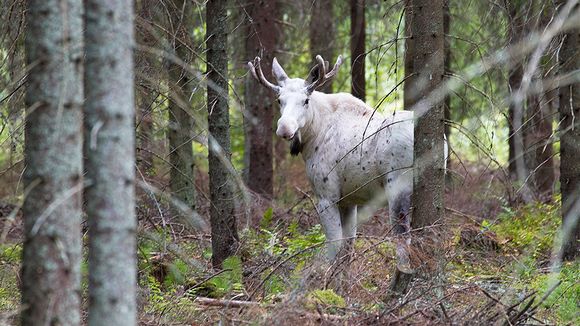
Then, I saw this photo of an albino moose:

Yle Antti Terava valkoinen hirvi

Natural snow camouflage. Hmmm.

It’s not that far-fetched an idea, apparently. The Soviet Union attempted to build a moose cavalry in the first half of the 20th century, but they were unsuccessful. In our world, the solitary habits of moose seem to be standing in the way of domestication. If we’re talking about a fantasy world, however, I don’t see why not.

Images: Rushing moose gif via Crazy Hyena. White moose by Antti Terävä via Yle

The Visual Inspiration occasional feature pulls the unusual from our world to inspire design, story-telling, and worldbuilding. If stuff like this already exists, what else could we imagine?

In a World Without Alfalfa…

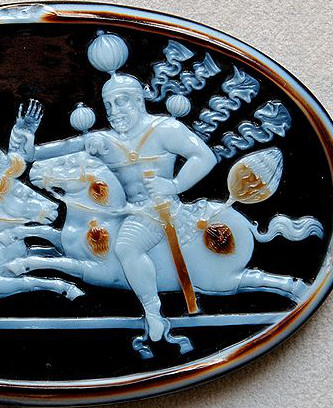
151019Shapur… Marcus Licinius Crassus would have been the first emperor of Rome instead of Julius Caesar.

Stick with me here.

Alfalfa is a plant in the pea family that resembles clover. It originally comes from south central Asia and was cultivated in the northern parts of the Iranian plateau as animal fodder. Compared with other fodder plants, alfalfa is very high in protein, so it is mostly fed to cattle. It can be given in small amounts to most horse breeds, but in large amounts it causes bloating as horses cannot use the excess protein.

The exception is Nisaean horses, a breed of horse that was developed in northern Persia and bred to feed on alfalfa. These horses were able to absorb the extra protein of alfalfa into their bones, giving them denser, stronger bones than other horses. These dense bones enabled the Nisaean horses to make sudden turns while galloping at high speed that would have broken other horses’ legs and to carry heavier weights than other horses of the ancient world could manage.

Continue reading

The Pre-Gunpowder Rock-Paper-Scissors

150629BayeuxGunpowder changed the world. It took a while — the earliest gunpowder arms were too unwieldy and unpredictable to have much of an effect on the ways people fought, but in time the weapons got better and armies adapted their tactics and organization in response. Before firearms, though, the battlefield operated on a basic rock-paper-scissors relationship among three different types of troops: infantry, cavalry, and missile troops.

Before getting into the types of troops, we need to lay out a few things about pre-modern warfare.

Continue reading