In addition, over 1,000 objects from the National Museums have been added to the Google Arts & Culture online collection. They are arranged in groups that work much like online photo albums. Clicking on an image opens a detailed view of that item with additional information.
Four separate museums form the National Museums Scotland: in Edinburgh, the National Museum of Scotland and the National War Museum, plus the National Museum of Flight in East Lothian and the National Museum of Rural Life in East Kilbride.
This is so great! I’ve been lucky enough to be able to visit the National Museum of Scotland in person, but that was years ago and I couldn’t get to everything I wanted to see. Now I can patch those holes in my not-quite-a-bucket-list. 🙂
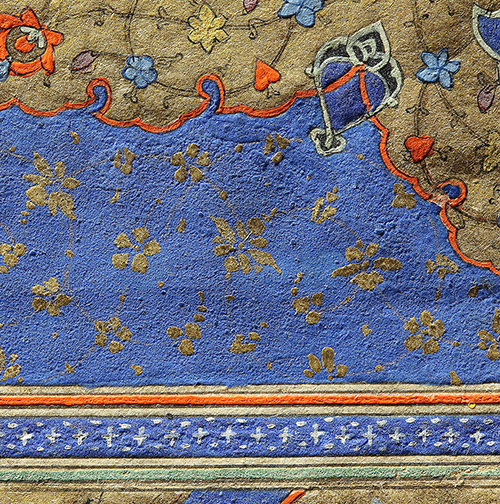
A short post gives a few tantalising details on lapis lazuli, the mineral that was ground down to get bright blue pigment for example for illuminating Medieval manuscripts:
“In his travels Marco Polo vividly described the cold province of Badakhshan, a prosperous land where horses that descended from Alexander’s horse Bucephalus were once bred and where priceless rubies and the finest lapis lazuli were found.
“Since ancient times lapis lazuli has been sourced in this remote region, north-east of modern Afghanistan, and exported over vast distances. Its mines on the steep Hindu Kush Mountains, above the Valley of the Kokcha River, can only be reached through a tortuous and dangerous route.
“Lapis lazuli consists of a large number of minerals, including the blue mineral lazurite, the white mineral calcite and golden specks of iron pyrites.
“A laborious process transforms this composite mineral into the pigment ultramarine; various grades of ultramarine can be obtained, from the purest extremely expensive deep blue, composed mostly of lazurite particles to the pale grey so-called ultramarine ash.”
The conservators at Bodleian (Anita Chowdry, David Margulies and Marinita Stiglitz) learned how to make pigment from scratch in a two-day workshop, and shared their notes in a longer post.
Both the historical process and conservators’ efforts are fascinating! Did you know, for instance, that before explosives were developed, lapis lazuli was mined with the help of large fires and cold water?
In the U.S., and indeed more widely in the Anglo-American world, Meriwether Lewis and William Clarke are known for their two-year expedition of the Louisiana territory (purchased from France in 1803) and the land beyond the “great rock mountains” in the west.
Less commonly remembered in cursory mentions is the extent of Lewis and Clarke’s interactions with local Native Americans. (Apart from Sacagawea, who is known at least in the U.S.) The whites didn’t just exchange gifts or talk about trade or clash with the local population; they received invaluable help and information (like when the expedition wintered with the Mandan people in present-day North Dakota).
Now it seems that western historians need to re-evaluate that extent.
According to The Jefferson Watch, cartographers have identified at least ten places in the journals of Lewis and Clarke where the captains talk about the maps by Native American hosts to help them figure out the lay of the land.
Christopher Steinke, at the time a graduate student at the University of New Mexico, found one of those maps at the archives of the Bibliothèque nationale de France (BnF) in Paris. It was drawn by Inquidanécharo, a chief of the Arikara (in French, Ricara), who was apparently also known as Too Né.
“The Bibliothèque nationale de France contains a hitherto unnoticed map attributed to Inquidanécharo, a Ricara chief. Lewis and Clark knew him as Too Né, an Arikara village leader who accompanied them upriver to the Mandan and Hidatsa villages in 1804. The map, which Too Né showed to playwright and artist William Dunlap when he visited Washington in 1806, is the most detailed surviving Indian representation of the Great Plains from this period. It invites scholars to reorient early American exploration and cartography from indigenous perspectives. Too Né interpreted his map as a work of history and cartography and situated the American explorers in the historical and religious landscape of the Arikara people.”
In “Here is My Country”, Steinke outlines some of the main features of Inquidanécharo’s map, and recounts some history surrounding it. He also lists a few other Native American maps from the eighteenth and early nineteenth centuries.
What most struck me, though, is that Native American maps seem to have contained more information than just geographical details—they also depicted cultural connections and ethnographical information.
I knew Native Americans used symbols and pictograms, and had to have—like people everywhere—a way of talking about and remembering locations outside their immediate surroundings. I had no idea, however, that Native American cartography was as polished or wide-reaching as it was (a hint for the Finnish school system), let alone that their maps might still be extant. Fascinating!
There’s been some buzz—quite understandably, too, for the drone looks pretty neat—but the vehicle doesn’t seem to have been ready for the international market quite as soon as some western newsoutlets have reported. It sounds like the battery life is still rather limited, too. Fortunately the limitations of the current tech do not have to restrain a science fiction writer—just think of how much cell phone batteries have improved in the last ten years alone.
My goodness, it’s exciting to be living now! 🙂
The Visual Inspiration occasional feature pulls the unusual from our world to inspire design, story-telling, and worldbuilding. If stuff like this already exists, what else could we imagine?
I’m not a fan of the Victorian age per se, but watching Murdoch Mysteries has piqued my interest somewhat. Here are some intriguing photographs from the later 1800s to early 1900s.
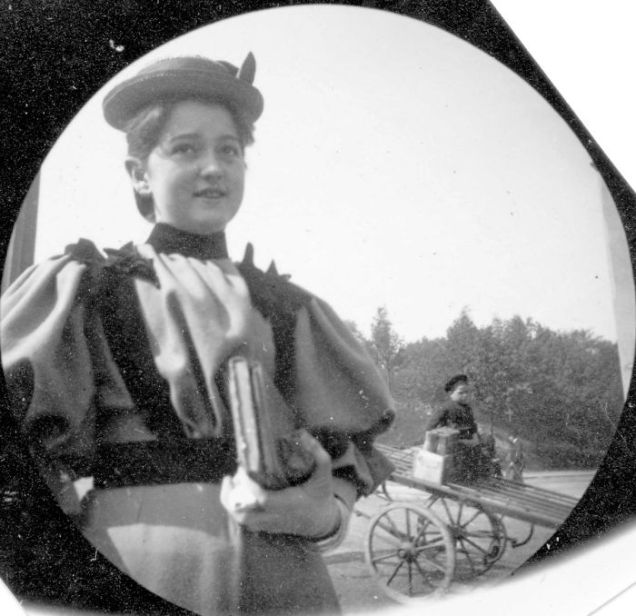
From a set of unscripted photos taken in the streets of 1890s Norway by Carl Størmer, a young woman with books:
Young woman with books, photograph by Carl Størmer via Imgur (Oslo, Norway, 1890s)
All of the subjects in this set are remarkably relaxed. Love the contrast to the stiff studio portraits of the era!
(I’ve had trouble finding a more detailed source, unfortunately. Possibly Størmer’s photos are gleaned from the 2008 book 80 millioner bilder: Norsk kulturhistorisk fotografi 1855-2005 [’80 Million Pictures: Norwegian Culture-Historical Photography 1855-2005′], edited by Jonas Ekeberg and Harald Østgaard Lund.)
Finnish ladies and gentlemen on a ski trip in the 1890s:
Hiihtoretkeläiset ryhmäkuvassa (‘ski trip participants in a portrait’), photograph via Helsinki City Museum (Helsinki, Finland, 1890s, image number N252030, CC BY 4.0)
Judging by their attire, they are indeed ladies and gentlemen. What struck me is that, apparently, it wasn’t at all odd for the upper class to go skiing in their regular daywear.
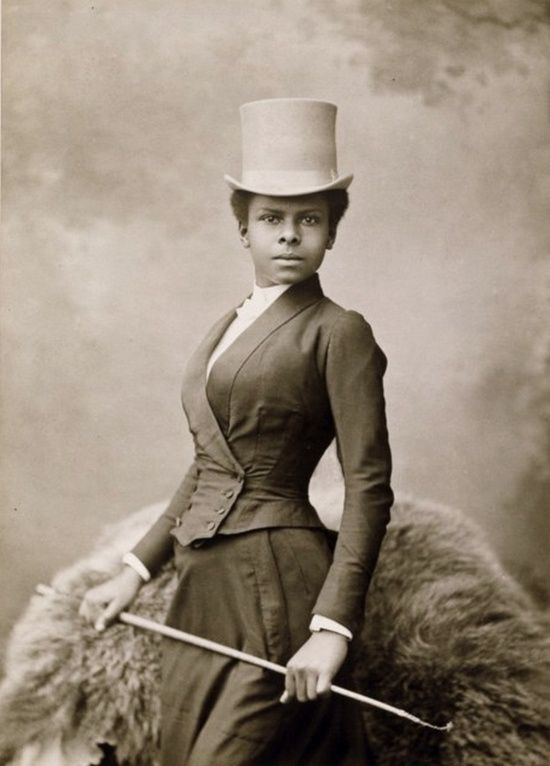
Speaking of sports and Victorians, from 1891, here is high school dressage equestrian Selika Lazevski by Félix Nadar:
Selika Lazevski, photograph by Félix Nadar courtesy of Ministère de la Culture, France, via Black Female Equestrians (Paris, France, 1891)
What an arresting portait!
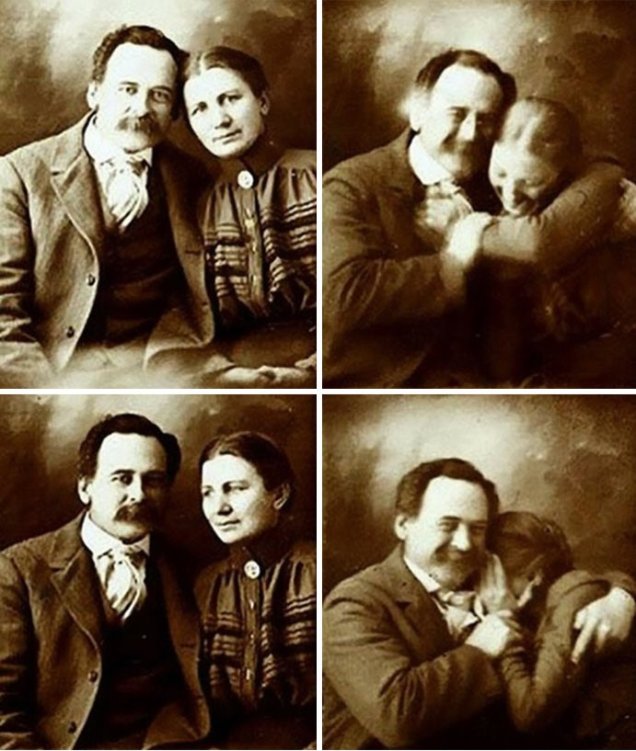
A Victorian couple from Leeds trying not to laugh while getting their portraits done in the 1890s:
Victorians certainly loved their wheels! I wonder exactly how one would’ve operated this chair—there’s clearly a handle bar connected to the front wheel, but if grabbing it with both hands, where does the propelling force come from?
A Sami woman from Finland photographed at Ellis Island in the U.S., so presumably immigrating, around 1905-1914:
Laplander / Sami woman from Finland, photograph by Augustus F. Sherman via New York Public Library digital collections (Ellis Island, New York, NY, c. 1905-1914, image ID 418041, public domain)
I wish the portrait hadn’t cut off at the waist; I would’ve liked to see the rest of the details of her dress (the belt looks especially interesting). I know that nowadays Sami outfits (gákti) are unique. Each is made for its wearer to reflect the personal / family history and area (and possibly the people as a whole?). I don’t know, however, how far back in time that practice goes.
Anyway. These old photos give fascinating glimpses of western life only about 100 years ago. So similar and yet so, so different.
Out There is an occasional feature highlighting intriguing art, spaces, places, phenomena, flora, and fauna.
Apart from various aspects of the story and the movie series, the exhibition covers for example illustrations, the history of real-world magic, and early sketches and notes by J.K. Rowling. In addition, on display are a number of items from the Museum of Witchcraft and Magic.
My favorite feature is perhaps the section covering the real-world history of various Hogwarts classes, closely followed by the animals and fantastical beasts section.
Pacific Rim Uprising opens in four weeks (March 23, 2018) and even the second trailer has been out for a few weeks now. First things first, though:
Pacific Rim Uprising – Official Trailer (HD) by Legendary
And here’s the second trailer:
Pacific Rim Uprising – Official Trailer 2 [HD] by Legendary
Pacific Rim Uprising is directed and co-written by Steven S. DeKnight; other writers credited with the screenplay are Emily Carmichael, Kira Snyder, and T.S. Nowlin. I have seen some of DeKnight’s writing and directing for Dollhouse and possibly even story editing for Buffy the Vampire Slayer. The rest of the writing team are entirely new to me however (apart from having at least heard of one of Snyder’s latest producing credits, The Handmaid’s Tale).
While I’m mostly not in the mood, now and then I like lots of smacking monsters around and busting buildings. But not only that—destruction without a reason gets tiresome faster than you can say marmalade sandwich. Among the falling skyscrapers and lurching jaegers in these trailers I’m left wondering about the human stories.
The features of the first Pacific Rim that most strongly attracted me to the story were specifically that—human stories. One was Learning to Work Together and the other was the respect that Raleigh Becket showed Mako Mori. I’ve seen interviews with Guillermo del Toro and the design team where everyone kept calling Mako Raleigh’s “love interest”. Come on, dudes. Reducing a character to her gender and relationship to a male character is the worst kind of dismissal. She has a name and you know it, not to mention that Mako would kick your butt eight days in a week. (It’s sad when a fictional character has to take his creators to school on how to respect women as people.)
I really hope Uprising will be a case of Never Trust a Trailer, and the movie will be at minimum tolerable. Granted, the first trailer is more people- than fight-heavy, so that’s a reason to stay positive. At the very least we’ll see more of Rinko Kikuchi, John Boyega—looking forward to seeing what kind of depth he has—and Tian Jing, whose performance in The Great Wall I enjoyed but for whose character there was pitifully little to do in Kong: Skull Island.
This post has been edited for clarity.
Hey, look! We found a thing on the internet! We thought it was cool, and wanted to share it with you.
For a good long while, I’ve been having unpredictable hiccups when submitting comments on other people’s blogs. It’s gotten so bad that I routinely copy & paste my comment in a text document before submitting it in case it’s eaten up by the hungry Internet Mawster.
Sometimes logging in and out helps, sometimes it doesn’t. Sometimes disabling my ad blocking software helps, sometimes it doesn’t. Et cetera, et cetera.
This past week takes the cake, though: now I can’t even like a post reliably anymore. Clicking on the little star just doesn’t necessarily register regardless of whether I’m logged in and browsing a blog, or reading a post through my subscription feed, or running around the house howling at the full moon.
I might be a tad bit… miffed.
Ohwell. I dare say I’ll find a workaround at some point.
A false-color image of Saturn’s rings made from uncalibrated ultraviolet data, created and selected by Joshua Colwell, UVIS co-investigator:
The colors are incredible—the red is a real stand-out.
Titan and Epimetheus, selected by Morgan Cable, Project Science and system engineering assistant:
The size differences of Saturn’s moons are amazing. Moreover, this photo almost looks like it’s framed by a professional photographer when, in fact, it’s from outer space. Love it.
Enceladus’s plumes, selected by Molly Bittner, systems engineer, Cassini Spacecraft Operations:
Jets of water bursting from a subsurface ocean. On an icy moon. In Saturn’s orbit. And NASA got photos of it!












 Co-Geeking
You must be logged in to post a comment.