Review: Blindsight by Peter Watts

Recently I’ve been trying to read more SFFnal classics among my normal selection. I can’t remember why I added Blindsight by Peter Watts (published in 2006) onto my library holds list. When it finally became available and I started to read, I discovered that one of the characters is called Jukka Sarasti (which is a Finnish name), so perhaps that was it.

Content note: spoiler alert!

Current Reading Blindsight

The novel’s events start in the year 2082. A first contact situation arises after thousands of unknown devices burn up in Earth’s atmosphere in a coordinated manner and radio signals are detected near a Kuiper belt object.

Earth sends a ship captained by an AI (called the Captain) to investigate. Theseus is crewed by five augmented humans or transhumans, including their leader, a genetically reincarnated vampire (Sarasti). When the crew wakes from hibernation they discover that Theseus was rerouted mid-flight to a new destination in the Oort cloud. Orbiting a previously undetected rogue gas giant is an enormous, constantly growing object, presumably a vessel, which the crew dub Rorschach.

The Theseus crew begin studying Rorschach with telemetry and excursions despite some very hostile environmental conditions. Additional challenges are posed by psychological effects (hallucinations) and extremely fast, multi-limbed organisms on Rorschach, and on Theseus the crew’s aggravation with the narrator, synthesist Siri Keeton. Eventually relations between Theseus and Rorschach culminate in physical attacks, and only one crew member, Keeton, is sent back to Earth in an escape pod with copies of the information collected before Theseus detonates its payload to destroy Rorschach.

What was especially delightful is that—setting aside Sarasti, who as mission commander and a predator is kind of outside the crew anyway—Theseus’s crew consists of two men and two women, and everyone is described the same way regardless of the configuration of their bodies. Skills and personalities are what matter most. (This is especially enjoyable after reading certain other classic SF novels, which I will leave unnamed to languish in their stifling obsolescence.)

Another interesting detail is that Susan James, the linguist in the crew, actually carries three other personalities or cores in her head, all working and socializing in harmony, and collectively referred to as the Gang by the rest of the crew.

Blindsight turned out to have one suprisingly topical detail. The Gang figure out that despite conversing with the Theseus crew seemingly normally, Rorschach doesn’t really understand the communication. This sounds very much like the recent discussion of Chat-GPT and other AI engines, doesn’t it?

One of the strengths of Blindsight is that it fuses elements from both the so-called hard sciences and the social sciences. Surely SFF (and all storytelling, for that matter) is at its strongest when it’s questioning our perceived realities or possible realities, starting from what makes humans tick. I’m quite tired of SFF that takes bland “and then they went to x and did y” travel narratives and merely cloaks them in fancy wrappings.

Alas, Blindsight has quite a few horror elements and closes with a rather despondent situation. Despite being skillfully written and constructed, it’s therefore not for me.

Blindsight was followed (in 2014) by the novel Echopraxia to make up the Firefall duology.

ICBIHRTB—pronounced ICK-bert-bee—is short for ‘I Can’t Believe I Haven’t Read This Before’. It features book classics that have for some reason escaped our notice thus far.

Quotes: Being Awesome While Female

Sam Hawke guest posted at Fantasy Book Cafe about tomboy protagonists for the blog’s annual Women in SF&F feature in 2019:

“There is a particular kind of character in SFF. You know her. She’s smart and tough, determined, decisive, and she can kick the collective arses of any takers. She comes in a few varieties—in better stories she’s an Alanna of Trebond or a Brienne of Tarth, with depth and history and more than one dimension; in weaker ones she’s an empty Strong Female Character™ who has no real contribution to the plot other than Being Awesome While Female—but either way it’s her prowess at fighting, particularly against men, that sets her apart. […]

“Instead, I wrote a woman, Kalina, with a chronic illness who couldn’t fight to save her life. Literally. I wrote a book in which the main characters’ problems couldn’t be solved by the strategic and entertaining use of violence even if they had the skills to deploy, and I did it purposefully. I did it in part in response to my own sewing test.

“Let me explain.

“The sewing test is failed when a book deploys a lazy code to tell me how much better, more interesting, more deserving, the female character is than those silly other women by making a point of having her hate sewing or embroidery or [insert other feminine-coded activity or trait of your choice—but you wouldn’t believe how often it’s sewing]. These days, if a book does this, I’m out. It’s not just lazy, it’s not just a cliché, it’s a statement by the author that I’m expected to cheer on one woman by disparaging the rest of them. […]

“Basically, there’s a nasty underbelly to over-reliance on this very limited model of ‘strength’, and it’s rooted in the same insidious patriarchal BS that gave us the old style women-as-objects-to-be-rescued stories: here are traits which are traditionally coded as masculine, which you have been taught are more valuable than traits which are coded as feminine. See how you should cheer on this woman because she’s different and better than those other women, who are weak and shallow and worthless. Reward her for those traits, and punish those who lack them.”

author Sam Hawke at Fantasy Book Cafe blog, 2019
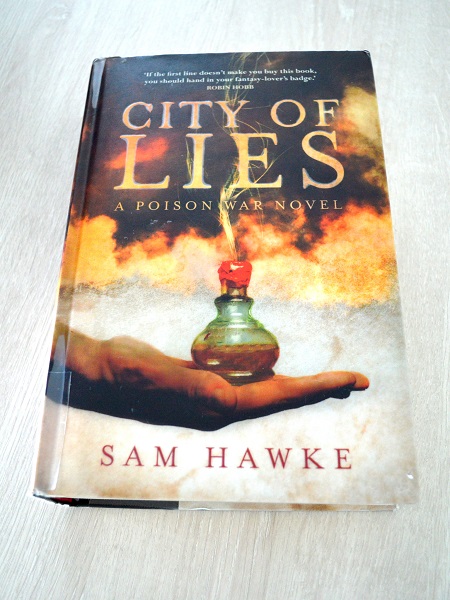
Hawke City of Lies

Hawke is perfectly right, if you ask me. As awesome as ass-kicking women are, other ways of being awesome exist and should be recognized more widely. Because the variety of life skills to be excelled in is much, much wider than merely physical prowess, fighting skill, or attitude.

Moreover, as we all know, there are situations where the application of know-how or just the right tool will create such a better outcome than anything else that at best it’s not even fair to compare them. Why should genre literature forget these skills when women stand in the protagonists’ shoes?

I’m going to be adopting the phrase “being awesome while female” for all kinds of amazing things that women do. It’s just that awesome. 🙂

P.S. I just read City of Lies, Hawke’s book with the female protagonist who has a chronic illness. I thoroughly enjoyed her strategic and entertaining use of her brain—and ditto for the male protagonists, Kalina’s brother and his best friend.

Image by Eppu Jensen

Serving exactly what it sounds like, the Quotes feature excerpts other people’s thoughts.

A Babylon 5 Reboot Is in Active Development

‘Tis official: a Babylon 5 reboot is in the works.

The Catholic Geeks babylon52

(Please read the thread for more of Straczynski’s thoughts on the announcement. Looks like at this writing many articles available online largely just rephrase his tweets.)

Without wading too deep into all of the speculation, I did glean this tidbit about the timing of the new B5:

Pretty exciting, wouldn’t you say? Of course, in the end the fan reaction—including mine—will depend on the technical quality of the final product, our personal preferences, which aspects were chanced and which retained, and whether the cast will be able to carry the stories. I’m certainly looking forward to more news on the project, and fervently wish that the casting will be successful (and quality-wise more even).

Image via The Catholic Geeks

Murderbot Mayhem Music: Fan Playlist for Network Effect

For the pure joy of having our sea container finally arrive with our moving goods, I’ve been re-reading all of Martha Wells’ Murderbot books in the past few weeks. That reminded me of a playlist Meghan Ball made to accompany the Murderbot novel Network Effect. I gave it a listen, and found it conveyed a very different idea of Murderbot than my impression.

So, I made my own playlist. It starts with a concert version of Darude’s “Sandstorm”, which I thought appropriate due to the reference of Murderbot visiting the Preservation planet for a cultural festival with concerts and operas in the beginning of the book.

  • Darude: “Sandstorm”, performed by Synthony and the Auckland Symphony Orchestra
  • Armin van Buuren: “Blah Blah Blah”
  • Paul Ruskay featuring Kokia: “Strike Suit Zero Main Theme”
  • Linkin Park: “Numb”
  • Darude’s “Sandstorm” and Rammstein’s “Du Hast” mashup by Monsterovich
  • Clint Mansell: “Lux Aeterna” (soundtrack from Requiem for a Dream, directed by Darren Aronofsky)

The “Blah Blah Blah” and “Numb” lyrics remind me of the doubts some humans (especially Thiago in this story) have about Murderbot, and Murderbot’s attitude towards those kinds of humans. The mashup of “Sandstorm” and “Du Hast” nicely marries action-paced music with the weirdness that comes with Murderbot finally finding targetControlSystem and the thread of targetContact contamination and the crystalline growth / alien hivemind taking over Murderbot. Ending the list with a piano piece brings some calm again.

Below are videos for your listening convenience.

Darude’s Sandstorm performed by Synthony and the Auckland Symphony Orchestra by Auckland Symphony Orchestra on YouTube

Armin van Buuren – Blah Blah Blah (Official Lyric Video) by Armin van Buuren on YouTube

Strike Suit Zero Main Theme via Paul Ruskay – Topic on YouTube

Linkin Park – Numb [Lyrics on screen] HD via LinkinParkLyrics100 on YouTube

Durude [sic] Haststorm (Du hast remix) by Monsterovich’s Music on YouTube

Requiem for a Dream – Lux Aeterna (Piano Version) by Patrik Pietschmann on YouTube

What would you add or subtract? Do you have your own playlist?

An occasional feature on music and sound-related notions.

The Second Villeneuve Dune Trailer Published

The second trailer for director Denis Villeneuve’s Dune is out now, and looks as breathtakingly gorgeous as the first:

Dune | Official Trailer | HBO Max by HBO Max on YouTube

Wow, right? This adaptation certainly gets many of the visualities closer to my impression of the novel than the earlier ones do. The visually minded might also be interested in posters of the various characters; they’ve been published on Twitter as a thread. If not, you might be interested in the soundtrack, of which some details are out as well (e.g. Tor.com has a short piece on two tracks by Hans Zimmer).

There’s still one question that neither of these trailers answer, however: is Duke Leto aware that Arrakis is a trap? Surely he does? My memory, at least, says he and his top aides all did, but the first trailer has only the Reverend Mother Gaius Helen Mohiam impart that information to young Paul. I’ll have to re-read as soon as I get my books back from the person I lent them to.

I’m really, really hoping the story of this adaptation is as good as its visuals!

Dune will be released in theaters on October 22, 2021, and simultaneously streamed on HBO Max.

Hey, look! We found a thing on the internet! We thought it was cool, and wanted to share it with you.

Quotes: Time Belonged to a Higher Realm

There’s a lot (a lot!) I liked about Karen Lord’s scifi novel The Best of All Possible Worlds. This snippet, for instance, puts words to a childhood wonder I remember from elementary school when learning math:

Karen Lord The Best of All Possible Worlds

“Standard Time was invented by Sadiri pilots. Most Sadiri procedures and quantification followed straight lines and linear progressions, created for the convenience of the ten-fingered. But Time… Time belonged to a higher realm. It could not be carried in human hands, not while it constantly carried human minds. It was all circles, wheels within wheels, a Standard year of three hundred sixty Standard days coiled up in twelve months, which in turn were composed of the small whirlings of twelve hours day and twelve hours night, tiny spinning minutes and seconds, ever-cycling breaths and blinks and beats.

“To be described as having a pilot’s mind was both curse and compliment; it could mean being unable to tell the difference between prophecy, memory, and mere déjà vu.”

– Karen Lord, The Best of All Possible Worlds

I just couldn’t fathom why the decimal system is different from time measurements, and remember that for a time trying to reconcile them was very confusing. But time—heh, heh—helped with that, of course, along with more advanced classes, in addition to a certain amount of shrugging and just getting on with life.

It’s intriguing when a book serendipitously reminds you of thoughts you thought were long buried, isn’t it?

Lord, Karen. The Best of All Possible Worlds. New York: Ballantine Books, 2013, p. 40.

Serving exactly what it sounds like, the Quotes feature excerpts other people’s thoughts.

Quotes: Infohistory Is a Mess

Elizabeth Bear’s scifi novel Machine has a succinct sum-up of just some of the problems concerning information retrieval:

“Wait,” I said. “How can information decay?”

“They used to call it bit rot. Servers get taken down, data falls through the cracks and doesn’t get backed up. Physical substrates are destroyed or damaged, or degrade over time—especially the primitive ones. A holographic diamond is very durable but can’t be changed once it’s written to, and magnetic media only lasted a decan or so under ideal conditions.

“And even if the data is preserved somewhere, that somewhere might not be networked. If it’s networked, it might not be indexed. Even if it’s indexed, it might be half the galaxy away and take two or three ans for the file request to get there, be fulfilled, turn around, and come back. And then you might find out that you needed different files entirely.” He huffed with great satisfaction. “Infohistory is a mess.”

– from a discussion between Dr. Brookllyn Jens and the medical librarian AI Mercy in Machine by Elizabeth Bear [original emphasis]

Despite this being from a fictional work, it rings very true. My librarian heart was delighted to read an account that acknowledges not just the physical difficulties of dealing with old media—whatever shape that media might take, from cuneiform to CDs—but also the search-related problems. Metadata, or in case of libraries, the information about the items in the collection, doesn’t feature in stories very often. Also, it is why good reasearch librarians and archivists are worth their weight in gold.

Bear, Elizabeth. Machine. London: Saga Press, 2020, p. 203.

Serving exactly what it sounds like, the Quotes feature excerpts other people’s thoughts.

Trailer for Debris

Has anyone followed news on Debris? It’s a new tv series described to be a bit like Fringe. Here’s a trailer:

DEBRIS | Official Trailer by NBC on YouTube

The story follows two agents, one from MI6 and the other from CIA, who investigate debris—surprise, surprise—from an alien spacecraft falling to Earth.

Debris is set to debut on NBC on March 01, 2021.

Hey, look! We found a thing on the internet! We thought it was cool, and wanted to share it with you.

Protagonists with Radical Acceptance Decide to Let Adversity Wash over Them

Fantasy and science fiction author Vida Cruz tackles an aspect in SFF that was new to me: that BIPOC protagonists are often seen by (white, Western) editors and readers as inactive, and why that’s false.

(I’ve written elsewhere a little about teaching myself to read novels in English after I started learning the language in 7th grade, how it’s so effortless to me now because I took the time and trouble then, and how reading mostly Anglo-American literature has shaped my thinking and expectations of stories.)

Cruz’s thread starts here. I’ve unraveled it below:

***

I want to talk about how western editors and readers often mistake protags written by BIPOC as “inactive protagonists.” It’s too common an issue that’s happened to every BIPOC author I know.

Often, our protags are just trying to survive overwhelming odds. Survival is an active choice, you know. Survival is a story. Choosing to be strong in the face of the world ending, even if you can’t blast a wall down to do it, is a choice.

It’s how we live these days.

Western editors, readers, and writers are too married to the three-act structure, to the type of storytelling that is driven by conflict, to that go-getter individualism. Please read more widely out of your comfort zone. A lot of great non-western stories do not hinge on these.

Sometimes I wonder if you’re all so hopped up on the conflict-driven story because that’s exactly how your colonizer ancestors dealt with people different from them. Oops, I said it, sorry not sorry. Yes, even this mindset has roots in colonialism, deal with it.

If you want examples of non-conflict-driven storytelling google the following: kishoutenketsu, johakyu, daisy chain storytelling/wheel spoke storytelling. There was another one whose name I forgot but I will tweet it when I recall it.

Anyway, I think there is a space in literature and beyond for stories about radical acceptance or that have a radical acceptance aesthetic. Accepting the things you cannot change but dealing with them in your own way. No pyrotechnics but plenty of potential for drama.

What you want in a story is drama. Conflict does not necessarily equate to drama. Conflict is driven by two or more forces colliding. If a protagonist decides to let the force wash over them instead, that does not mean the protagonist is inactive.

Once again, I repeat: SURVIVING IS A DECISION. BIPOC based in Western countries do it all the time. Us third worlders do it all the time. But of course if you grew up white in a Western country, being mired in hopeless systems will be hard for you to grasp.

And if you’re a BIPOC author, listen: you may be already as good, if not better, than most of the competition out there. You keep getting rejected not because your story sucks but because white editors do not know how to read your work. Keep trying.

Last but not least, we don’t just need diverse demographics for everything, WE NEED DIVERSE STORIES. Get your colonizer heads out of your asses and seek out other traditions. End rant.

I found the other storytelling structure! It’s called Robleto and is of Nicaraguan origin.

Thank you for coming to my TED Talk.

One last! Another type of story that everyone loves (or pretends not to love) but no one will publish in the west is FLUFF. YES THAT’S RIGHT, FANFICTION FLUFF. SUCK ON THAT.

It has been pointed out several times so I will amend the thread to say: all my points apply for disabled, neurodivergent, and chronically ill protagonists, too. Our way of showing agency is DEFINITELY different from yours so please be mindful of that.

***

For me, the main point Cruz makes is:

“What you want in a story is drama. Conflict does not necessarily equate to drama. Conflict is driven by two or more forces colliding. If a protagonist decides to let the force wash over them instead, that does not mean the protagonist is inactive.”

– Vida Cruz on Twitter

This reminds me of my frustration with the Halle Berry -led SF series Extant (which I referred to in an earlier post). I’ve asked myself whether they really wrote her merely feeling and flailing around or whether it is my misreading. Granted, it was some years ago now, but I don’t think I misinterpreted it; Extant lacked self-awareness or self-examination. (Or perhaps the writers’ room was forced to put out such claptrap by people higher up in the production.)

Possible examples of stories with radical acceptance / survival protagonists that do come to mind include the novels The Sound of Stars by Alechia Dow (Black protag) and Among Others by Jo Walton (disabled protag).

Anything you can think of? Please share! The concept is something I’m still mulling over, so more examples would help.

Also, any suggestions on a concise name for protagonists like this? I’m drawing a blank for the moment.

Story Time is an occasional feature all about stories and story-telling. Whether it’s on the page or on the screen, this is about how stories work and what makes us love the ones we love.

Animatic Murderbot Fanart

Creator mar made an animatic Murderbot video – because who wouldn’t want Murderbot on the screen! – and uploaded it for us to view.

Note: the creator’s content warning’s are: blood, guns, scopophobia, slight body horror, and injuries. There are also slight spoilers for Network Effect.

I’m Not Your Hero – The Murderbot Diaries Animatic by mar on YouTube

The animatic is set to Sara Quin and Tegan Quin’s “I’m Not Your Hero”. The song wasn’t familiar to me, but I have to admit it fits pretty well.

And, seriously, someone please buy the rights and develop a fantastic longform Murderbot screen adaptation. Like, now! *standing with money in my outstretched hand*

Found via Tor.com.

In Making Stuff occasional feature, we share fun arts and crafts done by us and our fellow geeks and nerds.