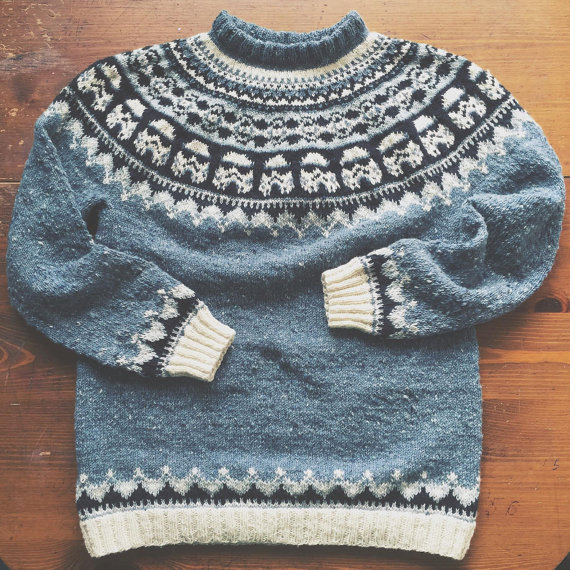
A speed-knitter and a Star Wars fan? There might still be time to make one of these awesome stormtrooper sweaters for Rogue One opening!
NatelaDaturaDesign on Etsy
Both the instant download patterns and finished knits are by Natela Astakhova at NatelaDaturaDesign on Etsy. Just glancing at it, my eye read the pattern as your generic Scandinavian circular yoke sweater, then I did a double take. As I already said, awesome!
In Making Stuff occasional feature, we share fun arts and crafts done by us and our fellow geeks and nerds.
This skeleton lounging with a drinking vessel in its hand, sitting next to bread and an amphora of wine is definitely very apropos:
Known as the skeleton mosaic, the panel is part of a triptych discovered in the dining room of a house in Antakya, Turkey (ancient Antioch). The accompanying words (‘euphro’ + ‘synos’) have been translated as “be cheerful, live your life,” presumably to remind diners of the briefness of life.
In an article at SAPIENS, archaeologist Stephen E. Nash discusses the difficulty of interpreting prehistoric life due to the fact that artifacts made of perishable materials are so rarely preserved to be found. It’s a quick, fascinating read, but what jumped at me was this image of a split-twig figurine that Dr. Nash shared:
Figurine of a deer or bighorn sheep, accession number DMNS/A1291.1, by Denver Museum of Nature & Science via SAPIENS (Dolores Cave near Gunnison, Colorado; c. 2,500 BCE; split twigs)
Found in Dolores Cave near Gunnison, Colorado, and at 4,500 years old it’s apparently the oldest and easternmost example of an artifact style found in dry cave environments across the American West. It’s unknown whether the figurine had ritualistic (or magical) uses or whether it was a child’s toy.
Regardless of what its function was, the figurine is an intriguing example of Stone Age material culture. Like Dr. Nash points out, much of the coverage of prehistoric cultures concentrates on artifacts made of nonperishable materials—stone, bone, shells, metal, or the like. It’s exhilarating to see something that could basically have been the equivalent of a twig toy horse.
The Visual Inspiration occasional feature pulls the unusual from our world to inspire design, story-telling, and worldbuilding. If stuff like this already exists, what else could we imagine?
“A Day in Pompeii” is an 8-minute high-definition video on how a series of eruptions wiped out Pompeii over 48 hours, produced by Museum Victoria (Melbourne Museum) and Zero One Animation for an exhibition at Melbourne Museum in 2009.
It would’ve been more stunning with changes in the POV rather than a static camera, but it was still interesting.
To accompany the exhibit, Melbourne Museum produced a wealth of additional online material.
Unfortunately there’s currently no index page, but articles are still available on the Museum website (do a search for Pompeii). For example, House of the Vine is a nifty virtual recreation of a beautiful Pompeian house. And did you know that Pompeii had running water and lavatories? There is even a replica of a loaf of bread from Pompeii:
After Melbourne, the exhibition traveled to other places. The Western Australian Museum also built a helpful site, still fully available, to go with their 2010 version in Perth.
Complementary views can be found from photos of the current state of the city at Pompeii in Pictures, website by Jackie and Bob Dunn. (Getting to the photos themselves takes a bit of clicking through the menus, but they’re there.)
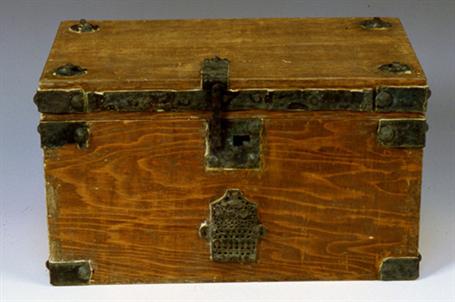
Images: Box, (c) Soprintendenza Speciale per i Beni Archeologici di Napoli e Pompei via Melbourne Museum (House of Julius Polybius, Pompeii; original iron and bronze fittings and wood reconstruction). Loaf of bread via Melbourne Museum (bakery in Pompeii; plaster copy of an original, carbonized loaf)
The Visual Inspiration occasional feature pulls the unusual from our world to inspire design, story-telling, and worldbuilding. If stuff like this already exists, what else could we imagine?