Making Clothes 2: Historical Inspirations

This post is a part of our Making Clothes series.

For the purposes of these posts, we are imagining an outfit that might have been made and worn in many parts of Eurasia or North Africa in the premodern period. Our imaginary wardrobe takes inspiration from a variety of sources, both archaeological and written.

Our oldest piece of inspiration comes from the Altai Mountains in central Asia. In the fifth century BCE, a woman was buried in a tomb on the high Ukok plateau of what is today the Altai Republic in Russian Siberia. The cold, dry climate of the region helped preserve the burial until the late twentieth century when it was discovered and excavated. The woman, popularly known as the Siberian Ice Maiden, was well dressed for her burial, and her clothes were remarkably well preserved. She wore a dress of wool and camel hair, a silk shirt, and thigh-high leather boots, along with a tall headdress made of wood.
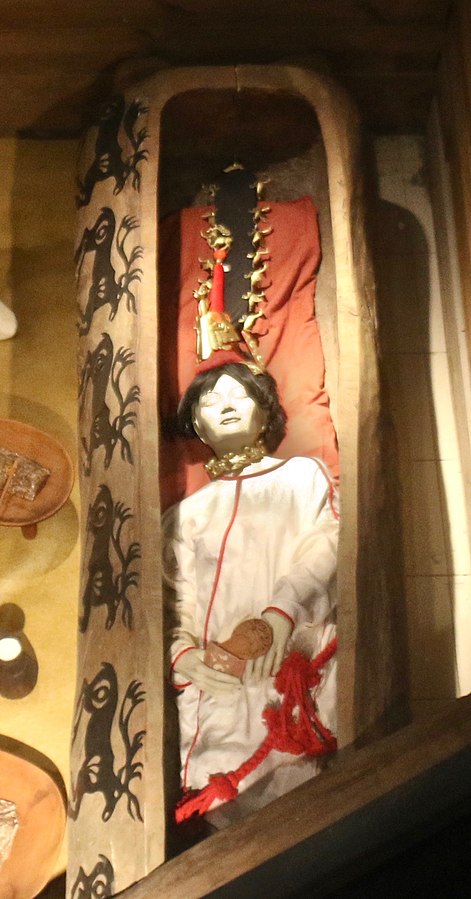
Reconstruction of the Ukok woman’s clothing and coffin, photograph by Sue Fleckney via Wikimedia

For our next historical reference, we look to the Vindolanda Tablets, an assortment of documents written on thin sheets of wood found at a Roman fortress near Hadrian’s Wall in northern Britain. Wooden tablets like these were used in antiquity for personal letters, memoranda, and other everyday documents of the kind that rarely survive for very long. These documents were written in the first and second centuries CE, and survived because they were preserved in waterlogged ground around the fortress. Among them we find the household accounts of Roman soldiers and officers detailing what sort of clothes they were spending their money on. A couple of tablets record the business affairs of a man named Gavo. We do not know who he was or what role he played in the life of the fort, but he seems to have supplied a lot of clothing and other textiles. One tablet lists some foodstuffs along with several bedspreads, a cloak, and thirty-eight pounds of wool. (Tabulae Vindolandenses II 192) Another tablet, part of whose text has been lost, listed at least ten cloaks of different types, three tunics, seventeen hooded cloaks, and some number of capes. (Tabulae Vindolandenses II 207) Yet another letter—we don’t know from or to whom—evidently accompanied a gift of underwear, socks, and sandals to some lucky soldier. (Tabulae Vindolandenses II 346)

Reconstruction of a Roman soldier’s dress, photograph by Fabryb13 via Wikimedia

Our last piece of inspiration comes from Egypt in the late antique period, probably the fifth century CE. It is a beautifully preserved tunic made of linen with intricate decorations woven into the fabric in dyed wool. The decorations include flowing vine motifs and depictions of the god Dionysus in surrounded by mythical sea creatures.

Tunic with Dionysian Ornament via the Metropolitan Museum of Art

We’ve chosen this set of examples to inspire our fictional wardrobe for a few reasons. Between them they span nearly a thousand years of history across Asia, Europe, and North Africa. They come from a wide range of environments, from the cold, arid heights of Central Asia to the hot, dry Egyptian desert to the rainy British Isles. The Ukok woman presents us with the complete outfit of one person; the Egyptian tunic gives us a detailed look at the construction of one garment; and the Vindolanda Tablets help us see individual items of clothing in the context of a larger economic and social world.

Our Example Outfit Described

For the purposes of quantifying necessary raw materials and production time to make a single outfit, we needed a specified set of clothing.

Our imaginary wardrobe starts with a long linen undertunic or short linen underdress. (From the point of view of materials and time required, we consider a dress very roughly equivalent of pants plus a tunic.)

The underlayer is topped by a silk overtunic. For the under- and overtunics, we imagined a simple T-style cut. Many historical tunics use gores at the side and central seams to add comfort, but we’ll try to keep our numbers manageable and stick with a basic design.

In addition, we include leather shoes or boots. Finally, a good-sized, rectangular wool cloak or mantle protects the wearer from elements.

For simplicity’s sake, we postulated a dyed but otherwise unadorned outfit, since the size and amount of decorative banding, embroidery, etc., can vary so widely. Accessories like underwear, wool socks and wool legwraps, hoods and headwear, belts, pouches, bags, and the like were also left out of our example.

How It Happens looks at the inner workings of various creative efforts.

Making Clothes 1: Introduction

For most of human history, people couldn’t walk into a shop and buy a new outfit. The work of creating clothing was complex and demanded multiple skills and a lot of labor. In the pre-modern world, the processes that led from raw materials to finished clothing were long and took up a significant amount of everyday people’s time and energy.

We’re beginning a new series of posts where we examine what it took to make a single outfit, from the raw natural materials to the finished product, in a world without factories and global supply chains. To do that, we’re starting with an imagined wardrobe that would have been at home in many parts Eurasia within the past couple of millennia and working out just what would have gone into creating such a set of clothes, both the materials it would have taken to make and the work that would have gone into gathering, processing, and finishing those materials.

In our next post, we’ll introduce our imaginary set of clothes and show you some of the historical examples that inspired it. After that, we’ll talk about where the raw materials to make our set of clothes would have come from and the labor that would have gone into producing and gathering them. From there, we’ll break down just how each of those raw materials got turned into textiles, and how those textiles then got turned into clothing. We’ll round the series out by trying to quantify the labor and resources that would have gone into our imaginary wardrobe with some hard(-ish) numbers.

Image: Women doing textile work, from Boccaccio’s De Mulieribus Claris via Wikimedia (currently Bibliothèque Nationale, Paris; 15th c.; illumination)

How It Happens looks at the inner workings of various creative efforts.

Vintage Car Looks Exactly Like a Character from an Animated Movie

Doesn’t this vintage car look exactly like an animated character from a Pixar movie?

Twitter QuirkyRides Belka

Developed by the Central Scientific Research Automobile and Automotive Engines Institute of the USSR / Russian Federation, known also with a much more user-friendly abbreviation NAMI, the car even has an appropriate name for a cartoon character: Belka means ‘squirrel’.

I’m used to thinking—wrongly or rightly—that Soviet design is, to put it politely, butt-ugly. (Think of brutalism, for example.) But this car is, indeed, very cute for midcentury modern design, even if it looks top-heavy (and perhaps therefore too wobbly for safety).

Image via QuirkyRides on Twitter.

Some things are just too silly not to share!

Dark Academia: A Moody Celebration of Higher Ed and Cultivation

Have you heard of the style dubbed dark academia? According to Wikipedia, dark academia is “a literary and social media aesthetic and subculture concerned with higher education, writing/poetry, the arts, and classic Greek and Gothic architecture.”

Sounds very geeky and nerdy, doesn’t it? (Apparently, again according to Wikipedia, a number of genre novels are, indeed, cited either as inspiration for or popular among the subculture.)

Well, it seems dark academia is now sufficiently popular that mainstream sites have started catering to its fans. While digging into it, I’ve seen clothing, books (of course), movies (ditto), and PC wallpapers for sale. There are also beginner’s guides, playlists for studying, recommended emoji combos, mood guides, critiques, and opinion pieces. (You know a thing has made it when opinion pieces appear!)

I found dark academia when a DIY / thrifting / home decorating blogger I follow and admire, Sarah Ramberg, published her own take on it for the October 2022 challenge in their Thrift the Look series. Here’s one view of her vignette:

Sadie Seasongoods Dark Academia Challenge

Ramberg used mostly thrift store items to outstanding effect. The crystal skull is in fact a thrifted vodka bottle, and it looks stunning. (It’s my favorite element in her recreation, in fact.)

While dark academia (like its kissing cousin steampunk) is not quite my cup of tea, I found it an interesting version of literary appreciation.

Image by Sarah Ramberg at Sadie Seasongoods

In Here highlights interesting spaces created by our fellow geeks all over the world.

Light Magnifier out of a Spherical Water Bottle

I stumbled upon a Tumblr post by Peter Morwood on non-electric light sources in period and/or fantasy writing and screen adaptations, and found out about a brilliant (no pun intended!) historical lighting aid. It’s simply a spherical water bottle or a glass globe arranged in front of a candle to concentrate the light.

It’s surprisingly effective as a magnifier: placing a candle behind the bottle does diffuse much more light around than placing a candle beside it. Morwood tried it in his kitchen with good results.

Tumblr Peter Morwood Light Magnifier Comparison

The principle works with electric light bulbs, too, as the photo below with a woodcarver shows.

Tumblr Peter Morwood Wood Carver

Similar to for instance burning glasses or reading stones, these light magnifiers are apparently often called lacemaker’s lamps, (glass) focusing lamps, or magnifying globes or condensers. If interested, you can read more e.g. at LaceNews blog post Collecting: Lighting for the Lacemaker.

Morwood even refers to one in Peter Jackson’s movie Fellowship of the Rings:

Tumblr Peter Morwood LotR FotR

Well, what do you know! From the extensive making-of documentaries I already knew how carefully the Weta teams worked on the Lord of the Rings props. This just proves it again. Great job!

Found and images via Peter Morwood on Tumblr.

History for Writers looks at how history can be a fiction writer’s most useful tool from worldbuilding to dialogue.

Living in the Science-Fictional Now: Flying Cars Are Closer than Ever

Flying cars have been dreamed of as long as cars have been around. If certain projects or companies are to be believed, flying cars will actually become available soon. For certain values of soon, anyway, and for certain values of car.

Current designs are as varied as the propulsion technologies and terminologies: flying cars, hovercars, gyrocopters, passenger drones, quadcopters, VTOL aircraft, eVTOL, maglev cars, personal air vehicles… Whatever you call them, aircraft that look less like airplanes and more like other small personal vehicles do seem be closer than ever to everyday reality.

Klein Vision AirCar in Flight Sm

For example, Volocopter’s air taxis have been demonstrated in Singapore (2019). The Dutch PAL-V Liberty gyroplane has not only test flown (2012) but also been approved for road use in Europe (2022). The AirCar by Klein Vision (pictured above) has completed a test flight between two cities(!) in Slovakia (2021) and received a certificate of airworthiness from the Slovak Transport Authority (2022). Reportedly, recent projects are also ongoing in Turkey and China. And, related to flying cars, a smart city and tourist destination being built in northwestern Saudi Arabia—dubbed Neom—has been planned for rail traffic and air taxis according to some reports.

Now, I’d assume all of the above is predicated on plentiful energy. How P*tin’s attempted extortion of Europe’s energy market (which has wider ripple effects, I’m sure) affects the development of flying cars will remain uncertain for some time yet.

I have to say, if flying cars do become common enough to be relatively easily available, I am tempted to get a pilot’s license (whatever kind might be required)—if I’m not too old by that time. (Planes are too high a hurdle, but small personal vehicles might just do for me.)

As a linguist, though, I’m mostly engaged with the question of a handy everyday name. That, too, is likely to be wrangled over at least as much as the technology side of their development.

Image: AirCar by Klein Vision

Hey, look! We found a thing on the internet! We thought it was cool, and wanted to share it with you.

Sound Sample Played on a Paleolithic Instrument Replica

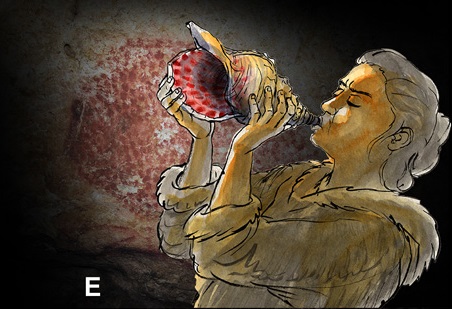
A group of French researchers published their study of a conch shell from the Upper Paleolithic period based on an assumption that it was used as a musical instrument. The article includes a sound sample gained by blowing into it—the first such sample published.

The conch shell in question, a Charonia lampas—a handsome marine mollusk—was found already in 1931 at the cave of Marsoulas, which is a so-called decorated cave. The shell is dated to roughly 16,000 BCE. And, interestingly, the shell was not only modified—presumably to make it fit a human mouth more easily—but also decorated with traces of colors and engravings.

Science Advances Conch Shell Horn Sm

The color is mostly found in fingerprint-sized and -shaped red dots on the internal surface of the shell. They are similar to motifs present on the cave walls, including a bison covered with a layer of red dots (seen in the background of the image above).

Aren’t the dot decorations fascinating? Apparently, similar conch shells have been used around the world as musical instruments in later periods, with similar modifications. Also, the oldest known flutes discovered thus far come from earlier paleolithic periods, roughly 40,000-20,000 years BCE, so the the concept of horn or flute should have been known. It certainly would make sense, then, that this shell was a horn.

You can hear the sound by downloading an audio file attached to the article.

Fritz, C. et al. “First record of the sound produced by the oldest Upper Paleolithic seashell horn” in Science Advances, Vol 7, Issue 7 (10 February 2021). https://doi.org/10.1126/sciadv.abe9510

Image by G. Tosello via Science Advances

An occasional feature on music and sound-related notions.

Minoan Mugs as Handsome as Modern Ones

It’s a common misconception that the further you go in history, the poorer the materials and decorations used were. Materials were simpler, yes; complex metal alloys, synthetic textile fibres, or clean rooms, for example, were a long way in the future.

But the more we study extant material remains, the clearer it is that humans have always appreciated beauty in their surroundings and—if they possessed the means—decorated both themselves and their everyday environment. Case in point: Minoan mugs from ca. 1,500 BCE.

Flickr George Plakides Minoan Mugs

Mugs in similar shapes can easily be found in modern tea shops, even if we don’t use exactly the same decorative motifs in the same combinations or colors anymore.

What’s also fascinating is that the handles are exquisitely formed, with just about exactly the same range of variations you can find nowadays. These people clearly knew how to make a practical and pretty mug.

Image by George Plakides on Flickr

Out There highlights intriguing art, places, phenomena, flora, and fauna.

Visual Inspiration: Ruins Don’t Need to Be Grey and Dull

Ruins and abandoned places are often seen as plain and boring. Granted, the color of untreated, inexpensive rock (which the majority of surviving buildings tend to be made from) often isn’t anything to write home about. But in our fiction, ruined areas don’t need to be austere and grim. You can even find real-life ruins in a variety of styles for inspiration.

For example, houses in Herculaneum famously featured colorful mosaics and painted murals. In addition, paint was generously applied elsewhere, like these pillars and external wall from House of the Relief of Telephus show:

Flickr Andy Hay Herculaneum

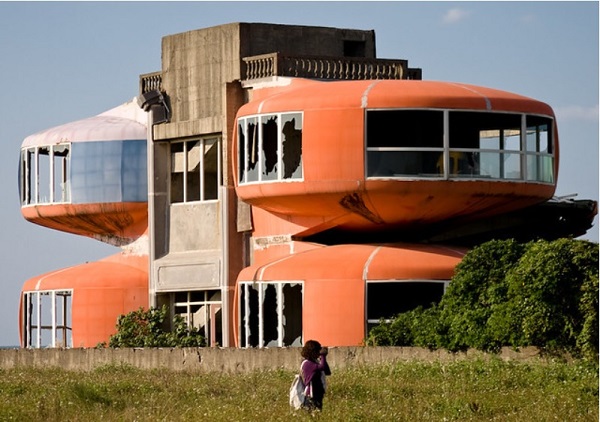
In Sanzhi, Taipei County, Taiwan, clusters of colorful pod houses or UFO houses once stood:

Flickr mingshah Sanzhi Pod Houses

It’s not always humans who have applied the color onto the ruins either. At the ancient Maya site called Bonampak or Ak’e, in the Chiapas area, Mexico, strikingly orange lichen is taking over building facades:

Flickr Carsten ten Brink Bonampak

(Check out the Bonampak Wikipedia article for a stunning relief carving and a painted mural!)

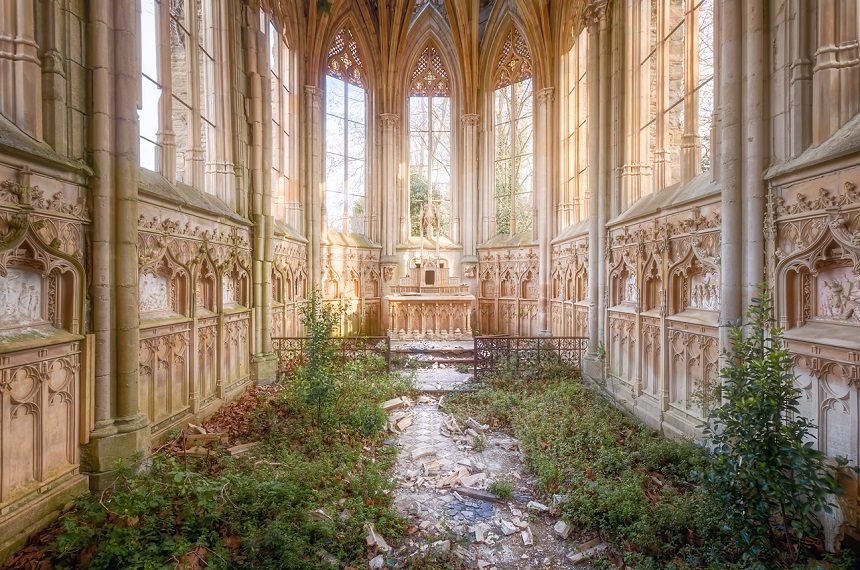
In Dutch photographer Roman Robroek’s shots we can see that a ruin definitely need not be grey, blocky, and boring. Partly overrun by nature could mean an almost orderly takeover, like in the photo of a Gothic-style former chapel built at the end of 19th century, below:

Robroek Former Gothic Chapel Sm

Beautiful, brightly colored arches among rubble from the childhood house of Lebanese singer Fairuz (who was born in 1934) in Beirut form a striking contrast to the greenery outside:

Robroek Arches House of Fairuz

Finally, a still strikingly turquoise—if peeling—underside of a round staircase:

Robroek Blue Staircase Sm

It vaguely reminds me of peacock feathers! I wish the photographer gave us a little more information about the history of this place. Browse more via Colossal or at Robroek’s website.

Since they exist in real life, I would be delighted to read about vibrantly colored and visually striking abandoned places in my genre fiction, too.

Images: Herculaneum by Andy Hay via Flickr (CC BY2.0). Sanzhi Pod Houses by mingshah via Flickr. Bonampak by Carsten ten Brink via Flickr (CC BY-NC-ND 2.0). Images by Roman Robroek: Former chapel. Arches at the house of Fairuz. Blue staircase.

Out There is an occasional feature highlighting intriguing art, spaces, places, phenomena, flora, and fauna.

Estonian Muhu Skirts Dyed with Mine Chemicals

Kadri Liik shared on Twitter some of her family history of using mines to dye fabric for colorful folk skirts in western Estonia in 1930s.

Strictly speaking, of course, it’s not mines themselves that were used in dyeing, but the picric acid in them. Russian World War I battleship Slava sank in 1917 between Muhu island and mainland Estonia, only 12 years after putting to sea.

Google Maps Muhu Estonia

Estonians scrapped the ship in the early 1930s. During that process, picric acid was extracted and put to use. According to Encyclopaedia Britannica, picric acid was first used in dyeing in 1849, initially of silk. In Muhu, it was apparently used with wool.

The bright yellow derived from picric acid was locally known as mine yellow (miinikollane). Below is the Muhu skirt made from scratch by Liik’s grandmother or great aunt in 1930s:

Twitter Kadri Liik Muhu Skirt

Apparently, Muhu skirts enjoyed such popularity that older women might be doing their everyday chores in them as late as the 1960s.

It’s quite striking, isn’t it? It seems that some of these traditional patterns survive, either in traditionally woven textiles or as prints on modern fabrics, which is fabulous. I’m not sure I’d like to know exactly how the picric was extracted in the 30s, though…!

Images: map of Muhu island by Google Maps. Skirt by Kadri Liik via Twitter.

How It Happens is an occasional feature looking at the inner workings of various creative efforts.