As a historian, its always fascinating to me to encounter the historiographic practices of another culture. Every culture has reasons to remember the past, and finds its own solutions to the problems posed by the limitations and fallibility of human memory. While written narrative histories have been privileged in the Western world, they are not the only way of preserving the past.
The winter count is a tradition of the Lakota, Kiowa, and several other indigenous nations of the North American plains. Customarily painted on buffalo hide, the winter count records years with one or two pictographic symbols representing major events of the year. These documents served as an aid to memory so that important past events could be recalled and put in relation to one another. In more recent times, some were also created on fabric or paper.
Copy of a Kiowa winter count for 1889-1892 via Wikimedia (previously Smithsonian Museum, now lost; 1890s; ink on buckskin; copy by Ankopaaingyadete of his original work on paper)
We know of winter counts dating from as early as the late seventeenth century and some still being kept in the early twentieth century. Not many have survived intact to today. Like many cultural objects created by indigenous North Americans, winter counts were sometimes destroyed by white settlers and at other times taken by collectors as anthropological curiosities. Some of those that no longer survive were photographed or copied, and in some cases, while the images have been lost, written descriptions survive.
There’s more than one way to preserve historical knowledge. Here’s one idea to keep in mind when thinking about how we know about the past and how people in a culture different from our own might relate to historical memory.
History for Writers looks at how history can be a fiction writer’s most useful tool, from worldbuilding to dialogue.
For most of human history, people couldn’t walk into a shop and buy a new outfit. The work of creating clothing was complex and demanded multiple skills and a lot of labor. In the pre-modern world, the processes that led from raw materials to finished clothing were long and took up a significant amount of everyday people’s time and energy.
We’re beginning a new series of posts where we examine what it took to make a single outfit, from the raw natural materials to the finished product, in a world without factories and global supply chains. To do that, we’re starting with an imagined wardrobe that would have been at home in many parts Eurasia within the past couple of millennia and working out just what would have gone into creating such a set of clothes, both the materials it would have taken to make and the work that would have gone into gathering, processing, and finishing those materials.
In our next post, we’ll introduce our imaginary set of clothes and show you some of the historical examples that inspired it. After that, we’ll talk about where the raw materials to make our set of clothes would have come from and the labor that would have gone into producing and gathering them. From there, we’ll break down just how each of those raw materials got turned into textiles, and how those textiles then got turned into clothing. We’ll round the series out by trying to quantify the labor and resources that would have gone into our imaginary wardrobe with some hard(-ish) numbers.
Fulvia was a descendant of one of the leading families of the Roman republic and wife of Marcus Antonius, one of the men responsible for its end. Her family commanded both respect and enormous financial resources. While there was no formal role for women in Roman politics, aristocratic women were often important in connecting families and individuals. Fulvia went further than most Roman women, aiding her husbands’ ambitions not just with her family connections but with a canny knack for political theatre. She even raised and helped to lead her own army in the penultimate stage of the Roman civil wars.
The politics of the late republic were chaotic and sometimes violent. The violence of the times was a symptom of a deeper shift in the political and social landscape. Changes were under way in the Roman world that not everyone was astute enough to recognize or skillful enough to manage. Fulvia was among the most skillful players of this game, and although she ended up on the losing side, her history is a valuable window into what it took to survive the politics of the end of the republic.
From its earliest days, the Roman republic had survived by balancing the interests of two groups: the wealthy aristocracy and the ordinary people of Rome. The balance was not always easy to strike, and early Rome went through periods of tension, even violence, as these two groups hashed out a way of living together. Many things bound these groups together. The people fought in Rome’s armies, led by aristocrats; while generals got the glory that came with victories, the citizen-soldiers who fought for them expected to see their share of the profits of war. Elite families dominated the competition for political office, but they depended on the people to elect them, and could not afford to entirely ignore the peoples’ needs and opinions. Ties of patronage ran through all levels of Roman society, as the more privileged exchanged favors and protection for the services and support of those lower down the social ladder. For most of the history of the republic, the rich and the poor found ways of working together—sometimes with gritted teeth and held noses, but together nonetheless.
In the second century BCE, the compromises and concessions that had kept Rome functional began to break down. By this time, Rome had become a Mediterranean empire, but its politics were still organized for a city-state. The profits of conquest on such a grand scale made some of the rich so rich that they could now buy off voters, bribe juries, and force their way through political life without adhering to the traditional compromises. While the rich were getting richer, economic changes buffeted the poor, leaving many without the means of making a living.
Roman politicians of the late republic had divided into two camps, calling themselves the optimates and the populares. The optimates represented the interests of the elite. They tended to be conservative, even reactionary. The populares depended on the common people as their base of support. They pushed for reforms to better the lives of Rome’s poorer citizens at the same time as they rabble-roused in support of their own ambitions. Neither group was a political party as we would understand it, with a coordinated message or strategy, but individual politicians triangulated themselves between these two interest groups.
Optimates and populares alike were slow to realize that the political ground was shifting under their feet. By the end of the republic, there was a third constituency up for grabs whose support would be key to political success. In the last century of the republic, The Roman army had shifted away from the old model of a citizen militia into a professional force, which meant that the interests of soldiers were no longer the same as the interests of civilians. Rome’s soldiers and veterans were themselves slow to coalesce as a political force, but the middle of the first century BCE, astute politicians were starting to realize that Roman politics now had three major interest groups, not two: the aristocracy, the people, and the army. Success would come not to those who most ardently supported one, but who could most skillfully coordinate the support of at least two, if not all three.
Fulvia was one of the people who grasped this new reality. From her early days as a political actor, she was deep in the realm of the populares. Her first husband was Publius Clodius Pulcher, a scandal-prone popularis leader who was loved by the people as much for his outrageous provocations against aristocratic convention as for his reformist policies. Clodius also exerted power through his patronage of armed gangs on the streets of Rome. Fulvia and Clodius were inseparable, and she was as much a part of his public life as any of his male allies. When Clodius was killed in a clash with a rival’s gang, Fulvia had his bloody body publicly displayed, knowing the sight would rouse his supporters among the people. Under her leadership, Clodius’ followers smashed their way into the Senate house and turned it into Clodius’ funeral pyre.
After Clodius’ death, Fulvia retained the loyalty of his street gangs and was one of the few members of Clodius’ circle who remained in Rome amidst the optimatis backlash. She married again to Gaius Scribonius Curio, a former optimatis turned popularis. Unlike Clodius, Curio had some military experience under his belt. He and Fulvia allied with the rising general Julius Caesar, and Curio was tasked with recruiting soldiers for Caesar’s bid to take over the Roman state. Curio died while commanding part of Caesar’s army in Africa.
After Curio’s death, Fulvia married again, aligning herself even more closely with Caesar’s cause by taking his right-hand man Marcus Antonius as her new husband. Fulvia brought with her not only her family’s wealth and connections but also her ties to Clodius’ clients and supporters. After Caesar’s assassination, Antonius skillfully stage-managed his funeral as an opportunity to whip up the anger of the people against the assassins and their aristocratic supporters, and it is likely he was guided by Fulvia’s expertise at provoking and channeling popular outrage.
When Antonius and Caesar’s heir Octavian became the leaders of the two sides in a new round of civil war, Fulvia vigorously supported her husband, not just politically but militarily. Together with Antonius’ brother, she traveled around Italy raising troops for Antonius’ side and visiting towns where veterans had been settled to remind them of their loyalty to Antonius. While Antonius was away in the east, Fulvia’s army briefly held Rome against Octavian before being forced out, besieged at Perusia, and finally defeated. Fulvia was sent into exile, where she died of an unknown illness.
The literary sources are not kind to Fulvia, and they may exaggerate some elements of her life. She was on the losing side of the final stage of the Roman republic’s self-destructive civil wars, and like her husband Antonius, her memory was tarnished by Octavian’s supporters. A frequent theme in anti-Antonius propaganda was to portray him as effeminate, so making out his wife to have been overly masculine was a natural addition. Nevertheless, it seems clear that Fulvia was not shy of engaging with the man’s world of politics and war. She was a confident political operator, a popularis provocateur, a chief of street gangs, and a capable recruiter and leader of soldiers. She learned from the men in her life and shared the lessons she had gained from them.
What’s more, she grasped the fundamental shift in late republican politics: it was no longer enough to be with the aristocrats or with the people. Neither popularis nor optimatis could prosper if they did not get the support of the soldiers. It was a truth that the most successful politicians of the age, men like Caesar and Octavian, had realized, and a fact that laid the ground for the imperial age to come. If some of the civil war’s battles had turned out differently, we might look back to Fulvia as one of the founding figures of Rome’s first dynasty.
Image: Coin portrait of a woman, possibly intended to be Fulvia; photograph by Classical Numismatic Group via Wikimedia (Copenhagen; c. 41-40 BCE; copper alloy)
History for Writers looks at how history can be a fiction writer’s most useful tool, from worldbuilding to dialogue.
When you go on vacation, you want to make sure you get the best experience. If you’re rich enough, other people will do it for you. That was just as true in the past as it is today. Here’s a fragment of a letter that has survived on papyrus from the Ptolemaic period in Egypt about preparations for a tour of the Faiyum oasis.
A Roman senator, Lucius Memmius, was touring Egypt in the late second century BCE. Someone in Alexandria wanted to make sure that Memmius had a good trip, so instructions were sent on ahead to make sure everything was ready for the important guest.
From Hermias to Horos, greetings. Attached is a letter to Asclepiades. Make sure that these instructions are followed. Be well. Year 5, 17th of Xantikos, 17th of Meikheir (March 5, 112 BCE)
To Asclepiades.
Lucius Memmius, a Roman senator who holds a position of great worth and honor, is making a grand expedition from the city [of Alexandria] to the Arsinoite nome to see the sights. See that he is properly welcomed, and take special care to see that lodgings are furnished along with landing places at the proper locations […] Make sure that the welcoming gifts listed below are ready to be handed over to him at the landing places, and that the furnishings for the lodgings, the usual morsels for Petesouchus and the crocodiles, the equipment for visiting the Labyrinth, the […] and the offerings and supplies for the household sacrifice are provided. In all respects, take the greatest care that everything should be prepared for his enjoyment, and be zealous […]
P. Tebt. (Papyri from Tebtunis) 1.33
(My own translation)
It looks like Memmius’ itinerary included watching crocodiles being fed and visiting the Labyrinth, a sprawling ancient temple complex whose walls and passageways were famous in antiquity.
It’s also interesting to note that, although Hermias wanted to make sure that special care was taken for Memmius’ visit, Memmius was evidently following an established tourist route. Hermias does not need specify where lodgings should be prepared for him or what equipment is needed for visiting the Labyrinth. The crocodile feeding was apparently a customary spectacle. Asclepiades clearly knew what to do to receive an important visitor, Hermias just wanted to make sure he did it. Faiyum tourism was evidently an established practice at the time.
History for Writers looks at how history can be a fiction writer’s most useful tool, from worldbuilding to dialogue.
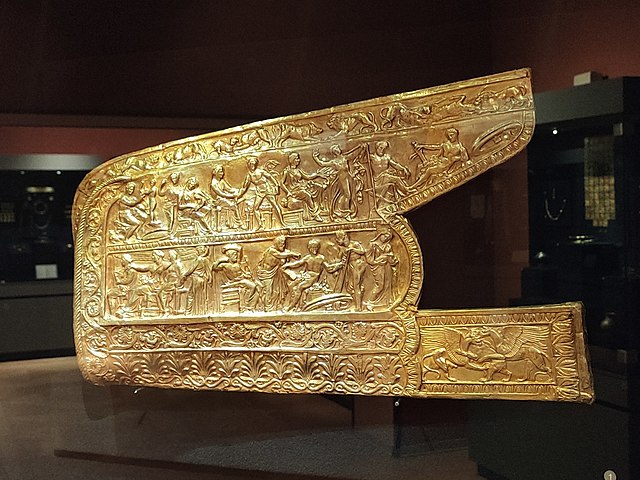
Here’s a beautiful work of art. This is a golden decorative panel from a gorytos, a combination quiver and bowcase that was used widely among ancient peoples of the steppes and the Iranian plateau. This example was found in Melitopol in southeastern Ukraine.
Gorytos, photograph by VoidWanderer via Wikimedia (found Melitopol, currently Kyiv; 4th c. BCE; gold)
Scythian artisans were expert metalworkers, and the Scythian elite valued high-quality metalwork, especially in gold, as emblems of status. This panel was made by Greek crafters serving the Scythian market. The central panel shows scenes from the life of Achilles, a Greek hero whose legends were sometimes associated with Scythia and whose warrior prowess was appealing to Scythian tastes. The outer panels feature decorative scenes of animals hunting, a popular motif in Scythian metalwork.
This piece is not just a beautiful work of art, it’s also an example of how art and artisans in antiquity crossed boundaries and bridged cultures.
Out There highlights intriguing art, places, phenomena, flora, and fauna.
Latin, like any foreign language, can be confusing sometimes, especially when so many Latin words have been adopted into other languages and often changed in the process. Still, it’s hard to think of a Latin word more misunderstood than vomitorium. The popular image is that Romans had rooms in their houses where they went to purge themselves mid-orgy so they could go back and keep eating. It’s an entertaining image (for certain values of entertainment), but it’s also completely false.
The word vomitorium is a form of vomitorius, derived from the verb vomo, meaning “to vomit.” In normal usage, vomitorius refers to emetics, substances used to induce vomiting for medical purposes. Pliny the Elder uses the word in this sense to describe the medicinal properties of some sort of plant (the exact plant is unclear, but it seems to be something in the allium family).
There is a plant with leek-like leaves and a reddish bulb that the Greeks call “bulbine.” It is considered very effective in treating wounds, so long as they are recent. The bulb that is called “vomitorius” because of its emetic effect has dark, glossy leaves that are longer than those of other types.
Pliny the Elder, Natural History 20.40
(My own translations)
Only one extant source uses the word vomitorium in reference to an architectural feature, and it was not a room for vomiting. The passage is from the Saturnalia by Macrobius, a late Roman writer. The Saturnalia is a fictional account of a dinner party conversation, a popular genre among Greek and Roman writers. In this case, the diners spend a good deal of time talking about the origins and usage of various words, particularly those connected with eating and digestion. Vomitorium comes up in a discussion of metaphorical and poetic uses of vomo:
Lucilius said in his fourteenth book:
“If there were no praetor hanging around bugging me
that wouldn’t be bad, I tell you. He’s the one disemboweling me.
In the morning every house vomits a wave of sycophants.”
That’s well said, and it’s an old expression, too, for Ennius says:
“And the Tiber river vomits into the salt sea”
And so nowadays we talk about “vomitoria” in the theatre, through which crowds of people pour in to get to the seats.
Macrobius, Saturnalia 6.4.2-3
Macrobius is describing the monumental entrances of public buildings that were built to accommodate large flows of people, such as we typically find on Roman theatres and amphitheatres. They look something like this:
Vomitorium of the Colosseum looking outward, photograph by Ank Kumar via Wikimedia (Rome; 80 CE; stone)
Vomitorium of the Roman amphitheatre in Bordeaux looking inward, photograph by Michaël Van Dorpe via Wikimedia (Bordeaux; 3rd c. CE; stone)
It’s hard to say how formal or widely used the term was. We don’t have any mention of it from Roman texts on architecture. It certainly carries more than a whiff of aristocratic disdain for the crowds of ordinary folks who had to jostle their way into the seats, unlike Macrobius and his upper-crust set who could count on reserved seating. Still, it must have been a word that late Roman aristocrats like Macrobius would recognize, or else there would be no reason to bring it up in a discussion of etymology and poetry. In modern times, architectural historians have taken Macrobius’ bit of upper-class slang and turned it into a technical term for describing the wide entry passages of Roman public buildings, and you’ll find it in more than one scholarly work on Roman architecture, but there’s no evidence that the people who designed, built, or used those structures referred to them as such.
Now, it’s not entirely clear how we got form a misapplied architectural term in historical scholarship to the idea of upper-class Romans pausing mid-party to go to a separate room and throw up, but somewhere along the way there are probably a couple generations of bored school kids enlivening their Latin lessons with overactive imaginations and gross-out humor. They may well have gotten inspiration from some of the more revolting passages in Latin literature. In one such passage, the philosopher Seneca laments the maltreatment of enslaved household workers who are made to stand silent and hungry while the man of the house overindulges:
For this reason, I laugh at those who think it is unseemly to share a meal with their slaves. Why should it be, when it is only haughty habit that has a crowd of slaves standing around while the lord dines? He eats more than he can handle and in his overpowering greed stretches out his belly until it can no longer do its job, then he has to work harder to get it all out than he did to put it in. And all this time, the poor slaves cannot move their lips, not even to speak.
Seneca, Moral Letters 47.2
Another, even more explicit example comes from Suetonius’ biography of the emperor Claudius:
He rarely left the dining table until he was gorged and sloshed, and as soon as he was on his back and snoring, a feather was slipped into his mouth to get him to unburden his stomach.
Suetonius, The Lives of the Caesars, “The Deified Claudius” 33.1
Both of these passages pretty clearly describe elite Romans overeating and then inducing themselves or being induced to vomit. It would be a mistake, however, to take either of these passages as evidence that self-purging was a normal enough part of Roman life to require a dedicated room.
Seneca is condemning the greed, vanity, and inhumanity of wealthy Romans. The point of his imagery is the revolting contrast between the master who eats more than he can handle and the slaves who get nothing to eat at all. Seneca is not describing the real behavior of a real person but concocting a repulsive mental image to make a philosophical point. Suetonius, on the other hand, is describing a real person’s real behavior, but that person was not a typical Roman. The Roman elite found Claudius eccentric and off-putting, a fact Suetonius illustrates with multiple anecdotes. What Suetonius describes here is not the lifestyle of an average Roman aristocrat but a weird, gross habit of a weird, gross person.
Both of these passages are meant to disgust the audience, but neither was written with modern sensibilities in mind. They were meant to be disgusting to an audience of elite Romans. Seneca and Suetonius wrote about self-purging Romans not because it was something Romans did but because it was something their Roman readers would cringe at. If a mid-feast vomit had been a common enough practice to warrant making it a special feature of the home, these passages would have had no force.
Now, none of what I’ve explained here should be taken to mean that no Roman ever induced a post-feast hurl, nor even that there were no Romans who made a habit of it. People do a lot of strange things, and people of any culture or time can have a troubled relationship with food, but a few people acting strangely does not amount to a cultural practice. The idea of the vomitorium as a purging room is a bizarre pile-up of misunderstood slang, schoolkid humor, and a pruriently selective reading of sources. The ancient Romans weren’t any more likely to be intentionally losing their dinners than anyone is today, and they certainly didn’t build rooms for it.
History for Writers looks at how history can be a fiction writer’s most useful tool, from worldbuilding to dialogue.
I stumbled upon a Tumblr post by Peter Morwood on non-electric light sources in period and/or fantasy writing and screen adaptations, and found out about a brilliant (no pun intended!) historical lighting aid. It’s simply a spherical water bottle or a glass globe arranged in front of a candle to concentrate the light.
It’s surprisingly effective as a magnifier: placing a candle behind the bottle does diffuse much more light around than placing a candle beside it. Morwood tried it in his kitchen with good results.
The principle works with electric light bulbs, too, as the photo below with a woodcarver shows.
Morwood even refers to one in Peter Jackson’s movie Fellowship of the Rings:
Well, what do you know! From the extensive making-of documentaries I already knew how carefully the Weta teams worked on the Lord of the Rings props. This just proves it again. Great job!
Our Western calendars will soon be moving on from 2022 to 2023. Since most of us are used to living with calendars that count forward inexorably year after year, it may be hard to grasp that the idea was, at one time, revolutionary and even provocative.
In the ancient world, most peoples’ ways of tracking time were cyclical rather than linear. Observing the natural cycles of day and night, the moon’s phases, and the turning of the seasons led people to construct methods of tracking time that always returned to the same starting point. In small-scale agrarian societies, there was rarely a need to keep track of time periods longer than a year or to know exactly how long ago events out of living memory had happened. Larger, more organized societies began to think on longer time scales, but still within a cyclical framework. Monarchic states like Egypt, Babylon, and Persia dated events by regnal years: the year in which a new king acceded to the throne was year 1, the next year was year 2, and so on, until the king died and the cycle started over again with year 1 of the next king.
Sometimes the idea of the cycle was even more important than the reality: some Egyptian inscriptions record thirty-year celebrations for kings whose reigns lasted only ten or twenty years. A king was expected to celebrate his thirtieth year, so it was recorded in inscriptions whether it had happened or not. The cycles of regnal years were thus treated as if they were as natural and dependable as the rise of the sun and the waning of the moon. These calendars had no defined beginning or regular way of determining how far back events of the distant past were.
For those with an interest in the past, these cycles could be organized in order. Many states, from the Assyrian Empire to the Roman republic, kept annals, records of reigning figures and significant events on a year by year basis. The structure of the calendar in which these events were recorded, though, continued to prioritize the regular return of cycles rather than linear movement forward.
The first Western calendar to have a defined beginning and a linear count of years was initiated by the Seleucid dynasty after the collapse of Alexander the Great’s empire. One of Alexander’s generals, Seleucus, was appointed governor of Babylon under Alexander’s successor in 311 BCE. A few years later, Seleucus broke away and declared himself king of a new kingdom stretching from the Mediterranean Sea to the borders of India. Rather than use regnal years like earlier kings, Seleucus instituted a new calendar that was backdated to begin with his appointment as governor and continued numbering the years from then on, never resetting when a new king came to power.
The novelty of Seleucus’ calendar was a response to the unusual nature of the kingdom itself, a cobbled-together empire of diverse peoples, many of whom had traditions of civic life and imperial rule thousands of years older than the upstart Macedonian warlords now running the show. Seleucus’ calendar was meant to unify the many peoples of his realm but also to mark a definitive break with the past. The Seleucid dynasty was to be unique, its claims to power not dependent on anything that had come before. Its subjects should not be allowed to imagine that the Seleucid kings might have their time and then fall to be replaced by new cycles of native rulers. The Seleucid era was intended to be eternal, and the way it counted endlessly into the future, never cycling back, was a key part of the regime’s propaganda.
Like all imperial propaganda, however, the Seleucid calendar met resistance. Local people throughout the empire continued to use their own traditional ways of marking time alongside the official calendar. Other powers responded by creating their own linear calendars with different starting points. An inscription from Greece known as the Parian Chronicle takes the idea of a definitive turning point and inverts it, recording historical events in terms of how far in the past they happened before a defined date. This chronicle made an implicit challenge to the Seleucid kings in two ways. First, the date from which it counted back was the date of a major treaty between Greek cities and the Ptolemaic dynasty of Egypt, one of the Seleucids’ major rivals. More subtly, by looking backwards rather than forwards, it emphasized the antiquity and historical importance of the Greek cities in contrast to the parvenu status of the Seleucids.
Other peoples found other ways of challenging the Seleucids’ claims to authority. Among the Jewish people, who struggled for freedom from Seleucid rule, the new calendar inspired a rethinking that made the shift from cyclical time to linear time a rallying point against oppression. If time could have a definitive beginning, it could also have a definitive end. Apocalypticism, the belief that the end of the world was foreseeable, even imminent, became one of the unifying ideas of Jewish resistance to Seleucid rule. Apocalyptic narratives gave an urgency to resistance: if the world was coming to an end, then the time to act in the name of justice was now. They also inspired the hope that no matter how powerful the Seleucid king and his armies might seem, the divine plan for the world was greater.
This apocalyptic thread remained part of Jewish thought, if not always in the mainstream, even after the defeat of the Seleucid kings. It saw a revival when the Jews faced another imperial intrusion under Rome. Rome had its own linear calendar, counting years forward from the supposed founding date of the city in 753 BCE, and apocalyptic narratives were as useful in organizing anti-Roman resistance as they had been in the face of the Seleucids. The early Christian movement took shape in the turmoil of this time and took on the idea of a foreordained end to time as part of its own narrative.
Something as seemingly straightforward and utilitarian as a calendar can have complicated layers of meaning. Enjoy 2023!
Image: Ancient sundial, photograph by Ad Meskens via Wikimedia (Currently Side Archaeological Museum, Side, Turkey; Roman period; stone and metal)
History for Writers looks at how history can be a fiction writer’s most useful tool. From worldbuilding to dialogue, history helps you write.
People have long been fascinated by dreams and seen them as potential sources of meaning and insight. While today we focus on dreams as potential windows into our unconscious minds, ancient peoples often thought of dreams as a potential channel to the supernatural. Ancient Greeks produced complex manuals for interpreting the symbolism of dream images as a way of understanding the gods and predicting the future.
In that context, it is interesting to see evidence for a more rational, grounded approach to dreams. This passage comes from Herodotus’ account of how King Xerxes of Persia decided to invade Greece. After debating the merits of the proposed campaign with his court and deciding against it, Xerxes repeatedly dreamt of a shadowy figure that demanded he carry on with the attack. When Xerxes brought up this dream to his uncle Artabanus, Artabanus offered a level-headed interpretation:
Now when you have come around to a better way of thinking, you say that although you have decided to abandon the expedition against Greece, you are visited by a dream from some god forbidding you from giving up on the plan. But there is nothing divine in this, my boy. I have many years on you, so I’ll teach you what recurring dreams like this are about: the things we see in our dreams are usually the things we have had on our minds during the day, and in recent days we have been concentrating on this campaign.
Herodotus, Histories 7.16b
(My own translation)
Now, in Herodotus’ narrative, it turns out that Artabanus was wrong and Xerxes really was being visited by some divine force prompting him to carry on with the invasion plan, but the fact that Herodotus could put that argument into Artabanus’ voice tells us that the idea was part of the contemporary conversation in the Greek world. Indeed, Artabanus generally figures in Herodotus’ work as a wise and perceptive counselor whose advice Xerxes would have done well to heed. Giving this argument to Artabanus gives it a significant weight as an idea, even in a cultural context where people were inclined to see dreams as messages from the gods.
Serving exactly what it sounds like, the Quotes feature excerpts other people’s thoughts.
Carved gravestones with images and short poems celebrating the deceased were common in the ancient world, but it wasn’t just people who got them. This one commemorates a pig who apparently died in some kind of traffic accident. Like other Greek epitaphs, this one is phrased in the first person, as if the pig were narrating its own story.
A little pig, everyone’s friend, a young quadruped, I lie here, after leaving behind the land of Dalmatia to be offered as a gift. I walked through Dyrrachium and Apollonia in my longing, and passed through the whole earth alone untouched. Now, by the violence of wheels, I have left the sunlight behind. I longed to see Emathia and the phallic chariot, but now I lie here, and my debt to death is cleared.
Supplementum Epigraphicum Graecarum 25:711
(My own translation)
The story seems to be that a pig was bought somewhere in Dalmatia (the Balkans) and driven overland toward the plain of Emathia in Macedonia (west of modern-day Thessaloniki), to be offered as a sacrifice in a festival for Dionysus (which often involved a large decorated phallus carried in a procession). The stone was found in Edessa, a city right at the edge of Emathia, and it seems that here the poor pig got run over by a cart.
It’s certainly unusual for an animal to have a gravestone like this. There was a custom of writing joke epitaphs for animals, but few people went to the expense of actually getting them carved in stone. Perhaps this pig was special, or perhaps the gravestone represents a kind of substitute for the religious act of sacrifice that was no longer possible once the pig was killed on the road.
Whatever the case may be, that was clearly some pig.
Image: Copy of pig stela, photograph by Philipp Pilhofer via Wikimedia (Edessa; 2-3 c. CE; carved stone)
Out There is an occasional feature highlighting intriguing art, spaces, places, phenomena, flora, and fauna.




 Co-Geeking


_09.jpg)


You must be logged in to post a comment.