Or: Some History behind Ostrich Riding, Part 2 of 7
Background: I ran into two historicalimages from California with ostriches used as transportation. That got me wondering about the history of ostrich riding. And that lead me down quite a rabbit hole.
I’ve divided my findings into separate posts (find them with the ostrich riding tag). Warning: serious early history and language nerdery ahead in Serious Academic Voice.
TL;DR – Tracing ostrich riding to a 3rd century BCE tomb find (a statue of Arsinoe II) from Egypt doesn’t hold up. The use of various ostrich products in human material culture dates back thousands of years. A few ancient depictions involve humans handling ostriches; however, extant sources don’t tell us whether ostriches were merely hunted or whether they were also tamed in the ancient world.
Or: Some History behind Ostrich Riding, Part 1 of 7
Background: I ran into two historicalimages from California with ostriches used as transportation. That got me wondering about the history of ostrich riding. And that lead me down quite a rabbit hole.
I’ve divided my findings into separate posts (find them with the ostrich riding tag). Warning: serious early history and language nerdery ahead in Serious Academic Voice.
TL;DR – Tracing ostrich riding to a 3rd century BCE tomb find from Egypt is rubbish, but the concept is, indeed, ancient.
One of my weaknesses as a writer is dialogue, particularly dialogue that needs to carry subtext. I’m not good at writing the kinds of things that people say when they’re not actually saying what they’re saying. When I need inspiration for how to write a scene in which people say one thing while really conveying something else, the place I look is the argument between Achilles and Agamemnon in book 1 of the Iliad (lines 101-244).
There are a lot of good translations of the Iliad available if you want to check it out. I’m especially fond of the Robert Fagels translation for the strength of its poetry. Richmond Lattimore’s version is good if you really want to get close to the rhythms and patterns of the original Greek. The translation on Perseus is older and less readable, but you can pick up the scene I’m talking about around the middle of this page (start after [100]). There are plenty of other choices.
To set the scene: As the Iliad opens, the Trojan war has been going on for ten years and has come to a stalemate. The Greeks are not able to breach the high walls of Troy while the Trojans cannot dislodge the Greeks from their camp on the shore. To break the impasse, the Greeks have begun trying to put pressure on the Trojans by raiding the smaller towns nearby that are allied with Troy. One of these raids carried off a young woman, Chryseis, who was awarded to Agamemnon as his prize. Chryseis’ father Chryses, a priest of Apollo, comes to the Greek camp to ask for his daughter’s return, but Agamemnon refuses and sends him away. Chryses prays to Apollo for aid and Apollo obliges by spreading plague through the Greek camp. After ten days of suffering, the Greek kings gather together to discuss the situation. The seer Chalcas reveals the cause of Apollo’s wrath.
Aerial view of Dún Aonghasa, photograph by Ronan Mac Giollopharaic via Wikimedia
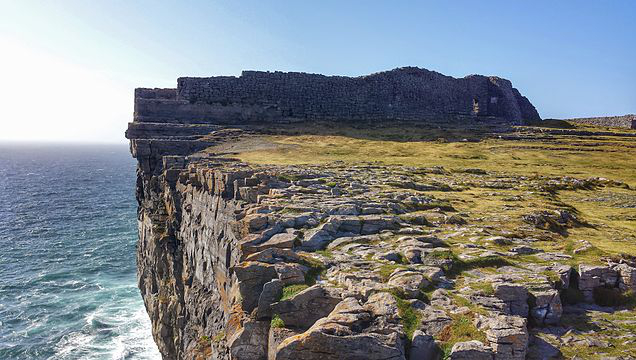
While doing some research on northern European hillforts recently, I found myself looking at some pictures of Dún Aonghasa (also known as Dun Aengus). It’s an impressive site. The fort is a series of concentric half-rings backing up onto 100-meter cliffs on the island on Inishmore off the western coast of Ireland. The earliest construction on the site has been dated to around 1100 BCE. Later additions were made around 500 BCE. It is one of the largest well-preserved examples of a type of structure that was built throughout northern and western Europe, from Spain to Sweden, in the prehistoric era.
The “cheveaux de frise,” a barrier of jagged stones set up to slow down attackers, photograph by Herbert Ortner via Wikimedia
There has been disagreement in the scholarship about the function of Dún Aonghasa and similar forts. While often identified as fortified settlements, some have suggested that they were actually sites of religious ritual. It has to be said that if Dún Aonghasa and sites like it were religious sanctuaries, they were amazingly well-defended ones. I think it is more likely that sites that were originally built for defense were centuries later repurposed as ceremonial sites, much like how medieval castles built for defense have centuries later become museums and tourist attractions.
The walls of Dún Aonghasa and the cliffs of Inishmore, photograph by Jal74 via Wikimedia
It may be hard to believe that such an enormous fortification was built in so remote a place, but forts like Dún Aonghasa were once fairly common across western and northern Europe. Most, however, have been lost to decay, erosion, and the reuse of stones. It is only in remote places like Inishmore that they still survive.
Thoughts for writers
Just a simple thought today: the world is full of interesting possibilities. Fortresses don’t have to look like medieval castles. Religious sites don’t have to look like cathedrals or Greek temples. History is huge and there are amazing things out there to inspire your imagination.
History for Writers is a weekly feature which looks at how history can be a fiction writer’s most useful tool. From worldbuilding to dialogue, history helps you write. Check out the introduction to History for Writershere.
The Roman empire had a problem. It was just too big. When a crisis developed on one frontier, it could take weeks for the emperor to hear about it, then months or even years to move troops and supplies into position to deal with it. The large frontier army consumed supplies which had to be delivered at great expense from the agricultural heartlands. The roads built by the Roman army helped make all this travel faster and easier, but if the Romans had built railroads they could have made it much easier still. A Roman empire with railroads might not have fallen apart in the fifth century CE. So why didn’t the Romans build them?
The obvious answer is that they didn’t have the technology of steam power, nor the resources of coal and iron needed to build a functioning railroad. It’s a good answer, but like many such obvious answers it’s missing something.
Last week, I shared the image of an ostrich cart. There must’ve been random serendipity rays in the air, because this week I happened on a photo of someone actually riding an ostrich:
Man riding an ostrich at the Cawston ostrich farm, South Pasadena, California. Via Elle Decor, June 2014, p. 67.
Cawston ostrich farm. Postcard by Detroit Photographic Company; South Pasadena, California, unknown date. From the collection of Marc Walter, published in An American Odyssey: Photos from the Detroit Photographic Company, 1888-1924, by Marc Walter and Sabine Arqué (Taschen, 2014). Found in Elle Decor magazine, June 2014, p. 67.
Huh. I used to think that the various tallstrider or hawkstrider type mounts in World of Warcraft were based more on fantasy than fact. I’m sure large birds come with a host of training and handling issues, but apparently it’s not as far-fetched as I thought. On the other hand, having grown up two hours south of the Arctic Circle and traveled in Lapland multiple times, seeing reindeer doesn’t make me bat an eye. Just goes to show how our experiences influence our sense of normal. 🙂
The Visual Inspiration occasional feature pulls the unusual from our world to inspire design, story-telling, and worldbuilding. If stuff like this already exists, what else could we imagine?
We all know that the pyramids of Egypt were tombs for the pharaohs. (Yes, yes, and landing pads for Goa’uld spaceships; you can put your hands down now.) Thinking about what it took to build them, though, gives us an idea of what else they were.
The construction of the pyramids is a perpetual favorite subject of cranks and crackpots (Lost technologies of Atlantis! Sound waves!). Even among the more reality-bound, there is no end of theories ranging from the mundane (ramps and sledges) to the reasonably plausible (pulleys and levers) to the unlikely but not impossible (poured concrete). No matter what technique we imagine, however, one thing was definitely required: massive amounts of labor.
What most armchair pyramidologists miss about the problem of megalithic construction is that the physics of moving large stones are very simple. Apply enough force to a mass and it will move. Some things can make the application of force easier: ramps, pulleys, rollers, whatever you’ve got, but in the end it’s just a matter of force versus inertia. No matter how you go about building a pyramid, what you need in the end is the same: muscle power and time. With enough muscle power and time you can build pretty much anything, but labor is expensive. The real problem that would-be pyramid builders have to solve isn’t technological, it’s economic. The real question isn’t “How did they build the pyramids?” but “How did they afford the pyramids?”
Ostrich pulling a cart at the Los Angeles Ostrich Farm. Postcard by unknown; Lincoln Park, Los Angeles, California, 1919. From the Werner von Boltenstern Postcard Collection; Department of Archives and Special Collections, William H. Hannon Library, Loyola Marymount University. In public domain.
Why do fantasy stories so often employ equines as beasts of burden, when you could breed large birds for the task? In our world, humans do have a long history with the horse family, but who’s to say that in another, more SFFnal one you couldn’t find giant versions of armadillos, capybaras, or rats used for transportation? Or faster, large-scale chameleons?
The Visual Inspiration occasional feature pulls the unusual from our world to inspire design, story-telling, and worldbuilding. If stuff like this already exists, what else could we imagine?
The majority of the stuff that needs to get done in an agrarian society is basic manual labor: primarily farm work, but also things like construction, building and road maintenance, mining, carrying, housework, etc. Any functioning pre-industrial society needs lots of workers to do all that work, but there are many different kinds of workers, some of which are not so familiar to us today. Some of these kinds of workers had it much better than others.
Here’s a list of possibilities, by no means exhaustive, arranged roughly in order from worst to best conditions.
I suppose that title’s a little more interesting than “Pre-modern Demography.”
You’ve probably heard the statistic that the average lifespan in the European middle ages was 35. I remember learning that when I was young. Most of my students have heard it, too, and just like I used to, they imagine that it means that when medieval people got to thirty-two or thirty-three it was time to start looking around for a cemetery plot and a good gravedigger, and that anyone who made it to forty must have been a revered elder, if not a terrifying freak on nature. The truth is much more interesting.
Data about births and deaths is hard to come by for periods before the rise of modern bureaucracies. In a few localities there are church records going back into the late middle ages. Legal documents like wills, deeds, and contracts occasionally offer information about peoples’ births, ages, and deaths, but such documents come from only a very restricted class of people and they may be unreliable because people misrepresented the truth when it suited their political and economic purposes. Archaeological studies of burials can be very useful, although determining age from skeletal remains is imprecise, and we are at the mercy of biases in burial customs and survival of remains. All of these sources of information are partial and biased, but pulling them together gives us a rough sense of how people lived and died in earlier ages.
There are broad patterns that can be discerned from the evidence, but as with most such broad patterns we should always be alert to local variations. Another caution: I’m working from the evidence that I happen to be familiar with, which is mostly European and Mediterranean. Many of the same forces that were at work in that region of the world are relevant to others as well, but we must be alert to regional differences.




 Co-Geeking


You must be logged in to post a comment.