Or: Some History behind Ostrich Riding, Part 5 of 7
Background: I ran into two historicalimages from California with ostriches used as transportation. That got me wondering about the history of ostrich riding. And that lead me down quite a rabbit hole.
I’ve divided my findings into separate posts (find them with the ostrich riding tag). Warning: serious early history and language nerdery ahead in Serious Academic Voice.
TL;DR – Tracing ostrich riding to a 3rd century BCE tomb find (a statue of Arsinoe II) from Egypt doesn’t hold up. The use of various ostrich products in human material culture dates back thousands of years. A few ancient depictions involve humans handling ostriches; however, extant sources don’t tell us whether ostriches were merely hunted or whether they were also tamed in the ancient world. The most promising source seems to be a description of a magnificent parade put together by Arsinoe II’s husband-brother Ptolemy II. This Grand Procession included eight chariots drawn by pairs of ostriches, and the ostriches may have been ridden by boys in costumes.
I had hoped to find a nice, neat selection of ancient texts putting the Greek word for ‘ostrich’ in context, but even a cursory look reveals that the history of the word strouthos is complex. At best, we can say that there are no immediate red flags either in the original Greek or modern English translations for Arsinoe II’s statue or Ptolemy II’s Grand Procession. The poem Berenice’s Lock was said to contain further evidence of ostriches as mounts in Ptolemaic Egypt after Arsinoe II’s death. Instead, what we seem to have is a case of poetic ambiguity translated with poetic license and taken uncritically as evidence.
Halloween will soon be upon us. The origins of this holiday are obscure. It is often connected with the Gaelic festival of Samhain, which marked the end of the harvest and the beginning of winter, but Halloween, at least as popularly celebrated today in the US and some other countries, has wider connections. It is an example of a type of holiday found in many cultures: the “feast of fools.”
… Marcus Licinius Crassus would have been the first emperor of Rome instead of Julius Caesar.
Stick with me here.
Alfalfa is a plant in the pea family that resembles clover. It originally comes from south central Asia and was cultivated in the northern parts of the Iranian plateau as animal fodder. Compared with other fodder plants, alfalfa is very high in protein, so it is mostly fed to cattle. It can be given in small amounts to most horse breeds, but in large amounts it causes bloating as horses cannot use the excess protein.
The exception is Nisaean horses, a breed of horse that was developed in northern Persia and bred to feed on alfalfa. These horses were able to absorb the extra protein of alfalfa into their bones, giving them denser, stronger bones than other horses. These dense bones enabled the Nisaean horses to make sudden turns while galloping at high speed that would have broken other horses’ legs and to carry heavier weights than other horses of the ancient world could manage.
Down the crimson marble steps of the temple of Zurukh, god of blood, came a bald priest in the red robes of the Order.
“Heathens!” he cried, pointing with his holy whip at Our Heroes. “Heretics! Blasphemers! You shall bow down and worship Zurukh or burn in the fires of the Scarlet Inquisition!”
“Silence!” answered Inessa, stepping forward from the party and raising aloft her crosier. “Repent of your wickedness! The power of Adnea, Lady of the Pure Light, compels you!”
Religions are tricky to write. If you’ve delved into much fantasy, you’ve probably seen a lot of faiths that seem oddly familiar. In fact, the religions of some fantasy worlds can be charitably described as “Catholicism with the serial numbers filed off.” Even given a profusion of gods with their own temples and cults and spheres of influence, fantasy religions tend to work more like the modern monotheisms than like the actual ancient “pagan” traditions they are outwardly imitating.
How can you make your fantasy religion feel more authentically ancient? There’s no rules to it, but in this and some future History for Writers posts, I’ll share some of what we know about historical beliefs from around the world that may help you imagine a religious worldview that feels less modern.
In this age of selfies and Instagram, we are very aware of how consciously we all create the image of ourselves that we show to the world. The people of antiquity were no less self-conscious about their public image. Look at these two sculptures of Cleopatra VII.
Cleopatra VII Philopator is the famous Cleopatra, Queen of Egypt and lover of both Julius Caesar and Marcus Antonius. She was the last of the Ptolemaic dynasty in Egypt, founded by Ptolemy I, one of the generals of Alexander the Great. The Ptolemies ruled Egypt for almost three hundred years, arguably the first European colonial state in Africa. Like other Macedonian dynasties in the relics of Alexander’s short-lived empire, Ptolemy and his heirs took a pragmatic approach to ruling over a large population that did not share in their Hellenized Macedonian culture. They embraced a kind of cultural bilingualism in which they presented themselves in very different ways to different audiences.
Portrait head of Cleopatra VI, photograph by Louis le Grand via Wikimedia (Altes Museum, Berlin; 40-30 BCE; white marble)
This marble head of Cleopatra is sculpted in a Hellenistic style and presents the queen in a Greek cultural context. White marble was favored for sculpture in the Greek world because it reacts to light in ways similar to human skin, making marble sculpture appear more naturalistic. Details like the soft rendering of the mouth, the detailed delineation of the hair, and the slightly off-center tilt of the head are drawn from the artistic repertoire of late Classical and Hellenistic portrait sculpture. This statue asserts Cleopatra’s Greekness and her participation in the broader Mediterranean cultural world. It was probably displayed in Alexandria, the Ptolemaic capital, which had a cosmopolitan population largely made up of Macedonians and Greeks, along with substantial Jewish and Persian communities and a variety of other peoples, but few ethnic Egyptians. It was meant to be seen by an audience that would recognize and appreciate the way this portrait fit into the larger history of Hellenistic ruler portraiture.
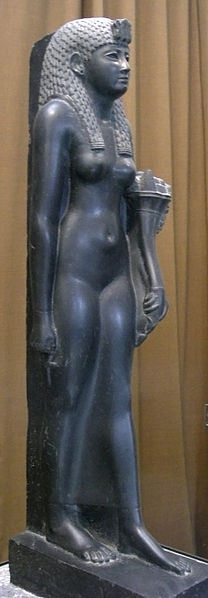
Statue of Cleopatra VII photograph by George Shuklin via Wikimedia (Hermitage Museum, St. Petersburg; late 1st c. BCE; basalt)
This basalt statue of Cleopatra uses not only an Egyptian artistic style, but an almost entirely Egyptian iconographic vocabulary. Many different stones were used for Egyptian portrait sculpture, but basalt was a popular one since the stone is very hard and durable, giving a sense of permanence especially to royal portraiture. Cleopatra is presented here as an Egyptian pharaoh. She wears a wig adorned with the royal uraeus and carries an ankh in her right hand. The cornucopia in her left hand is a Greek symbol, but its connotation of bounty is similar to the ankh’s symbolism of life. Also note that one of her feet is advanced. Egyptian women were typically depicted with feet together and men with one foot advanced, but the adoption of masculine traits to represent a ruling queen is also traditionally Egyptian. This statue was intended for an Egyptian audience and meant to convey Cleopatra’s commitment to ruling over her Egyptian subjects through the forms and structures that they had long been accustomed to.
The Ptolemaic monarchs were aware that their power rested on two precarious premises: that the people of Egypt would accept rulers who were not themselves ethnically Egyptian and that other Mediterranean, African, and Asian powers would respect as equals a royal house of comparatively recent vintage. These sculptures show the confidence with which Cleopatra balanced those two needs and reinvented her image for two different audiences.
The Visual Inspiration occasional feature pulls the unusual from our world to inspire design, story-telling, and worldbuilding. If stuff like this already exists, what else could we imagine?
Or: Some History behind Ostrich Riding, Part 4 of 7
Background: I ran into two historicalimages from California with ostriches used as transportation. That got me wondering about the history of ostrich riding. And that lead me down quite a rabbit hole.
I’ve divided my findings into separate posts (find them with the ostrich riding tag). Warning: serious early history and language nerdery ahead in Serious Academic Voice.
TL;DR – Tracing ostrich riding to a 3rd century BCE tomb find (a statue of Arsinoe II) from Egypt doesn’t hold up. The use of various ostrich products in human material culture dates back thousands of years. A few ancient depictions involve humans handling ostriches; however, extant sources don’t tell us whether ostriches were merely hunted or whether they were also tamed in the ancient world. The most promising source seems to be a description of a magnificent parade put together by Arsinoe II’s husband-brother Ptolemy II. This Grand Procession included eight chariots drawn by pairs of ostriches, and the ostriches may have been ridden by boys in costumes.
I had hoped to find a nice, neat selection of ancient texts putting the Greek word for ‘ostrich’ in context, but even a cursory look reveals that the history of the word strouthos is complex. At best, we can say that there are no immediate red flags either in the original Greek or modern English translations for Arsinoe II’s statue or Ptolemy II’s Grand Procession.
“The truth is, said she, wheresoever is learning, there is most commonly also controversy and quarreling; for there be always some that will know more, and be wiser than others; some think their arguments come nearer to truth, and are more rational than others; some are so wedded to their own opinions, that they never yield to reason; and others, though they find their opinions not firmly grounded upon reason, yet for fear of receiving some disgrace by altering them, will nevertheless maintain them against all sense and reason, which must needs breed factions in their schools, which at last break out into open wars, and draw sometimes an utter ruin upon a state or government.”
– Margaret Cavendish, Duchess of Newcastle, The Blazing World and Other Writings
There is nothing new under the sun, not even disagreements.
Cavendish, Margaret, Duchess of Newcastle. The Blazing World and Other Writings. Edited by Kate Lilley. London: Penguin, 2004 [originally published 1666; reprint with a new chronology and further reading], p. 202.
This is a very, very, very basic introduction to the question of race from a historical perspective. If you’ve studied any world history, human genetics, or even just had your eyes open in the past decade, there’s probably nothing here you don’t already know. Everything I have to say has been said before, so why say it again? I have two reasons.
First, there are some more obscure and complicated things I want to talk about concerning race and history and it would be useful to have some basic points covered for future reference.
Second, there are some people who don’t know the basics of race, even some very intelligent people (even some Supreme Court justices), so it can’t hurt to say these things again.
Or: Some History behind Ostrich Riding, Part 3 of 7
Background: I ran into two historicalimages from California with ostriches used as transportation. That got me wondering about the history of ostrich riding. And that lead me down quite a rabbit hole.
I’ve divided my findings into separate posts (find them with the ostrich riding tag). Warning: serious early history and language nerdery ahead in Serious Academic Voice.
TL;DR – Tracing ostrich riding to a 3rd century BCE tomb find (a statue of Arsinoe II) from Egypt doesn’t hold up. The use of various ostrich products in human material culture dates back thousands of years. A few ancient depictions involve humans handling ostriches; however, extant sources don’t tell us whether ostriches were merely hunted or whether they were also tamed in the ancient world. The most promising source seems to be a description of a magnificent parade put together by Arsinoe II’s husband-brother Ptolemy II. This Grand Procession included eight chariots drawn by pairs of ostriches, and the ostriches may have been ridden by boys in costumes.
Well, no I don’t actually want one. I don’t have room for one to begin with, and I don’t live in the right climate anyway. That doesn’t change the fact that iwans are cool. Literally.
An iwan is a large room with a vaulted ceiling that has walls on three sides and the fourth side open to the air. They were built in the heat of Mesopotamia to create large shady spaces that were still open to light and air. The earliest iwans are thought to have been constructed under the Parthian empire in the first or second centuries CE. One of the earliest examples to survive into modern times was at Ctesiphon on the Tigris River, built by the Sasanian empire in the sixth century CE. Unfortunately, the building fell into poor repair over time and was destroyed by wars in the twentieth century, but in these old photographs you can still see enormous vaulted space.
Sasanian iwan, from Wonders of the Past vol. 2 via Wikimedia (photograph 1864). Note the people standing on top of the roof vault for a sense of scale.Photograph of the same iwan from half a century later showing ongoing decay via Wikimedia (photograph currently San Diego Air and Space Museum)




 Co-Geeking


You must be logged in to post a comment.