When Your Favorite Creator Has a Bad Take

It happens sometimes, especially in today’s social media world: the creator of something you love, be it a book, movie, tv show, comic book, or some other work of art, has a bad take. We’re not talking about your garden-variety difference of opinion. (Despite what the Internet would have you believe, people who like pineapple on their pizza and people who don’t can, in fact, live in peace together.) We’re talking about a serious bad take, one that denies the fundamental humanity of a whole group of people or supports acts of violence in the real world. What do you do then?

The first steps are obvious enough. You can speak out against them, whether online or off. You can affirm your support for the people they targeted, whether publicly to the world at large or privately to the people you care about.

You can watch how the creator responds, whether they learn and grow from the experience or double down on their bad ideas. A lot of us have had to learn to challenge the bad ideas we absorbed from the culture around us, and most of us didn’t do it in public with an audience of millions. It’s fair to say that if someone has reached an age where they are producing art for a mass audience, they should really have gotten past basic prejudices and misjudgments, but if somehow they haven’t, it’s better that they do it now than not at all. Whether you find their actions convincing or sufficient is up to you. You don’t owe anyone your forgiveness, no matter what they may say or do. You’re also not wrong if you choose to give it. You are the only one who gets to decide what is enough for you.

If someone’s bad ideas are egregious enough to merit it, you can stop giving them money. Don’t buy their latest book or a ticket to their new movie. This may get complicated if their work is tangled up with the work of other people whose good work you still want to support, but loss of revenue is one of the biggest pressures you can put on a company or organization to drop a problematic actor or cut ties with a writer who has spewed hate. You can stop giving them attention, too. Unfollow or even block them on social media. Don’t give clicks to articles or posts about them or their latest work.

What about the works you already have? Do you have to clear their books off your shelves or throw away the DVDs? You can, of course, if you feel it’s right for you. If your enjoyment of those pieces of art would forever be tainted by their creator’s asinine or prejudiced comments, then there is no need for you to keep them. Like forgiveness, it’s a personal decision you can only make for yourself.

But what if you want to keep them? What if there are still things you love about those works, despite their creator’s attack of foot-in-mouth disease? How do you continue to enjoy them?

I spend a fair amount of my time reading books that were written by people who were absolutely wrong about a lot of important things ranging from the intellectual capacity of women to the morality of slavery. Much of this I read simply for my work, not for pleasure, but there are ancient texts I enjoy, some I have read over and over again for sheer delight, like the masterfully-told stories of Herodotus, the heroic deeds of the Homeric epics, Sappho’s longing love poetry, Martial’s wickedly funny epigrams, and others. Even without having a social media feed from any of these authors, I am confident that most of them believed in things we would find abhorrent today. How can I continue to enjoy their work?

The art is not the artist. This is the principle known in literary criticism as “the death of the author” (which is less dire than it sounds). What we create exists outside of ourselves. Once an author publishes a novel or a director releases a movie, their creative work is done. It is up to the audience to decide how they will receive and understand the work. Our experiences of art are not dictated wholly by the creator’s intentions but are a complicated interplay of our own thoughts and emotions with the artist’s ideas. Those experiences are personal and unique, and they do not depend on the moral qualities or opinions of the artist.

When I go back to the Iliad, I know that I am reading the product of a culture whose values were sharply different from my own on gender roles, the morality of war, the acceptability of slavery, and many other fundamental questions. It is impossible to read the epic without facing all of those differences. Many of them are so deeply woven into the story that it simply would not be possible to tell the story without them. The Iliad is the story of male warriors fighting over the possession of a beautiful woman; without any of these elements, it would cease to be the Iliad. And yet there are things to enjoy in the epic, without excusing or ignoring the cultural assumptions it is grounded in. Some of the most powerful passages in the work are those in which the humanity of individual characters comes through despite the cultural baggage around them. Helen has moments in the Iliad where we see her fear, her grief, her frustration and anger about the war being fought for her, and we glimpse her as a whole person, just as complex as any of the warrior-heroes around her. The final image of Achilles and Priam weeping together over their lost loved ones is a moving expression of the power of human compassion to overcome hatred. There is beauty and value in these things, and I can enjoy them while still being aware of the context around them.

If there is a book you love but whose author recently revealed themselves as a bigoted ass, it’s all right for you to still love the book and treasure the memories of how it made you feel when you first read it. Your experience of that book belongs to you, not to the author. Once their words and ideas entered your imagination, they became part of you, as much as any other experience in your past. You don’t have to excuse the author for their bad take, but neither does their bad take have to tarnish your enjoyment of their book.

It’s also okay if you decide that you can’t pick up that book again. You are the only person who knows what is right for you.

Here there be opinions!

Disruptive Technology: Iron

These days, every new decade seems to bring a new technology that totally upends the way we live our lives, but the ability of new technologies to disrupt societal structures is not new. Many times in history, the development or introduction of a new technology had far-reaching effects on how people lived their lives. One such technology is iron. The development of iron for military purposes—to make stronger weapons and tougher armor—led to plenty of disruption, but iron could have powerful effects even when used for peaceful and mundane purposes.

One place we can see an example of iron’s effect on society is in southern Scandinavia. The Iron Age began in Denmark around 500 BCE. The changes that came as a result can be seen throughout much of northern Europe, but they have been particularly well studied in Denmark.

Southwestern Denmark is rich in deposits of bog iron, a form of iron ore that is comparatively easy to extract and process. Iron was soon put to use to produce stronger swords, axes, and spearheads, but it was also used to make sturdy blades for agricultural tools such as sickles, scythes, and pruning knives.

The introduction of iron-bladed tools made possible a dramatic change in the agrarian economy. Earlier flint or bronze tools could not hold a cutting edge well enough to effectively cut large quantities of hay or twigs to be stored as fodder for cattle. Accordingly, cattle could only be kept in relatively small numbers to avoid overgrazing the sparse vegetation available through the winter. With iron tools, winter fodder could be cut, dried, and stored in quantity for the winter, allowing large herds of cattle to be kept in denser concentrations. These cattle provided meat and milk as a food source in addition to the grain people were already growing.

Cattle also produce something else: manure. Manure is a rich source of nitrogen for fertilizing fields. With larger herds of cattle producing more manure, exhausted fields could be refertilized without a long period of lying fallow, which increased grain production.

Keeping larger herds of cattle significantly increased the available supply of food, which allowed for population growth. It also, however, changed social relations. Before iron, individual families largely tended their own fields and kept small herds of cattle, producing only enough for their own subsistence. There was little social differentiation between one family and the next because everyone did essentially the same work and there weren’t many opportunities to get richer than your neighbors. With iron came larger cattle herds, which meant that some people had to do the dirty scut work of cutting hay and mucking out stalls, while those who owned the cattle enjoyed extra food to use for trade or creating new social connections through the giving of expensive gifts. The archaeological evidence from Iron Age settlements in Denmark shows a process of social differentiation, as some families consolidated their economic power and rose to the top while others became dependent workers supporting the new elite.

The availability of economic surplus in the form of grain, cattle, and trade goods also meant that raiding nearby settlements could now be a profitable way of life for those strong enough to get away with it, and so the new cattle-owning elite soon also put iron to work to equip themselves for defense or to launch raids of their own. The agricultural elite became in time a military elite, with farming duties largely handed off to dependent workers. In time, this military elite consolidated its power enough to found royal dynasties commanding wide swaths of land and conducting raiding activities far from home.

These changes did not happen quickly. Unlike the effects of electricity, automobiles, and the Internet in the modern world, the effects of iron in ancient Denmark played out over centuries. The changes came slowly enough that, in lived experience, they probably did not seem all that disruptive. Looking back with the perspective of archaeology and history, though, we can see what enormous social transformations can be traced back to the introduction of stronger tools made of iron.

The most disruptive technologies don’t always come from the sources you expect, nor can we always predict the long-term effects of what seem like simple changes. These observations may seem very modern to us, but they were as true in the past as they are today.

Image: Raw bog iron, photograph by Tomasz Kruan via Wikimedia

History for Writers looks at how history can be a fiction writer’s most useful tool. From worldbuilding to dialogue, history helps you write.

Hospitality Tokens

Ancient societies had a problem that we still find familiar today: how do you know that someone is who they say they are? Within small-scale societies (as discussed here) it’s easy enough; when everyone in your village knows you, or knows someone who knows you, it’s not hard to prove who you are. The difficulty comes when you leave your home community and travel far away.

Guest-friendship (which I wrote about here) was one important way of overcoming the challenges of traveling far from home in a time when it was risky to do so. Guest-friends had an established relationship in which each friend promised to help and support the other. Having a guest-friend in a distant place provided some security for when you were far from home.

But even guest-friends might find it difficult to prove their identity to one another. This sort of relationship existed between people whose communities might be widely separated and who might see each other only very rarely. If someone turned up at your door claiming to be a guest-friend who hadn’t visited in twenty years, how could you be sure that they were really who they said they were and not some thief or imposter trying to bluff their way into your house and hospitality? Since guest-friend relationships were often hereditary, the problem could be even more acute: how could you trust that the person who turned up on your doorstep was actually the grandson of your grandfather’s guest-friend and thus someone to whom you still owed a duty of hospitality?

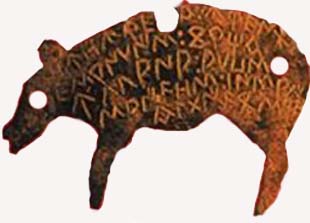
The solution to this problem came with tesserae hospitales, or hospitality tokens. Typically made of bronze, these tokens were a matched pair, sometimes with holes drilled through them, each one inscribed with the name, ancestry, and origins of one of the pair of guest-friends. By putting the two pieces together, one could verify that they matched. A person carrying such a token could present it for verification by comparison with its other half and thus prove that they had a right to claim hospitality in a particular house.

Here’s an example of one such token, made in Spain, probably in the second or first century BCE. This one is in the shape of a pig and has a few holes drilled through it. The text, written in the local Celtiberian language, gives the identity of the man who first carried it: “Lubos, of the Aliso family, son of Aualos, from Contrebia Belaisca.”

Tesseara hospitalis in the shape of a pig, photograph by Carlosblh via Wikimedia (found Uxama, currently Museo Numantino de Soria; 2nd-1st c. BCE; bronze)


Of course, few problems have perfect solutions. Hospitality tokens could, in theory, be lost, stolen, damaged, or copied, but as a way of verifying identity they worked well enough to be used for many centuries in the ancient Mediterranean. Numerous examples have turned up in the archaeological record, and some matching pairs have been found from contexts as widely separated as North Africa and northern Italy.

History for Writers looks at how history can be a fiction writer’s most useful tool. From worldbuilding to dialogue, history helps you write.

The Vivid Colors of the Dome of the Rock

We often picture history in muted terms, at least in the West. We think of the white marble statues of Greece and Rome, the gray stone of medieval castles, the dull brown cloth of historical costumes. It can be hard to remember how much color has been lost to age, weathering, even deliberate destruction. (A few useful examples here and here.) For an alternative view, it helps to look at examples that go far back in history but have been maintained and restored. One good example is the Dome of the Rock in Jerusalem.

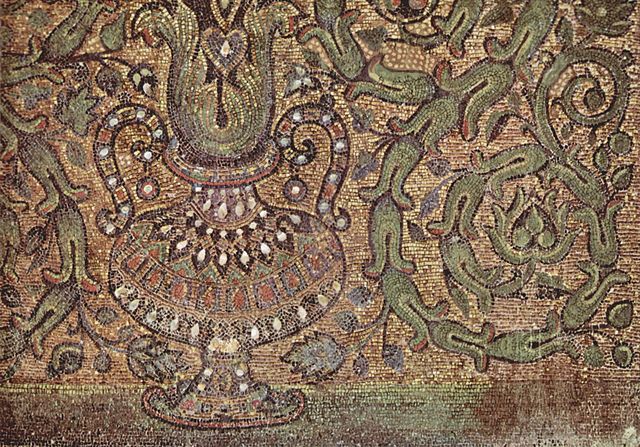
Originally completed in 692 CE, the shrine has continued to be an important Islamic site ever since. Its original design was colorful, and in the following centuries it was elaborated with tiles, mosaics, and metalwork. Several major restoration projects in the past several centuries have kept the colors vibrant. While individual details of the decor may not go back to the original construction, the overall effect gives us a sense of how richly colorful the built environment of the past could have been.

Tiled exterior wall of the Dome of the Rock, photograph by Godot13 via Wikimedia (Jerusalem; construction 692, tiles restored 1552; glazed tile; tiles by the workshop of Abdullah Tabrizi)


Interior mosaic, photograph by the Yorck Project via Wikimedia (Jerusalem; originally 692, later restored; glass, mother of pearl, and stone mosaic)


Dome interior, photograph by Virtutepetens via Wikimedia (Jerusalem; originally 692, later restored; metal and enamel)


The Dome of the Rock was a monument that was meant to make a statement. Other buildings of the time were not necessarily so dizzyingly colorful, but the shrine preserves a variety of visual culture we have very few other examples of. Even if nothing else exactly like it was ever built, many buildings once existed with just as bright an array of colors that are now long gone. When imagining what places in the past might have looked like, or when imagining new worlds inspired by them, remember that gray stone and white plaster are not the only options.

History for Writers looks at how history can be a fiction writer’s most useful tool. From worldbuilding to dialogue, history helps you write.

Sappho: Making a Life in Archaic Greece

The poet Sappho (c. 630 – c. 570 BCE) is among the earliest writers whose work comes down to us from ancient Greece. She is best known for her lyric poetry, much of it on themes of love and longing. (Read some of my translations of her work here and here, or hear a recreated musical performance of one of her poems here.) Her literary works were widely popular in Greece and Rome, and later authors wrote many things about her life, few of them reliable. Much of what we think we know about Sappho’s life is conjecture based on her poetry. Still, even amid this uncertainty, Sappho stands for us as a representative of one of the most important transformative forces in ancient Greek history: the rise of trade.

During the Early Iron Age, a period of Greek history extending from around 1200 to 750 BCE, the Greek world was largely isolated. People lived in small villages of at most a few thousand people. Most people got by at a subsistence level, producing enough for their own needs and engaging in trade outside their own households in only a limited way. Political power, such as it was, rested with an entrenched class of warrior-aristocrats who monopolized control of scarce farmland. This elite class occasionally traded their agricultural surplus overseas for modest amounts of foreign luxuries, but that trade had little impact on the Greek world, and to the extent that it did, it only reinforced the social status of an existing elite. The poetry of this elite is represented by the Homeric epics, the Iliad and the Odyssey, which celebrate martial values and the exploits of the warrior heroes that the aristocrats claimed as their ancestors.

Between 750 and 700, this stability was rapidly undermined by the development of new patterns of trade. Greeks began to venture out into the larger Mediterranean more often and more purposefully. The earliest accounts we have from the outside world describe the Greeks as pirates and raiders. Such dangerous ventures were not for the comfortably well off. The first Greeks to try their luck abroad were those who could not survive at home under the dominance of the entrenched aristocracy. Their risky raiding voyages had limited success, but the experience they gained in places like Egypt and the Levant prepared them for more profitable ventures as mercenaries and merchants. By the mid-600s, there was a growing class of successful merchants, artisans, and other professionals in Greece whose prosperity came from their connection to the outside world rather than control of land and who were increasingly agitating against the old aristocracy for a share of political power.

Sappho spoke for this new class of Greeks whose wealth came from abroad. Her brother Charaxus, whom she addresses in a few of her poems, was engaged in trading wine from their home on the island of Lesbos to Egypt. Sappho’s poetry invokes the importance of foreign contacts by using Lydia, a kingdom in Anatolia, as an image of beauty and luxury. Unlike the Homeric epics, Sappho’s lyrics speak of immediate, personal, emotional experiences. Individuals with their own desires and passions emerge as more important than family lines or warlike values.

Sappho’s poetry describes her intense romantic feelings for young women. Although we cannot know for sure to what extent these poems reflect Sappho’s personal experiences and how much is just literary invention, the idea that love mattered was, in its way, a radical thought. Among the landowning class, marriage was mostly a matter of family politics and economic negotiation. Ideally, of course, husbands and wives felt affectionately toward one another, but powerful, passionate love was not something to be sought out or valued. Homer’s heroes have little time for the emotional power of love: Helen is a prize to be fought over like any other piece of treasure, and the suitors who clamor for Penelope’s hand talk of their estates, not their feelings. In Sappho’s day, the Greeks who were making their living in trade could still be perfectly mercenary in their personal relationships, but the idea that love had power and that the feeling of longing for another person was worthy of attention was new and exciting. In much the same way that the shift from an agrarian economy to an industrial one in the nineteenth century CE brought with it a new interest in romantic love, Greeks in the seventh century BCE whose fortunes no longer depended on controlling land were beginning to think of individual feelings of love as something to value in a relationship.

Like the merchants and mercenaries who sought their fortunes amid the dangers of the unknown world outside Greece, the voices of Sappho’s poems dream that they might have what they long for, that their individual lives and struggles might matter.

Image: “Sappho embracing her lyre” via Wikimedia (Musee des Beaux-Arts de Brest; 19th c.; painting; by Jules-Elie de Launay)

History for Writers looks at how history can be a fiction writer’s most useful tool. From worldbuilding to dialogue, history helps you write.

A Note to Future Historians

I’ve just been going through my expenses for the past month, comparing receipts and my notes with my bank statements and that sort of thing. Among my other expenses are a number of cases where I have lumped together a few separate expenses in my notes, or I’ve added tips left in cash to the figures I record having paid with a card, or subtracted rebates, or other inconsistencies like that. The experience has made me think of all the furious academic debates that have been sparked because of small inconsistencies in our written sources, and I feel bad for any future historian who comes across my financial records and tries to make sense of them.

Future historians, if you’re reading this: I’m sorry. I know my spreadsheets are incomprehensible, but I wrote them for myself, not for you, and they make sense to me. Anyway, I’m sure you have more important and interesting sources to read for 2020, like Twitter and British tabloids.

Good luck!

History for Writers looks at how history can be a fiction writer’s most useful tool. From worldbuilding to dialogue, history helps you write.

Sigiriya

In the hills of central northern Sri Lanka are the remains of a palace built over a thousand years ago on top of an extraordinary natural rock formation. The place is known as Sigiriya. At the base of the rock, intricately organized gardens incorporating sophisticated irrigation and water retention structures stretch out along the hillsides. On top of the rock was originally a fortress, later converted into a Buddhist monastery.


A view of Sigiriya from a nearby hilltop, photograph by Azharkhanam via Wikimedia

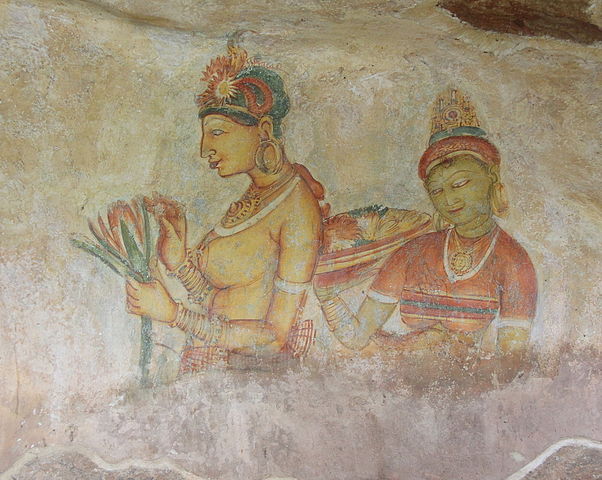
According to Sri Lankan literature, the site was built in the late 400s CE by the king Kashyapa. Sources describe colorful frescoes covering the sides of the rock and a great gate in the shape of a lion, both of which are now only to been seen in fragmentary form. After Kashyapa’s death, Sigiriya ceased to be a royal site and for the next thousand years was inhabited by monks and visited by pilgrims, many of whom left inscriptions on the frescoed faces of the rock. Today, it continues to attract many visitors, although writing on the walls is no longer allowed.

The remains of the lion gate at the base of the citadel, photograph by Cherubino via Wikimedia
Surviving fragments of fresco, photograph by Peter van der Sluijs via Wikimedia (Sigiriya; late 5th c. CE; fresco)

The next time you’re imagining where the royals of your world might live for a story, artwork, or game, think of Sigiriya and remember that a palace doesn’t have to look like Neuschwanstein or Versailles.

History for Writers looks at how history can be a fiction writer’s most useful tool. From worldbuilding to dialogue, history helps you write.

Six Kings

When Islam first stepped onto the world stage in the seventh century CE, it came as a surprise to the great powers of the day, the Byzantine (or Eastern Roman) Empire and the Sassanian Persian Empire. A powerful religious, political, and social movement sprang up from among the Arabs, the fragmented desert-dwelling peoples who had been pushed back and forth by the wars between Rome and Persia for centuries.

Muslims of the early Islamic period were aware that they were stepping into a world of powerful forces, and some examples of early Islamic art reflect the desire to stake a claim for Islam’s place in the world. For example, a wall painting from an early Islamic palace, in modern-day Jordan, shows how early caliphs positioned themselves in relation to the larger world.

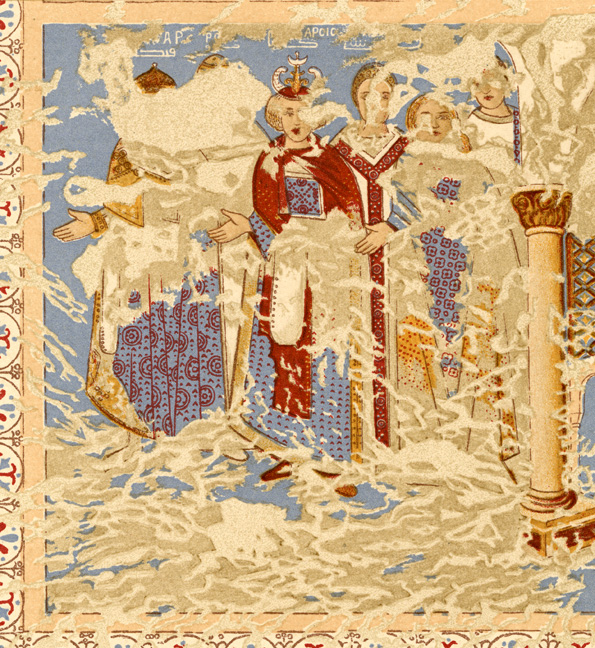
This painting, known as the “Six Kings” painting, is in very poor condition today, partly because of some European travelers who saw it in the early twentieth century and tried to chisel it off the wall and take it with them. (This is why we can’t have nice things.) Working from the painting in its current damaged state and an impressionistic copy made by those travelers, though, we can get a sense of what the original looked like.

Six Kings painting, photopgraph by Ghazi Bisheh via Wikimedia (Qasr Amra, Jordan; 710-740 CE; wall painting)
Copy of Six Kings painting via Wikimedia (1907; by Alois Musil)

Six royal figures stand together, all gesturing toward the caliph’s throne. The six figures were originally labeled in both Arabic and Greek. While not all of them can be identified now, we can tell that they include the Byzantine emperor, the Sassanian Persian emperor, the Visigothic king of Spain, and the king of Axum, a nation in what is today Ethiopia that was a powerful political and commercial state at the time.

This painting comes from the early 700s, a time when Islam was barely a century old but the caliphate had already become a major world power. By placing these figures on the wall, the caliphs were placing themselves among the great powers of the day, even positioning themselves as leaders of a world whose boundaries stretched from Spain to Persia and Constantinople to the horn of Africa. That was no small claim for such a young polity to make. The message was clear: Islam had arrived and was ready to be taken seriously as a world power.

Out There is an occasional feature highlighting intriguing art, spaces, places, phenomena, flora, and fauna.

History for Writers Compendium: 2019

History for Writers explores world history to offer ideas and observations of interest to those of us who are in the business of inventing new worlds, cultures, and histories of our own. Here’s where we’ve been in 2019:

Ethnicity and identity

Food

Warfare

Social structures

Spooky things

Fun with history

Join us in 2020 for more history from a SFF writer’s perspective.

History for Writers is a weekly feature which looks at how history can be a fiction writer’s most useful tool. From worldbuilding to dialogue, history helps you write.

Making a Mark

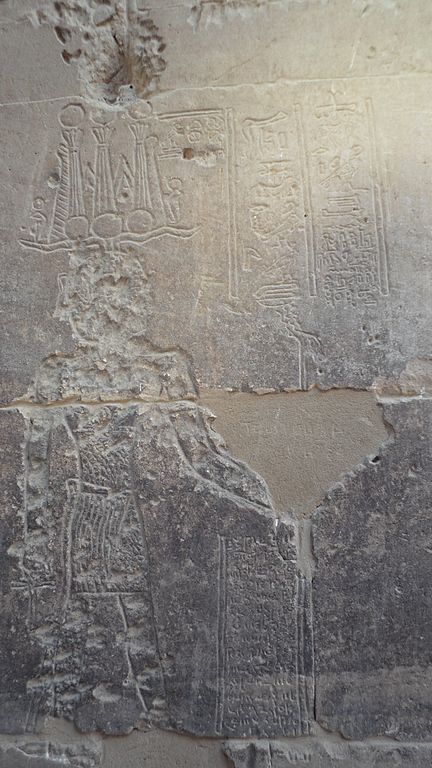
Some things never change. For instance, there will always be people who feel the need to leave their mark wherever they go. The graffiti in this image comes from the temple of Isis, originally located on the island of Philae in the Nile River in southern Egypt (since moved to the nearby island of Agilkia because of the damming of the Nile). The temple to Isis and other buildings were constructed at Philae by pharaohs in Egypt’s Late Period, between the eighth and fourth centuries BCE, and the Macedonian Ptolemaic kings who ruled Egypt between 323 and 30 BCE continued to build there. During this period, Philae marked the southern boundary of Egypt. Garrisons of soldiers were stationed there, and it was also a site of pilgrimage not just for Egyptians but for people from the larger Mediterranean world as well as from farther up the Nile in Africa. Under Roman rule, Philae continued to be an important religious site, and soldiers were stationed at a frontier post nearby.

Many people came to Philae for many reasons, and the temple is filled with inscriptions left by visitors. This one, for example, was carved in honor of the Nubian sun god Mandulis. A companion inscription dates the graffiti to 394 CE, which makes this the last known hieroglyphic inscription carved in ancient Egypt.

Inscription of Esmet-Akhom, photograph by A. Parrot via Wikimedia (Philae; 394 CE; inscription in stone; by Nesmeterakhem)

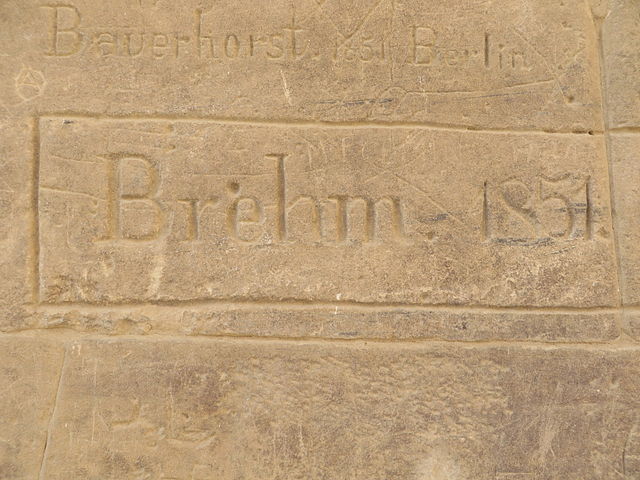
Later tourists got in on the action, too, like Bauerhorst and Brehm, two European visitors who left their marks in 1851.

Insciptions by Bauerhorst and Brehm, photograph by Michael Brehm2 via Wikimedia (Philae; 1851 CE; inscription in stone)

This one may look like it comes from the Roman period, but B. Mure is not a Roman name. It may have been left by Benoit Mure, a French homeopath who traveled in Egypt in the mid-1800s promoting homeopathy.

Inscription of B. Mure with addition, photograph by Ad Meskens via Wikimedia (Philae; c. 1850 CE; inscription in stone)

Another thing you can always count on is smartasses. After Mure left his mark at Philae, whenever that was, someone else came along and added a Latin inscription stultus est, “is an idiot” below his name.

History for Writers looks at how history can be a fiction writer’s most useful tool. From worldbuilding to dialogue, history helps you write.