A Fantastical Mancave Reno

Most often, nerdy and geeky home decor is the work of enthusiastic fans channeling their love of the genre into their spaces. Sometimes, though, you do see a mainstream professional hired for the work. One such is the case of a fantasy-loving family in Finland, who hired interior designer Minna Haapakoski to plan a reno of their bland basement mancave. And she pulled out all stops.

Entry to the space is now hidden behind a tall, ornate mirror. Visitors are greeted at the door by an armor-wearing figure. In addition, decorative arches were added to divide the space into two working / gaming spaces separated by a tv / lounge area with a large built-in seat.

Meidan talo Johanna Myllymaki Mancave1
Meidan talo Johanna Myllymaki Mancave2

Both open shelving and cabinets provide storage. Surface materials have been cleverly used to change the feel of the room. Wall paneling is made from reclaimed wood, and the faux tiles are made with plaster and painted. All the lighting is on dimmers, and sound-proofing was applied to the door as well as walls.

Meidan talo Johanna Myllymaki Mancave3
Meidan talo Johanna Myllymaki Mancave4

Now, the room looks fantastic, doesn’t it? (No pun intended!) It houses not just one but two desks plus the lounging area, which is great for versatility. The design elements all work towards creating a harmonious whole, the colors are nicely balanced, and details like faux bois plant pots add to the illusion.

Even so, I’d have a hard time picking useable ideas for a potential reno of my own. First of all, many of the surface materials would be out for me for health reasons, but to each their own. Secondly, the entry with the armored dummy is merely there for looks, which means it’s basically a wasted area. (Then again, if you have a home of 200+ square meters / 2,150 sq ft or so—I’m wildly guessing here—and money to burn…)

Furthermore, there’s a pragmatic issue with the floor plan that would drive me absolutely nuts. There doesn’t seem to be open floor between the two desks. Say what?!?

While I love spaces that indicate that some thought has gone into making them look nice, I absolutely, utterly, ardently must have function first. Especially if it’s my home, it has to work for me; having to battle hindrances every single day is simply unacceptable. If this mancave were in my home, having to clamber over (or through?) the built-in lounge to get to the far side would JUST. NOT. WORK.

I guess it just goes to highlight how unique individual wants and needs can be. This family loves their new mancave, and good for them. 🙂

There is one final thing that I’d kinda like to know. The dummy seems to be from the game Dark Souls II. (If you look carefully, you can see writing on the riser below his step.) Now, where does one buy a life-sized dummy from a ten-year-old gaming franchise, and how everloving much does it take in effort and cost to a) freight it in, AND b) install it into your basement mancave? That’s some serious fan action!

Images by Johanna Myllymäki via Meidän talo

Two Copies of the Same Library Book

Erik and I usually go to the library at the same time, but do our own things, sometimes with funny results: the other day we picked up the same book.

2023 09 Two Copies of the Same LIB Book

(Nettle and Bone by T. Kingfisher)

While there’s overlap in our interests, they’re not identical—I tend to prefer scifi, Erik fantasy, for example—and while we’ve read and liked many of the same novels, it’s never been quite this coordinated before. We didn’t even discover it until a few days later when one of us got through their current book and pulled out the next on Mt. To Be Read.

Reader, I LOLed! 😀

Quotes: The Roman Custom When Clearing a Stand of Trees

At least since Tolkien’s Ents smashed up Isengard, the idea of resurgent nature rebelling against those who would destroy it has been a theme in modern fantasy. The idea seems to be a product of modern industrialization and environmentalism. There is no comparable trope in the literature of the ancient Mediterranean, but the idea that humans exist in a relationship with nature that must be properly observed and maintained does find echoes there. The early Roman writer and politician Cato the Elder included this advice in his handbook on farming for those who wanted to cut down trees to clear land:

This is the Roman custom when clearing a stand of trees. With the sacrifice of a pig, use these words: “Whether you are a god or a goddess to whom this wood is sacred, since it is fitting for you to receive the sacrifice of a pig for the clearing of this wood, therefore for these reasons, whether I do it myself or someone does it at my command, let it be correctly done. Therefore with the burnt offering of this pig I pray the correct prayers, so that you may look kindly on me, my family, my household, and my children. For these reasons, therefore, may the burnt offering of this pig be worshipfully made.”

If you wish to plow the ground, make another sacrifice in the same way, adding the words: “for the purpose of doing this work.” As long as the work is ongoing, the same ritual must be done every day in some part of the land. If you miss a day, or if public or family celebrations interrupt the work, you must perform an additional sacrifice.


Cato the Elder, On Agriculture 139-40

(My own translation)

Cato does not elaborate on what might befall a farmer who failed to perform the correct ceremonies. Given what we know of Roman religion, it is more likely that bad luck or a poor harvest was the feared consequence, not angry spirits coming out of the woods to wreak havoc. Still, the idea that interfering with nature is something to be done carefully and with a good purpose is an ancient one.

Serving exactly what it sounds like, the Quotes feature excerpts other people’s thoughts.

Diana Wynne Jones: Howl’s Moving Castle

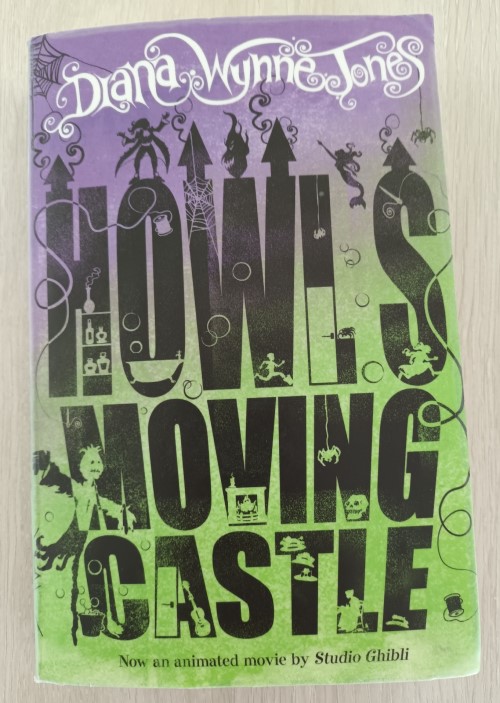
I’ve been looking for cozy, comfortable fantasy reads lately, and I’ve seen several recommendations of Diana Wynne Jones’s Howl’s Moving Castle. Until recently, I had known this name only for the Studio Ghibli animation (which I have never watched either), and I was surprised to discover that it was a novel first. I have read and enjoyed some of Jones’s short stories, so I was hopeful about picking up this novel. Alas, my hopes were soon dashed.

The story follows Sophie, a young hatter who is cursed by the Witch of the Waste to turn into an old woman and to be unable to tell anyone about the curse. Sophie goes in search of someone who can not only break the curse, but recognize that there is a curse to break without her having to tell them. She ends up in the small cottage of the wizard Howl, which is enchanted to look like a mobile castle on the outside. Howl seems to take no notice of Sophie, but his pet fire demon Calcifer recognizes the curse and agrees to help her if she will in turn help him break his contract with Howl, which, for magical reasons, he can’t talk about either. So Sophie settles in as a sort of freelance housekeeper to Howl and his apprentice Michael, while keeping her eyes open for anything she can learn about Howl and Calcifer’s contract.

So far so fairy tale. It’s a strong beginning with a promising cast of characters an interesting set of problems for them to unravel. And then nothing happens. Nothing continues to happen for two-hundred pages, until the last twenty pages when all the plot that didn’t happen in the rest of the novel suddenly comes crashing in like five trains trying to run on the same track at once.

It’s not that the characters don’t do anything for all that time—there are trips to the royal palace, covert visits to sisters, and a jaunt to modern Wales, but none of them make any sense or accomplish anything for the characters. Indeed, most of what the characters do is senseless. Over and over again the novel repeats that Sophie does or says something “without knowing why.” Jones, of course, knows why, and most of these nonsensical acts turn out to be coincidentally relevant in the finale, but far too much of what happens in the story happens because the author is setting up what she thinks is a clever ending, not because it makes sense given what motivates the characters and what they know or think they know at the time.

Indeed, it turns out in the end that Howl knew about Sophie’s curse all along. So did her sisters, not to mention the powerful magic-worker one of her sisters was studying under, and they were all trying to help break the curse. In fact, almost everyone Sophie encounters over the course of the novel knew about her curse and was trying to help her all along, but none of them ever bothered to tell her so. Why not? For no reason I can see other than that it would have broken the dramatic tension before Jones was ready.

Although the story mostly takes place in Howl’s small cottage, I found the atmosphere more stifling than cozy. Howl is an irresponsible jerk who makes everyone around him clean up his messes (both literal and figurative) while he moons over one lady or another. He is moody and mean, given to sulking when he doesn’t get his way, and never shows appreciation for how much work the people around him are doing to keep him afloat. Sophie falls in love with him at the end of the novel, as a fairy tale demands, but for no reason that I can fathom.

The only interesting thing I can point to in the novel is how it cleverly remixes themes and elements from The Wizard of Oz. There is a living scarecrow, a wicked witch in a castle, a humbug of a wizard from our world lost in a fantasy land, and a girl in search of a way back to her familiar life. She even eventually acquires a faithful dog and magical traveling footwear. For all these echoes of Oz, the story never feels like a pastiche or homage; it reimagines and recombines these elements to form an entirely different story. If only that story were any good, it would be an impressive narrative feat.

Howl’s Moving Castle left a bad enough taste in my mouth that I think I’ve been put off Jones for a good while. Maybe someday I’ll give her other works a try, but I need to cleanse my palate a bit first.

Image by Erik Jensen

ICBIHRTB – pronounced ICK-bert-bee – is short for ‘I Can’t Believe I Haven’t Read This Before’. It features book classics that have for some reason escaped our notice thus far.

Discovering Genderbent Ori Cosplays from The Hobbit

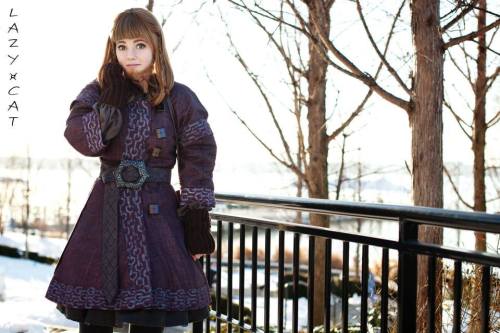
The other day I fell into the rabbit hole of cosplay from Peter Jackson’s Hobbit trilogy. I was sure there’d be a lot, but I was surprised of how much there actually is. And so much of it exquisite! The cutest ones by far are female versions of Ori, the youngest Dwarf in Jackson’s movies. I found three. Lizard Leigh both made and modeled this detailed outfit:

Tumblr frauleinninja Ori Cosplay1
Tumblr frauleinninja Ori Cosplay2

AmeZaRain’s version of Ori was a group effort:

DeviantArt AmeZaRain Ori Cosplay

This unknown cosplayer…

Alexander Turchanin Unknown Ori Cosplay

… even looks a little like Adam Brown from the movies!

Pinterest Chen Ori Portrait

I do love how she included Ori’s notebook and quill; a very nice detail that’s also beautifully included in the photo.

Here’s Ori’s base costume on display for comparison:

Pinterest Sofia Ferreira Oris Costume on Display

They all did a great job invoking the essence of the character, didn’t they?

Images: Lizard Leigh’s Ori by Karina as Lazy Cat via Leigh’s Tumblr (frauleinninja). AmeZaRain’s Ori by Elemental Sight via AmeZaRain’s DeviantArt account. Unknown Ori cosplay by Alexander Turchanin on 500px. Ori portrait found via Chen on Pinterest. Ori’s costume on display found via Sofia Ferreira on Pinterest.

In Making Stuff we share fun arts and crafts done by us and our fellow geeks and nerds.

Willow Trailers

Willow is joining the 1980s franchise reboots. The new incarnation bears the same name as the 1988 movie, but this time it’s going to be an 8-episode series. Here is the official teaser trailer:

Willow | Official Teaser Trailer | Disney+ by Lucasfilm on YouTube

And the official trailer:

Willow | Official Trailer | Disney+ by Lucasfilm on YouTube

At first is looks like the only returning characters are Warwick Davies’ Willow Ufgood and Joanne Whalley’s Sorsha. However, at least one of the two pixies—Rool and Franjean in the original—sounds awfully familiar. Their actors aren’t listed in IMDB, however, but the cast listing is very cursory overall at this writing, so who knows.

I am of the generation who grew up with Willow. In fact, we recently re-watched it for nostalgia’s sake. (Little did I know that there would be more soon!) It’ll be fascinating to see what they’re going to do effects-wise, since the old Willow was already a trailblazer: it was the first time we saw successful, computer-animated morphing on the big screen. (Some other effects looked clumsy now, but the morphing was spot-on.)

Anyway, it’s hard to say anything definite on the basis of the short teaser, except there’s great potential for learning to work together. I saw comments elsewhere to the effect of this series looking like a bargain-basement version of Shannara, or a copy of the new Wheel of Time series. The full teaser looks a lot better, however.

Still, not knowing two of the three listed writers (John Bickerstaff and Hannah Friedman; Jonathan Kasdan I only know from Solo and an episode of Freaks and Geeks) I just don’t know if this is worth investing my time in, 80s nostalgia or not.

Willow the series is scheduled to premiere on November 30, 2022.

Hey, look! We found a thing on the internet! We thought it was cool, and wanted to share it with you.

Quotes: Being Awesome While Female

Sam Hawke guest posted at Fantasy Book Cafe about tomboy protagonists for the blog’s annual Women in SF&F feature in 2019:

“There is a particular kind of character in SFF. You know her. She’s smart and tough, determined, decisive, and she can kick the collective arses of any takers. She comes in a few varieties—in better stories she’s an Alanna of Trebond or a Brienne of Tarth, with depth and history and more than one dimension; in weaker ones she’s an empty Strong Female Character™ who has no real contribution to the plot other than Being Awesome While Female—but either way it’s her prowess at fighting, particularly against men, that sets her apart. […]

“Instead, I wrote a woman, Kalina, with a chronic illness who couldn’t fight to save her life. Literally. I wrote a book in which the main characters’ problems couldn’t be solved by the strategic and entertaining use of violence even if they had the skills to deploy, and I did it purposefully. I did it in part in response to my own sewing test.

“Let me explain.

“The sewing test is failed when a book deploys a lazy code to tell me how much better, more interesting, more deserving, the female character is than those silly other women by making a point of having her hate sewing or embroidery or [insert other feminine-coded activity or trait of your choice—but you wouldn’t believe how often it’s sewing]. These days, if a book does this, I’m out. It’s not just lazy, it’s not just a cliché, it’s a statement by the author that I’m expected to cheer on one woman by disparaging the rest of them. […]

“Basically, there’s a nasty underbelly to over-reliance on this very limited model of ‘strength’, and it’s rooted in the same insidious patriarchal BS that gave us the old style women-as-objects-to-be-rescued stories: here are traits which are traditionally coded as masculine, which you have been taught are more valuable than traits which are coded as feminine. See how you should cheer on this woman because she’s different and better than those other women, who are weak and shallow and worthless. Reward her for those traits, and punish those who lack them.”

author Sam Hawke at Fantasy Book Cafe blog, 2019
Hawke City of Lies

Hawke is perfectly right, if you ask me. As awesome as ass-kicking women are, other ways of being awesome exist and should be recognized more widely. Because the variety of life skills to be excelled in is much, much wider than merely physical prowess, fighting skill, or attitude.

Moreover, as we all know, there are situations where the application of know-how or just the right tool will create such a better outcome than anything else that at best it’s not even fair to compare them. Why should genre literature forget these skills when women stand in the protagonists’ shoes?

I’m going to be adopting the phrase “being awesome while female” for all kinds of amazing things that women do. It’s just that awesome. 🙂

P.S. I just read City of Lies, Hawke’s book with the female protagonist who has a chronic illness. I thoroughly enjoyed her strategic and entertaining use of her brain—and ditto for the male protagonists, Kalina’s brother and his best friend.

Image by Eppu Jensen

Serving exactly what it sounds like, the Quotes feature excerpts other people’s thoughts.

Writing Prophecies

Prophecies are a staple of fantasy fiction, and for good reason: they are a convenient way of providing the heroes with information to get the plot moving while also imparting an aura of ominous mystique. How do you write a good prophecy for your story or game? Let’s start by looking at how prophecies worked in historical cultures.

Nearly every people in history has believed in some way of communicating with supernatural forces in order to gain special knowledge or insight, but the methods, purposes, and results of that communication could vary widely from culture to culture. By “prophecy” we usually mean something more particular: statements about specific future events which impart the necessary knowledge for the recipient to avert, influence, or at least cope with the effects of those events. Numerous cultures in history believed in some way of gaining these kinds of insights.

The problem that historical oracles faced, of course, was that predicting the future doesn’t actually work. The priestesses at Delphi or the authors of the Sibylline Books at Rome had no special insight into the future any more the authors of modern horoscopes and fortune cookies do. Nevertheless, many people believed in the power prophecy. The Histories by Herodotus, a work which makes frequent references to oracles, gives a useful view of the ways in which people coped with the unreliability of prophecy.

Reasonable guesswork. Prophets may not have special knowledge of the future, but they can make reasonable guesses about what is likely to happen, the same as anyone else. When the small Greek city of Miletus led a rebellion against the powerful Persian Empire, it didn’t take much special foreknowledge to predict that things were going to go badly for Miletus. The Delphic oracle produced this prophecy: “Miletus, you who scheme at evil deeds, will be a feast and splendid gifts for many. Your wives will wash the feet of long-haired men. Strangers will tend my shrine at Didyma.” (Herodotus, Histories 6.19, my own translations) This prophecy turned out to be true, but plenty of other Greeks claiming no connection to the gods also knew that things were going to go badly for Miletus, and so refused to join the revolt.

Vagueness. The standard dodge for prophets from Delphi to Nostradamus is to give an answer vague and cryptic enough that it will seem to suit whatever actually happens. The most famous example is perhaps the Delphic oracle’s response to the Lydian king Croesus, who asked whether he should invade Persia. The oracle replied that by doing so, Croesus would destroy a great empire, neglecting to mention which empire would be destroyed. As it happened, Croesus’ attack on Persia led to the Persian conquest of Lydia, but if things had gone the other way, the oracle would still have been right. (Herodotus 1.53)

Unspecificity. Some prophecies, like the one given to Croesus about his war with Persia, gave vague information about a specific event; others gave detailed information without specifying what event it related to. For example, a little-known Athenian seer named Lysistratus predicted that “The women of Colias will cook with oars,” which came true when wreckage from the naval battle of Salamis washed up on Cape Colias and was used as firewood by the locals. (Herodotus 8.96) This prophecy is unambiguous about what will happen, but says nothing about when or why. Colias was downstream of an important harbor and shipping channel; it was not hard to predict that wreckage from some significant event would wash up there and be salvaged sooner or later.

Selection bias. People tend to remember things that confirm their beliefs and forget things that don’t. People who believed in the power of oracles accordingly tended to remember prophecies that turned out to be true or could be interpreted to be true. Almost all the historical prophecies we have recorded were written down only after they had apparently come true. A number of recorded prophecies from the Delphic oracle begin with the word “But,” suggesting that some preceding part of the oracle has been left out, possibly because it turned out to be wrong or not relevant, such as in another Delphic reply to Croesus: “But when a mule becomes the king of the Medes, then flee, soft-footed Lydian, by the pebbly Hermus, and do not be ashamed to be a coward.” (Herodotus 1.55) This part of the prophecy was interpreted after the fact to refer to the Persian king Cyrus, whose ancestry was both Persian and Median, analogous to a mule, which is the progeny of a horse and a donkey.

Intrigue. Sometimes prophecies were manipulated in order to achieve the results some party wanted. It was an open secret that the priests at Delphi could be bribed to give particular answers. Other oracles and seers were no doubt similarly open to influence. The Alcmaeonid family of Athens were known to have bribed the Delphic priests to encourage the Spartans to help them against their rivals in Athens. (Herodotus 5.63) Another kind of manipulation is exemplified by Onomacritus, a collector of oracles who tried to encourage the Persian king Xerxes to invade Greece by sharing only those prophecies in his collection that seemed positive for him and hiding any that seemed negative. (Herodotus 7.6)

Now, as an author with full control over the world of your imagination, you don’t have to resort to any of these dodges. If you want your ancient prophecies to come true, then they will. The problem with prophecies in fiction, though, is they risk undermining the agency of the main characters. If prophecies predict the threat or its resolution too reliably or in too much detail, opportunities for drama are lost. If your work is for a game or some other setting where other people will have input to the plot, you can bet your dice that as soon as you hand them a prophecy they will try to exploit, invalidate, or weasel out of it in some way.

Uncertainty is a source of drama. When your audience already knows how everything is going to end, it’s harder to keep them interested in the story. Prophecies risk diminishing drama by introducing too much certainty. How do you keep the uncertainty in a story when there’s a prophecy involved? The techniques mentioned above are a good place to start because they serve the same function for a different reason: historical prophets had to keep uncertainty in their predictions because they didn’t actually know what was going to happen. You can use the same ideas in order to avoid tipping your hand too much to your audience or players.

Reasonable guesswork. If an in-story prophecy confirms something your heroes already suspect or adds useful detail to a picture that was already becoming clear, it can add impulse to the plot without dominating it. Conversely, a prophecy that doesn’t provide answers but spurs your heroes to ask important questions can be a good way to get things moving.

Vagueness and unspecificity. Both these techniques are good ways of keeping a prophecy from overwhelming the agency of your characters. If the prophecy refers to a specific event but doesn’t give clear details about it, or gives a clear prediction without specifying when, why, or how it will come about, there’s more room for your characters to work around it.

Selection bias. Lean in to the fact that prophecies can be wrong. If your characters (or their players) are aware that prophecies are unreliable or only seem true after the fact, their doubts about the truth or usefulness of the prophecy they’ve received can be a good source of drama.

Intrigue. There’s even more drama to be mined out of the fact that a prophecy might have been tampered with or invented, or that an authentic prophecy might have been delivered to your characters in such a way as to influence their understanding of it. Such puzzles open up interesting possibilities for side plots and interactions with antagonists.

As an author, the future is in your hands, a power that historical prophets never had. Still, you can learn from their examples how to make your prophecies sufficiently portentous without overwhelming your characters and plot.

History for Writers looks at how history can be a fiction writer’s most useful tool. From worldbuilding to dialogue, history helps you write.

Fantasy Religions: Divinity and the World

It’s been a while since I last wrote about ways of making religious elements of a secondary world feel more authentic, but here’s another thought worth considering when you’re writing: how people feel about the gods tends to reflect how they feel about the world.

Traditional religions tend to see the world differently and posit that divinity exists within the world, that the physical world around us and the social world we inhabit as humans is also inhabited by sacred forces. Interacting with the world means necessarily interacting with divine entities. Some modern religions preserve this view of the divine, notably Hinduism and Shinto. In traditions like these, divine forces are located within the world, whether they are gods associated with natural features such as mountaintops or rivers, or divinities connected to human relationships, such as blessed ancestors or household spirits.

For many of the major modern religions, by contrast, such as Buddhism, Christianity, Islam, and some versions of Judaism, the divine exists outside the world. The physical world we live in and the social world we inhabit as human beings is a barrier between ourselves and divinity, and the function of religion is to help us transcend that barrier. Attachments to worldly goods or to social relationships are seen as impediments that must be resisted or shed in order to achieve harmony with the divine.

This distinction is not an absolute one. Traditional religions can also understand divine forces as abstractions or seek ways of achieving a closer communion with the divine through asceticism, and modern religions can see sacredness connected to specific places and people. Still, one of the defining characteristics of any religious tradition is whether it encourages people to seek harmony with the divine by inhabiting the ordinary world in meaningful ways or by escaping from its distractions and temptations.

The point for writers is not that one or the other of these religious approaches is right or wrong for an imagined world, but that each one responds to the needs of societies under different circumstances. People are inclined to see the divine in the world around them when they feel at home in that world. Well-established cultures with a strong sense of identity and long history moored in place are likely to see the world itself as sacred. Shinto in Japan and Hinduism in India both arise out of this kind of long history. Religions that see the world as a barrier to be overcome tend to arise in times when people are unsettled and feel powerless within the world they live in. Buddhism, Christianity, and Islam all arose among peoples who lived with chaos, violence, and a lack of control over their own destinies, while Judaism has been deeply shaped by a history of diaspora and oppression.

What kind of religions exist in your invented worlds depend on what the people in them have experienced. If your characters feel connected to and safe within the world they inhabit, they are likely to perceive divine forces all around them; if their world feels dangerous and alien, they are likely to feel equally alienated from the divine.

Other entries in Fantasy Religions:

History for Writers looks at how history can be a fiction writer’s most useful tool. From worldbuilding to dialogue, history helps you write.

Worldbuilding in a Sentence

This fall I am finally teaching a course I have long dreamt of: History for Fantasy Writers. The course is built around the same ideas that I often blog about here, that studying history is a good way of exploring the possibilities of human societies and is our best resource when we want to imagine a world that is not like the one we live in.

As an early exercise to examine this idea, I asked my students to consider the following sentence: “The knight in shining armor rode his trusty steed toward the queen’s castle.” What can we tell about the world of this story just from this one sentence? They came up with some good answers:

  • The existence of knights and queens implies a stratified social structure. If we’re hearing about the people at the top, there must also be a lot of people at the bottom.
  • For instance, the knight must have dozens of people supporting them: someone to take care of the horse, someone to polish the shining armor, lots of people working the farms so they all have something to eat. The same and much more goes for the queen. Someone had to build that castle and keep it running. The lifestyle of a queen involves both politics and pageantry, for which she needs advisers and staff. All those people have to be clothed and fed.
  • Castles and knights in armor only make sense with certain kinds of warfare. In particular, this world must not have effective gunpowder weapons, which made both castles and mounted knights obsolete in our history.
  • If the queen lives in a castle, that means there must be a lot of fighting in this world. A castle is designed for defense, and it’s not a particularly convenient kind of place to live in peacetime. A queen wouldn’t be likely to live in one if she didn’t need to defend herself on a regular basis.
  • The fact that it’s the queen’s castle means that at least in some cases women in this world can wield power.
  • Castles and armor tell us something about the level of their technology. Building a castle takes a lot of quarrying, cutting, transport, and fitting of stones; armor requires mining and smelting ore to create metal, then working that metal into some complex shapes to make effective armor.

Of course, any of these observations could be undone in fiction. Maybe in this world horses magically take care of themselves. Maybe everyone is a knight or a queen and they’re all equal. Maybe the castle is carved out of a mountain of crystal, and the armor is made of enchanted tree bark. You can do that sort of thing in fantasy if you want to, but that’s where history helps you understand the “rules” so that you can break them in a way that is thoughtful and interesting.

I’m impressed by my students’ work so far and looking forward to more conversations like this one.

History for Writers looks at how history can be a fiction writer’s most useful tool. From worldbuilding to dialogue, history helps you write.