Right. The biggest thing staring at me are the colors. They are too muted, IMO—by now there’s plenty of evidence that the ancient world was awash with color. Some of it is explained by the weather in the trailer scenes, but there really should be more color. Even the glimpse of Penelope’s (Anne Hathaway) turquoise gown is left in the shadow of her head, making it appear darker.
(This is a tendency in some modern films I just can’t abide; wash-out tones like sepia have never appealed to me. History was colorful! And don’t get me started on the pervasiveness of black. Like slapping on unnecessary buckles and straps, pretensions of historicity while choosing black clothes for earlier periods has started to seriously irk me. Sure, if your film is about puritans, go for it. The antiquity? Black is certainly not as omnipresent as this!)
Otherwise, we see hints of several scenes from the epic. Perhaps too many; the whole feels jumbled, disorganized, and erratic. I am likely to want to see the movie, but unfortunately this trailer did nothing to encourage me to visit a theater to do so. Endless dark scenes of men in dark costumes glancing apprehensively around in dark surroundings, while I myself am sitting in a dark auditorium, holds no attraction for me. (For that much dark, we have Finnish winters, thank you very much.) I might as well wait for the disc and see it at home in greater comfort to offset all of that gloom.
The Odyssey will open on July 17, 2026.
Hey, look! We found a thing on the internet! We thought it was cool, and wanted to share it with you.
Today would’ve been the birthday of Leslie Fish, folk musician and filker. She passed away at the end of November 2025.
Decades ago when I first discovered filk, Fish was one of the names I started to soon recognize. Some of the songs I still remember include “Carmen Miranda’s Ghost”, “Signy Mallory” with Mercedes Lackey, “Space Hero” and “One Last Battle” with Vic Tyler (I believe), and “Wind’s Four Quarters” with Mercedes Lackey and Heather Alexander.
“Hope Eyrie” is the only one of hers I’ve sung in a crowd, the last time at a filk worshop at Ropecon 2024 or 2025 (or maybe both), which is an indication of her enduring influence.
RIP, Ms. Fish.
An occasional feature on music and sound-related notions.
Well, now. This is clearly an origin story. I’m hazy on how—and why—would little Adam be sent to Earth to hide and what, exactly, there is at Castle Grayskull to protect in this version of the story. Perhaps that’ll become clearer in future trailers.
The protagonist is played by Nicholas Galitzine, a complete unknown to me, but the supporting cast has some very big names like Morena Baccarin, Idris Elba, Jared Leto, James Purefoy, and Kristen Wiig, and smaller familiar ones like Alison Brie, Hafþór Júlíus Björnsson, and Jóhannes Haukur Jóhannesson.
Like Molly Templeton said at Reactor magazine, so far it “looks like the generic version of Thor: Ragnarok, as ordered from a questionable website.” Agreed! Also, some clips and effects look almost like they’re copy-pasted from other Marvel Cinematic Universe content.
I haven’t bothered to dig up the MCU cinematographers or visual effects companies for comparison, to see whether there is a real overlap or whether this could be a case of a visual language being increasingly adopted within the genre movie industry in general. (It could also be a blatant case of stylistic copying to try and lure in MCU fans, of course.)
But I do have to wonder, if visuals across big productions are starting to resemble each other to this extent, what does it forebode for future genre action movies? I’ve gotten quite tired of the stagnant action movie structure, to be honest. For a while the larger story arc across the separate MCU movies was interesting, since it had never been done before on that scale. (In fact, MCU reminds me of Babylon 5, the first to introduce really extensive story arcs for SFFnal tv shows.) But is there going to be anything interesting that’ll define action franchises anymore? Thematic differences like fast custom cars (vroom vroom!) or superpowered individuals or big monsters will remain, sure, but anything worth caring about? I guess I’m hankering after a paradigm shift in action movies, really.
Annnyway. 🙂
Travis Knight is directing a script by Chris Butler, Aaron Nee, Adam Nee, and Dave Callaham. Callaham at least I recognize from the 2014 Godzilla, Wonder Woman 1984, Shang-Chi and the Legend of the Ten Rings, and Spider-Man: Across the Spider-Verse.
The release date for the U.S. and U.K. for MotU is listed as June 05, 2026.
Hey, look! We found a thing on the internet! We thought it was cool, and wanted to share it with you.
When you’re designing a settlement for your player characters to visit, one thing you might want to include is local religious establishments like temples and shrines. In a world where divine beings actively grant powers to their followers, adventurers can visit these establishments looking for magical services, just like they might head to a tavern to listen for rumors or go to the local blacksmith to get their armor repaired. Here’s a homebrewed guide to temple services, suitable for Dungeons & Dragons 5th edition (2024), that you can use or adapt for your own games.
Temples in town
The first step is to determine what kind of holy places exist in the town you’re creating. Not all gods are worshiped everywhere, and not every settlement can support a large religious sector.
Holy places come in three sizes: shrine, temple, and grand temple.
A shrine is a small, humble place where the faithful can make offerings and present prayers to the gods that matter in their daily lives. A shrine typically does not have a full-time staff performing rituals, but one or two dedicated caretakers who make sure that it stays tidy and welcoming. Local people will know who to go to if some special services are needed. A shrine and its custodians can offer only services of rank 1.
A temple is a larger structure with a dedicated full-time staff of priests and acolytes. Regular religious rituals are carried out here, and there is usually someone on hand who can see to the needs of worshipers and visitors in between their duties to the god. A temple can offer services up to rank 2.
A grand temple is a community unto itself, containing a sanctuary for the god, treasuries for storing valuable offerings, and residences for a full-time staff of priests, along with the kitchens, workshops, storage sheds, and other mundane necessities for keeping the community going. A full hierarchy attends the grand temple, from the high priest and hierophants down to the acolytes learning their first prayers and the workers supplying the priests’ daily needs. Receiving visitors and attending to their religious needs is part of the routine work of the grand temple, and some of its staff are dedicated to doling out the god’s favors to adventurers and other folk in need. A grand temple offers all services.
Each religious institution in a town also serves one particular god and belongs to that god’s divine domain. This homebrew system includes options for gods in the domains of Death, Knowledge, Life, Light, Nature, Tempest, Trickery, and War, but you can use these examples as a basis for adding other domains as your setting requires.
When you are designing a settlement, it shouldn’t be too hard to decide what sort of holy places can be found there: a small village in the woods may not have much more than shrines for Life and Nature deities, while a huge port city probably has temples for every domain and a grand temple for a Tempest god.
If you want to randomly generate your settlement’s places of worship (either to save yourself a little thinking effort, or just because math rocks going clicky-clack is fun) here’s a couple of tables you can use.
First, roll 1d6 and adjust the roll depending on the size of the settlement, from -4 for a tiny village to +4 for a huge metropolis.
Adjusted roll
Religious institutions in town
-3
None
-2
1 shrine
-1
1 shrine
0
2 shrines
1
3 shrines
2
4 shrines
3
4 shrines, 1 temple
4
3 shrines, 2 temples
5
2 shrines, 3 temples
6
1 shrine, 4 temples
7
5 temples
8
5 temples, 1 grand temple
9
6 temples, 1 grand temple
10
6 temples, 2 grand temples
For each religious institution in your settlement, roll 1d8 to determine which domain it belongs to, rerolling any rolls that give the same result as one already rolled.
1d8
Domain
1
Death
2
Knowledge
3
Life
4
Light
5
Nature
6
Tempest
7
Trickery
8
War
Services available
The tables below list the services available in each domain, the rank of each service, and its cost. A description of all services is given after the tables.
The cost given in the tables below is for characters who wish to pay for services in cash, and includes the cost of any necessary material components, which the priest performing the service provides. As an alternative, some other means of payment are suggested in the next section.
Services are granted to the character requesting and paying for them, or to another creature or object that character designates. The recipient of a service knows what effect they are receiving, and a service fails if the recipient is unwilling to receive it. Only one service can be active on a given creature or object at a time, but one creature can carry multiple objects with different services active on them.
Services marked with an asterisk (*) are spells found in the Player’s Handbook or the System Reference Document 5.2.1. A brief description is given below for convenience, but see one of those sources for fuller information if needed. If a character receives one of these spells as a service, apply the following conditions:
The spell is cast at its lowest level.
The spellcaster’s ability is Wisdom, and their ability modifier is +4.
A spell provided as a service does not require concentration from either the priest providing it or the creature receiving it.
A spell cast as a service can only affect the creature who received the service or an object they carry, even if the spell normally allows its caster to choose another or multiple targets.
Any spell whose duration is either Instantaneous or 12 hours or longer takes effect exactly as listed in the spell description as soon as the service is provided.
Any spell that has a duration more than Instantaneous but less than 12 hours does not take effect immediately. The service instead creates an aura of magical potential around the receiving creature which lasts for 24 hours. At any time during that 24 hours, the creature may take a Magic action to activate the spell. The spell immediately becomes active and lasts for its full duration.
Death
The following services are available from a shrine, temple, or grand temple of a deity of Death.
Rank
Service
Cost
1
Detect Poison and Disease*
50 GP
1
Lesser Blessing of the Grave
5 GP
2
Gentle Repose*
50 GP
2
Grace of the Departed
125 GP
3
Raise Dead*
700 GP
3
Speak with Dead*
100 GP
Knowledge
The following services are available from a shrine, temple, or grand temple of a deity of Knowledge.
Rank
Service
Cost
1
Detect Magic*
50 GP
1
Detect Poison and Disease*
50 GP
1
Identify*
60 GP
1
Lesser Blessing of Sagacity
10 GP
2
Augury*
80 GP
2
Grace of the Wise
50 GP
3
Sending*
100 GP
3
Speak with Dead*
200 GP
3
Tongues*
200 GP
Life
The following services are available from a shrine, temple, or grand temple of a deity of Life.
Rank
Service
Cost
1
Bless*
25 GP
1
Cure Wounds*
1 GP
1
Lesser Blessing of Healing
5 GP
2
Grace of the Protector
50 GP
2
Lesser Restoration*
75 GP
2
Protection from Poison*
125 GP
3
Protection from Energy*
200 GP
3
Raise Dead*
700 GP
3
Remove Curse*
100 GP
Light
The following services are available from a shrine, temple, or grand temple of a deity of Light.
Rank
Service
Cost
1
Bless*
25 GP
1
Cure Wounds*
1 GP
1
Lesser Blessing of Flame
5 GP
1
Shield of Faith*
50 GP
2
Augury*
80 GP
2
Grace of the Illuminated
50 GP
2
Magic Weapon*
125 GP
3
Dispel Magic*
100 GP
Nature
The following services are available from a shrine, temple, or grand temple of a deity of Nature.
Rank
Service
Cost
1
Cure Wounds*
1 GP
1
Detect Poison and Disease*
50 GP
1
Goodberry*
25 GP
1
Lesser Blessing of the Serpent
5 GP
1
Longstrider*
50 GP
2
Gentle Repose*
50 GP
2
Grace of the Wild
50 GP
2
Protection from Poison*
125 GP
3
Water Breathing*
100 GP
Tempest
The following services are available from a shrine, temple, or grand temple of a deity of Tempest.
Rank
Service
Cost
1
Cure Wounds*
1 GP
1
Lesser Blessing of the Storm
5 GP
1
Longstrider*
50 GP
2
Grace of the Winds
25 GP
2
Magic Weapon*
125 GP
3
Water Breathing*
100 GP
Trickery
The following services are available from a shrine, temple, or grand temple of a deity of Trickery.
Rank
Service
Cost
1
Detect Poison and Disease*
50 GP
1
Lesser Blessing of Cunning
10 GP
1
Protection from Evil and Good*
75 GP
2
Grace of the Dissembler
50 GP
2
Lesser Restoration*
75 GP
3
Dispel Magic*
100 GP
3
Remove Curse*
100 GP
3
Tongues*
200 GP
War
The following services are available from a shrine, temple, or grand temple of a deity of War.
Rank
Service
Cost
1
Bless*
25 GP
1
Cure Wounds*
1 GP
1
Lesser Blessing of Wrath
5 GP
1
Shield of Faith*
50 GP
2
Grace of the Marauder
100 GP
2
Magic Weapon*
125 GP
3
Protection from Energy*
200 GP
Descriptions of Services
The ranks of services and the domains which can offer them are given in parentheses after the name for reference. Services marked with an asterisk (*) are spells found in the Player’s Handbook or the System Reference Document 5.2.1. A brief description is given below for convenience, but see one of those sources for fuller information if needed.
Augury* (2 – Knowledge, Light)
School: Divination
Duration: Instantaneous
Consult a divine force about a specific course of action and receive a positive or negative omen.
Bless* (1 – Life, Light, War)
School: Enchantment
Duration: 1 minute
Add 1d4 whenever you make an attack or save roll. (Note: when received as a service, this spell targets only the creature that received the service.)
Detect Poison and Disease* (1 – Death, Knowledge, Nature, Trickery)
School: Divination
Duration: 10 minutes
Become aware of any source of poison or disease within 30 feet.
Dispel Magic* (3 – Light, Trickery)
School: Abjuration
Duration: Instantaneous
Ends one magical effect of level 3 or lower.
Gentle Repose* (2 – Death, Nature)
School: Necromancy
Duration: 10 days
A recently deceased creature is protected from decay and becoming Undead.
Goodberry* (1 – Nature)
School: Conjuration
Duration: 24 hours
Create 10 berries, each of which heals 1 Hit Point and provides nourishment for one day.
Grace of the Departed (2 – Death)
School: Necromancy
Duration: 24 hours
Whenever a spell you cast causes a creature to make a Constitution saving throw, it does so at Disadvantage.
Grace of the Dissembler (2 – Trickery)
School: Enchantment
Duration: 24 hours
You have Advantage on Charisma (Deception) and Dexterity (Stealth) checks.
Grace of the Illuminated (2 – Light)
School: Evocation
Duration: 24 hours
You may use a Magic action to cast the spell Light, requiring no material components. You may cast this spell any number of times while this service lasts. When you cast Light using this service, Wisdom is your spellcasting attribute, and if your Wisdom modifier is less than +4, it is considered +4 for purposes of this spell.
Grace of the Marauder (2 – War)
School: Transmutation
Duration: 24 hours
You gain a +1 bonus to your attack rolls and AC.
Grace of the Protector (2 – Life)
School: Abjuration
Duration: 24 hours
Whenever you roll dice to restore Hit Points to any creature, that creature also receives Temporary Hit Points equal to the highest number on any one of the dice you rolled.
Grace of the Wild (2 – Nature)
School: Enchantment
Duration: 24 hours
You have Advantage on Intelligence (Nature) and Wisdom (Survival) checks.
Grace of the Winds (2 – Tempest)
School: Evocation
Duration: 24 hours
Once per turn, when you deal damage to another creature, you may move your target up to 10 feet away from you or move yourself up to 10 feet away from your target. (This movement does not provoke opportunity attacks.)
Grace of the Wise (2 – Knowledge)
School: Enchantment
Duration: 24 hours
You have advantage on Intelligence (Arcana) and Intelligence (History) checks.
Identify* (1 – Knowledge)
School: Divination
Duration: Instantaneous
Learn the properties of one magical object.
Lesser Blessing of Flame (1 – Light)
School: Transmutation
Duration: 24 hours
An enchantment is placed on one weapon of your choice. That weapon deals either Fire or Radiant damage in addition to any other types of damage it deals (you choose the type of damage when receiving the service).
Lesser Blessing of Cunning (1 – Trickery)
School: Enchantment
Duration: 24 hours
Choose 1 skill based on Dexterity or Charisma. An enchantment is placed on an item you carry. Any creature carrying that item gains a bonus equal to their proficiency bonus to d20 checks made with that skill.
Lesser Blessing of Healing (1 – Life)
School: Transmutation
Duration: 24 hours
An enchantment is placed on an item you carry. Whenever a creature carrying that item casts a spell with a spell slot that restores Hit Points to any creature, that spell restores a number of additional Hit Points equal to the caster’s proficiency bonus.
Lesser Blessing of Sagacity (1 – Knowledge)
School: Enchantment
Duration: 24 hours
Choose 1 skill based on Intelligence or Wisdom. An enchantment is placed on an item you carry. Any creature carrying that item gains a bonus equal to their proficiency bonus to d20 checks made with that skill.
Lesser Blessing of the Grave (1 – Death)
School: Transmutation
Duration: 24 hours
An enchantment is placed on one weapon of your choice. That weapon deals either Necrotic or Psychic damage in addition to any other types of damage it deals (you choose the type of damage when receiving the service).
Lesser Blessing of the Serpent (1 – Nature)
School: Transmutation
Duration: 24 hours
An enchantment is placed on one weapon of your choice. That weapon deals either Acid or Poison damage in addition to any other types of damage it deals (you choose the type of damage when receiving the service).
Lesser Blessing of the Storm (1 – Tempest)
School: Transmutation
Duration: 24 hours
An enchantment is placed on one weapon of your choice. That weapon deals either Lightning or Thunder damage in addition to any other types of damage it deals (you choose the type of damage when receiving the service).
Lesser Blessing of Wrath (1 – War)
School: Transmutation
Duration: 24 hours
An enchantment is placed on one weapon of your choice. That weapon deals either Force or Radiant damage in addition to any other types of damage it deals (you choose the type of damage when receiving the service).
Lesser Restoration* (2 – Life, Trickery)
School: Abjuration
Duration: Instantaneous
Remove Blinded, Deafened, Paralyzed, or Poisoned conditions.
Longstrider* (1 – Nature, Tempest)
School: Transmutation
Duration: 1 hour
Your Speed increases by 10 feet.
Magic Weapon* (2 – Light, Tempest, War)
School: Transmutation
Duration: 1 hour
A weapon you touch becomes a magic weapon with +1 to attack and damage rolls.
Protection from Energy* (3 – Life, War)
School: Abjuration
Duration: 1 hour
Gain Resistance to one damage type: Acid, Cold, Fire, Lightning, or Thunder.
Protection from Evil and Good* (1 – Trickery)
School: Abjuration
Duration: 10 minutes
You are protected against Aberrations, Celestials, Elementals, Fey, Fiends, and Undead. ( Note: when received as a service, this spell targets only the creature that received the service.)
Protection from Poison* (2 – Life, Nature)
School: Abjuration
Duration: 1 hour
Gain Resistance to Poison damage and Advantage on saving throws against the Poisoned condition. ( Note: when received as a service, this spell targets only the creature that received the service.)
Raise Dead* (3 – Death, Life)
School: Necromancy
Duration: Instantaneous
Revive a creature that has been dead less than 10 days.
Remove Curse* (3 – Life, Trickery)
School: Abjuration
Duration: Instantaneous
Remove all curses affecting an object or creature.
Sending* (3 – Knowledge)
School: Divination
Duration: Instantaneous
Send a message of 25 words or less to another creature.
Shield of Faith* (1 – Light, War)
School: Abjuration
Duration: 10 minutes
Gain +2 AC. (Note: when received as a service, this spell targets only the creature that received the service.)
Speak with Dead* (3 – Death, Knowledge)
School: Necromancy
Duration: 10 minutes
Ask 5 questions of a corpse.
Tongues* (3 – Knowledge, Trickery)
School: Divination
Duration: 1 hour
Understand any spoken or signed language. ( Note: when received as a service, this spell targets only the creature that received the service.)
Water Breathing* (3 – Nature, Tempest)
School: Transmutation
Duration: 24 hours
Gain the ability to breathe under water. (Note: when received as a service, this spell targets only the creature that received the service.)
Alternative payment
Instead of a donation in coin, you might offer your player characters a chance to pay for their services with services of their own. This can be a good option for a cash-strapped party, and can also provide opportunities for side quests or for downtime activities to let your players practice some of their lesser-used skills. Here are some suggestions to consider:
Rank 1 services
Entertain the children at the local orphanage for an afternoon (Life, Trickery)
Fix a leaky roof, patch gaps in the walls, replace some broken floor tiles, or perform other simple maintenance in the temple (Nature, Tempest)
Gather firewood for the temple from nearby woods (Light, Nature)
Gather wild plants to restock the temple’s store of spell reagents (Knowledge, Life, Nature, Tempest)
Participate in a solemn funeral procession for a recently deceased local hero (Death, Light)
Play a small, harmless prank on the priests of a rival temple (Trickery)
Recount tales of your party’s adventures to be recorded for posterity (Knowledge, Light, Trickery, War)
Spar with some paladin trainees (Light, War)
Tidy up the local graveyard (Death, Nature)
Rank 2 services
Clean out a local village’s irrigation channels (Life, Tempest)
Convince some mischievous wood sprites to move out of a sacred grove (Light, Nature, Trickery)
Deliver needed medicines and potions to an outlying village (Life, Nature)
Fight a demonstration duel against a band of chosen champions for paladin initiates to observe and learn from (Light, War)
Find a ghost that has been haunting a local crypt and find out what it needs to be able to move on into the afterlife (Death, Knowledge, Light)
Fish, hunt, and gather foods from the local wilderness for a communal feast (Life, Nature, Tempest)
Join in the funeral games for a fallen local hero and win at least one victory in the god’s name (Death, Life, War)
Spy on a local criminal syndicate to find out where their meeting spot is so the authorities can deal with them (Knowledge, Light, Trickery)
Rank 3 services
Compose and stage a play about the party’s adventures for the entertainment and education of local townsfolk (Knowledge, Life, War)
Hunt a wild beast that has been terrorizing villages the hinterlands (Light, Nature, Tempest)
Investigate the local noble houses to determine which of them has been skimming off the temple tithes (Knowledge, Light, Trickery)
Keep an overnight vigil in a local graveyard on a night when minor evil spirits are known to wander. Keep the spirits distracted to stop them from causing trouble. (Death, Trickery)
Recover a lost relic last known to have been in the possession of a fallen hero, who may have since become undead (Death, Light, War)
Seek out and defeat a minor local bandit or other troublemaker (Life, War)
Spend a stormy night standing watch at a dangerous headland and rescue the survivors from ships that founder in the waves (Life, Light, Tempest)
Track a noble beast that was gravely wounded but not killed in an upstart noble’s botched hunt and put the creature out of its pain (Death, Nature)
Oh, I had not come across this—a new Robin Hood adaptation is coming to the big screen. It involves an old, wounded Robin, and they’ve scored quite a big name for the titular role: Hugh Jackman.
Here’s a trailer:
The Death of Robin Hood | Official Trailer HD | A24 by A24 on YouTube
There are some impressive locations and cinematic beauty, like when the little girl (who sounds like one of the protagonists) and Robin meet in the woods and he promises to make her a bow. Sadly, though, I find the trailer a bit too vague; too many flashbacks to Robin’s past, perhaps? Also, some of the scenes are too dark to see. While that’s a benefit for me when really graphic violence is depicted, I can’t say I really care for either. (I wish the movie business would get out of the if-it’s-fantasy-it-must-be-explicitly-violent-because-Game-of-Thrones-was-and-that-did-great rut already!)
It seems that Jackman is the only name I know from the cast. Even the writer-director Michael Sarnoski is completely unknown to me, so I can’t even guess at the style of story this might be. I do like what I see of the adult and young female protagonists, though (played by Jodie Comer and Faith Delaney, it looks like).
While there is something to be said for a tale where a man and a girl form a meaningful connection, this doesn’t look like a movie for me. (Like I implied in my post about the 2025 Red Sonja reboot, there is no longer a need to see absolutely everything SFFnal if you want to see anything, since the selection has grown so much.) We’ll see if that changes with further trailers.
According to IMDB, The Death of Robin Hood has only two release dates at this writing: one for Mexico on May 28, 2026, and merely 2026 for United States.
Hey, look! We found a thing on the internet! We thought it was cool, and wanted to share it with you.
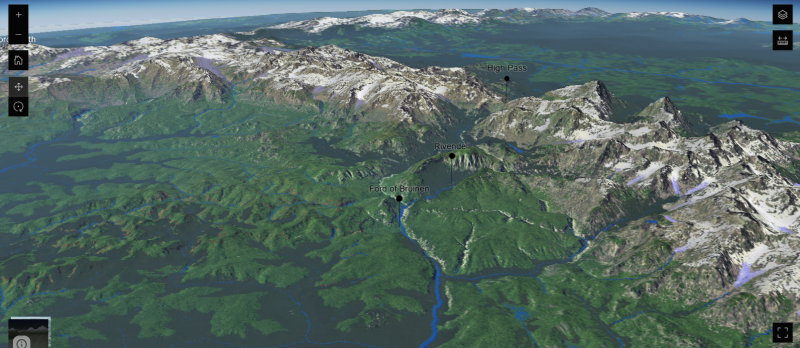
The level of detail is incredible. There are both 2D and 3D versions of the map that you can zoom in on and fly around like a modern digital map. Here’s a view of Rivendell and the nearby Misty Mountains from the 3D version.
The Middle-Earth Map is a project Micah Vander Lugt, a geographic information sciences analyst. It’s great to see people put their professional skills to work on hobbies that they’re passionate about!
Hey, look! We found a thing on the internet! We thought it was cool, and wanted to share it with you.
Jimtheviking on Tumblr wrote about how the Dwarven names in J.R.R. Tolkien’s The Hobbit connect with Old Norse, especially Dwarf names listed in the poem Völuspá.
According to Jimtheviking, Tolkien chose a number of names from Old Norse and tweaked those names in an interesting way. Namely, Tolkien grasped Old Norse grammar well enough to know that the omission of one n from a name ending in –inn changed it from masculine to feminine. To quote Jimtheviking:
“Well, I give you the names of the Dwarves from the Hobbit, as they appear in Dvergatal (stanzas 14-16) and in the order they appear:
“Now, you notice something with the way those names got changed? That’s right, he changed the masculine -inn definite suffix to -in, which is feminine.
“That means that, at least grammatically, Dwalin, Dáin, Thorin, Thráin, and Glóin are female Dwarves.”
Then, moving on from purely linguistic, Jimtheviking continues with an intriguing argument:
“Since we know Tolkien was meticulous about his grammar, this was done most likely as an in-joke […] [emphasis original]
“But there’s a not-inconceivable chance that the Dwarves were using the masculine pronouns in Westron because that’s what the Men who met them used, despite the fact that a third of the company was female, and hey, it’s kinda neat to think he wrote a bunch of Dwarf-ladies going on an adventure.”
It is really interesting, isn’t it, to posit male and female Dwarves in Tolkien’s adventures?!
Poking around, I found versions of Völuspá that differ from the Dwarf list as given by Jimtheviking*. Not just the list itself, but also spellings differ depending on the edition you’re using (which isn’t rare at all in philology). Nevertheless, the main point stands: Tolkien changed names that had –inn in the original to just –in in English.
Of all Tolkien’s Dwarf names, he seems to have adopted Durin, Dwalin, Náin, Dáin, Bifur, Bofur, Bombur, Nori, Óin, Thorin, Thrór, Thráin, Fíli, Kíli, Fundin, Náli, Oakenshield (Eikinskjaldi, cf. Icelandic ‘oak shield’), Glóin, Dori, and Ori from the Völuspá.
Of them, Durinn, Dvalinn, Náinn, Dáinn, Óinn, Þorinn, Þráinn, Fundinn, and Glóinn are all originally spelled with a double n. (In addition, there’s a change from a double r to a single one in Bívurr / Bívǫrr, Bávurr / Bávǫrr, and Bömburr / Bǫmburr, which Jimtheviking does also comment on.)
Anyway, the whole thing kinda reminds me of the first time I read The Lord of the Rings, decades ago now. I was young enough that it was in translation, which means the young me ploughing through LotR was quite confused over the gender of some characters. The Finnish language doesn’t have grammatical gender, you see. Instead of he or she, we just have one third-person singular pronoun, hän, which is used of all people regardless of sex, gender, age, kinship, marital status, whatever, just like the English third-person plural they is. Normatively, in Finnish everyone is a hän.
Even at that young age, I knew that (apart from Astrid Lindgren) most of the publications, including those for the younger audience, centered boys and male characters. Contextually, I could tell that Frodo and Sam were male. Same for Legolas and Gimli, Aragorn and Boromir, and Gandalf and Elrond. Arwen, Galadriel, and Eowyn were female.
But Glorfindel? Maybe male, I thought, but there is nothing explicit at all in the Finnish translation. And Merri and Pippin? Somehow at that time I couldn’t make them out at all; indeed, they’re the two characters whose gender confused the young me the most.
Having grown up reading the Moomins, Pippi Longstocking, Ronia the Robber’s Daughter, The Famous Five series, and The Dark Is Rising sequence, I saw nothing odd in girls and women also going on adventures. So I thought it was quite plausible that Merri and Pippin could be female, and was too young to read all of the textual cues that imply they aren’t. (Remember that in Finnish the gender-neutral pronoun hän gives absolutely no clue whatsoever about anyone’s gender.)
The possibility of a linguistic in-joke regarding these Dwarven names really tickles the imagination and would be completely plausible of Tolkien. Interestingly, the name Gandalf also originally comes from the Dvergatal (see e.g. stanza 12 in Pettit’s 2023 edition, which lists the name as Gandálfr). A Dwarven Gandalf would, indeed, give quite a different vibe to LotR.
And now I kinda want new movies of The Hobbit, with the amazing attention to detail that Weta lavished on the effects and props in Peter Jackson’s versions, but with more heedful writing and with half the Dwarves in the party female. That would be a truly intriguing take!
I’ve long been aware of Anne McCaffrey’s Pern books, if only on a superficial level—fantasy, dragons, getting a bit old but supposed to be good; that sort of an idea. While on the lookout for more cozy fiction in our local library, I randomly ran into Dragonflight, the first Pern novel, and decided to finally give it a go.
And before I get into my review: Spoiler warnings in effect! Also, a heads-up on one f-bomb.
It was interesting. No, truly—not the “interesting” interesting, the faux compliment or empty-nothings-version of polite interesting. Really, truly interesting. And it does feel somewhat old. (Published in 1968, so not as old as The Lord of the Rings, to put it into my own SFFnal context).
Humans settled the third planet in the Rukbat solar system and called it Pern. Contact with Earth was broken, however: after two generations, Rukbat’s stray planet (which follows a wildly erratic orbit) came close enough that deadly spores crossed over to Pern and dropped from the sky with devastating losses, not just among the settlers but native Pernese life as well—only solid rock and metal proved impervious.
To burn these devastating silvery threads from the air before they had a chance to land, men and women with high empathy and rudimentary telepathic ability were trained to work with “dragons” bred from indigenous life forms that resembled their mythical Terran namesakes. The process took generations, and a complex, stratified society with tithing responsibility was created to feed and equip the dragonriders while they focused on defence and training in their unfertile mountaintop abodes known as Weyrs.
Each time the stray planet—also known as the Red Star—passes close enough, the Threads fall for a period of 50 years. Then the wanderer swings far enough away and at least another 200 years (sometimes 400 due to the erratic orbit) go by in peace, which is long enough for the rest of the populace to forget and start resenting the tithes and scorning the dragonmen until the next 50-year Pass comes along.
The two main characters are Lessa of Ruatha Hold and dragonrider F’lar of Benden Weyr. We first encounter Lessa as a ragged kitchen girl who survived by serving those who betrayed her family and took over their lands. F’lar offers her a chance to impress a golden dragon, a future queen dragon, with whom she will share a telepathic bond, and to become a Weyrwoman, a co-leader of a Weyr, possibly with F’lar himself.
Over the couple of years it takes for her queen Ramoth to mature, Lessa learns more about the civilization on Pern, the ballads, the teachings, and what it means to be Weyrwoman. The major problem Benden Weyr faces is that another Pass is impending, but there are not enough dragons to protect all of Pern, for currently only one Weyr out of six remains populated; why dragonriders in the others disappeared hundreds of years ago is not known.
The setting falls into fantasy despite the science-fictional premise, but some details deviate from “pure” medieval-European-based fantasy. For instance, the dragons are able to breathe fire after chewing (fueling up on) a native rock called firestone; dragonriders use this ability to destroy as many Threads as possible while they are still falling. Dragons can also travel instantly from one place to another, or one time to another. Furthermore, all dragons are able to converse telepathically and willing to pass on messages from human to human. Finally, crafters (which I wish were talked about more) end up re-inventing flamethrowers to destroy spores that made it to ground.
The structure differs quite a bit from the typical structure of current fantasy novels. The book is divided into four sections that at times felt like they would’ve worked better as individual short stories. Apparently Dragonflight is actually two novellas squished together to make a novel, so that probably explains this tangle.
There were also confusing things. For example, some events span many Turns (the Pernese year) in a very short span of pages and this isn’t very clearly remarked upon. Somewhat annoying was the s’elling of d’agonrider n’mes w’th an a’ostrophe. There is a story-internal reason, but it’s only vaguely referred to.
Moreover, it was frustrating to me that Lessa kept leaping to conclusions and acting without thought; I would’ve liked to see more character development. The description of the society also remains rather narrow, since the POV characters are almost solely Lessa and F’lar. This feels to me like a deliberate choice by the author, not a flaw due to lack of skill, but your mileage may vary.
Some of the more disgusting details include F’lar’s tendency to call Lessa merely “the girl” and to grab and shake her, and yet he cannot fathom why she at times resents him. Hello, dude, could there possibly be a reason…?!? This might be a character development choice, but it never paid off, IMO. Also, during Ramoth’s first mating flight (with Flair’s dragon Mnementh), Lessa was pressured to stay in telepathic contact with her dragon to take advantage of the surge of sexual desire and to essentially manipulate a pairing of Lessa and F’lar, like their dragons.
Browsing reviews, it’s pretty clear that Dragonflight (and likely the rest of the Pern series) has a particular audience that cares deeply for McCaffrey’s approach and worldbuilding; the rest don’t. I can see why many people liked it, and I can also see why many people disliked it.
I saw one reviewer complain that the main problem was solved “easy peasy because of time travel”. I’d say that’s missing the point; to me the focus isn’t how the lack of dragonriders was solved. Instead, the author concentrates on the attempts to get there. How to find the right people and put them in places where they can be most effective. Convincing others, the necessary political maneuverings, discussing possible strategies, etc., to try and wrangle out a solution to a deadly dilemma given these particular constraints. A kind of council of Elrond, if you like, but as a novel.
I found Dragonflight engaging enough that I started reading the sequel, Dragonquest. However, I soon found I didn’t have the motivation to continue the same kind of people-wrangling, when a lot of the interpersonal relations were antagonistic (I do like my stories with a heaping of Learning to Work Together), and especially because F’lar still fucking cannot stop shaking Lessa. I’ll be better off spending my reading time elsewhere, now that the novelty has worn off.
Image by Eppu Jensen
ICBIHRTB—pronounced ICK-bert-bee—is short for ‘I Can’t Believe I Haven’t Read This Before’. It features book classics that have for some reason escaped our notice thus far.
The Greek historian Herodotus provides some interesting information about a people living in the mountains beyond the eastern steppes whom he calls the Argippaioi:
They are said to be bald from birth, men and women alike, and they have flat noses and large chins. They speak their own language, but wear Scythian clothes, and depend on trees for their food. The tree they live off of is called “pontic.” It is about as big as a fig tree and bears stone fruits the size of beans. When the fruit is ripe, they strain it through cloth, and it yields a thick black juice, which they call “askhy.” They lick this juice up or mix it with milk and drink it; they make cakes out of the thickest of the leavings and eat them. They do not keep large flocks, for their pastures are not suited to it. Each of them lives under a tree, which they cover with white wool felt in the winter, but not in the summer. No person harms them, for they are said to be sacred, and they carry no weapons. Their neighbors refer conflicts to them for judgment, and anyone who flees to them for refuge is safe from harm. They are called Argippaioi.
– Herodotus, Histories 4.23 (my translation)
This is an interesting passage both from a historical perspective and as storytelling inspiration.
Historically speaking, many of the details Herodotus presents seem to indicate some actual knowledge of a central Asian culture. The geographic description could apply to the Altai Mountains, which lie east of the broad Eurasian steppes. The physical description of the people might be a garbled attempt to describe Asian features. The description of the tree fruit and its use matches fairly well with traditional ways of using the fruit of the bird cherry. The tree covered in white cloth could be a Greek’s misunderstanding of a chum or other type of tent. In contrast to some of Herodotus’ wilder accounts of the distant regions of the world, it sounds like he may have gathered some fairly accurate information about peoples in central Asia, which he put together as best he could given the limits of his own knowledge. The trade routes that we know as the silk road were already active carrying people and goods across Eurasia in his time, so it is not implausible that during his research among the Scythians he might have learned about peoples at the farther end of the route.
On the other hand, the idea of a sacred people who live without weapons and are left unharmed by their neighbors is an interesting concept to think about as a writer. Herodotus perhaps mistakenly associated privileges that belonged to a priestly or shamanic class with a whole people, but what if there actually were a sacred people living in peace in the mountains, acting as wise advisers to others and providing refuge to the desperate? What would it be like to live in such a culture, and what kind of conflicts could arise among a people who don’t fight? What worldbuilding could you do around such an idea? In one kind of story, the sacred people could be a refuge for the hero on their journey and a source of wise counsel, like the Elves are to Tolkien’s Hobbit heroes. In a different kind of story, imagine how power struggles would play among a people who do not fight, who even must not fight in order to preserve the awe that their neighbors feel for them. Replace the battles and murders of Game of Thrones with competitions over personal purity or devious advice given to neighboring peoples, and you could have a story that is dramatically different but with just as many opportunities for vicious betrayals and sudden reversals.
History can be a great source of writing inspiration when we get it right, but it can spark good narrative ideas even when it’s wrong.
History for Writers looks at how history can be a fiction writer’s most useful tool, from worldbuilding to dialogue.
Hm. Not very many fantasy elements, merely the large cyclopian monster on the arena. Other than that it reminds me of Game of Thrones and not in a good way, sadly.
I’m looking forward to another trailer—at least I’m hoping we’ll get another one—and a few more details, since at this writing it still doesn’t look like there will be a theatrical release in Finland.
Finally, a PSA since some people on the Internet seem to need it: this version of Sonja does not wear a chainmail bikini. I am not an expert in armor, but I do know what chainmail looks like, and this isn’t it. This is scale mail of some sort.
According to IMDB, this version of Red Sonja is already out in Australia, Greece, and Kazakhstan, with releases coming in the U.S. (Aug 13, 2025), Ireland (Aug 18), and Thailand (Aug 21).
Hey, look! We found a thing on the internet! We thought it was cool, and wanted to share it with you.



 Co-Geeking

You must be logged in to post a comment.