A Hannu Rajaniemi Standalone to Come in August 2017

Mathematician and author Hannu Rajaniemi, known for his Jean le Flambeur series, will publish a new novel later this year.

Gollancz Summerland_revised

Called Summerland, the novel is a standalone and sounds like a mix of ghost and spy stories:

“Loss is a thing of the past. Murder is obsolete. Death is just the beginning.

“In 1938, death is no longer feared but exploited. Since the discovery of the afterlife, the British Empire has extended its reach into Summerland, a metropolis for the recently deceased.

Yet Britain isn’t the only contender for power in this life and the next. The Soviets have spies in Summerland, and the technology to build their own god.

“When SIS agent Rachel White gets a lead on one of the Soviet moles, blowing the whistle puts her hard-earned career at risk. The spy has friends in high places, and she will have to go rogue to bring him in.

“But how do you catch a man who’s already dead?”

Summerland will be published at the end of August.

Having read the Jean le Flambeur trilogy, though, “ghost and spy story” is a woefully flat and utterly inadequate description. I’ve no doubt Rajaniemi will again produce something extraordinary. I’m looking forward to reading this particular fellow Finn again.

Image: Summerland cover by Jeffrey Alan Love via Gollancz

Johanna Sinisalo on the 2016 James Tiptree Jr. Award Honor List

Finnish author Johanna Sinisalo’s novel The Core of the Sun (Auringon ydin, translated by Lola Rogers) made it onto the 2016 James Tiptree Jr. Award Honor List.

Amazon Sinisalo The Core of the Sun

The James Tiptree Jr. Award is a juried award presented annually to works of science fiction or fantasy that explore and expand the understanding of gender and gender roles. In addition to selecting the winners, the jury chooses a Tiptree Award Honor List. The Honor List is a strong part of the award’s identity and is used by many readers as a recommended reading list.

Onnea! That’s fantastic news. Earlier, The Core of the Sun was also voted onto the BSFA Awards 2016 longlist for best novel. Sounds like a very good year for the book.

The Award announcement has several books that I’ve already read or that are on my TBR pile. I might also have to check out some of the others; several sound interesting.

Image via Amazon

Quotes: Stereotypes … Sometimes Bear Truth’s Imprint

“Stereotypes are untrue. Sometimes, though, they bear truth’s imprint. Sometimes they spring up from what truth has crushed down. As they manifest they can co-opt and mispurpose inescapable realities.”

– Nisi Shawl in the introduction to Ancient, Ancient by Kiini Ibura Salaam

I’ve been thinking of reductivism lately and, serendipitously, found more food for thought in my fiction reading.

Shawl, Nisi. “Annunciation” (introduction). In Ancient, Ancient by Salaam, Kiini Ibura. Seattle, WA: Aqueduct Press, 2012.

Serving exactly what it sounds like, the Quotes feature excerpts other people’s thoughts.

Quotes: It Is Dangerous to Build

“It is dangerous to build. Once you have built something–something that takes all your passion and will–it becomes more precious to you than your own happiness. You don’t realize that, while you are building it. That you are creating a martyrdom–something which, later, will make you suffer.”

– Sofia Samatar: A Stranger in Olondria

That which we deeply care about always has a chance to destroy us.

Samatar, Sofia: A Stranger in Olondria. Easthampton, MA: Small Beer Press, 2013, p. 103.

(This quote comes from my 21 new-to-me SFF authors reading project.)

Serving exactly what it sounds like, the Quotes feature excerpts other people’s thoughts.
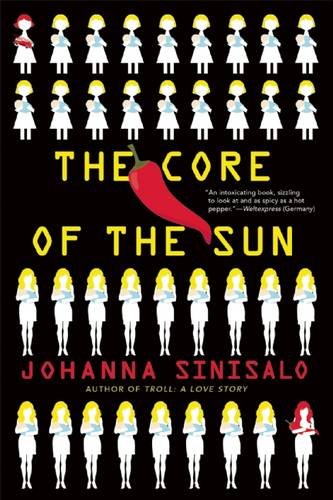
Johanna Sinisalo on the BSFA Awards 2016 Longlist

Finnish author Johanna Sinisalo’s novel The Core of the Sun (Auringon ydin, translated by Lola Rogers) was voted onto the BSFA Awards 2016 longlist for best novel.

Amazon Sinisalo The Core of the Sun

The BSFA Awards are awarded each year to the best Novel, Short Fiction, Artwork and work of Non-Fiction as voted for by the members of the British Science Fiction Association. BSFA members can vote on the longlist to draw up a shortlist between January 01 and January 31. The shortlists for these four awards will normally comprise the five works in each category that receive the most individual nominations by the deadline.

Congratulations! I’m looking forward to hearing whether Sinisalo makes it onto the shortlist.

Incidentally, Sinisalo is one of the guests of honor at Worldcon 75 in Helsinki this coming August.

Found via File 770.

Image via Amazon.

Quotes: She Tried to Take It All in

“She tried to take it all in, to memorize every detail of the amazing historical event she was witnessing: The young woman splashing in the fountain with three officers of the Royal Norfolk Regiment. The stout woman passing out poppies to two rough-looking soldiers, who each kissed her on the cheek. The bobby trying to drag a girl down off the Nelson monument and the girl leaning down and blowing a curled-paper party favor in his face. And the bobby laughing.”

– Connie Willis: All Clear; London, 7 May 1945

Just a part of the World War II Victory in Europe Day celebration in Trafalgar Square, London, according to author Connie Willis. What a delightful image, especially the bit about the bobby and the girl with the party favor!

Willis, Connie: All Clear. New York, NY: Spectra, 2010, p. 14.

(This quote comes from my 21 new-to-me SFF authors reading project.)

Serving exactly what it sounds like, the Quotes feature excerpts other people’s thoughts.

Maria Turtschaninoff’s Novel Maresi Optioned

Swedish-speaking Finnish author Maria Turtschaninoff announced last week that her fantasy novel Maresi has been optioned for a movie by the U.K.-based company Film4.

Congrats—grattis! Awesome news!

The historically inspired fantasy was originally published in Finland in 2014 and awarded the prestigious Finlandia Junior Prize in the same year. It’s the first in the Red Abbey Chronicles series.

Turtschaninoff Maresi US 2017 Cover

Film4 has developed and co-financed many of the most successful films from the U.K. in recent years, including Academy Award winners 12 Years a Slave and Slumdog Millionaire. Earlier Film4 productions include K-Pax, Trainspotting, and Four Weddings and a Funeral.

The U.S. edition of Maresi will be released January 03, 2017.

A freestanding sequel called Naondel has just been published in Swedish and Finnish, but at this writing there’s no information about translations. Turtschaninoff is currently working on book three for the series.

Maresi comes highly recommended by a friend of mine, but I haven’t yet been able to get it. I’m eagerly looking forward to January!

Image via Maria Turtschaninoff

Quotes: There Is Something about Talking in the Night

“There is something about talking in the night, with the shreds of sleep around your ears, with the silences between one remark and another, the town dark and dreaming beyond your own walls. It draws the truth out of you, straight from its little dark pool down there, where usually you guard it so careful, and wave your hands over it and hum and haw to protect people’s feelings, to protect your own.”

– Margo Lanagan: Tender Morsels

The magic of night-time works in many ways.

Lanagan, Margo. Tender Morsels. New York, NY: Alfred A. Knopf, 2008, p. 307.

(This quote comes from my 21 new-to-me SFF authors reading project.)

Serving exactly what it sounds like, the Quotes feature excerpts other people’s thoughts.

Quotes: Discover Not Just the Abstract Thought

“As he watched the TV, he remembered a lecture in his second year of college by a professor of environmental science. The gist had been that institutions, even individual departments in governments, were the concrete embodiments of not just ideas or opinions but also of attitudes and emotions. Like hate or empathy, statements such as ‘immigrants need to learn English or they’re not really citizens’ or ‘all mental patients deserve our respect.’ That in the workings of, for example, an agency, you could, with effort, discover not just the abstract thought behind it but the concrete emotions.”

– Control (John Rodriguez)

That… sounds like sociology or anthropology. Clearly environmental science has more connections with humanities / social sciences than I’ve previously thought!

VanderMeer, Jeff. Authority (Southern Reach Trilogy 2). New York, NY: Farrar, Straus and Giroux, 2014, p. 147.

Recommended Reading: Apuleius, The Golden Ass

161017kantharosModern fantasy literature has taken a lot of inspiration from ancient Greek and Roman mythology. Many people have noted how comic book superheroes play much the same role in modern culture that heroes like Hercules and Odysseus did for ancient readers. The important difference is that Greeks and Romans regarded their heroes as real, semi-divine figures of history. Modern fantasy knows it’s all made up. That’s one of the fundamental differences between myth and fiction: the poet who retells a myth wants you believe that the story is true; the fiction author knows they’re spinning a tale.

But modern people aren’t the first to tell stories just as stories. Ancient literature, in addition to myths that made claims to historical and religious truth, offered tales of adventure, romance, and comedy, just like modern fiction. It even had some works that we would class as speculative fiction. Metamorphoses—more commonly known as The Golden Ass—by Apuleius is one of them.

There are lots of translations available. Here’s one you can read online, but I particularly recommend the translation by Sarah Ruden (Yale, 2012), which expertly captures the wit and cheek of Apuleius’ original text.

The story is told by Lucius, a young man about town who gets in over his head with magic and accidentally turns himself into a donkey. He then has madcap misadventures—getting stolen by bandits, requisitioned by a soldier, displayed in the arena, and mutely witnessing all kinds of domestic comedy and tragedy as he tries to stay alive long enough to find the antidote to cure his transformation.

In this passage, Lucius the donkey has been bought by a local magnate and is being trained to perform tricks, which causes a bit of a tricky situation for the human mind in the donkey body:

He gave me to a favored freedman of his, a well-off man, having instructed him to take good care of me. This man treated me kindly and fed me well and, to please his patron, eagerly encouraged my tricks. First he taught me to recline at the dining table, then to wrestle and even dance with my forelegs in the air. Then—even more remarkable—to respond to words by tossing my head, signing “no” by throwing it back and “yes” by nodding. When I was thirsty, I could request a drink by alternately winking my eyes at an attendant. Of course, this was all perfectly simple for me to follow and I hardly needed a trainer, but I was afraid to behave in too human a way at the table uninstructed, or they might take me for an ill omen, set on me as a monster, and serve up my fat body to the vultures.

– Apuleius, The Golden Ass 10.17

(My own translation)

Lucius’ adventures range from the lewdly ludicrous, as when a rich lady takes him for a lover, to the tragic, as when he witnesses the death of a happy newlywed couple. On the way, just about every level of society, from poor farmers to rich landowners comes in for a bit of satirical skewering. There’s also a surprise ending, which I won’t give away here.

In transforming Lucius into a donkey, Apuleius also addresses the anxieties of his time, in a society where slavery was routine and barriers of language and culture often impeded communication. Romans of his time looked on some other peoples in their world as little better than animals, and must have worried about being seen the same way themselves by others. Sudden loss of status, whether by being taken captive in war or stripped of citizen rights in the court, was nothing strange. While no one had to worry about not behaving donkeyishly enough, as Lucius does, many Roman slaves probably faced the predicament of ingratiating themselves with their masters without seeming too clever or ambitious. The story of Lucius’ adventures, like much fantasy and science fiction of recent decades, provides a way to observe and comment on these anxieties and even, in the end, to offer some hope.

The Golden Ass is a good read and a nice example of how there’s nothing new in the human urge to make up fantastical stories, or to use that fantasy to contemplate contemporary problems.

Image: Donkey head kantharos, photograph by Pymouss via Wikimedia (Athenian, currently British Museum; late 6th c. BCE; black-figure pottery)

History for Writers looks at how history can be a fiction writer’s most useful tool. From worldbuilding to dialogue, history helps you write. Check out the introduction to History for Writers here.