Quotes: Little Moments of Being Sure

One of Anne Corlett’s characters in the novel The Space between the Stars grasps at the meaning of life:

“Was this how it was for everyone? Little moments of being sure, of fitting into the world around you, all strung together on a flimsy thread of doubt and confusion and not belonging?”

– Jamie, The Space between the Stars by Anne Corlett

On one hand, sounds legit; on the other, not entirely, but when it does it’s terribly sad…

Corlett, Anne. The Space between the Stars. New York, NY: Berkeley, 2017, p. 310.

Serving exactly what it sounds like, the Quotes feature excerpts other people’s thoughts.

Global Medieval Sourcebook Brings More Manuscripts Online

Stanford University’s Global Medieval Sourcebook (GMS) now brings English versions of previously untranslated Middle Ages literature to everyone’s fingertips for free.

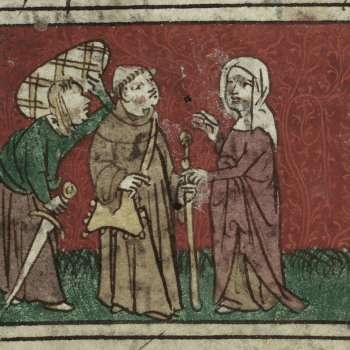
Global Medieval Sourcebook The Gosling

The open access, open source teaching and research tool offers manipulable scans of the manuscripts alongside transcribed texts in their original language and in new English translations. Also a brief introduction for each text is included, providing a commentary on the text’s cultural context and transmission history, its content, and the scholarly conversation around it.

The texts come from Europe, North Africa, the Middle East, and Asia between the years 600 and 1600. The current selection of languages is impressive: Old and Middle High German, Middle Low German, Medieval Dutch, Old and Middle French, Old and Middle English, Medieval Italian, Medieval Latin, Old Spanish (including Aljamiado), Medieval Hungarian, Chinese, Arabic, and Persian.

Texts are searchable by genre, author, period, language, and keyword. The GMS also includes a few audio files of specialists reading the texts in their original language.

Sounds like a fascinating resource! I’m especially intrigued by the audio files, since that’s not a typical resource in medieval text databases. Stanford seems just to be getting started, however, since at this writing only some dozen or so texts are included in the sourcebook. I also encountered some glitches, hopefully to be fixed shortly.

Image: The Gosling / daz genselin from British Library MS Harley 4399 f.37 via Global Medieval Sourcebook / Stanford University (Middle High German, c. 13th, illuminated manuscript)

Out There is an occasional feature highlighting intriguing art, spaces, places, phenomena, flora, and fauna

Octavia Butler to Be Adapted for TV

I missed this when it was first announced, but here it is nevertheless: Octavia Butler’s novel Dawn is to be adapted for tv!

https://twitter.com/ava/status/895354839567171586

Dawn (originally published in 1987) opens the Xenogenesis trilogy (also known as Lilith’s Brood), where the Earth is mostly uninhabitable and humanity almost extinct until the alien Oankali intervene. Writer / producer / director Ava DuVernay and Charles D. King (Macro Ventures) are slated for executive producer posts, and writer / director Victoria Mahoney for the adaptation itself.

I first read the trilogy in the early 1990s in Finnish translation. The books have stayed with me, although over the years it became clear I’d forgotten quite a bit. Some 20 years later, I got my own omnibus in English to (re)read, and the trilogy was just as excellent as I remembered.

Looking forward to seeing what the team makes of Dawn! (Also, note to self: read more Butler!)

Amatka Book Talks by Karin Tidbeck in BOS, NYC, and San Diego

Swedish fantasy and weird author Karin Tidbeck is giving book talks on her debut novel Amatka in the United States.

Karin Tidbeck Amatka

Amatka was originally released in Swedish in 2012. It was first published in English a few weeks ago, at the end of June 2017. The publisher describes the novel as follows:

“A surreal debut novel set in a world shaped by language in the tradition of Margaret Atwood and Ursula K. Le Guin.

“Vanja, an information assistant, is sent from her home city of Essre to the austere, wintry colony of Amatka with an assignment to collect intelligence for the government. Immediately she feels that something strange is going on: people act oddly in Amatka, and citizens are monitored for signs of subversion.

“Intending to stay just a short while, Vanja falls in love with her housemate, Nina, and prolongs her visit. But when she stumbles on evidence of a growing threat to the colony, and a cover-up by its administration, she embarks on an investigation that puts her at tremendous risk.”

In connection with the book birthday, Tidbeck will do a short publicity tour in the U.S. First, she’ll appear at Readercon 28 in Quincy, south of Boston, on July 13-16, 2017. (No further details at this writing.)

There’ll be a second book talk at New York City’s Scandinavia House on Tuesday, July 18, 2017, at 7 p.m. (free entry).

Finally, Tidbeck will be at Comic-Con in San Diego on July 20-23, 2017. (No further details at this writing.)

I haven’t read Tidbeck before, but Amatka sounds intriguing. She describes the birth of the novel in a blog post like this:

“I had spent some years collecting dream notes, and I found myself wondering if they could be mapped. What did my dream country look like? I found that some places showed up again and again, although the geography, events and people shifted. I ended up ordering the notes according to an imagined compass: north, south, east and west, and finally, a central city. […]

“Vanja, a somewhat reluctant protagonist, agreed to be my guide. But what was the world? Dreams, as I thought of them, are ruled by language. What would Vanja’s life be like? What would a society be like in a world where language ruled over matter? The story of Amatka began to unfold. It broke loose from my dream continent and became a world of its own.”

On the surface it sounds a bit like Le Guin’s The Left Hand of Darkness and Emmi Itäranta’s The Weaver. The way Tidbeck talks of language ruling over matter also reminds me of the way mathematics rules over reality in Yoon Ha Lee’s The Ninefox Gambit. As a linguist, I’m doubly intrigued and excited to read Amatka!

This post has been edited to correct a spelling error.

Medieval Advice: No One on Their Right Mind Should Sleep Lying on Their Back

Advice books are nothing new. Here’s an example from late Medieval Europe:

“Those who have weak stomachs should sleep face down, for it will aid digestion and will not allow phlegm to accumulate through the increase of natural heat which stiffens the harmful humors. Moreover, it is extremely helpful to sleep at first on the right side, then on the left. No one on their right mind should sleep lying on their back.”

– Bartolomeo Platina, De honesta voluptate et valetudine (c. 1474)

(Translation by Erik Jensen)

Screencap Lancelot-Grail BLib Add MS 10293 f283r

This rather strongly worded hint is found in a Latin-language cookbook De honesta voluptate et valetudine by Bartolomeo Sacci (1421-1481; better known as Platina). Platina’s work was published c. 1474, and is often called the world’s oldest printed cookbook. It’s more than a collection of recipes, however; it also included his reflections on health, healthy habits, and physical activity, for instance.

A scanned version in Latin (with full record) is available through the Rare Book and Special Collections Division of the Library of Congress.

As a side-sleeper, I (very non-seriously!) agree that sleeping on your back can’t be good for you. All of those wicked humors must then be free to wander around your body, you know… 😉

Image: Lancelot-Grail (The Prose Vulgate Cycle), Lancelot sleeping in a pavilion having killed the owner who lies outside, screencap of Add MS 10293, folio 283r via British Library (northern France; early 14th c.; illustration on parchment)

Some things are just too silly not to share!

NYC Subway Library Offers Free Reads This Summer

Subway riders in New York City are in for a treat this summer: e-books, e-shorts, and excerpts from full-length books are available in subway stations for free download.

This six-week Subway Library promotion comes from the cooperation of the New York Public Library, Brooklyn Public Library, and Queens Public Library with the Metropolitan Transit Authority and Transit Wireless.

The e-books and short stories come from the NYPL’s permanent collection, while excerpts have been made available by big-name publishers (including Hachette, HarperCollins, Penguin Random House, Plympton, and Simon & Schuster).

Along with the free reading, there is a social media competition, and a special Library Train will alternate running along the 6th and 8th Avenue lines (E and F trains). The latter has a car decorated to look like the Rose Main Reading Room inside the 42nd Street branch of the NYPL.

Publishers Weekly Subway Library Train Interior

Read more about and browse the free selection at the Subway Library website!

Found via Tor.com and Publishers Weekly.

Image: interior of Subway Library train car by NYPL via Publishers Weekly

Out There is an occasional feature highlighting intriguing art, spaces, places, phenomena, flora, and fauna.

Quotes: Sometimes Silence Is the Greatest Wisdom

“’I think I’m supposed to say something, but I don’t know what,’ he said.

“’Then don’t say anything. Sometimes silence is the greatest wisdom.’”

– The volunteer and N’Kya in “The Volunteer” by Maurice Broaddus

Oh, so much this. Not only because I think it’s true, but because it reminds me of a cultural difference that’s highly personal to me. In my culture, silence is definitely seen differently than in the U.S. Over the years, I’ve struggled to explain it. This is the closest I’ve come so far:

For a Finn to be silent isn’t an indication of inattention or rudeness; far from it. Silently listening is a sign of interest, i.e., not interrupting before the other speaker has had a chance to finish. Silence means attention to the topic and respect towards another person’s life and space. (Finns need a larger bubble of personal space than other Europeans.) And silence can also be an indication of deep camaraderie.

In essece, then, silence means space, and space means respect.

Broaddus, Maurice. “The Volunteer.” In The Voice of Martyrs. Greenbelt, MD: Rosarium, 2017, p. 103.

Serving exactly what it sounds like, the Quotes feature excerpts other people’s thoughts.

Hugo Awards 2017 Voter Packet Is out

Since last Wednesday, I’ve been like:

Twitter Adam Holisky Picard Full of Win

And:

Kermit Flail

And:

Lady Fancifull reading-film-gif

As members of Worldcon75, we are participating in this year’s Hugo Awards voting. Last week, the con released a packet of reading and visual works to help voters access materials on the finalists list. (Note to self: We have until July 15, 2017, 2:59 am EST to get our votes in.)

Apparently this year’s packet is larger than ever before in the 10 years it’s existed. While definitely not the reason for our memberships, it’s an invaluable bonus.

In addition to the official packet, JJ at File 770 did a huge favor for readers and collected a comprehensive list of finalist works published free online.

With all of this reading, I definitely will have no problems with how to fill my days in the foreseeable future!

Thank you, various creatives and rightsholders, thank you, Worldcon75 Hugo Awards staff, and thank you, JJ and Mike Glyer / File770.

Images: Kermit flail via Walker—Bait on Tumblr; Captain Picard Full of Win via Adam Holisky on Twitter; Reading film: radicktv via Lady Fancifull

Quotes: In the Hopes that They Will Be Able to Pass for One of the Glintelligentsia

“The Merita hotel chain offers rooms at a steep discount to people whose Information shows that they are interesting: as cocktail-chatter counterparts, as connections for enterpreneurs, as potential romantic partners. It’s a strategy to convince wealthier, duller clientele to pay a premium in order to share some sparkling conversation, or in the hopes that they will be able to pass for one of the glintelligentsia themselves.”

– Malka Older, Infomocracy

I just love the word glintelligentsia! It should be in mainstream use already. 🙂

Older, Malka. Infomocracy. New York, NY: Tor.com, 2016, p. 77.

Serving exactly what it sounds like, the Quotes feature excerpts other people’s thoughts.

Johanna Sinisalo Is a 2017 Prometheus Award Finalist

Author Johanna Sinisalo’s latest novel, dystopian The Core of the Sun (Auringon ydin, translated by Lola Rogers) has gained another distinction: it is a finalist for the 2017 Prometheus Award.

The Prometheus Award, sponsored by the Libertarian Futurist Society (LFS), was established in 1979, making it one of the most enduring awards after the Nebula and Hugo awards, and one of the oldest fan-based awards currently in sf. Presented annually since 1982 at the World Science Fiction Convention, the Prometheus Awards include a gold coin and plaque for the winners.

Congratulations! I hope she will give a talk on on TCotS at Worldcon 75.