News on a Red Sonja Reboot

If I ever heard of a Red Sonja reboot project, I must’ve immediately forgotten it, for the fate of movie projects is unknowable and often fickle, and that is multiplied for genre projects starring women.

Now, though, it sounds like Millennium Media’s Red Sonja is due for release later this year in the UK and Ireland. This version is directed by M.J. Bassett and written by Tasha Huo and Roy Thomas on the basis of Robert E. Howard’s original comic book characters. Matilda Lutz plays Sonja.

At this writing, IMDB doesn’t list much information and has only 10 photos for the production, including a poster.

IMDB 2025 Red Sonja Poster

Interestingly, IMDB also lists Roy Thomas as an uncredited writer for the comic book. Thomas’s latest big-name project is Deadpool & Wolverine.

I hazily remember the previous adaptation from 1985 starring Brigitte Nielsen. ‘Twas the time when there were so few SFFnal movies and tv series in the boonies where I grew up that you pretty much had to see everything coming your way if you wanted to see anything. If I recall, it was like the 80s Conan adaptations—Conan the Barbarian in 1982 and Conan the Destroyer in 1984—which is to say pretty campy, but attempting very, very, very earnestly to bring epic fantasy to screen.

Bassett’s version is filmed in Bulgaria and Greece, and reportedly will have a different tone from male-gaze versions of the character. While both of these details sound promising, and while I would love to see more genre projects led and directed by women, somehow I seem to doubt the movie will be released on the big screen here in Finland. We’ll see.

Image via IMDB

Barbarian Migrations: The Imaginary and the Real

Previously we considered how large the groups of people who moved around the ancient world actually were and what challenges such large groups faced in migrating from one place to another.

The idea of large, cohesive groups traveling across the map to resettle elsewhere is largely a product of two things: ancient literary conventions and modern historiography. Ancient Mediterranean writers had their own literary habits. Among them was positing large groups of people picking up and resettling elsewhere as a way of explaining cultural relationships (such as, for instance, the legend that the Romans were the descendants of Trojans, or that the Spartans were long-lost kin of the Jews). These stories were not based in any reality but served the literary and political needs of those who told them.

Modern historians of the nineteenth and early twentieth centuries approached ancient history with the assumption that ethnic groups were coherent units with definable traits whose history could be traced across time and space. There was, they believed, a distinct “Gothic” or “Celtic” character that could be identified in literature and art and that marked the movement of whole peoples to replace or subjugate others. These assumptions were grounded in the systems of modern imperialism and the ideals of Romantic nationalist movements, not the realities of ancient history, but they shaped how scholars read ancient literary sources. The idea that there were mass migrations across Europe at any point in antiquity is largely a figment of the modern imagination.

When we revisit the ancient sources and the archaeological evidence, we can identify several different kinds of movement, each of which faced different versions of the problems outlined above and had different ways of dealing with them.

Long-term movement: Many of the “migrations” identified by nineteenth-century scholars are better understood as the result of small groups of people such as families, extended kin groups, or raiding parties taking similar routes over time. Each individual group was small enough to travel without overstraining the resources of the lands they moved through, but many such groups taking the same journey over an extended time period could eventually lead to significant shifts in population and local culture. This kind of movement can be seen for example in the migration of Gaulish warbands into northern Italy in the fifth and fourth centuries BCE and the large-scale shift of populations from northern and western Europe into the southern and eastern Mediterranean in the later centuries of the Roman Empire.

Armies: Other movements did involve large groups of people moving within a short time frame, and are best understood as armies on the march, attended by followers and hangers-on. The frontier peoples of the late Roman period were deeply interconnected with the Roman world. Under their own leaders, they competed for power and wealth in much the same way that Roman armies competed to put their leaders into power. Many of these groups included veterans of the Roman army and had diplomatic relations with the Roman elite. Their movements were directed at political ends, and they drew on the same resources that Roman armies did to manage the logistics of travel. The late Roman Franks and Vandals, for example, functioned essentially as armies with large civilian followings.

Refugees: Other groups of people moved en masse not by choice but because the alternative was worse. Economic and political changes could uproot some people and force them to relocate, whether they were prepared for a journey or not. Those forced to relocate could face extreme hardship, just as modern refugees too often do. We can get an idea of how desperate ancient refugees could be from accounts of peoples crossing into eastern Roman territory in the late fourth century selling their fellow refugees to the Romans as slaves at bargain prices just to feed themselves. Refugees faced the same challenges that traveling armies did, but with none of the same support; these groups probably lost many members along the way to illness, hunger, combat, or enslavement. Refugee groups include the Cimbri and Teutones in the late second century BCE and the Visigoths in the fourth century CE.

Migrating groups in antiquity were mostly small. The idea of barbarian hordes hundred of thousands strong is more fiction than history. Those who did travel in large groups mostly did so either as organized armies drawing on the same logistical resources that other ancient armies did or as refugees driven by desperation who managed the best they could under terrible circumstances.

The idea of massive hordes of barbarians migrating at once across the ancient landscape is a figment of the imagination, but that doesn’t mean that they ancient world was static. People moved, and sometimes they moved in large groups, but any such group faced enormous practical challenges. Some groups were in a position to overcome these challenges; many were not. “Barbarian” peoples did not have any special way of overcoming the practical problems of migration. They solved those problems the same way that other peoples did, in small groups, as armies, or as refugees.

Image: “Battle of Guadalete,” photograph by Christie’s via Wikimedia (1882; oil on panel; by Mariano Barbasán Lagueruela)

Barbarian Migrations: Logistics

In a previous post, we considered the sizes of migrating groups in antiquity. We can probably dismiss any idea of hundreds of thousands of people pouring across the Roman Empire, but the challenges of moving even 10,000 people long distances in ancient conditions are significant.

People need things: clothing, bedding, medicine, tools, weapons, and most of all food and water. People on the road have to make do with less, but some things are still essential for survival and must be either carried with the group or found along the way. The more stuff people carry with them, the slower they move and the longer it takes for them to get to a place where they can settle down and start rebuilding; the faster people move, the less they can carry with them and the more they have to either rely on finding what they need along the way or suffer without. The logistics for moving a large group of people are always a compromise between stuff and speed.

The amount of stuff people can carry is limited. A healthy adult can typically carry around 20-25 kilos and still manage to walk long distances. Trained individuals can carry more, but people who can manage this feat are few, and in a large group will be outweighed by the young, elderly, sick, and disabled who can carry less. Animals can add to carrying capacity, but they also create greater demands for food, water, and medical care; carts or sledges can add capacity, but they are slower and limit what terrain a group can cover. The best way to carry large amounts of stuff long distances is over water, but this also limits what routes a group can take.

Healthy adults traveling by foot in good conditions can typically maintain a walking pace of about 4-5 kilometers an hour, and keep up that pace for hours at a time, covering between 20 and 40 km a day, but large migrating groups were not all made up of healthy adults and did not always have the luxury of traveling in fair conditions. A large group traveling across country would have been slow, and the larger the group, the slower it would have traveled.

The most important supplies for a traveling group are food and water. In extreme circumstances people can do without bedding, tools, weapons, even clothes, but if they run out of food and water they are done for. The average adult needs about 1.5 kilos of food and 1.5 liters of drinking water every day to sustain the exertion of long-distance travel by foot. Fresh water is available from wild sources across many parts of the temperate world, but large groups can exhaust local supplies. Some amount of food can be foraged or hunted in the wild, but there are very few landscapes anywhere rich enough in wild food sources to sustain a group of 10,000 while still allowing them time to make significant progress on their journey. A large group of people traveling across an ancient landscape had only two practical choices: carry food with them, or acquire it from the farms and fields of the regions they passed through.

Carrying your own food for a journey is helpful, but it has limits. Considering that typical adult carrying capacity is 20-25 kilos, and an adult needs 1.5 kilos of food a day, even a person carrying nothing but food can only carry about two weeks’ worth of rations. Carrying that much food means sacrificing any other gear, even the tools to prepare and cook the food with. In a large group including young, old, sick, and disabled, some people have to carry food for others. Even in the best conditions, a large group traveling overland could carry its own food for only about 10 days. Adding pack animals does not help the situation, because the proportion between what a horse, donkey, or camel eats and how much food it needs to sustain itself is the same as for a human being: even a pack animal loaded with nothing but food will eat up its entire cargo in less than two weeks. Allowing animals to graze extends the number of days they can go, but also slows them down. A large group traveling for 10 days might just be able to carry all their essential supplies with them. 10 days of travel would allow them to cover a distance of at best around 200 km, but in practice most migrating groups could not maintain such a speed. Realistically, any large group undertaking a long journey would have to acquire food (and other supplies) from the regions they traveled through.

Acquiring supplies locally is its own challenge. Ancient agriculture was of limited productivity. Most ancient farming towns did not produce a large surplus. Large migrating groups were unlikely to be carrying with them either trade goods or cash sufficient to buy or barter for all the food they needed (unless they were willing to sell off some of their own number as slaves). Any large migrating group probably reached a point, willingly or not, where they had no option but to take by force the food they needed to keep going. Such raiding surely provoked the local population to either fight back or hide their food supplies, either of which was another problem for the migrating group that slowed down their travel and stretched their resources.

Now, all of these problems did have solutions in ancient conditions. They are essentially the same problems that an army on the march faced, and there were plenty of armies in the ancient world, some of which may even have numbered in the hundreds of thousands. Armies, though, had two advantages that migrating groups did not: 1) they were mostly made up of healthy adults, and 2) they had the financial and logistical support of a state behind them. Groups of people that did not have these two advantages faced serious challenges if they wanted to move long distances en masse.

Next time, we’ll put together what we know about the realities of numbers and logistics to see what we can say about what a “barbarian migration” might have actually looked like.

Image: Huns via Wikimedia (1910; painting; by Georges-Antoine Rochegrosse)

Barbarian Migrations: Numbers

Barbarian migrations are a staple of popular histories of the ancient world. From early wandering groups like the Cimbri and Teutones in the late second century BCE to massive hordes of Goths, Vandals, Juthungi, and the like streaming across the map of the late Roman Empire, it seems that gathering up in huge masses and tromping around the world is just what barbarians do.

But is it? The popular image of migrating barbarian hordes comes from older scholarship, many of whose assumptions and conclusions have been challenged in recent generations. No one today doubts that people in antiquity moved, sometimes in groups, and sometimes long distances, but the idea of massive hordes pouring across the landscape is becoming less and less tenable.

To get an idea of why massive barbarian migrations are questionable, we’ll consider two interrelated issues: numbers and logistics. How large were the groups that moved long distances in antiquity? And how did those groups manage the practical problems that come with moving long distances? This post addresses numbers. In the next post, we’ll talk about logistics. Finally, we’ll see what conclusions we can draw about how and why large groups of people moved around the ancient world.

Ancient sources are notoriously unreliable when it comes to estimating the numbers of people in large groups. Greek and Roman writers trying to describe the movements of large groups of potentially hostile outsiders are especially unreliable. Even today it is difficult to estimate the size of crowds, and we have much better tools at our disposal than ancient authors did. Most writers who report figures for the movement of large groups were not eyewitnesses, and were certainly not in a position to get an accurate count.

Greek and Roman authors had reasons to exaggerate the scale of forces they perceived as hostile intruders. A large movement was more dramatic to write about, and the defeat of a large hostile force reflected more glory on the Greek and Roman armies and leaders who fought them. The literary mood of late antiquity was particularly pessimistic, influenced both by the competition for power among rival generals who needed to claim that they had triumphed over unbeatable odds and the Christian hope for an apocalyptic end of the world. The image of massive hordes of invading barbarians suited the needs of contemporary writers, but that does not mean that barbarians were actually invading in massive hordes. The same dire language was used to describe urban unrest, rural banditry, undisciplined soldiers, even overzealous monks.

Still, there was nothing new about Greek and Roman authors wildly overestimating the size of outside groups on the move. The Greek historian Herodotus in the fifth century BCE famously estimated the size of the Persian king Xerxes’ expeditionary force in Greece (army and navy combined) at a ludicrously high figure of 5,283,220; modern estimates vary, but generally put the total at less than 100,000.

Given these facts, we should be skeptical of ancient sources that breezily conjure up 80,000 Vandals, 150,000 Goths, or 400,000 followers of Radagaisus. While any of these figures could theoretically be correct, and we cannot categorically reject them, none of them is any better than an estimate by an outside observer passed through several hands and recounted by a writer with literary and political axes to grind.

So, how large were the actual groups of people moving around the ancient world? It is impossible to say with any certainty, but we can make a few suggestions. To begin with, the lower literary estimates are a workable upper bound. 80,000 is repeated by enough sources in enough different contexts that it probably represents a literary convention for “a very big number of people.” If we suppose that this literary convention is derived from actual experience of the practicalities of moving large groups of people, then it makes sense to suggest that few if any moving groups in antiquity numbered more than 80,000, and most were much smaller.

Accounts of some late antique battles give figures of approximately 10,000 fighters in the “barbarian” armies. These figures are questionable for all the same reasons described above, but they are not out of proportion to the sizes of known ancient armies. Fighting forces represent only a fraction of an entire population, conventionally estimated at an eighth, or perhaps as much as a quarter in extreme circumstances. A fighting force of 10,000 would then represent a total population of 40,000-80,000. Since the “barbarian” armies in these battles were often temporary alliances of disparate groups, the constituent groups themselves must have been smaller.

Our numbers can only be speculative, but drawing together these inferences, we are probably not terribly far wrong if we imagine most migrating groups in antiquity on the scale of 10,000-20,000 people, with some temporary alliances adding up to 80,000 or so.

In the next post, we’ll think about what it would actually take for even a group of 10,000 or so people in ancient conditions to migrate from one place to another.

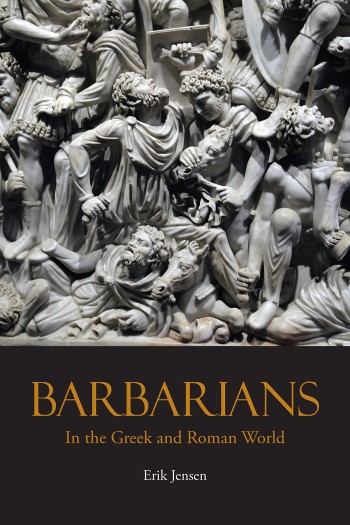
Image: Ludovisi sarcophagus, photograph by Jastrow via Wikimedia (currently Museo Nazionale Romano di Palazzo Altemps, Rome; c. 251 CE; marble)

Barbarians in the Greek and Roman World Preview

What did the ancient Greeks and Romans think of the peoples they referred to as barbari? Did they share the modern Western conception—popularized in modern fantasy literature and role-playing games—of “barbarians” as brutish, unwashed enemies of civilization? Or our related notion of “the noble savage?” Was the category fixed or fluid? How did it contrast with the Greeks and Romans’ conception of their own cultural identity? Was it based on race?

These are the questions that my first book addresses. Barbarians in the Greek and Roman World will be published in the fall of 2018. The book explores both the realities of interaction among peoples of different cultures in the ancient Mediterranean and the ways in which Greek and Roman thinkers interpreted these interactions to create the idea of the “barbarian.”

Here’s a preview, discussing the experience of the Greeks in their colonial settlements around the Mediterranean Sea:

* * *

The history of Greek settlement in Egypt demonstrates the complexity of colonial interactions. In the late 600s BCE, Egypt was under Assyrian dominion. An Egyptian noble, Psammetichus, had been appointed as governor, but when the Assyrians were distracted by internal conflicts, Psammetichus raised a rebellion, bolstered by mercenaries from Greece and Caria, a region of southwestern Anatolia. When the fighting was done and Psammetichus had become king of a newly independent Egypt, he settled the remaining mercenaries in the Nile delta. These settlements also attracted other foreigners, such as Phoenician crafters who made imitation Egyptian artworks on the site for export.

The mercenaries remained in Egyptian service, and it appears their descendants did as well, since some were deployed to southern Egypt under Psammetichus II decades later. One such band carved graffiti on the temple of Abu Simbel to commemorate their adventures: “When King Psammetichus came to Elephantine, this was carved by the companions of Psammatichus, son of Theocles, who sailed beyond Kerkis as far as the river went.” The mercenary Psammatichus was evidently named after the pharaoh by his Greek father. Some families went beyond names and embraced Egyptian culture, as shown by the burial of Wahibre-em-akhet, whose name and hieroglyph-inscribed sarcophagus are conventionally Egyptian; the only clue to his foreign ancestry are the Greek names of his parents, Alexicles and Zenodote. Other soldiers left graffiti at Abu Simbel in Carian and Phoenician, another testament to the cultural and linguistic diversity of those traveling and trading around the Mediterranean at this time.

Sometime after 570, the pharaoh Amasis reorganized the Nile delta settlement. Land was granted for the construction of a Greek colony, which, unusually, was collectively founded by nine Greek cities from the coast of Anatolia. Representatives from these cities jointly governed the new community now called Naukratis. Greek ships were banned from landing anywhere else in Egypt for trade. The colony thus became the primary site of exchange between Greeks and Egyptians. Trade connections brought people of many different backgrounds to Naukratis and connected its people to a wider world. One visitor was Charaxos, the brother of the poet Sappho, who traded wine from his home city Mytilene to Naukratis. He met a slave courtesan there, a Thracian woman named Rhodopis who had been brought to Egypt by her Samian owner. Charaxos fell in love with Rhodopis, bought her, and freed her, after which she chose to remain in Naukratis to ply her trade. To celebrate the fortune she had amassed in her work, Rhodopis later made a rich dedication at Delphi in Greece. A hieroglyphic inscription on a stele erected by the pharaoh Nectanebo in the fourth century, dedicating revenues from Naukratis to the temple of Neith, shows that the pharaohs kept an active interest in the administration of the colony. Naukratis retained its importance and trading privileges after the Persian Empire conquered Egypt in 525. It continued to welcome not only traders but tourists and other travelers, like Herodotus, who visited Egypt and whose writings record the existence of a local industry of tour guides and interpreters. The Greeks who settled in Egypt did not exist in isolation but had productive relationships with traders, artisans, and the ruling class alike.

The interactions in and around Naukratis are a window into the complexity of the colonial world. There were Greeks trading with Egyptians, but also Phoenicians making knockoffs of Egyptian art, Greeks assimilating into Egyptian culture, Thracians and Carians negotiating the needs of Egyptian and Greek patrons, and Egyptians making a living off showing the wonders of their country to curious foreigners. Interactions like these were happening all around the Mediterranean. There is no simple way to describe Greek relations with non-Greek peoples in the archaic and classical periods because those relations were never simple.

* * *

If you’ve enjoyed some of my posts about ancient trade connections, the diversity of ancient armies, individuals crossing cultural boundaries, modern peoples’ attempts to claim ancient peoples’ identities for themselves, and the variety of different kinds of “barbarian” you may find something to enjoy in Barbarians in the Greek and Roman World.

Barbarians in the Greek and Roman World comes out in September from Hackett Publishing.

Hardcover: $48 / Paperback: $16

You can pre-order directly from Hackett or on Amazon.

Image: Barbarians paperback cover by Hackett Publishing

Announcements from your hosts.

Know Your Barbarians

The word “barbarian” today conjures a fairly specific image: a large, muscular man or woman wearing leather or furs hefting an enormous weapon. They are ragged and dirty and if they have any kind of organization, it is as a rabble of warriors following whoever happens to be the strongest. This image has its roots in classical Greek and Roman literature, but Greco-Roman ideas about barbarians were broader and more complicated than this.

Greeks and Romans both had complicated relationships with the outside world. The economy of ancient Greece depended on foreign trade, especially with Egypt, but Greece was also on the northwestern frontier of the Persian empire, which often threatened Greek cities or interfered in their internal politics. Rome was an expansionist empire with ambitions of conquering the whole world, but the strength and stability of the empire depended on integrating conquered peoples into Roman culture.

Out of these historical experiences, Greek and Roman writers, artists, and philosophers developed a wide repertoire of narrative models for describing other peoples. These narratives ranged from the nuanced and admiring to the stereotyping and pejorative. “Barbarian” could mean many different things in different times and contexts. Among this repertoire, there were conventional archetypes that authors and artists could draw on and expect that their audience would recognize them.

These archetypes were nebulous conglomerations of tropes and stereotypes, not always consistent and liable to be manipulated, tweaked, and subverted in individual works of art or literature. They could be reduced to caricature or filled out with individual details. They functioned much like modern national and ethnic stereotypes. Imagine the caricature version of a British gentleman, replete with bowler hat and umbrella. We might expect such a character to have certain typical qualities, both positive (unflappable, chivalrous, witty) and negative (stodgy, proud, insensitive) and engage in typical behaviors (sipping tea, playing polo, driving a Jaguar). Of course, stereotypes don’t have to be followed. A Brit in a bowler hat with an umbrella may also turn out to be a tongue-tied chocoholic who raises miniature goats and likes to watch telenovelas, but the author who creates such a character and the audience that encounters them will recognize how the standard tropes have been played with.

Greeks and Romans had two principal archetypes for barbarians. One was based on small, materially poor, less well organized cultures mostly found to the west or north, such as Scythians, Thracians, Gauls, Germans, Iberians, Britons, and Dacians. The other was based on large, wealthy, sophisticated cultures mostly found to the east or south, such as Egyptians, Persians, Phoenicians, Lydians, Carthaginians, and Etruscans.

The northwestern barbarians are the ancestors of the modern “barbarian” image. They were portrayed as violent, ignorant, savage, and lacking in technology and social organization. They had no idea how to behave in a civilized society and were almost like wild animals. They lived in poverty and with barely any kind of government except the ability of the strong to impose their will on others. They could also be shown with good qualities, such as generosity and honesty. The were the original “noble savages,” ignorant of the benefits of civilization but also uncorrupted by its temptations.
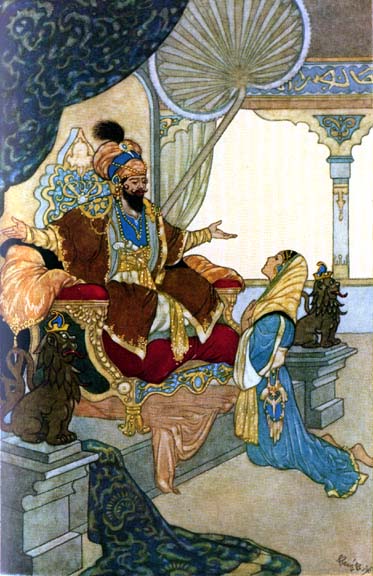
The southeastern barbarians were the opposite. They were portrayed as weak, decadent, devious, overwhelmed by luxury and tangled in arcane social hierarchies. They had given in to the corrupting effects of civilization and overindulged in every kind of physical pleasure. They lived like slaves under the rule of despotic tyrants, but they were so accustomed to the comforts of luxury that they lacked the will to resist. They could have positive qualities as well. Their cultures were ancient and sophisticated, rich in accumulated knowledge. We don’t have a good term for the opposite of “noble savages,” but we might call them “depraved sophisticates.”

Central to both of these archetypes is one of the key values of Greco-Roman society: self-control. The southeastern barbarians displayed too little of it, giving in every kind of indulgence and unable to resist the rule of a tyrant. The northwestern barbarians, by contrast, were too willful, unable to subordinate themselves to the structures of law and social order. By creating these archetypes, Greeks and Romans positioned themselves in the middle—sophisticated enough to enjoy the benefits of civilization, but strong enough to resist its corrupting effects.

Both of these archetypes have come down into modern literature. The northwestern barbarian has become the standard modern “barbarian,” but aspects of it can also be seen in modern Western stereotypes of Africans, African Americans, and Native Americans. “Darkest Africa” stories about wild cannibal tribes dumbfounded by modern technology and scientific knowledge play upon the same images of violence, savagery, and technological ignorance that Romans applied to the Gauls and Germans. The southeastern barbarian formed the basis for romanticized Western depictions of the Islamic world, China, and India. “Arabian Nights” fantasies of scandalous harems and treacherous palace politics, ancient secrets and fabulous treasures hidden in the twisting back streets behind markets filled with spices and gems evoke Greek tales about Egypt and Persia.

These archetypes have also found their way into fantasy and science fiction. Tolkien’s Elves reflect some of the more positive southeastern qualities of wisdom and sophistication while his Orcs display the violent, fractious, bestial traits of the northwest. Star Trek‘s Klingons and Romulans represent the tropes of warlike honor and treacherous sophistication. The people of Westeros in A Song of Ice and Fire and Game of Thrones face the rugged, wild, disorderly peoples of the north and the rich, old, devious kingdoms of the east.

Once you know your barbarians, you’ll recognize them everywhere.

Images: Hyboria, by Yan R. via Flickr. Sultan from the Arabian Nights, by Rene Bull via Wikimedia.

History for Writers is a weekly feature which looks at how history can be a fiction writer’s most useful tool. From worldbuilding to dialogue, history helps you write. Check out the introduction to History for Writers here.