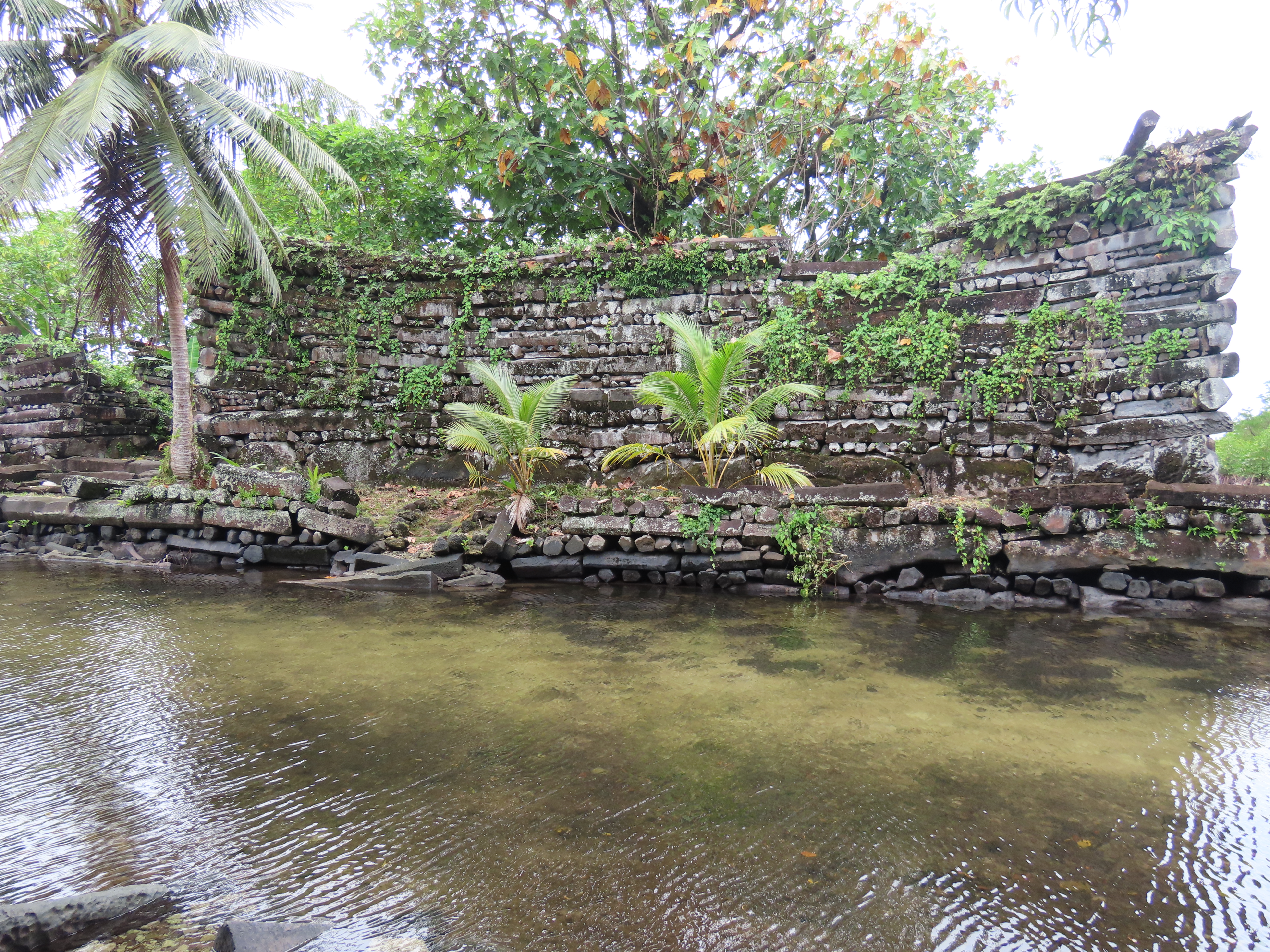
On the eastern coast of the island of Pohnpei, part of the Federated States of Micronesia, are the remains of a gigantic complex of megalithic structures. These structures stand along the coast of the island and on nearly a hundred artificial islands just offshore. This site is called Nan Madol.
Platform and enclosure wall, photograph by Uhooep via Wikimedia (Nan Madol; c. 1100-1200 CE; stone)
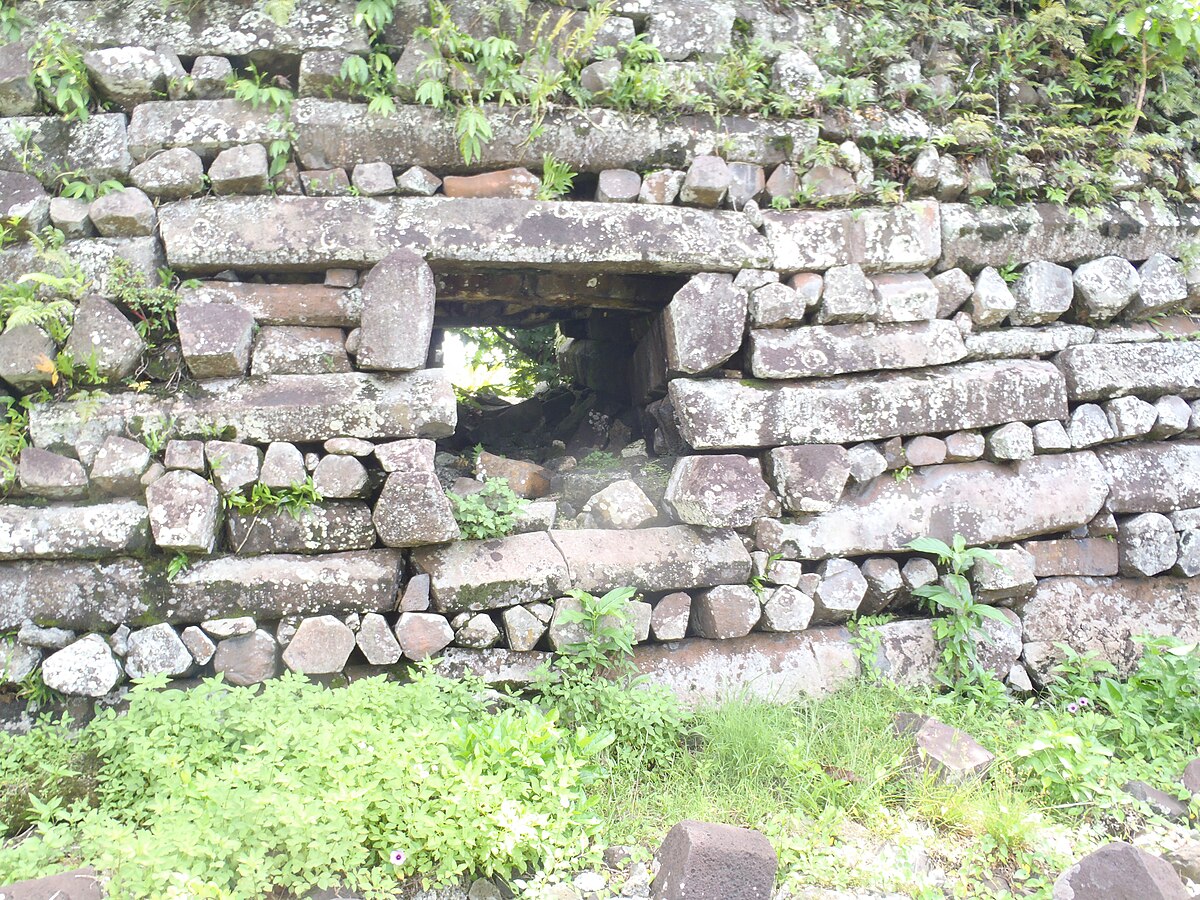
The structures of Nan Madol were first built in the 1100s CE and served as an administrative and ceremonial center for the Saudeleur ruling dynasty that held power over Pohnpei from approximately 1100 CE to the early 1600s. They were constructed using columns of volcanic rock that formed natural geometric shapes. By carefully jointing these stones together, the people of Pohnpei created large structures stable enough that many walls still stand today.
Wall with opening, photograph by Patrick Nunn via Wikimedia (Nan Madol; c. 1100-1200 CE; stone)
Nan Madol is one of many sites around the world that remind us that cultures capable of coordinated labor, careful planning, and social complexity are not the product of only one environment or part of the world.
Out There highlights intriguing art, places, phenomena, flora, and fauna.
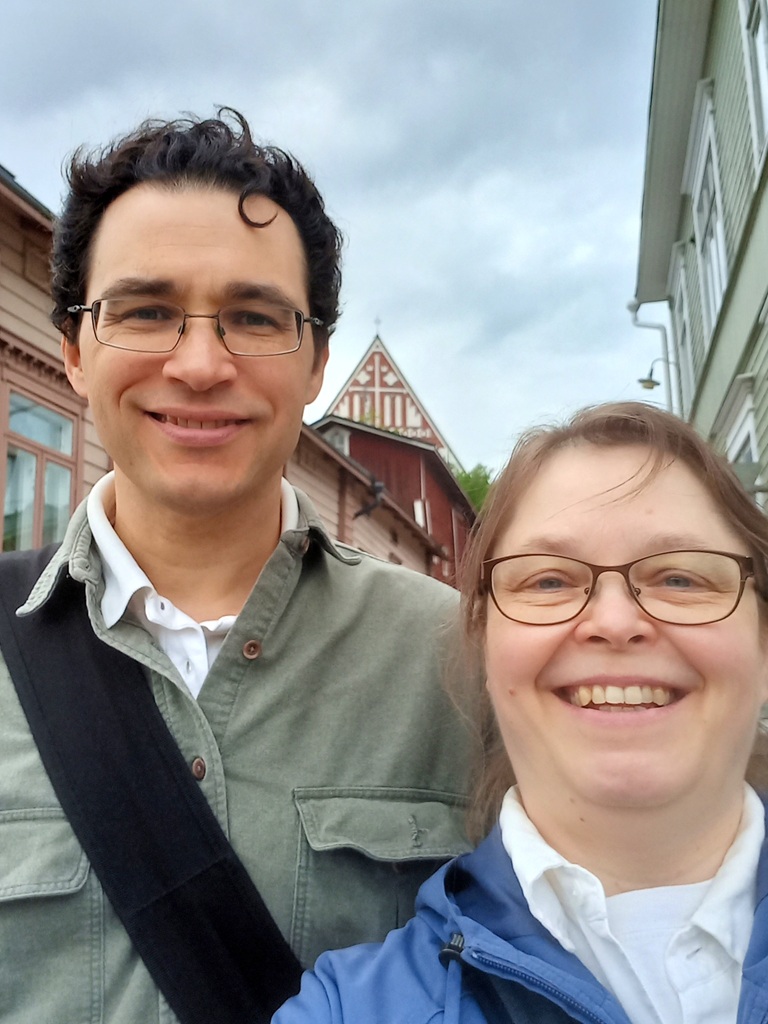
We started this blog together back in June 2015 with no grand ideas or plans, just wanting a place where each of us could post about the things we geek about and where we could post jointly about the things we geek about together. We had no idea what the next decade would bring us, but it’s been a fun ten years, and we’re still at it!
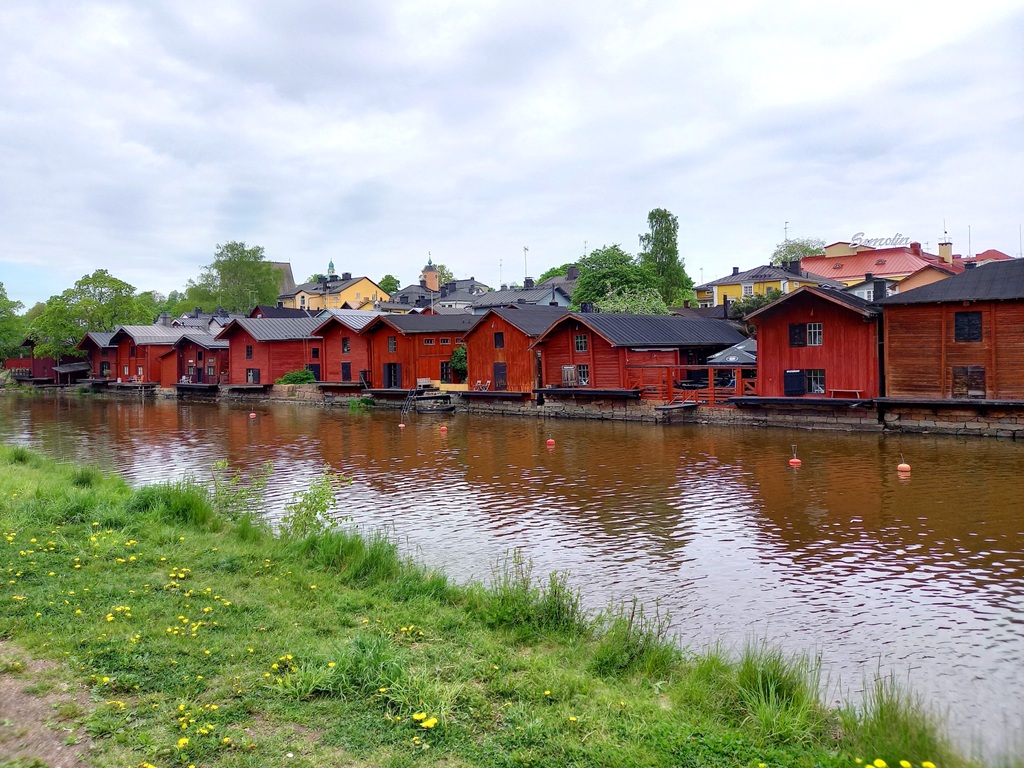
For a little celebration, we decided to take a short trip to a place we’ve both been interested in visiting for a while: the old town of Porvoo. Porvoo is a small city on the Finnish southern coast a little to the east of Helsinki. It’s like most Finnish cities except for its remarkable old town.
A large portion of the northern half of the city is made up of well-preserved colorful old wooden houses along cobblestone streets, all surrounding a medieval church.
While many of the house exteriors are legally protected, it’s not a museum or living history exhibit, just a part of town where ordinary folks and families live. Walking around there, though, is a little bit like stepping back in time.
Whatever brought you to Co-Geeking, we hope you’ve enjoyed our work. We look forward to another ten years, and who knows how many more!
It’s an all too well-known trope that the past is drab. When we picture ancient or medieval buildings, we tend to imagine white marble or gray stone. This assumption of colorlessness spills over into fantasy as well. When we imagine the built environments of made-up lands, we tend to see a lot of white and gray there too, but it doesn’t have to be that way.
The ancient Greek historian Herodotus gives a fantastical description of the Median city of Ecbatana, modern Hamadan, Iran, featuring a series of concentric walls topped by brightly colored parapets:
This walled city is built in such a way that each wall is higher than the wall encircling it by only the height of its parapet, partly by the fact that it is built on a hill, but largely by design. All together there are seven circles, with the palace and treasury in the innermost one. The largest wall is about as long as the walls of Athens. The parapet of the first wall is white, the second one black, the third red, the fourth dark blue, and the fifth amber. The first five walls had their parapets painted in these bright colors, but the next was covered in silver and the final one in gold.
– Herodotus, Histories 1.98
(My own translation)
Now, Herodotus probably got this description wrong. It does not match up with the archaeological remains on the ground in Hamadan. Herodotus never saw Ecbatana for himself, but relied on second-hand reports, which likely got garbled in the telling. In fact, Herodotus’ description of Ecbatana as a hill covered by concentric rings of walls fits a bit better as a description of a Mesopotamian ziggurat. A ziggurat is a pyramid-like structure made up of a series of terraces built one on top of another, getting smaller as they go up. Seen from ground level, they might well look like a series of concentric walls ascending a hill.
Ruins of the ziggurat of Choga Zanbil, photocollage by Pentocelo via Wikimedia (Khuzestan Province, Iran; c. 1250 BCE; brick)
Ziggurats had been built in Mesopotamia for thousands of years by Herodotus’ day, primarily to serve as temples. While not many new ziggurats were being built in the time of Herodotus, older ones were being restored and rebuilt, so news of a freshly (re)built massive structure with impressive concentric walls may well have reached Greece. The brightly colored walls Herodotus describes are not too far-fetched, either. Ancient Mesopotamians decorated important buildings with colorful glazed tiles, which still retain some of their impressive coloring even today, as can be seen in the Ishtar Gate from Babylon.
Detail of the Ishtar Gate, with modern reconstruction, photograph by Osama Shukir Muhammed Amin via Wikimedia (Babylon, currently Pergamon Museum, Berlin; 6th c. BCE; glazed tile and brick)
All of these things put together mean that Herodotus invented (albeit unintentionally) a fantasy version of Ecbatana flavored after a Mesopotamian ziggurat with colorful tiled walls. And if Herodotus could do it, there’s no reason the rest of us can’t do the same. Let’s see more fantasy cities with vibrant scarlet walls, turquoise roof tiles, or streets paved with lush green stone!
History for Writers looks at how history can be a fiction writer’s most useful tool, from worldbuilding to dialogue.
Latin, like any foreign language, can be confusing sometimes, especially when so many Latin words have been adopted into other languages and often changed in the process. Still, it’s hard to think of a Latin word more misunderstood than vomitorium. The popular image is that Romans had rooms in their houses where they went to purge themselves mid-orgy so they could go back and keep eating. It’s an entertaining image (for certain values of entertainment), but it’s also completely false.
The word vomitorium is a form of vomitorius, derived from the verb vomo, meaning “to vomit.” In normal usage, vomitorius refers to emetics, substances used to induce vomiting for medical purposes. Pliny the Elder uses the word in this sense to describe the medicinal properties of some sort of plant (the exact plant is unclear, but it seems to be something in the allium family).
There is a plant with leek-like leaves and a reddish bulb that the Greeks call “bulbine.” It is considered very effective in treating wounds, so long as they are recent. The bulb that is called “vomitorius” because of its emetic effect has dark, glossy leaves that are longer than those of other types.
Pliny the Elder, Natural History 20.40
(My own translations)
Only one extant source uses the word vomitorium in reference to an architectural feature, and it was not a room for vomiting. The passage is from the Saturnalia by Macrobius, a late Roman writer. The Saturnalia is a fictional account of a dinner party conversation, a popular genre among Greek and Roman writers. In this case, the diners spend a good deal of time talking about the origins and usage of various words, particularly those connected with eating and digestion. Vomitorium comes up in a discussion of metaphorical and poetic uses of vomo:
Lucilius said in his fourteenth book:
“If there were no praetor hanging around bugging me
that wouldn’t be bad, I tell you. He’s the one disemboweling me.
In the morning every house vomits a wave of sycophants.”
That’s well said, and it’s an old expression, too, for Ennius says:
“And the Tiber river vomits into the salt sea”
And so nowadays we talk about “vomitoria” in the theatre, through which crowds of people pour in to get to the seats.
Macrobius, Saturnalia 6.4.2-3
Macrobius is describing the monumental entrances of public buildings that were built to accommodate large flows of people, such as we typically find on Roman theatres and amphitheatres. They look something like this:
Vomitorium of the Colosseum looking outward, photograph by Ank Kumar via Wikimedia (Rome; 80 CE; stone)
Vomitorium of the Roman amphitheatre in Bordeaux looking inward, photograph by Michaël Van Dorpe via Wikimedia (Bordeaux; 3rd c. CE; stone)
It’s hard to say how formal or widely used the term was. We don’t have any mention of it from Roman texts on architecture. It certainly carries more than a whiff of aristocratic disdain for the crowds of ordinary folks who had to jostle their way into the seats, unlike Macrobius and his upper-crust set who could count on reserved seating. Still, it must have been a word that late Roman aristocrats like Macrobius would recognize, or else there would be no reason to bring it up in a discussion of etymology and poetry. In modern times, architectural historians have taken Macrobius’ bit of upper-class slang and turned it into a technical term for describing the wide entry passages of Roman public buildings, and you’ll find it in more than one scholarly work on Roman architecture, but there’s no evidence that the people who designed, built, or used those structures referred to them as such.
Now, it’s not entirely clear how we got form a misapplied architectural term in historical scholarship to the idea of upper-class Romans pausing mid-party to go to a separate room and throw up, but somewhere along the way there are probably a couple generations of bored school kids enlivening their Latin lessons with overactive imaginations and gross-out humor. They may well have gotten inspiration from some of the more revolting passages in Latin literature. In one such passage, the philosopher Seneca laments the maltreatment of enslaved household workers who are made to stand silent and hungry while the man of the house overindulges:
For this reason, I laugh at those who think it is unseemly to share a meal with their slaves. Why should it be, when it is only haughty habit that has a crowd of slaves standing around while the lord dines? He eats more than he can handle and in his overpowering greed stretches out his belly until it can no longer do its job, then he has to work harder to get it all out than he did to put it in. And all this time, the poor slaves cannot move their lips, not even to speak.
Seneca, Moral Letters 47.2
Another, even more explicit example comes from Suetonius’ biography of the emperor Claudius:
He rarely left the dining table until he was gorged and sloshed, and as soon as he was on his back and snoring, a feather was slipped into his mouth to get him to unburden his stomach.
Suetonius, The Lives of the Caesars, “The Deified Claudius” 33.1
Both of these passages pretty clearly describe elite Romans overeating and then inducing themselves or being induced to vomit. It would be a mistake, however, to take either of these passages as evidence that self-purging was a normal enough part of Roman life to require a dedicated room.
Seneca is condemning the greed, vanity, and inhumanity of wealthy Romans. The point of his imagery is the revolting contrast between the master who eats more than he can handle and the slaves who get nothing to eat at all. Seneca is not describing the real behavior of a real person but concocting a repulsive mental image to make a philosophical point. Suetonius, on the other hand, is describing a real person’s real behavior, but that person was not a typical Roman. The Roman elite found Claudius eccentric and off-putting, a fact Suetonius illustrates with multiple anecdotes. What Suetonius describes here is not the lifestyle of an average Roman aristocrat but a weird, gross habit of a weird, gross person.
Both of these passages are meant to disgust the audience, but neither was written with modern sensibilities in mind. They were meant to be disgusting to an audience of elite Romans. Seneca and Suetonius wrote about self-purging Romans not because it was something Romans did but because it was something their Roman readers would cringe at. If a mid-feast vomit had been a common enough practice to warrant making it a special feature of the home, these passages would have had no force.
Now, none of what I’ve explained here should be taken to mean that no Roman ever induced a post-feast hurl, nor even that there were no Romans who made a habit of it. People do a lot of strange things, and people of any culture or time can have a troubled relationship with food, but a few people acting strangely does not amount to a cultural practice. The idea of the vomitorium as a purging room is a bizarre pile-up of misunderstood slang, schoolkid humor, and a pruriently selective reading of sources. The ancient Romans weren’t any more likely to be intentionally losing their dinners than anyone is today, and they certainly didn’t build rooms for it.
History for Writers looks at how history can be a fiction writer’s most useful tool, from worldbuilding to dialogue.
The pyramids of Egypt may be famous, but they’re not the only pyramids to serve as royal tombs.
The region of Nubia lies along the upper Nile in modern-day southern Egypt and northern Sudan. The kingdom of Kush flourished here for a millennium and a half, even dominating Egypt for a century as the Twenty-Fifth Dynasty. Kushites had a long history of war, trade, and diplomacy with Egypt, including incorporating elements of Egyptian art and architecture into their own culture. Like all such cultural borrowings, the Kushites did not simply imitate what they had seen in Egypt but reimagined and innovated on those ideas to suit their own needs.
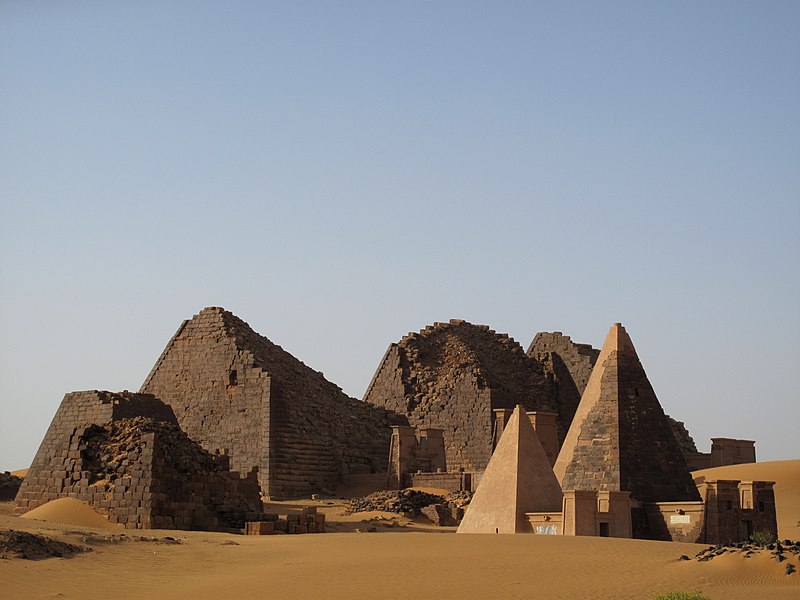
Pyramids at the northern cemetery at Meroe. The larger pyramids in the background are in ruins, but the two smaller ones in the foreground have been restored in modern times to give an idea of the original shape. Photograph by UNESCO via Wikmedia (Meroe, Sudan; c. 300 BCE – 350 CE with modern restoration; stone)
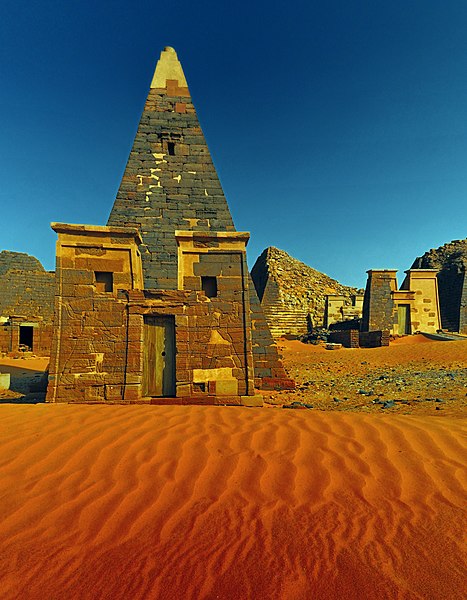
In Egypt, Kushite visitors would have seen the massive ancient stone pyramids of the early kings still famous today. They would also have seen small, steep-sided brick pyramids that were popular in later times as tomb markers for wealthy families. In their royal cemeteries in Nubia, Kushite rulers combined these forms to create stone pyramids much larger than the private monuments in contemporary Egypt, though not as large as the great pyramids of early pharaohs. These pyramids had steep sides, rising high over narrow bases. Many also had passages leading inside at ground level marked with monumental gates, a feature not found in Egyptian pyramids. While the major pyramids of Egypt were almost all built for kings, some of the largest Kushite pyramids were built for queens. These tombs drew on Egyptian ideas, but interpreted those ideas in a new way, marking the kings and queens of Kush as both connected to Egypt but also distinct.
Another view of a partially restored pyramid at Meroe. Photograph by Michael Walsh via Wikimedia (Meroe, Sudan; c. 300 BCE – 350 CE with modern restoration; stone)
The custom of building tombs in this style took hold in Nubia. Despite the depredations of modern treasure hunters, there are, in fact, about twice as many Nubian pyramids still standing today as Egyptian. They are are a remarkable piece of world heritage and a fascinating example of the adaptation and reinvention of one culture’s ideas in the hands of another.
Pyramids at Nuri. Photgraph by Vit Hassan via Wikimedia (Nuri, Sudan; c. 300 BCE – 350 CE; stone)
Out There is an occasional feature highlighting intriguing art, spaces, places, phenomena, flora, and fauna.
Ruins and abandoned places are often seen as plain and boring. Granted, the color of untreated, inexpensive rock (which the majority of surviving buildings tend to be made from) often isn’t anything to write home about. But in our fiction, ruined areas don’t need to be austere and grim. You can even find real-life ruins in a variety of styles for inspiration.
For example, houses in Herculaneum famously featured colorful mosaics and painted murals. In addition, paint was generously applied elsewhere, like these pillars and external wall from House of the Relief of Telephus show:
It’s not always humans who have applied the color onto the ruins either. At the ancient Maya site called Bonampak or Ak’e, in the Chiapas area, Mexico, strikingly orange lichen is taking over building facades:
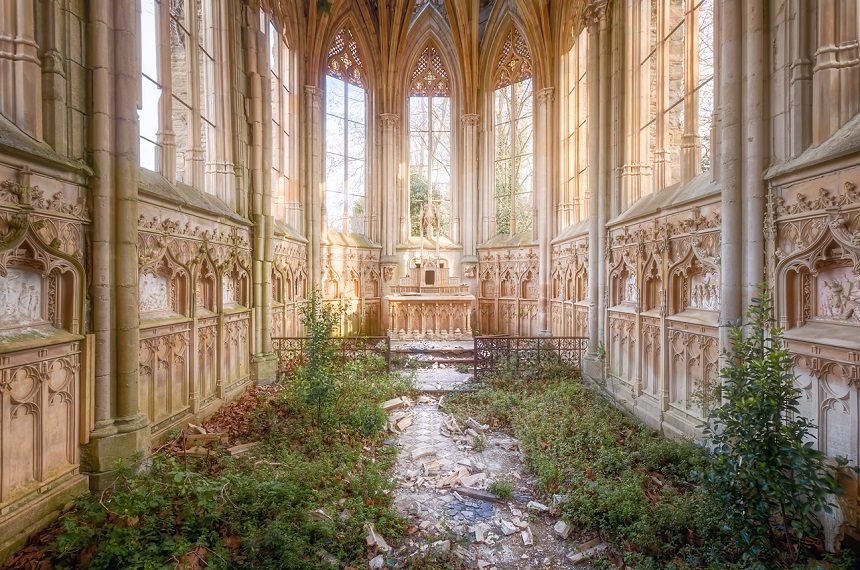
In Dutch photographer Roman Robroek’s shots we can see that a ruin definitely need not be grey, blocky, and boring. Partly overrun by nature could mean an almost orderly takeover, like in the photo of a Gothic-style former chapel built at the end of 19th century, below:
Beautiful, brightly colored arches among rubble from the childhood house of Lebanese singer Fairuz (who was born in 1934) in Beirut form a striking contrast to the greenery outside:
Finally, a still strikingly turquoise—if peeling—underside of a round staircase:
It vaguely reminds me of peacock feathers! I wish the photographer gave us a little more information about the history of this place. Browse more via Colossal or at Robroek’s website.
Since they exist in real life, I would be delighted to read about vibrantly colored and visually striking abandoned places in my genre fiction, too.
Advestudios, which produced these images, also creates videos and 360 vistas. Their work is wonderful for helping to picture these sites as living, functioning cities and settlements.
Hey, look! We found a thing on the internet! We thought it was cool, and wanted to share it with you.
A recent article in the journal Antiquity by archaeologist Debby Sneed argues that some ancient Greek temples were built with ramps to make them more accessible to people with limited mobility.
The argument begins from the observation, already familiar to archaeologists, that some temples had stone ramps leading from ground level up to the sanctuary. While in some places these ramps clearly seem designed to facilitate the movement of carts or chariots as part of religious rituals or the delivery of supplies and offerings, many are too narrow to be explained this way. Nor can these ramps be explained as part of the building process, since they are permanent and built in stone—far more difficult and expensive to construct than the packed earth ramps that would have been used in building—and they reach only to the level where people would have entered the temple, not all the way to the roof where building materials had to reach.
The interesting observation that Sneed adds to the discussion is that the distribution of these ramps is neither universal nor random, but they are particularly associated with temples connected with healing, and especially with temples where the evidence of inscriptions and votive offerings show a special focus on healing afflictions of the legs and other impairments to mobility. This pattern of distribution, while not definitive, does suggest that the ramps were purposely built at these particular sites to make it easier for people who might have difficulty climbing steps to gain access to the temple structures where they could participate in prayers or healing rituals.
Once built, of course, these ramps could well have served other purposes as well, such as making it easier to bring in offerings or supplies such as wood or wine needed for the routine operations of the temple, but this is also true of mobility accommodations today: once there’s a ramp in place, lots of people can use it for lots of different purposes. The planners of these sanctuaries may well have had this kind of multiplicity of functions in mind when building the ramps. Nevertheless, the fact that these ramps tend to appear at healing sanctuaries and not at others does indicate that the particular needs of those temples and their patrons were an important factor in the design.
The study of disability and its accommodation in history is a growing field. Studies like this one show how revisiting familiar evidence with new questions in mind can yield fertile new observations and interpretations.
Image: Artist’s reconstruction of the Temple of Asclepius at Epidaurus, Sneed, Debby, “The Architecture of Access: Ramps at Ancient Greek Healing Sanctuaries,” Antiquity (2020): 1-15, 9.
History for Writers looks at how history can be a fiction writer’s most useful tool. From worldbuilding to dialogue, history helps you write.
At CNN, an article by Poppy Koronka returns to the project launched in 2017 by the United Arab Emirates to colonize Mars within the next 100 years.
To me, though, the real point of interest is that there are now architectural plans for a potential Martian city—and plans to build a test version in the desert outside Dubai.
Quoting from Koronka’s article:
“Mars Science City was originally earmarked to cover 176,000 square meters of desert — the size of more than 30 football fields — and cost approximately $135 million.
“Intended as a space for Dubai’s Mohammed Bin Rashid Space Centre (MBRSC) to develop the technology needed to colonize Mars, architects Bjarke Ingels Group were asked to design a prototype of a city suitable for sustaining life on Mars — and then adapt it for use in the Emirati desert.”
I can’t say I routinely follow the Mars research; mostly I just read whatever happens to come my way, so plans this advanced were a surprise to me. Very impressive!










 Co-Geeking

_11.jpg)


_09.jpg)


.jpg)
You must be logged in to post a comment.