Random thoughts on Logan in no particular order. Spoilers ahead.
The movie was an interesting take on westerns. I know very little about that genre, but even I could thell the homage was there.
As expected, Patrick Stewart and Hugh Jackman were phenomenal.
It was very, very bleak, bleaker than I thought, and I went in expecting a certain amount of bleak.
The “Logan and his peeps” story was touching, but the “evil corporate types are evil” story I found cliched, boring, and corny. Those two facets of the plot didn’t really mesh well in my opinion. And speaking of evil corporate types: what’s with the mechanical hand attachments that so many of the evil army types sported? Their version of a goon uniform?? It was odd.
I was left wanting an explanation of what it was that Professor X did in Westchester that traumatized him so. (I may have missed it if it was there, since we didn’t see Logan subtitled.)
It was great to see something of the midwestern states (instead of the ever-present New York City, for example). For one thing, I had no idea Oklahoma City was so big.
Worldcon is in Helsinki this year. As a Finnish-American couple, we are very excited about this! In the coming months, we’d like to offer some practical advice about visiting Finland to our fellow fans who are considering going to the event but haven’t had experience with Finland and Finns before.
Eppu here. Sauna is among the most well-known things about Finland abroad. Incidentally, sauna might also be the most commonly known Finnish word in English (although kalsarikännit seems to be making some inroads lately). Here is a short introduction to sauna I hope will be helpful to newbies.
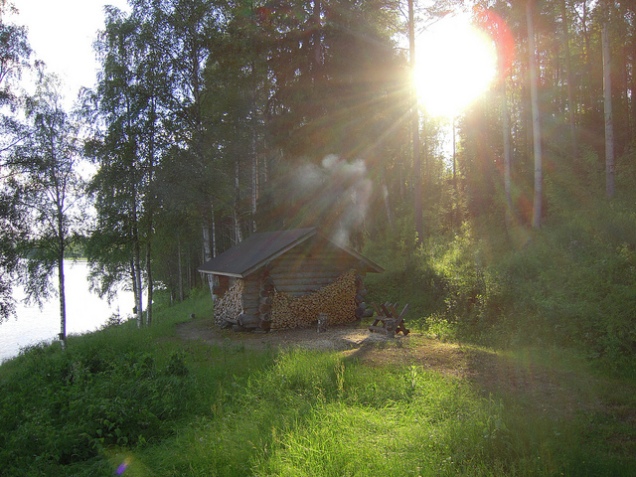
Sauna, Rovaniemi, on July 2, 2010, midnight sun; by johanjeijon
At its core, sauna bathing is exactly that: a form of cleaning yourself thoroughly. (Think extreme showering, of sorts.) Early saunas were typically small huts with benches along one wall, a wood stove (kiuas) in one corner, and a place for washing with pails of water in another. Modern saunas at pools or public baths (uimahalli) are right next to the showers, and in private homes they are attached to a full bathroom.
After an initial, quick shower, bathers sit down on the bench of their choice (high, middle, or low) and wait. If too cool, you can move up a bench and/or toss a ladle of water onto the stove for a burst of steam (löyly). If too hot, you can move to a lower bench, splash yourself with water with the ladle, or step into the shower room for a moment (or drink water, take a shower, go swim). In fact, dividing your sauna bathing into several consecutive short trips to cool off and then returning to the heat makes the experience more enjoyable. A final, good wash head to toe, fresh clothes, and a glass of water afterwards will feel heavenly.
Yes, you are indeed supposed to feel hot in sauna. Really hot. The point is to get the sweat flowing—that’s the main thing that’ll make you feel fresh and clean afterwards. However, you shouldn’t feel dizzy or bad; that’s not normal. Don’t be shy about stepping out for a moment before returning. Also note that anything metallic worn on the body (like glasses or jewellery) might get hot and feel uncomfortable.
Some people combine alcohol with sauna bathing (typically, a beer or two afterwards instead of water), but I find I get dehydrated enough to want to stick with non-alcoholic drinks. A little something savory can feel good to replenish the salt you’ve just sweated out, though.
There is some paraphernalia involved. The two absolutely essential ones are a bucket of water and a ladle, and they are included by default. If desided, you can bring a bottle of water to drink, a sauna whisk (vihta or vasta), a sauna hat, and a bathrobe (to cool off in after the final wash but before changing into fresh clothes). A small cotton or linen towel as a sit-upon (pefletti) can also be a good idea. (Note that some public saunas may require a sit-upon and rent or sell disposable ones to those who don’t bring a personal one.)
Sauna whisks for sale at a Finnish market square (kauppatori) in 2004
There are no time limits or minimum stay to “do sauna right”—you stay as long as you feel like. I know people for whom sauna bathing is an hours-long ritual, whereas I’m a fairly speedy bather myself. (Note, however, that if you’re paying for sauna access, like at hotels and pools, they typically do limit your bathing time.)
Sauna bathing can take many forms depending on the composition and mood of the group. It can be silent and meditative, or active and chatty, or anything inbetween. It can be a private affair with each bather in their own thoughts, or part of a stag or hen night. It can be a part of families’ weekend routine, or it can be enjoyed by a solitary business traveler in a hotel in the middle of the week.
That said, even the more taciturn Finns can open up in sauna. Because we’re all literally reduced to our bare essentials, sauna is seen as a great equalizer and an easier environment to talk to strange people, especially Intimidating Foreigners (thank you, Arttu, for the wonderfully self-deprecating phrase).
And yes, you really are expected to go in completely nude. This is perfectly normal in Finland. In fact, bathing suits that have been used in chlorinated pools may release toxic gases in the heat and are therefore usually prohibited in public saunas.
It’s typical for a family to bathe all together, but not necessarily outside the home, nor necessarily after the kids hit puberty. Public saunas may be either segregated or co-ed, or there may be shifts set aside for women and men separately.
Note that, as with any place where people appear in a state of undress, there are strict social codes in place. Imagine going to the beach with your family—you wouldn’t want to be stared at, followed, intruded on, touched, or have your physicality commented on. It’s the same while sauna bathing.
A note about co-ed saunas specifically: Co-ed bathing tends to skew towards the younger and/or student populations, but it’s not universal. Not all Finns are comfortable with co-ed saunas, and there’s nothing odd about that. It’s perfectly fine to skip a co-ed sauna. Breaches of conduct (lewd comments or gestures), while rare, can happen. Again, think of a beach: it’s not likely that someone misbehaves, but since it is a public setting no-one can guarantee that everyone behaves 100% of the time.
You can have a sauna year-round, and we Finns do. (Erik and I can personally testify how lovely it is to have a sauna after hand-shoveling a foot of snow from the driveway!) However, sauna bathing in the nightless night of summer is special, especially at a cottage with added dips into a lake, river, or the sea. Since Finnish natural waters can stay rather cool even in summer, it’s typical to make several visits (sauna, water, sauna, water, etc.) before washing up. And grill some sausages for a salty after-sauna snack.
Finally: It’s not weird to be apprehensive by the thought of a hot room full of naked strangers. However, sauna is a wonderful, relaxing, and cleansing experience, and may just be worth overcoming those doubts. YMMV, naturally. If you’re sauna-curious but extremely shy, a hotel room or an apartment with a private sauna (yes, both are a thing in Finland!) are a possibility.
But don’t take just my word for it. Below are links to non-Finnish sauna bathers’ thoughts. (Note: Some apply specifically to Ropecon, the largest Finnish role-playing con, and therefore to the younger end of the geeky / nerdy circles in Finland.)
And a note from Erik: For my fellow non-Finns who haven’t experienced sauna before, you may have your doubts about the whole thing. I certainly did before I tried it. Here’s what I knew about sauna before meeting Eppu and visiting Finland: 1) it’s damp and really, really, really hot; 2) you sweat a lot. Both these things are, of course, true. Now, my previous experiences with damp, hot environments and sweat were not good ones: humid summer days, over-heated pools, gym classes in un-air-conditioned spaces, etc. The thought that someone would voluntarily subject themselves to those kinds of conditions sounded very strange to me.
Here’s what I learned, though: sauna is different. In sauna, the damp heat and sweat feels good. It relaxes your muscles and quiets your mind. It gives you the all-over relaxing warmth of a hot bath, but no part of your body has to stick out in the cold air. You only stay in as long as it feels good: if it starts feeling bad, you just step out and cool down. And as soon as you’re done, you shower away all the sweat. There’s no feeling of clean quite like the clean of being fresh from the sauna.
Of course, your experience may be different. You may try sauna and decide you don’t like it, which is perfectly fine, but don’t be scared to give it a try.
Images: Sauna by johanleijon (CC BY-SA 2.0); Sauna whisks for sale by Eppu Jensen
This post has been edited to add resources.
In Live and Active Cultures we talk about cultures and cultural differences.
It’s an unavoidable fact that when we look at historical artifacts, we’re looking at things that are many years old, sometimes centuries or millennia. Physical objects, even those made of enduring materials like metal or stone, are changed by the processes of time. Exposure to light, moisture, changing temperatures, air pollution, wind, water, and other effects works changes on artifacts that can range from subtle to drastic. Our sense of what history looks like is shaped by things that no longer look like what they were when they were first being made, admired, and used by people in their daily lives.
Take, for example, the sculptures and architecture of ancient Greece. Our perception of ancient Greek art is shaped by the white marble statues and temples that remain today, but the originals were not white. We know from ancient descriptions and a few pieces with surviving traces of paint that the stone buildings and sculptures of ancient Greece were brightly colored.
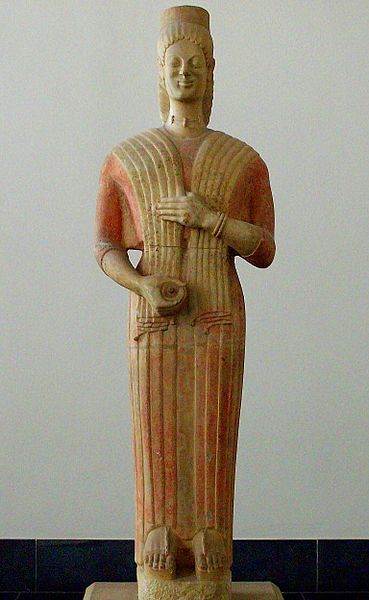
Examples like this statue of a woman, with traces of paint on her dress, suggest what such a statue might have originally looked like.
Statue of a woman (kore), photograph by Nemracc via Wikimedia (Keratea, Greece, currently Pergamon Museum, Berlin; 580-560 BCE; marble)
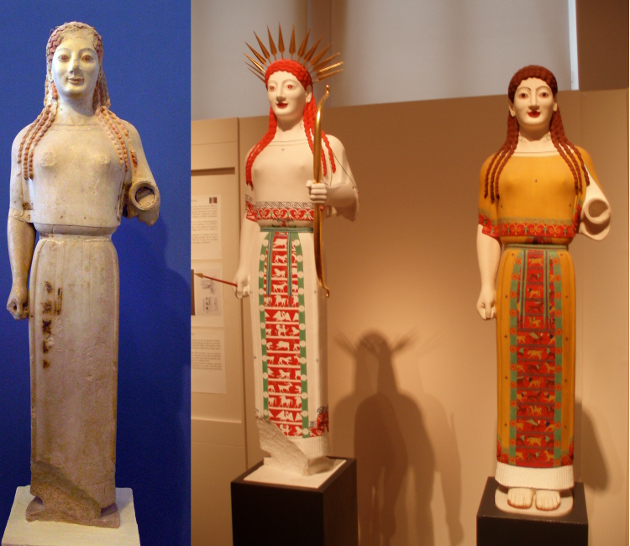
Evidence like this makes it possible to attempt to reconstruct what statues of this type looked like when first created. The two reconstructions on the right here offer two possible interpretations of what the original, on the left, may have looked like when it was new.
Statue of a woman (kore) and two reconstructions, composite of photographs by Marsyas, via Wikimedia (original: Acropolis, Athens; c. 530 BCE; marble; reconstructions: Acropolis Museum, Athens)
The striking colors of the past are not just a phenomenon of ancient Greece. At Stirling Castle, in Scotland, a recent restoration project has brought back the original rich yellow color of the walls of the medieval great hall, which was determined from traces of ochre mixed with the remains of the lime wash applied to the stone. You can see the striking contrast between the restored great hall in the background and the bare stone of the buildings in front.
Stirling Castle, photograph by dun_deagh via Flickr (Stirling, Scotland; c. 1500-1600; stone and lime wash)
Studying history requires an act of imagination. Just as we have to imagine ancient monuments are artifacts new and fresh, not as the worn-out relics we see today, we also have to imagine peoples of the past as vibrant, complicated, living societies, not the stilted, dry facts of textbooks. Fiction has a great value to the student of history, as it helps us imagine ourselves into the lives of people different from ourselves. Our history is always somebody else’s daily life.
History for Writers is a weekly feature which looks at how history can be a fiction writer’s most useful tool. From worldbuilding to dialogue, history helps you write. Check out the introduction to History for Writershere.
We like to watch tv together and we enjoy rewatching the best episodes of series we’ve seen before, but how do you remember which episodes were worth seeing again and which to skip? We came up with a solution to that problem: now when we watch a series, we rate each episode. Each of us gives each episode a rating from 0 to 5, like this:
0 – Terrible, I never want to see it again.
1 – Pretty bad, but had a few redeeming features
2 – Not awful, but kind of lacking
3 – Decent, solid, nothing special
4 – Pretty good
5 – Awesome!
(We also sometimes give half-points, so a 3.5 might be for an episode that is a little better than average.) Then we add our scores together to get a total rating from 0 to 10. We note this score down on a slip of paper that we keep with our discs. (We like to watch shows on disc. We’re old-fashioned like that.)
We often end up giving the same rating to an episode, so a rating of 6 usually means we both gave it a 3. Part of the fun of watching and rating is chatting about the episode afterwards to see how we both felt about it.
Now when we go back to rewatch a show we can decide what kind of mood we’re in. If we want to plow through everything—good, bad, and indifferent—we can. If we want to just skip the worst episodes, we can watch everything that rated above a 2. If we want only the good stuff, we can stick to 6 and above. If we only want the highlights, we can go for 8 and up. (Or straight to the tens.)
We recently finished rewatching and rating the first season of Leverage, an adventure/comedy show about a gang of thieves and con artists who decide to go straight(-ish) and start using their skills to take on wealthy criminals and evil corporations. Here’s how we felt about season 1.
The average of the ratings this season’s episodes is just under 6, which is respectable and pretty solid for the first season of a show.
The highest rating this season was an 8, for which two episodes tied. The first was the pilot, ep. 1 “The Nigerian Job,” about how the team all comes together for revenge on a corrupt executive who used them to steal a rival company’s plans and them sold them out. The other was ep. 8, “The Mile High Job,” in which the team stumbles into an attempted murder on an airplane and has to improvise their way through to keep the target safe. Both of these episodes give all of the characters plenty of time to shine and throw lots of interesting problems in their way for them to solve.
Our lowest-rated episode this season was only a 3, ep. 11 “The Juror #6 Job,” in which Parker, the team’s not-exactly-social thief, finds herself doing jury duty under one of her aliases. We found the case uninspiring and the character interactions a little icky.
Our full ratings:
Leverage, season 1
“The Nigerian Job” – 8
“The Homecoming Job” – 6
“The Two Horse Job” – 7
“The Miracle Job” – 5
“The Bank Shot Job” – 5.5
“The Stork Job” – 4.5
“The Wedding Job” – 5
“The Mile High Job” – 8
“The Snow Job” – 6
“The 12-Step Job” – 7.5
“The Juror #6 Job” – 3
“The First David Job” – 5
“The Second David Job” – 7
Any Leverage fans out there want to weigh in? Got a different pick for the best or worst episodes of the season? Let us know in the comments!
In the Seen on Screen occasional feature, we discuss movies and television shows of interest.
Author Becky Chambers argues the case for optimism in art and twines it with history:
“Optimism is important not just for the future as a whole, but for the individuals heading toward it. Again, a duality comes into play: Acting in the interest of individual need without considering the greater good breeds carelessness and greed. Acting in the interest of the greater good without considering individual need invites tragedy and injustice. You have to work with both considerations in mind. So it matters little whether an optimistic story is intended for the purpose of grand, ambitious change or simply to make a person feel better than they did before they sat down to read (or watch, or play). Those are two sides of the same coin.
“History tells us that art is—and has always been—a mirror. It shows us who we are, where we’re at, what’s at stake. But art does more than repackage reality with a fun-house twist. There’s nothing passive about a reflection. If you aim it right, it shines light back. In the times we’re in, there are few things we need more.”
I’ve read her first book, The Long Way to a Small, Angry Planet, and loved its humanity, positivity, and empathy. It’s been in my mind recently as a great counterexample to the bleakness of Logan (the latest Wolverine movie).
Serving exactly what it sounds like, the Quotes feature excerpts other people’s thoughts.
Author Johanna Sinisalo’s latest novel, dystopian The Core of the Sun (Auringon ydin, translated by Lola Rogers) has gained another distinction: it is a finalist for the 2017 Prometheus Award.
GoH Johanna Sinisalo's The Core of the Sun is nominated for the Prometheus Award. Winner declared at #Worldcon75 ! https://t.co/UtnGVZQSUT
The Prometheus Award, sponsored by the Libertarian Futurist Society (LFS), was established in 1979, making it one of the most enduring awards after the Nebula and Hugo awards, and one of the oldest fan-based awards currently in sf. Presented annually since 1982 at the World Science Fiction Convention, the Prometheus Awards include a gold coin and plaque for the winners.
Congratulations! I hope she will give a talk on on TCotS at Worldcon 75.
Finnish Weird is a recent project to publish new Finnish speculative fiction in English. Published yearly by the Helsinki Science Fiction Society and edited by Toni Jerrman, the issues are available online for free to read or download as either epub or pdf.
Each volume contains feature articles well as short stories by big-name authors such as Anne Leinonen, Leena Likitalo, Johanna Sinisalo, Pasi Ilmari Jääskeläinen, Maria Turtschaninoff, and others. At this writing, the fourth issue (2017) has just been released.
Author Johanna Sinisalo introduces the project and the style suomikumma (“Finnish weird”) in the inaugural 2014 issue:
“After barely a couple of hundred years of written literary tradition and decades of gatekeepers who have shunned works including elements of fantasy as cheap escapism, Finnish writers now create fiction that is a phenomenal mixture of sf, fantasy, horror, surrealism, magic realism – you name it. It’s highly original, fresh and surprising, sometimes it celebrates elements of our rich folklore and mythos, sometimes it soars sky-high in sf worlds, sometimes the stories are almost realistic, but have that little weirdness or twist that makes them something other than mimetic writing.
[…]
“I’m not trying to say that we Finns reinvented the wheel – new weird – and are trying to claim it as our own, not at all. What I am saying is that Scandinavian countries did not invent crime stories either, but in the wake of the international success of detective and crime fiction from Sweden, Norway, etc., ‘Nordic Noir’ has become a label for a certain quality of story. In my opinion, the label ‘Finnish Weird’ is also a brand – a brand that promises a roller-coaster ride of highly original prose from very diverse writers with truly personal styles. We are weird and very proud of it.”
Being in middle management sucks. You’re stuck between unreasonable bosses and uncooperative workers. If you’ve ever been in that position, you might have some sympathy with Panakestor, the overseer of a farm in Ptolemaic Egypt some of whose daily correspondence has been preserved on papyrus in the desert climate.
Between 323 and 30 BCE, Egypt was ruled by the Ptolemies, descendants of one of Alexander the Great’s generals. Ruling from Alexandria on the coast, the Greek-speaking Ptolemies depended on a large class of local administrators and subordinates to deal with the Egyptian-speaking population. Some of these subordinates were immigrants from Greece or other regions around the Aegean Sea; others were native Egyptians who saw opportunities working for the new regime. Panakestor was a Carian, from southwestern Anatolia (modern-day Turkey). He oversaw an estate near a town called Philadelphia belonging to Apollonius, a big shot in Alexandria who owned many such estates around Egypt.
The original agreement between Apollonius and the Egyptian farmers who worked his land was simple: at harvest time, they would hand over one third of their crop as rent and keep two thirds for themselves. In 257, however, Apollonius decided he wanted to change the system, even though it was very late in the season and almost harvest time anyway. Now he wanted the farmers to estimate the value of their crop at the beginning of the growing season and pay a portion of that as rent up front. This new arrangement would be good for Apollonius as he could guarantee his income, but if the crops failed the whole risk would be on the farmers.
Apollonius sent out a message ordering Panakestor to put the new system in place. Panakestor did his best, but soon wrote back explaining that things were not going well. Apollonius then sent out an impatient second memo:
[To Panakestor] from Apollonius. I was astounded at your negligence that you have written nothing, either about the estimation or about the harvest of the grain. Write to me now how each matter stands.
– PSI (Papiri della Societa Italiana) 5.502
(My own translations)
Panakestor wrote back giving fuller details of the problem. His letter also survives:
Worldcon is in Helsinki this year. As a Finnish-American couple, we are very excited about this! In the coming months, we’d like to offer some practical advice about visiting Finland to our fellow fans who are considering going to the event but haven’t had experience with Finland and Finns before.
Erik here. There is something special about the summertime in Finland and if you haven’t experienced it before, you have a lot to look forward to. If you’re not used to the summer at high latitudes, though, you should know what to expect. Here are some things to keep in mind:
The Finnish summer is a time of light. In northern parts of the country near midsummer, the sun is in the sky all night long and there’s no visible difference between midnight and noon. In Helsinki in August, although the sun does set for a few hours, it doesn’t get darker than twilight. Expect to see a lot of sun.
Unless it rains, which can happen a lot. There’s an old joke: “The Finnish summer may be short, but at least it doesn’t snow much.” Summer weather can be changeable, from cold, raw, and rainy to clear and hot. Be prepared for all possibilities.
If you’re not accustomed to the light summer nights, they can mess with your body clock (especially when piled on top of jet lag). You may find it easy to lose track of time without the changing light to cue your body to feel hungry or tired. Keep an eye on the time and make sure you’re eating and sleeping regularly.
If you’re like me, the light nights may also make it hard for you to sleep. Most hotels in Finland will have light-blocking curtains, but you may also want to consider a sleep mask. (I find melatonin very helpful for regulating my sleep as well.)
With the light nights, it cal also be easy to lose track of time if you have an appointment to make or shopping to do. Many Finnish shops and restaurants are not open as long as Americans may be used to, and they may have different hours in the summer (including some that have very limited weekend hours). It’s always a good idea to check store hours ahead of time.
Summer is also mosquito and tick season. If you’re going to the woods (which you definitely should, if you have the chance), make sure you protect yourself well with long, loose, light clothing and bug spray.
Finnish summer night
Despite these warnings, the Finnish summer is magical. There is really nothing to compare with the light, quiet summer nights. If you have the opportunity, go for a late-night walk. You’ll be glad you did.
Speaking of magical, don’t miss out on Finnish ice cream. Ice cream kiosks pop up all around in the summertime where you can get a cone or ice cream bar. Finns make good ice cream, and a lot of it is low-lactose or lactose-free (look for “VL” / “vähälaktoosinen” or “laktoositon”), and/or gluten-free (“GL” or “gluteeniton”).
I hope you enjoy seeing Finland in the summer. It is one of the best times to visit the country. It is also one of the best times for meeting Finns. The summer is a relief from the cold, dark winter and, at least for some people, it can have an effect on temperament. Characteristically dour, taciturn Finns can become more relaxed and open in the summer sun, even a little goofy. Summer is when this sort of thing happens:








 Co-Geeking
_1.JPG)

