The Rules of (Ancient) Magic

Not too long ago I was perusing a post by the fantasy author N. K. Jemisin about magic in fantasy. (The post is from several years back, but it only came to my attention recently—it’s well worth reading both the post and the comments after, if you’re interested in fantasy writing.) Jemisin takes issue with contemporary writers who obsess over rules and systems for magic rather than letting magic be the strange, unpredictable, sometimes frightening force that it often was in older fantasy by authors like Tolkien and Le Guin.

Naturally, being a historian of the ancient Mediterranean by training and a fantasy fan and author by inclination, it got me thinking about how magic is used in ancient Greek and Roman literature. The first problem is how to define magic. Lots of strange things happen in classical myths, but most of those are the action of gods, to whom turning people into peacocks or birthing fully-armed daughters out of their heads comes naturally. Ancient societies also widely believed that humans had the ability to invoke the gods to take action on their behalf through rituals including offerings, prayers, curses, and dances. I’m taking a more limited definition of magic, however: supernatural powers and events produced directly by humans at their will without requiring the aid and participation of gods or other superhuman entities. Using this definition, magic is actually quite rare in ancient literature, but here are a few examples.

In the Odyssey by Homer, the witch Circe uses enchanted food and a magic wand to transform Odysseus’ crew into animals. The god Hermes points Odysseus to a special herb which protects him from Circe’s magic as long as he is holding it, which allows him to overcome Circe and force her to restore his crew. (As a side note, this part of the epic may ultimately derive from Babylonian myths about the god Marduk, who held a sweet-smelling herb to protect himself from the poisonous blood of the dragon Tiamat and her monstrous children.)

In Euripides’ drama Medea, the sorceress Medea, abandoned by her husband Jason, sends a poisoned robe and crown to Jason’s new bride, Glauce. When Glauce dons the poisoned gifts, they cling to her body and burn her to death.

In Apuleius’ novel Metamorphoses (often also called The Golden Ass), the narrator Lucius learns that his friend’s wife dabbles in magic and can transform into a bird by rubbing a magic potion on her body. Lucius wants to try the same and steals some of her potion, but by mistake he gets the wrong one and is turned into a donkey. From the lady’s maid, Photis, he learns that the secret to reversing his transformation is to eat rose petals, but roses are not in season and the rest of the novel follows Lucius the donkey from one misadventure to the next as he tries to find roses to eat.

From these examples, we can notice some patterns about how Green and Roman authors thought about and used magic. On one hand, there is no sign of a magic system, as described by Jemisin. There are no universal rules and no explanation for how or why magic works. Every individual case is different. It depends upon secrets known only to its users, never shared with the audience, and its results often shock and terrify those who encounter them.

At the same time, even though we cannot call this magic systematic, there is a consistency to it. It tends to require special objects or substances, such as enchanted food, magic flowers, poisons, and potions. Those who are initiated into its powers can use them with confidence: Medea knows that her poison will be effective, just as Circe knows she is defeated when she sees Odysseus carrying the plant that makes him immune to her power. When the effects fail or go awry, it is because of ignorance or ineptitude on the part of the wielders, like Lucius using the wrong potion.

Despite this general consistency, the magic remains narratively powerful. It does not become dull and predictable or divert the stories away from the characters’ choices and their consequences. In fact, magic makes possible the human stories that are at the center of these narratives, from Medea’s calamitous vengeance to Lucius’ comic wanderings. How does it achieve these things? A few observations:

The stories include magic; they aren’t about magic. Magic is a MacGuffin. It sets things in motion or presents characters with choices to make, but once the magic has done its job, it disappears into the background and lets the characters get on with things.

Magic does not solve or circumvent the crucial problems. The human issues and choices at the center of these stories are ones that magic cannot touch. Odysseus is trying to get home. He deals with magic and monsters on his way, but it isn’t magic that gets him where he wants to go. Medea’s magic gives her the power to deeply hurt Jason in a way that a mundane woman in her position could not, but the story is about how she makes the choice to use that power. Lucius’ magical mishaps drive him to rethink his unsatisfying life and resolve to be a better person. Magic presents these characters with challenges and choices they wouldn’t otherwise face, but their stories are still about what happens in their hearts and minds.

We know only as much as we need to know. Apuleius does not list the ingredients in Lucius’ donkeyfying draught, nor is there an appendix at the end of the Odyssey to explain how Odysseus’ magical plant disrupted the mystical ether currents that Circe manipulated with her wand. Medea does not take time out from her revenge plot to give the audience a primer on fiery poisons. The magic simply works the way it is supposed to, and that’s all we need to know.

Thoughts for writers

There’s room in fantasy literature for many kinds of magic, from complex and internally consistent systems to strange and unpredictable effects. There’s even a place for fantasy with no magic at all. Whatever kind of fantasy you feel like writing, though, remember this: the story comes first. Whatever you do with your magic, don’t let it get in the way of your characters and the choices they have to make.

Image: Circe flees from Odysseus, with animal-headed crew, detail of photograph via Wikimedia (Metropolitan Museum of Art; c. 440 BCE; red-figure vase; by the Persephone Painter)

History for Writers is a weekly feature which looks at how history can be a fiction writer’s most useful tool. From worldbuilding to dialogue, history helps you write. Check out the introduction to History for Writers here.

80s Pop Improved by Fight Scene from Thor: Ragnarok

Incredibly, a fight scene from Thor: Ragnarok kind of goes with an 80s pop track:

Thor Ragnarok – I NEED A HERO!!! FUNNY via Locus on YouTube

The song in the background is “Holding out for a Hero” by Bonnie Tyler. Impressive job matching some of the punches on screen to the music.

Then I made the mistake of looking up the original music video. Oh, boy…!

WTF Is This Cat

Found via N. K. Jemisin on Tumblr.

Image: Confused cat via Meme Binge on Flickr (CC BY 2.0)

This post has been edited to correct a typo.

Some things are just too silly not to share!

Rating: Doctor Who, Season 6

Our rewatching and rating project carries on with season 6 of new-series Doctor Who. Here’s our ratings for this season’s episodes:

  1. “A Christmas Carol” – 7
  2. “The Impossible Astronaut” – 6
  3. “The Day of the Moon” – 7
  4. “The Curse of the Black Spot” – 4
  5. “The Doctor’s Wife” – 4.5
  6. “The Rebel Flesh” – 4
  7. “The Almost People” – 1.5
  8. “A Good Man Goes to War” – 6.5
  9. “Let’s Kill Hitler” – 6
  10. “Night Terrors” – 2
  11. “The Girl Who Waited” – 2
  12. “The God Complex” – 3.5
  13. “Closing Time” – 4
  14. “The Wedding of River Song” – 3.5

The average episode rating for this season is 4.4, which is a rebound from last season’s 3.7, but still well below the first four seasons.

This season has its good moments. The production team seems to have gotten a better handle on things and most of the episodes feel polished. The actors seem more comfortable in their roles and more willing to stretch their interpretations of the characters. A few episodes deliver new and creative stories. At the same time, a lot of this season feels underwhelming or poorly thought-out.

Our lowest-rated episode for the season, at 1.5, is “The Almost People,” the second part of a grimy industrial-punk story about goop-doppelgangers (goopelgangers?) gone rogue in a future acid-mining operation that for some reason happens in the remains of a medieval monastery. (Someone on the Who team clearly has a thing for goopelgangers: see season 4’s “The Sontaran Strategem” and “The Posion Sky.”) The first part was a bit nonsensical and left a lot of unanswered questions hanging (Why is acid-mining such a big deal in the future? Why use goopelgangers for it? Why are they in a medieval monastery? How did any of this get past health and safety, let alone the heritage council?), but at least it promised the possibility of a good old classic sci-fi “Who’s real?” and “What is the measure of a human?” story. The second part, though, just kind of falls apart and doesn’t pay off. Like last season’s “Flesh and Stone,” and “Cold Blood,” the second half of the story gets sidetracked into serving the season-long arc.

There are brights spots this season, though. Things start off at a strong 7 with an ingenious Christmas episode in which the Doctor finds himself traveling back in time to play Ghosts of Christmases Past, Present, and Future and save the soul of a heartless old plutocrat just in time to save a crashing spaceship with his friends Amy and Rory on board. A two-parter follows, “The Impossible Astronaut,” rated 6, and “The Day of the Moon,” another 7, about the Doctor’s friends trying to save the Doctor from being killed by a mysterious figure in a spacesuit and in the process discovering the sinister Silence, who erase themselves from the memory of anyone who sees them. These episodes are a good mix of horror, action, and comedy, and the Silence make interesting counterparts to the Weeping Angels: while the Angels disappear when you look at them, the Silence disappear when you look away.

Although this season has its ups and downs, it also has some larger problems. One is the ongoing obsession with an arc story, which gets significantly more convoluted in this season, sometimes to the detriment of what could have been decent stand-alone stories. New-series Doctor Who has a pretty bad track record when it comes to season-long arcs. Most of them feel obligatory and ratings-driven rather than organic and meaningful. Arc-dependent episodes have consistently been some of the worst, while the best episodes have been those that have nothing to do with the arc. I’d be happy to see Doctor Who stop trying to be Lost and focus on being Doctor Who.

Another problem, which appeared in earlier seasons but gets significantly worse over seasons 5 and 6, is the amount of time and narrative attention given to other characters talking about how great the Doctor is. It was used as a cheap get-out-of-plot-free card at the end of season 3’s “The Last of the Time Lords,” in which a world full of people thinking good thoughts about the Doctor powers the deus ex machina ending, but in season 6 it becomes a recurring theme as ubiquitous as the whooshing of the Tardis. Even River Song, who started off as a fascinating character in her own right, gets reduced to a chorus girl singing the “Oh, Doctor, you’re so amazing” refrain this season. This character shilling goes along with the continuing attitude that special people get a pass on basic human decency to make some scenes really uncomfortable to watch.

How do the rest of you feel about this season? Got any favorites (or anti-favorites) you want to share? We know that not everyone shares our tastes or out perspective on Doctor Who, so let us know in the comments what you loved or didn’t about this season.

Image: Doctor Who season 6 via IMDb

In the Seen on Screen occasional feature, we discuss movies and television shows of interest.

Geeky, Feminist Motivational Posters for the International Women’s Day

Due to a post-winterstorm blackout a week more than two weeks ago, I’m still catching up on my Internet reading, so I only saw these awesome, nerdy motivational posters now after the International Women’s Day. It was worth the wait, though:

Tumblr Risa Rodil Poster Shuri Improved
Risa Rodil on Tumblr.

“Just because something works doesn’t mean it can’t be improved.”

Referring of course to Shuri from the movie Black Panther. As another tinkerer, I wholeheartedly agree! 😀

Tumblr Risa Rodil Poster Successful Woman Herself
Risa Rodil on Tumblr.

“Behind every successful woman is herself.”

The posters are by letterer, illustrator and designerd Risa Rodil. She posted them on Tumblr in honor of the International Women’s Day (March 08).

Visit Risa Tumblr post for more geeky feminist posters. And while there, look at the rest of her work – such a distinct, lively, whimsical style. I especially liked this library poster:

Tumblr Risa Rodil Poster When Doubt Library
Risa Rodil on Tumblr.

“When in doubt, go to the library.”

Find more about Risa on her website, including where to buy her designs.

Images by Risa Rodil via Tumblr: Shuri and successful woman. Library.

This post has been edited.

Out There is an occasional feature highlighting intriguing art, spaces, places, phenomena, flora, and fauna.

Some Interesting Early Photo Portraits

I’m not a fan of the Victorian age per se, but watching Murdoch Mysteries has piqued my interest somewhat. Here are some intriguing photographs from the later 1800s to early 1900s.

From a set of unscripted photos taken in the streets of 1890s Norway by Carl Størmer, a young woman with books:

Imgur Carl Stromer Young Woman w Books 1890s
Young woman with books, photograph by Carl Størmer via Imgur (Oslo, Norway, 1890s)

All of the subjects in this set are remarkably relaxed. Love the contrast to the stiff studio portraits of the era!

(I’ve had trouble finding a more detailed source, unfortunately. Possibly Størmer’s photos are gleaned from the 2008 book 80 millioner bilder: Norsk kulturhistorisk fotografi 1855-2005 [’80 Million Pictures: Norwegian Culture-Historical Photography 1855-2005′], edited by Jonas Ekeberg and Harald Østgaard Lund.)

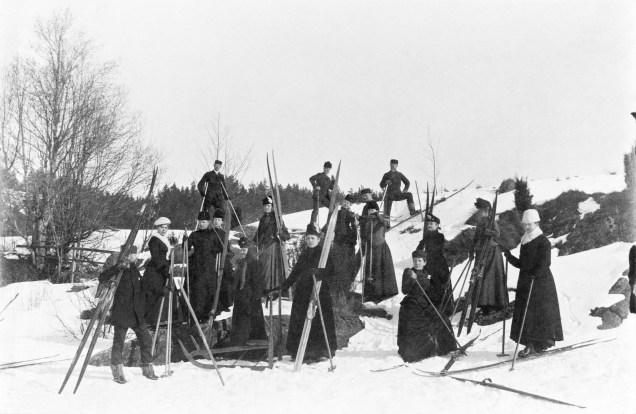
Finnish ladies and gentlemen on a ski trip in the 1890s:

Helsinki City Museum N252030 Hiihtoretkelaiset
Hiihtoretkeläiset ryhmäkuvassa (‘ski trip participants in a portrait’), photograph via Helsinki City Museum (Helsinki, Finland, 1890s, image number N252030, CC BY 4.0)

Judging by their attire, they are indeed ladies and gentlemen. What struck me is that, apparently, it wasn’t at all odd for the upper class to go skiing in their regular daywear.

Speaking of sports and Victorians, from 1891, here is high school dressage equestrian Selika Lazevski by Félix Nadar:

Black Female Equestrians Felix Nadar Selika Lazevski
Selika Lazevski, photograph by Félix Nadar courtesy of Ministère de la Culture, France, via Black Female Equestrians (Paris, France, 1891)

What an arresting portait!

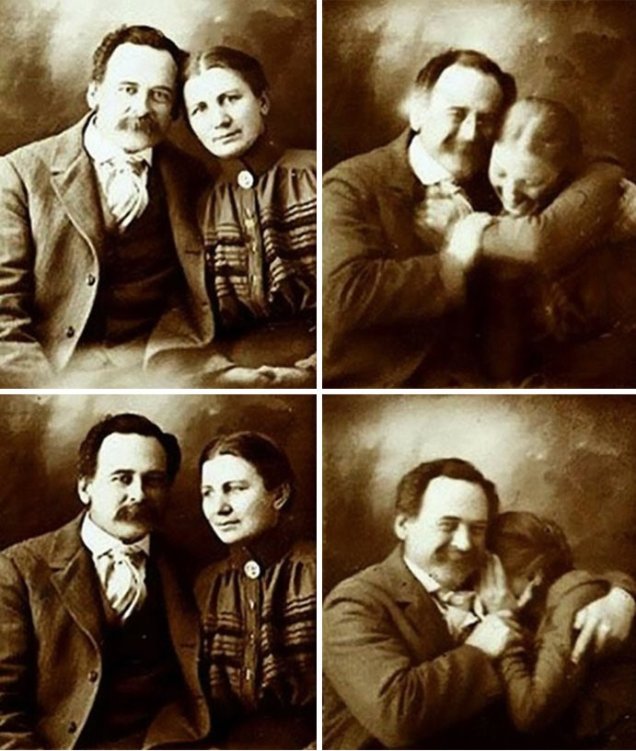
A Victorian couple from Leeds trying not to laugh while getting their portraits done in the 1890s:

Twitter Leeds Centre for Victorian Studies Couple Trying Not to Laugh
Victorian couple trying not to laugh while getting their portraits done, photograph via Leeds Centre for Victorian Studies on Twitter (Leeds, England, 1890s)

It’s like a photo version of a blooper reel! 🙂

Two Victorian ladies making a life-sized snow lady, also from Leeds in the 1890s:

Twitter Leeds Centre for Victorian Studies Making Snow Lady
Two Victorian ladies making a snow lady, photograph via Leeds Centre for Victorian Studies on Twitter (Leeds, England, c. 1890s)

With the correct corseted posture, dress ruffles, and hairdo. Wow, ladies, what a great job!

Nellie Franklin photographed holding a parasol in Tallahassee, Florida, between 1885 and 1910:

Florida Memory Nellie Franklin with Parasol HA00227
Nellie Franklin with parasol, photograph by Alvan S. Harper via Florida Memory (State Library & Archives of Florida) (Tallahassee, Florida, between 1885 and 1910, image number HA00227, public domain)

This photo clearly references painted portraits as ancestors of photographic ones.

A young man in a wheelchair:

Yale Robert Bogdan Disability Collection Wheelchair
Young man in a wheelchair, photograph via the Robert Bogdan Disability Collection at Yale University’s Medical Historical Library

Victorians certainly loved their wheels! I wonder exactly how one would’ve operated this chair—there’s clearly a handle bar connected to the front wheel, but if grabbing it with both hands, where does the propelling force come from?

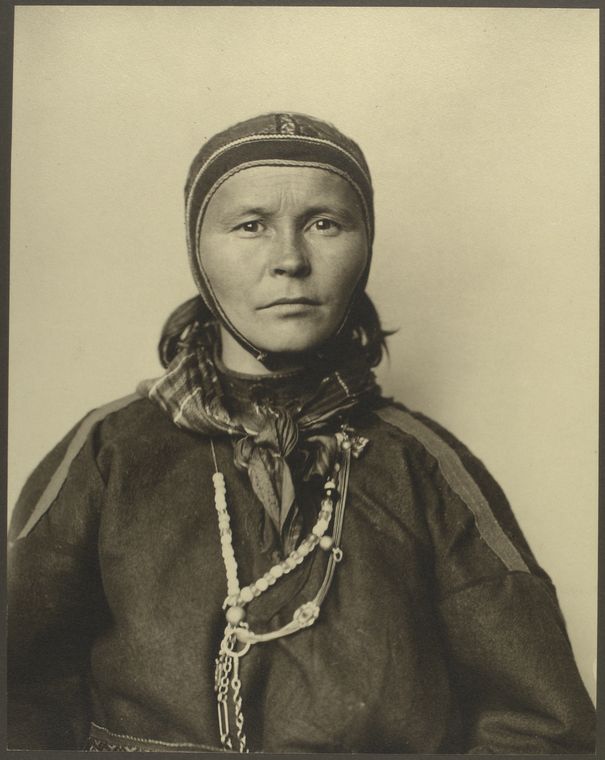
A Sami woman from Finland photographed at Ellis Island in the U.S., so presumably immigrating, around 1905-1914:

NYPL Digital Augustus Sherman Sami Woman 418041
Laplander / Sami woman from Finland, photograph by Augustus F. Sherman via New York Public Library digital collections (Ellis Island, New York, NY, c. 1905-1914, image ID 418041, public domain)

I wish the portrait hadn’t cut off at the waist; I would’ve liked to see the rest of the details of her dress (the belt looks especially interesting). I know that nowadays Sami outfits (gákti) are unique. Each is made for its wearer to reflect the personal / family history and area (and possibly the people as a whole?). I don’t know, however, how far back in time that practice goes.

Anyway. These old photos give fascinating glimpses of western life only about 100 years ago. So similar and yet so, so different.

Out There is an occasional feature highlighting intriguing art, spaces, places, phenomena, flora, and fauna.


Waiting for Mandulis

Then bright Mandulis came from high Olympus

bearing his bright cheeks and walking by the right hand of Isis.

You boast how you provide for the people,

how day and night and all the seasons revere you

and call you kin, Breith and Mandulis,

stars, emblems of the gods rising in heaven.

– Paccius Maximus

(My own translation)

These lines come from a poem written by a Roman soldier named Paccius Maximus and painted on the wall of the temple to Mandulis at Kalabsha, in modern Sudan. We know very little about Paccius besides what he tells us in this and one other poem, but based on some clues he is believed to have been a local African officer in the late Roman army.

Mandulis, often associated with his twin brother Breith, was a Nubian sun god. It’s interesting to note how Paccius readily connected Mandulis with both the Olympian gods and the Egyptian goddess Isis, easily harmonizing Greco-Roman, Egyptian, and Nubian religious traditions. His poem gives us a glimpse at how culturally complex and interconnected the world of the Roman empire was.

But, as fascinating as Paccius’ poem is, it’s on my mind today for a different reason.

It snowed here last night. Again. That’s the fifth snowstorm we’ve had this March.

You see this stuff? You see it? I’m sick of it. I like winter just fine, but it’s time for this winter to be over.

Mandulis, wherever you are, we could really use you and your bright cheeks right now. Any time you want to come start providing for us people here, buddy. Any time. I’ll be waiting.

When the suckage just sucks too much.

Downloadable Pattern for Nakia’s Scarf from Black Panther

Ruth E. Carter, costume designer for Black Panther, tweeted the knitting pattern for Nakia’s scarf. The pattern and scarf were created by Jeff Gillies.


Ravelry Black-Panther-Nakia_medium

Ravelry Nakia_s_Scarf_2_medium2

Since the pattern didn’t come through in full on Twitter, Gillies made the whole pattern available for download at Ravelry, including gauge information and recommended yarns.

Squee! How awesome!

Images by Walt Disney Pictures, Marvel Entertainment via Jeff Gillies at Ravelry

In Making Stuff occasional feature, we share fun arts and crafts done by us and our fellow geeks and nerds.

Transmog: The Wearing of the Green

Spring is almost upon us and its time to break out the green. We’ve put on our best spring transmogs just in time for St. Patrick’s Day.

Erik here.

Here’s my Tauren warrior in what I call her Boreal Defender set.

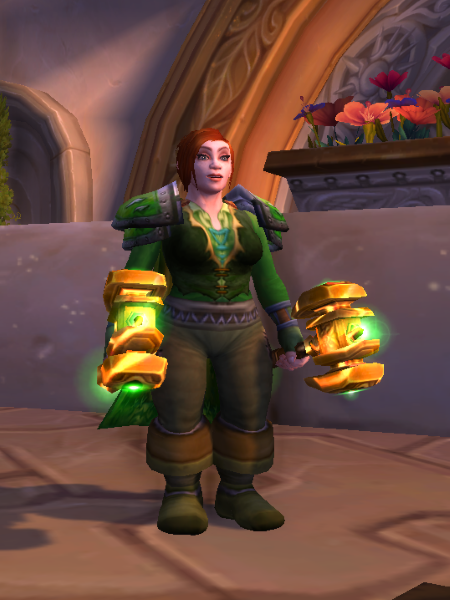
And here’s my Dwarven hunter wearing her Luck o’ the Dwarvish set.

Eppu here.

Despite her resplendent golden, white, and turquoise dress, my fire mage also rocks green.

WoW StPats Mog Fire Mage

And my rogue decided to dual-wield golden hammers with green stone accents.

WoW StPats Mog Rogue

Here is her full set.

Do you typically do a special mog for spring?

Of Dice and Dragons is an occasional feature about games and gaming.

Option for Breaking out of Eurocentric Worldbuilding Mold: Yareta Plants

Yareta or llareta (Azorella compacta) is a low evergreen that grows in the Andes mountains in Peru, Bolivia, northern Chile, and Argentina.

Flickr Miguel Vieira Yareta Ollague Volcano Lookout

Looking at the landscape where it’s found, it seems that the yareta latches onto ground or rock and grows up and out into the rounded shape over the years.

Flickr Knut-Erik Helle Yareta Bolivian Altiplano

The rounded, cotton-ball-like shape reminds me of how some mosses grow. Unlike them, though, the yareta can grow in dry conditions and nutrient-poor soil, if slowly. (According to Wikipedia, their growth rate is approximately 1.5 cm / 0.6 inches per year; however, an article in Pharmacognosy Magazine cites 1 cm in 20 years.)

Apparently the Andean people used yareta since Pre-Columbian times for the treatment of colds, pains, diabetes, asthma, bronchitis, womb complaints, gastric disorders, backache, wounds, and altitude sickness (Pharmacognosy Magazine Aug 2014).

Yareta looks like a great option for speculative writers and artists looking to break out of the Eurocentric worldbuilding mold.

Images: Yareta at Ollague Volcano lookout by Miguel Vieira via Flickr (CC BY 2.0). Yareta – Bolivian Altiplano by Knut-Erik Helle via Flickr (CC BY-NC-ND 2.0)

Out There is an occasional feature highlighting intriguing art, spaces, places, phenomena, flora, and fauna.

British Library’s Exhibition Harry Potter: A History of Magic Now Online

The British Library has partnered with Google Arts & Culture to bring online their physical exhibition Harry Potter: A History of Magic.

British Library Google Harry Potter A History of Magic Exhibition

Apart from various aspects of the story and the movie series, the exhibition covers for example illustrations, the history of real-world magic, and early sketches and notes by J.K. Rowling. In addition, on display are a number of items from the Museum of Witchcraft and Magic.

My favorite feature is perhaps the section covering the real-world history of various Hogwarts classes, closely followed by the animals and fantastical beasts section.

Found via Helsingin Sanomat.

Image: screencap from the Google Arts & Culture page for the Harry Potter: A History of Magic exhibition

Out There is an occasional feature highlighting intriguing art, spaces, places, phenomena, flora, and fauna.