Myths and Marketing

A lot of people have made comparisons between the pop-culture heroes of today like Marvel’s superheroes or the characters of Star Wars and the heroes of ancient Greek myth. (I’ve done it myself, here and here.) There’s a lot to be said for these comparisons in terms of narrative, but there are also interesting similarities in the way these characters are portrayed visually and sold to an admiring public.

Ancient Greek art went through an extraordinary transformation over a few centuries from the early archaic age (mid-700s BCE) to the high classical age (mid-400s BCE). One of the most telling signs of this transformation was the change in how mythic characters were represented.

Geometric krater, photograph by Metropolitan Museum of Art (found Attica, currently Metropolitan Museum of Art, New York; 750-730 BCE; pottery; attributed to the Hirschfeld workshop)

Here is a scene from a Greek vase painted around 750. The human figures are highly abstracted with no individual identifying characteristics. We can make out some of what is happening in the scenes. In the upper register, a single figure lies horizontally on a table or bed surrounded by standing figures with their hands on their heads. This scene is generally interpreted as a funeral, with wailing mourners surrounding the deceased. On the lower register, warriors with shields ride in chariots. Still, for as much as we can make guesses about what is going on in these images, the details elude us. Are these generic images or are they meant to tell a story? Are the two registers even related to one another? One possibility is that this image represents the funeral for Patroclus, from the Iliad, with the funeral pyre on the upper register and the games in honor of the dead on the lower, but we have no way of knowing for sure whether that was what the artist intended or not.

Polyphemus amphora, photograph by Sarah C. Murray via Wikimedia (currently Archaeological Museum of Eleusis; c. 650 BCE; pottery; Polyphemus painter)

This image comes from a vase painted a hundred years later, around 650 BCE. Now we have a definite story. A group of men come from the left carrying a long spear to stab the eye of a larger, seated figure on the right holding a drinking cup. Putting all these elements together, it is clear that this scene represents the blinding of Polyphemus, the giant cyclops whom Odysseus and his men got drunk before stabbing his one eye out. The scene is clear enough if you know the story, but reading the image depends on knowing the whole story and seeing the whole picture. The figures within it are not distinctive. If you took any one of the figures out and looked at it on its own, you would have no way of identifying it or guessing what story it came from.

Black figure olpe, photograph by Jastrow via Wikimedia (currently Louvre; c. 540 BCE; pottery; Amasis)

Another century later, the ways of depicting mythic figures had developed into something new. In this vase painting, from about 540, we see figures with distinctive characteristics. On the left a robed and bearded man holds a trident: unmistakably Poseidon, god of the sea. Hermes, the messenger god, approaches him, recognizable from his broad-brimmed hat, his snake-twined herald’s staff, and the wings on his sandals. Athena comes next, indicated by her helmet and spear and the shield she carries bearing her symbol, the owl. Behind her comes Heracles, not so visible in this image but still recognizable from the bow he carries and the lion skin he wears. Even though nothing much is happening in the image—it’s just a line of people—with this combination of characters, we can tell that it is representing the story of Heracles’ ascension to join the gods on Mount Olympus. Each character, though, is distinct. You could take any one of them out of the scene, and you would still know who you were looking at.

Ancient Greek art developed a rich but understandable visual language for identifying important figures from mythology. To understand why this development mattered, we have to think about the Greeks’ place in the larger Mediterranean.

Despite the importance the modern West has accorded to ancient Greek culture, ancient Greece itself was not a powerhouse of the Mediterranean. Greece was a poor, fractious backwater compared with the great centers of wealth and culture like Egypt, Persia, and Carthage. Trade was crucial to the Greeks’ survival, which meant they had to have something to offer that other people wanted. Wine and olive oil were the major commodities the Greek traded overseas, but over time they increasingly began to export their cultural products as well. Greek artisans, poets, musicians, and actors found work throughout the Mediterranean world and beyond. The changes in how Greeks depicted myths in their art went along with their expansion into the Mediterranean’s trade networks.

Exporting culture only works if your culture can offer something the market wants. The most valuable cultural property the Greeks had was their mythology. Greek mythology was not a complete and canonical body of work to be exported whole (as I discuss here), but a flexible, malleable set of stories and characters ready to be reimagined and recombined in new and unique ways. This flexibility allowed individual Greek artists and merchants to offer their patrons and trading partners versions of myths that suited the tastes of the local market. Heracles, for instance, went over well in Etruria, and before long Etruscans were creating their own stories about the character (calling him “Herkle”) that no Greek would have imagined. The Amazons similarly found their way into Egyptian literature. Underlying it all was a set of characters (gods, heroes, monsters) with basic identifying characteristics, personalities, and stories. A Persian or Carthaginian picking up a new Greek vase in the market might not know all the myths depicted on it, but it was easy to recognize Athena’s owl or Heracles’ lion skin and begin to put together the story from there.

In a similar way, symbolic attributes have become an important part of how we identify our modern heroes. From Captain America’s shield to Luke Skywalker’s light saber, from the Doctor’s TARDIS to the house crests of Westeros, having a set of easily recognizable symbols helps us identify our favorite characters and stories at a glance. They are also great fodder for marketing merchandise—which is exactly what our ancient Greek counterparts were doing with their mythology, too. Besides being the common cultural property of a far-flung people, Greek myths and their visual representations were a brilliant marketing device that got lots of Etruscans, Romans, Egyptians, Scythians, and others to buy Greek goods.

History for Writers looks at how history can be a fiction writer’s most useful tool. From worldbuilding to dialogue, history helps you write.
Rating: Castle, Season 1

We enjoyed the mystery/comedy Castle, despite some problems, and it makes a good comfort rewatch when we’re in the mood for something light. Here’s our take on season 1.

  1. “Flowers for Your Grave” – 10
  2. “Nanny McDead” – 6
  3. “Hell Hath no Fury” – 7
  4. “Hedge Fund Homeboys” – 6
  5. “A Chill Goes through Her Veins” – 7.5
  6. “Always Buy Retail” – 7
  7. “Home is Where the Heart Stops” – 9.5
  8. “Ghosts” – 6
  9. “Little Girl Lost” – 5
  10. “A Death in the Family” – 5.5

The short first season is excellent, with a lot of strong episodes from the beginning. At an average rating of 7, it’s one of the best seasons of any series we have. It starts right form the beginning with “Flowers for Your Grave,” at a full 10, the best of the season, which delivers a perfect combination of the mystery and comedy we expect from Castle with well-realized characters. Even the lowest-rated episode this season is a perfectly decent 5, for “Little Girl Lost.”

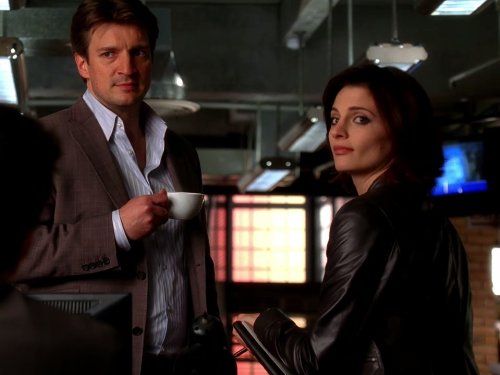
A big part of what makes Castle work so well is the characters. There’s Richard Castle, mystery writer and overgrown child, who foists himself on hard-nosed detective Kate Beckett in the name of “research,” but mostly just to pull her pigtails. There’s Espo and Ryan, the secondary-character buddy cops. There’s Castle’s flamboyant actress mother Martha and his teenage daughter Alexis, who seems to have gotten all the maturity that missed her father and grandmother. Any of these characters could easily have fallen into annoying caricature, but between smart writing and strong acting, they remain alive and enjoyable. Nathan Fillion’s sweet goofiness keeps Castle from being overbearing, while Stana Katic gives Beckett a depth and canniness that makes her more than a match for Castle’s antics. Jon Huertas and Seamus Dever, as Espo and Ryan, have a brotherly bond that only grows over the seasons. Susan Sullivan makes Martha infuriating and endearing in equal measure, while Molly Quinn makes Alexis both a rock of level-headedness in the madness of the Castle household and an awkward teenager growing into self-confidence step by stumbling step. The show may be named for one character, but it is the brilliantly balanced ensemble that makes it work.

Another part of the strength of Castle is how well it balances the mystery and the comedy. The cases that the team tackles are sometimes wacky, but they revolve around real and powerful human emotions, as all good mysteries do. Castle’s off-the-wall leaps of logic are often important in solving cases, but so is the solid investigative work that Beckett and the boys do. The characters often play off each other in funny ways, but they also have real and growing emotional connections. Castle is as much a show about family, in all its weird and wonderful permutations, as it is about solving crimes.

Any other Castle fans out there? Let us know what your favorite episodes of season 1 were!

Image: Castle and Beckett at work from “A Death in the Family” via IMDb

In the Seen on Screen occasional feature, we discuss movies and television shows of interest.

Living Vicariously Through Social Media: Firefall at Yosemite

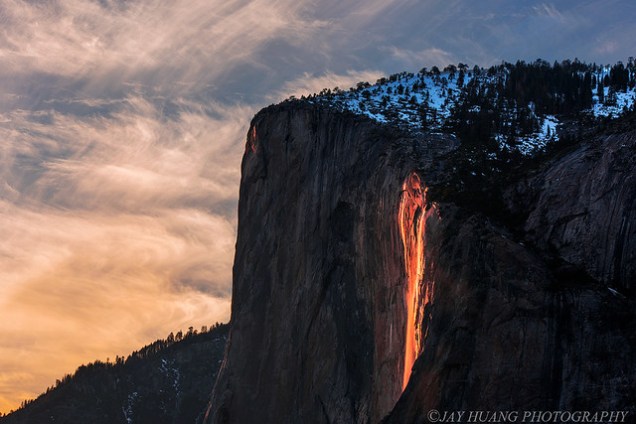
Each February, if conditions allow the seasonal Horsetail waterfall in Yosemite National Park in California to flow, the waterfall appears to be set ablaze by the setting sun. This event is known as the firefall (apparently as homage to Yosemite Firefall).

Flickr Jay Huang Firefall Yosemite National Park

Just stunning! Why hasn’t anyone put this kind of an effect into a story yet—or have I just missed it? Anyone know???

Image by Jay Huang via Flickr (CC BY 2.0)

Out There is an occasional feature highlighting intriguing art, spaces, places, phenomena, flora, and fauna.

A Note to Future Historians

I’ve just been going through my expenses for the past month, comparing receipts and my notes with my bank statements and that sort of thing. Among my other expenses are a number of cases where I have lumped together a few separate expenses in my notes, or I’ve added tips left in cash to the figures I record having paid with a card, or subtracted rebates, or other inconsistencies like that. The experience has made me think of all the furious academic debates that have been sparked because of small inconsistencies in our written sources, and I feel bad for any future historian who comes across my financial records and tries to make sense of them.

Future historians, if you’re reading this: I’m sorry. I know my spreadsheets are incomprehensible, but I wrote them for myself, not for you, and they make sense to me. Anyway, I’m sure you have more important and interesting sources to read for 2020, like Twitter and British tabloids.

Good luck!

History for Writers looks at how history can be a fiction writer’s most useful tool. From worldbuilding to dialogue, history helps you write.
Mulan in Live Action: Second Trailer

It’s about two months till the release of the live-action adaptation of Mulan.

Disney’s Mulan | Official Trailer by Walt Disney Studios on YouTube

The visuals continue to be as gorgeous as in the first trailer. (Suprise, surprise.) If I ever were to see this, it’d be mostly for the eye candy; the story hasn’t really drawn me in, at least in its earlier iterations, and as far as these two trailers go, they’ve not changed the situation. Well, there is Rosalind Chao, who is thoroughly awesome.

We’ll probably see it on disc eventually: giving our local library some circ stats isn’t a bad thing.

Mulan is expected to release March 27, 2020.

Hey, look! We found a thing on the internet! We thought it was cool, and wanted to share it with you.

Sigiriya

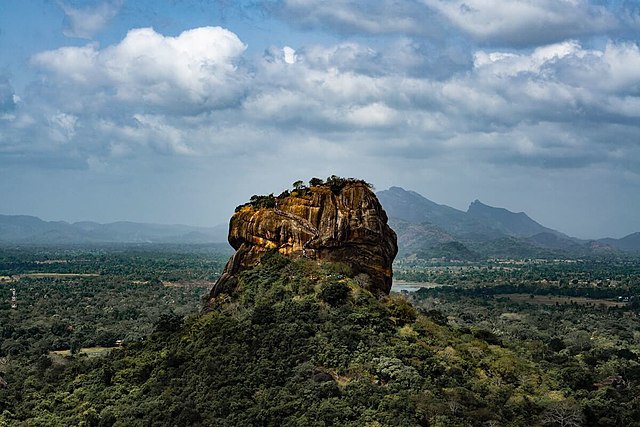
In the hills of central northern Sri Lanka are the remains of a palace built over a thousand years ago on top of an extraordinary natural rock formation. The place is known as Sigiriya. At the base of the rock, intricately organized gardens incorporating sophisticated irrigation and water retention structures stretch out along the hillsides. On top of the rock was originally a fortress, later converted into a Buddhist monastery.


A view of Sigiriya from a nearby hilltop, photograph by Azharkhanam via Wikimedia

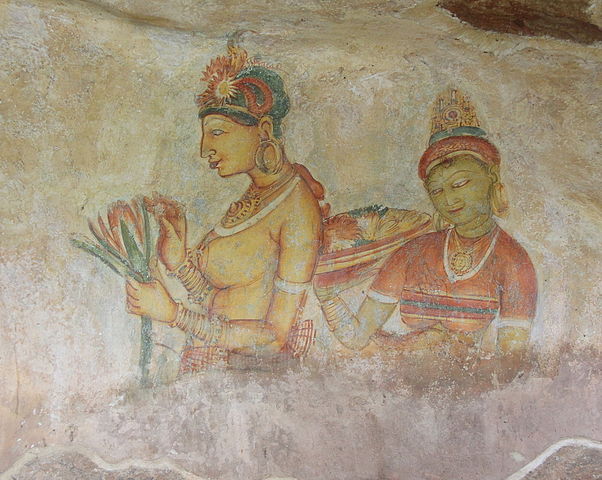
According to Sri Lankan literature, the site was built in the late 400s CE by the king Kashyapa. Sources describe colorful frescoes covering the sides of the rock and a great gate in the shape of a lion, both of which are now only to been seen in fragmentary form. After Kashyapa’s death, Sigiriya ceased to be a royal site and for the next thousand years was inhabited by monks and visited by pilgrims, many of whom left inscriptions on the frescoed faces of the rock. Today, it continues to attract many visitors, although writing on the walls is no longer allowed.

The remains of the lion gate at the base of the citadel, photograph by Cherubino via Wikimedia
Surviving fragments of fresco, photograph by Peter van der Sluijs via Wikimedia (Sigiriya; late 5th c. CE; fresco)

The next time you’re imagining where the royals of your world might live for a story, artwork, or game, think of Sigiriya and remember that a palace doesn’t have to look like Neuschwanstein or Versailles.

History for Writers looks at how history can be a fiction writer’s most useful tool. From worldbuilding to dialogue, history helps you write.

Slavic Pagan Fusion Photoshoot Is Out of This World

This photo project is an older one, but due to the buzz generated by The Witcher screen adaptation it might be of interest.

(FYI: I can’t find a webpage dedicated solely to the project, so what I know mainly comes from an article at Design You Trust.)

Polish photographer and graphic designer Marcin Nagraba collaborated with designer Agnieszka Osipa to create a photoshoot entitled Pagan Poetry. Stylistically it can be described as Slavic fusion meets myth, fantasy, or Baroque. Osipa’s outfits certainly are out of this world—just check out the three examples below!

FB Marcin Nagraba See No Evil

FB Marcin Nagraba White and Red

FB Marcin Nagraba Alberta Ushakova

Nagraba’s personal Facebook page states he’s a “Former Photographer at Marcin Nagraba – Photography & Art”, so it sounds like he will not be continuing this project. Osipa is active, however, and she’s posting new work on Instagram and Facebook.

Found via Design You Trust. Check out the article and Nagraba’s Facebook page for more photos!

Images by Marcin Nagraba via Facebook: See No Evil, red and white, Alberta Ushakova.

Out There is an occasional feature highlighting intriguing art, spaces, places, phenomena, flora, and fauna.

Quotes: When You Keep Harping on about It

You are pretty, Fabulla (we know!), and young (true enough!),

and rich (no one could say otherwise!).

But when you keep harping on about it,

you don’t seem pretty, or young, or rich.

– Martial, Epigrams 1.64

(My own translation)

This bit of grousing comes from the Roman poet Martial, who wrote in the first century CE, but it seems apt for today’s “influencer” culture, too. Some things never do change. Whether the lesson you take from that is “Rich young women will always be vain about themselves” or “Crabby old men will always complain about how young women present themselves” is up to you.

Serving exactly what it sounds like, the Quotes feature excerpts other people’s thoughts.

Six Kings

When Islam first stepped onto the world stage in the seventh century CE, it came as a surprise to the great powers of the day, the Byzantine (or Eastern Roman) Empire and the Sassanian Persian Empire. A powerful religious, political, and social movement sprang up from among the Arabs, the fragmented desert-dwelling peoples who had been pushed back and forth by the wars between Rome and Persia for centuries.

Muslims of the early Islamic period were aware that they were stepping into a world of powerful forces, and some examples of early Islamic art reflect the desire to stake a claim for Islam’s place in the world. For example, a wall painting from an early Islamic palace, in modern-day Jordan, shows how early caliphs positioned themselves in relation to the larger world.

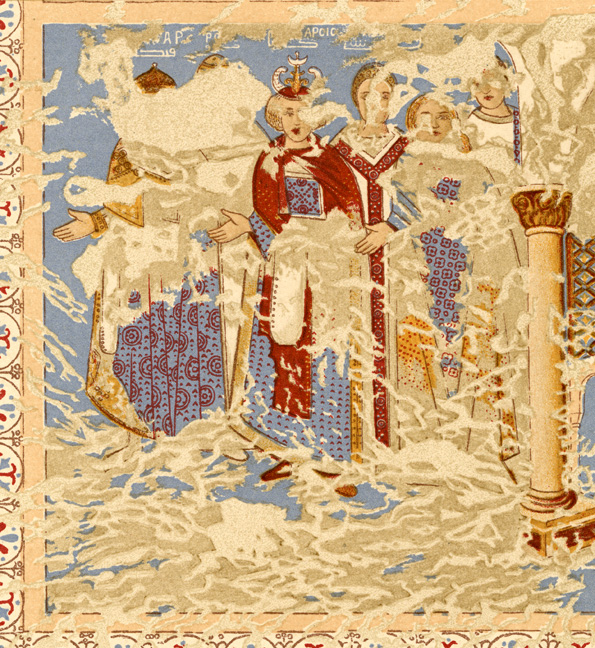
This painting, known as the “Six Kings” painting, is in very poor condition today, partly because of some European travelers who saw it in the early twentieth century and tried to chisel it off the wall and take it with them. (This is why we can’t have nice things.) Working from the painting in its current damaged state and an impressionistic copy made by those travelers, though, we can get a sense of what the original looked like.

Six Kings painting, photopgraph by Ghazi Bisheh via Wikimedia (Qasr Amra, Jordan; 710-740 CE; wall painting)
Copy of Six Kings painting via Wikimedia (1907; by Alois Musil)

Six royal figures stand together, all gesturing toward the caliph’s throne. The six figures were originally labeled in both Arabic and Greek. While not all of them can be identified now, we can tell that they include the Byzantine emperor, the Sassanian Persian emperor, the Visigothic king of Spain, and the king of Axum, a nation in what is today Ethiopia that was a powerful political and commercial state at the time.

This painting comes from the early 700s, a time when Islam was barely a century old but the caliphate had already become a major world power. By placing these figures on the wall, the caliphs were placing themselves among the great powers of the day, even positioning themselves as leaders of a world whose boundaries stretched from Spain to Persia and Constantinople to the horn of Africa. That was no small claim for such a young polity to make. The message was clear: Islam had arrived and was ready to be taken seriously as a world power.

Out There is an occasional feature highlighting intriguing art, spaces, places, phenomena, flora, and fauna.

Syltholm Woman: A Late Mesolithic Individual with Brown Skin and Blue Eyes

Britain’s Cheddar Man has gotten company: a DNA analysis of remnants left in a wad of chewed birch pitch from 5,700 years ago in Denmark showed that the chewer was a woman and likely had dark skin, dark brown hair, and blue eyes.

BBC Syltholm Individual Artists Reconstruction

The pitch was found at Syltholm, a Late Mesolithic / Early Neolithic site, on the southern coast of Lolland island, Denmark. Apart from the human DNA, it contained also microbial DNA (from the chewer’s oral microbiome) as well as plant and animal DNA potentially from a recent meal.

Nature Jensen et al Syltholm Birch Pitch Map
Denmark’s coastline 6,000 years ago and the findsite of the chewed birch pitch at Syltholm on Lolland

Like the Cheddar Man, the Syltholm individual was genetically more closely related to western hunter-gatherers from mainland Europe than hunter-gatherers from central Scandinavia. It’s even possible that some hunter-gatherer groups genetically distinct from Neolithic farming communities survived for much longer than previously assumed, says the study.

The results of the DNA sequencing by Theis Jensen et al. was published in Nature Communications.

It’s very exciting to be able to compare data from DNA analyses with archaeology; maybe one day we can also combine linguistic research to try to tease out even more details about our ancient ancestry.

My only complaint is that the process is so slow—think of how much more we could do in an entirely peaceful world, say, with no military budgets to hog the funding for humanities. (Oh, hey—there might be a bit more of a Star Trek fan in me than I previously thought.) It’s a good time to be an early history geek anyway. 🙂

Found via BBC.

Images: Artist’s reconstruction by Tom Björklund via BBC. Map of Denmark with birch pitch findsite by Jensen et al. via Nature Communications.