Representation Chart: Star Wars, Original Trilogy

We all know that the representation of people of different genders and races is imbalanced in popular media, but sometimes putting it into visual form can help make the imbalance clear. Here’s a chart of the Star Wars original trilogy movies (Episode IV: A New Hope, Episode V: The Empire Strikes Back, Episode VI: The Return of the Jedi).

Characters included

(Characters are listed in the first movie in which they qualify for inclusion under the rules given below.)

  • Episode IV: A New Hope: Luke Skywalker, Owen, Obi-Wan Kenobi, Tarkin, Princess Leia, Beru
  • Episode V: The Empire Strikes Back: General Rieekan, Admiral Piett, Emperor Palpatine, Lando Calrissian
  • Episode VI: Return of the Jedi:

If the absence of major characters like Darth Vader, Chewbacca, and Yoda seems strange, see below.

Rules

In the interests of clarity, here’s the rules I’m following for who to include and where to place them:

  • I only count characters portrayed by an actor who appears in person on screen in more or less recognizable form (i.e. performances that are entirely CG, prosthetic, puppet, or voice do not count).
  • The judgment of which characters are significant enough to include is unavoidably subjective, but I generally include characters who have on-screen dialogue, who appear in more than one scene, and who are named on-screen (including nicknames, code names, etc.)
  • For human characters that can be reasonably clearly identified, I use the race and gender of the character.
  • For non-human characters or characters whose identity cannot be clearly determined, I use the race and gender of the actor.
  • I use four simplified categories for race and two for gender. Because human variety is much more complicated and diverse than this, there will inevitably be examples that don’t fit. I put such cases where they seem least inappropriate. “White” and “Black” are as conventionally defined in modern Western society. “Asian” means East, Central, or South Asian. “Indigenous” encompasses Native Americans, Polynesians, Indigenous Australians, and other indigenous peoples from around the world.
  • There are many ethnic and gender categories that are relevant to questions of representation that are not covered here. There are also other kinds of diversity that are equally important for representation that are not covered here. A schematic view like this can never be perfect, but it is a place to start.

Corrections and suggestions welcome.

Chart by Erik Jensen

In the Seen on Screen occasional feature, we discuss movies and television shows of interest.

Living Vicariously Through Social Media: Cross Foxes

Cross foxes are a color variation of the red fox (like the silver fox, which I have heard of before). They seem to inhabit the more nothern reaches of the Northern hemisphere.

Flickr Humane Society US Cross Fox Father Child

Looks like they can have a variety of fur coloring, from mostly black and grey with only a little red, to almost half and half.

Flickr Robert Kowaluk Cross Fox

What I can’t tell from the photos and texts is how bright the red coat might naturally be—I’ve seen some striking photos with really bright red and deep black. I suspect those may be photoshopped, but of course individual variation is always possible. And, naturally, if you wanted to use cross foxes with saturated red-black coats as inspiration for a fantasy story, no-one’s stopping you! 🙂

Flickr Stephen Brown Cross Fox Closeup

Aren’t they handsome?

Found via Jonathan Webers on Twitter.

Images via Flickr: Father and child by The Humane Society of the United States (CC BY-ND 2.0). Side profile by Robert Kowaluk. Closeup by Stephen Brown.

Out There is an occasional feature highlighting intriguing art, spaces, places, phenomena, flora, and fauna.

Hospitality Tokens

Ancient societies had a problem that we still find familiar today: how do you know that someone is who they say they are? Within small-scale societies (as discussed here) it’s easy enough; when everyone in your village knows you, or knows someone who knows you, it’s not hard to prove who you are. The difficulty comes when you leave your home community and travel far away.

Guest-friendship (which I wrote about here) was one important way of overcoming the challenges of traveling far from home in a time when it was risky to do so. Guest-friends had an established relationship in which each friend promised to help and support the other. Having a guest-friend in a distant place provided some security for when you were far from home.

But even guest-friends might find it difficult to prove their identity to one another. This sort of relationship existed between people whose communities might be widely separated and who might see each other only very rarely. If someone turned up at your door claiming to be a guest-friend who hadn’t visited in twenty years, how could you be sure that they were really who they said they were and not some thief or imposter trying to bluff their way into your house and hospitality? Since guest-friend relationships were often hereditary, the problem could be even more acute: how could you trust that the person who turned up on your doorstep was actually the grandson of your grandfather’s guest-friend and thus someone to whom you still owed a duty of hospitality?

The solution to this problem came with tesserae hospitales, or hospitality tokens. Typically made of bronze, these tokens were a matched pair, sometimes with holes drilled through them, each one inscribed with the name, ancestry, and origins of one of the pair of guest-friends. By putting the two pieces together, one could verify that they matched. A person carrying such a token could present it for verification by comparison with its other half and thus prove that they had a right to claim hospitality in a particular house.

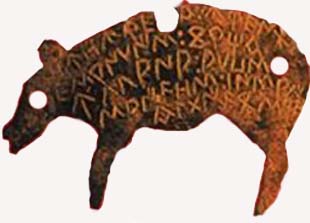
Here’s an example of one such token, made in Spain, probably in the second or first century BCE. This one is in the shape of a pig and has a few holes drilled through it. The text, written in the local Celtiberian language, gives the identity of the man who first carried it: “Lubos, of the Aliso family, son of Aualos, from Contrebia Belaisca.”

Tesseara hospitalis in the shape of a pig, photograph by Carlosblh via Wikimedia (found Uxama, currently Museo Numantino de Soria; 2nd-1st c. BCE; bronze)


Of course, few problems have perfect solutions. Hospitality tokens could, in theory, be lost, stolen, damaged, or copied, but as a way of verifying identity they worked well enough to be used for many centuries in the ancient Mediterranean. Numerous examples have turned up in the archaeological record, and some matching pairs have been found from contexts as widely separated as North Africa and northern Italy.

History for Writers looks at how history can be a fiction writer’s most useful tool. From worldbuilding to dialogue, history helps you write.

Quotes: Reading Books for Free Didn’t Kill the Publishing Business

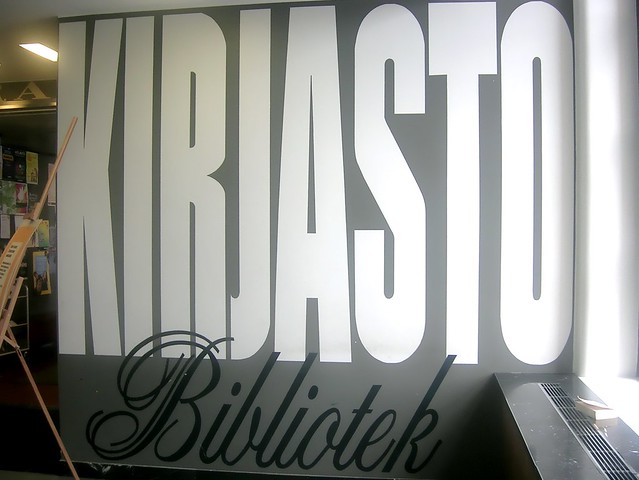
By this writing, after the government relaxed some of the covid-19 restrictions / recommendations, some of my native country Finland’s libraries have already opened, and others are preparing to open.

My Finland Kirjasto in Helsinki

“I love a library. The idea of reading books for free didn’t kill the publishing business; on the contrary, it created nations of literate and passionate readers. Shared interests and the impulse to create.”

– David Byrne, musician and author

Judging by my family, friends, and social media bubble, the openings are very welcome, even though at this stage you can’t really spend time in a library yet (they’re only open for picking up materials, not for lounging or programming). Visiting the library is also at the top of my list of things to do after the Stay at Home Advisory is no more!

Stories are such a huge part of our lives, and we like to talk about them regardless of the shape they’re in. What remains to be seen is how moving increasingly towards digital media will affect physical libraries.

Quote attributed to David Byrne at The Guardian, July 17, 2015; found via American Libraries November / December 2015, p. 28.

Image by Eppu Jensen

Serving exactly what it sounds like, the Quotes feature excerpts other people’s thoughts.

Teaching in a Pandemic 6: We Have Done the Best We Reasonably Could Have Expected

(Previous entries: part 1, part 2, part 3, part 4, part 5)

And that’s the semester. The deadlines have passed, the grades are turned in, all that’s left to look forward to is celebrating our graduating seniors at a safe distance. This is not the way any of us wanted this semester to end, but I think all of us—my fellow faculty, my students, and the university administration—have done the best we reasonably could have expected.

I was prepared to be lenient in my grading this semester, but I found that (after making some basic structural adjustments to my syllabi, such as dropping some assignments and adjusting the weight of others), I did not need to. My students have continued to turn in work of exceptional quality, despite the challenges of the times. Their papers are just as strong as I could have hoped for in a normal semester, their self-reflections just as thoughtful, their questions just as insightful. I credit this result to the quality of my students and not my skills at teaching online, which are dubious at best.

Not all my students made the transition to online learning gracefully. Across all my classes, only about two thirds of students ever engaged with the discussion questions I posted online. Still, I am treating those discussions as the equivalent of our classroom conversations, and getting two thirds of a class to speak up is not bad even in person. Some of those who didn’t engage in the online discussions still showed through their written work that they had done the reading thoroughly and thoughtfully. There were a few students who just disappeared, but on the whole they were the same students who had mostly disappeared from in-person classes before the outbreak of the pandemic.

The spread of final grades came out about the same as usual: a lot of Bs, a good handful of As, a scattering of Cs and Ds, and a few Fs for those who just never turned in the required work. I know from email exchanges with a few students that some of them have been under enough stress this spring that it was all they could do to manage a passing grade, and I’ve done my best to guide them to what they need to do to get it. For the most part, though, my students have done as well as I would normally have expected of them.

This will be my last update for this spring. We’ll see what the fall holds. I hope there has been something interesting in this view into the mild chaos of teaching in a pandemic. Stay safe and well, everyone.

How It Happens is an occasional feature looking at the inner workings of various creative efforts.

Rating: Castle Season 4

Season 4 of Castle is mostly solid, with a mix of highs and lows. Here’s how we rated the episodes:

  1. “Rise” – 2
  2. “Heroes and Villains” – 9
  3. “Head Case” – 6
  4. “Kick the Ballistics” – 2
  5. “Eye of the Beholder” – 6
  6. “Demons” – 8.5
  7. “Cops and Robbers” – 7.5
  8. “Heartbreak Hotel” – 6
  9. “Kill Shot” – 6
  10. “Cuffed” – 5.5
  11. “Till Death Do Us Part” – 6
  12. “Dial M for Murder” – 5
  13. “An Embarrassment of Bitches” – 6
  14. “The Blue Butterfly” – 4
  15. “Pandora” – 1.5
  16. “Linchpin” – 1.5
  17. “Once Upon a Crime” – 6
  18. “A Dance with Death” – 5.5
  19. “47 Seconds” – 5
  20. “The Limey” – 3
  21. “Headhunters” – 1.5
  22. “Undead Again” – 8
  23. “Always” – 0

The average for this season is 4.8, a bit of a comedown from season 3’s 5.9. Still, this season has a lot to offer. The average is dragged down by a bunch of boring hyped-up drama episodes, but this season still delivers the crime-solving comedy action we come to Castle for.

The bottom of the heap is the finale, “Always,” that we gave a complete 0. This episode is one more step in the long, drawn-out saga of Beckett’s mother and has absolutely nothing to appeal to us. A number of other episodes also hang out near the bottom of the pack, including “Headhunters,” at 1.5, which, despite reuniting Nathan Fillion with an over-the-top Adam Baldwin, spends too much time wallowing in the dysfunction of Castle and Beckett’s relationship. There’s also the bizarre two-parter “Pandora” and “Lincpin,” both at 1.5, which takes the Castle crew into a hard swerve from crime-solving into international intrigue. It’s not something this particular writing/production team does well.

At the top end, though, we have a good set of wacky cases-of-the-week, which are just what we want from Castle. The best is “Heroes and Villains,” at a 9, about do-it-yourself superheroes. Some of the other great episodes this season similarly dig into geeky subcultures, like ghost-hunting in “Demons” (8.5) and zombie LARP in “Undead Again” (8).

Along the way there’s also a good batch of episodes in the mediocre but perfectly serviceable 5-7 range. There’s a lot to like this season, even if there are several episodes well worth skipping.

Image: Beckett and Castle research superheroes, from “Heroes and Villains” via IMDb

In the Seen on Screen occasional feature, we discuss movies and television shows of interest.

Gandalf’s Staff-Top as Table Lamp

This shall most definitely pass!

Marco at 3dartem on Etsy makes and sells 3d-printed table lamps featuring the top of Gandalf’s staff from Peter Jackson’s Lord of the Rings movies.

Etsy Marco 3dartem Gandalfs Staff 3dPrinted Lamp

If the power supply weren’t 220 V type L, I’d seriously consider buying one. It’s absolutely gorgeous!

(We have no connection, financial or otherwise, with Marco.)

Image by Marco at 3dartem on Etsy

In Making Stuff occasional feature, we share fun arts and crafts done by us and our fellow geeks and nerds.

Death Star Lamp Tutorials for Star Wars Day

Happy Star Wars Day!

Have you heard of Ikea hackers? It’s a site for sharing projects modifying the DIY furniture store’s products. The hack below is both clever and timely: exploding Death Star ceiling lamp.

(Note: The Ikea hackers post I’m linking to has a few different options; I like Maria Krüger’s best, so the pictures are from her project.)

The hack starts with the PS 2014 lamp with copper insides. First it is spray-painted grey before details are applied. Maria Krüger masked in some stripes and used darker grey to paint most of the outer pattern.

Here’s a closeup of her Death Star:

Ikea Hackers Maria Kruger Death Star Lamp Closeup

And the finished lamp:

Ikea Hackers Maria Kruger Death Star Lamp

She’s also posted a short video of the lamp Death Star “exploding”:

Star Wars Death Star Lamp – IKEA PS 2014 Modification – Todesstern Lampe by Maria Krüger on YouTube

Isn’t it handsome? I’m not sure I’d have the patience. Or maybe I should say that I don’t care for the Death Star enough to go through the trouble and mess with paint. Now, if you have a fabric project, we might talk…! 🙂

Images by Maria Krüger via Ikea hackers

In Making Stuff occasional feature, we share fun arts and crafts done by us and our fellow geeks and nerds.

WoW Warrior Transmog Loosely Inspired by Ancient Greece

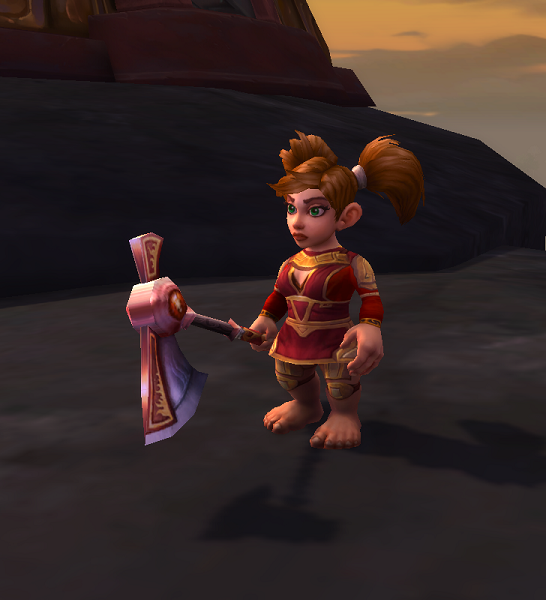
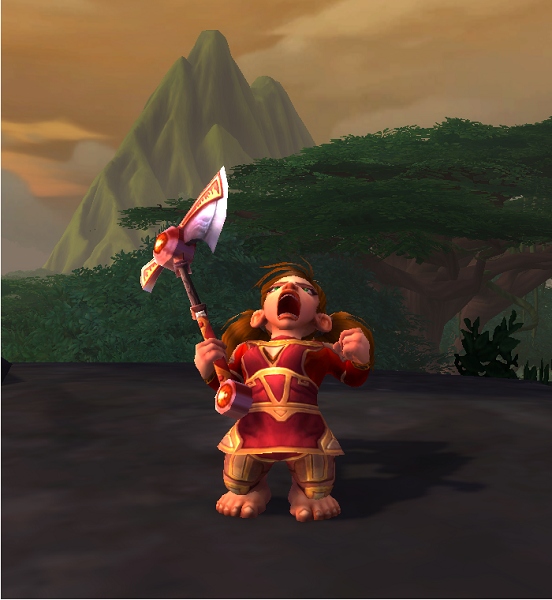
Hanging around World of Warcraft and taking advantage of the Winds of Wisdom buff inevitably leads to new transmogs. Here’s my new female gnome arms warrior mog:

WoW Arms Warrior Ancient Mediterranean Mog1

WoW Arms Warrior Ancient Mediterranean Mog2

I was idly flipping through the various leg slot possibilities when I noticed that one of the plate legguards has this short skirt-like fold at the top. I was able to find a color-matched chestpiece to go with it, and noticed they vaguely reminded me of ancient Mediterranean garb. I then turned off the head, shoulder, cloak, wrist, glove, waist, and boot slots; in the end, the only pieces I mogged were chest, shirt, legs, and the weapon.

WoW Arms Warrior Roar

Awesome roar, right?!? LOL!

If interested, you can have a look at the set in Wowhead’s Dressing Room.

Image: World of Warcraft screencaps

Of Dice and Dragons is an occasional feature about games and gaming.

Happy Belated Birthday, Hubble!

Oh my goodness, the Hubble telescope has turned 30 years!

NASA Large Magellanic Cloud Apr 2020 Sm

More specifically, it’s been operating, up there in Earth orbit, for 30 years. It was projected to be in service only about 10 years when it launched on April 24, 1990, from Kennedy Space Center in Florida. Impressive.

Read more at the NASA website:

Happy belated birthday, Hubble! Thank you for all of the space pics you’ve sent down.

Found via File 770.

Image: Large Magellanic Cloud, a vast star-forming region composed of the giant red nebula (NGC 2014) and its smaller blue neighbor (NGC 2020), by NASA / ESA / STScl via NASA