Rome Was Not Good

People sometimes argue that the Roman Empire was a good thing for the people of the Mediterranean, Europe, even the whole world. You will especially hear this argument made in connection with claims about the unique value of European (or, even more bluntly, “white”) civilization. Those who make this claim often, implicitly or explicitly, extend the argument to later history, implying that if the Roman Empire was good for the world, then so was all other European-led imperialism in world history.

This argument is wrong. The Roman Empire was not a force for good.

I am not speaking here of the moral qualities of any individual Roman or of the ancient Romans as a whole. People are people, and always have been; some are good, some are bad, and most of us are a mix of both. That is as true of the ancient Romans as of anyone else. My point is rather that the net effect of the Roman Empire on humanity as a whole was not one for good.

Pax Romana

The most typical claim made for the benefits of Roman imperialism is that it created peace in the lands it ruled. This is, in fact, the claim that Romans made for themselves. In the words the poet Vergil put into the mouth of the spirit of Anchises, revealing the future to his son, Aeneas:

Remember, Roman, that you shall rule the world’s peoples by your power.

These will be your arts: to impose the laws of peace,

to be merciful to the conquered and subdue the arrogant.

Vergil, Aeneid 6.851-853

(My own translations)

This claim is, at best, exaggerated. The history of Rome is marked with numerous revolts, civil wars, and other internal conflicts. The first century BCE and the third century CE were particularly blood-stained by the struggles of would-be dynasts and their personal armies. Many provinces saw revolts in the generations after their conquest, and some remained turbulent for centuries. The Roman response to provincial unrest was often a violent reconquest.

It is true that in some parts of the Roman world and in some eras of history, generations of provincial subjects lived free from the threat of war and other large-scale violence, but even this limited peace came at a cost. Roman peace was always the product of violence. Caesar’s conquest of Gaul in the mid-first century BCE has been estimated to have cost the lives of a million Gauls and the freedom of a million more forced into slavery; the population of Gaul may have been decreased by as much as half as a result. By any definition, Caesar committed genocide. Other Roman conquests may have been less thorough in their devastation, but Rome was never shy to apply overwhelming force. The Greek historian Polybius’ eyewitness account of Roman siege warfare is chilling:

When Scipio judged that enough soldiers had entered the city, he gave the order that most of them should kill everyone they chanced upon and spare no one, according to the Romans’ custom, and not to begin looting until the signal for it was given. They do this, I suppose, for the sake of terror. Because of this custom, you can see in cities captured by the Romans not only people slaughtered, but even dogs hacked in two and other animals with their limbs hewn off. Because of the numbers who were in the captured city, there was a lot of this sort of destruction there.

Polybius, History of Rome 10.15

The Roman historian Tacitus, imagining what the victims of Roman conquest would say of it, put things even more bluntly:

They falsely call stealing, slaughtering, and ravaging “empire,” and where they have made a wasteland they call it “peace.”

Tacitus, Agricola 30

To the extent that Roman rule created areas of peace inside the empire, it did so in part by creating more violence outside of it. The frontier was a militarized zone in which Roman soldiers had effective license to harass, extort, and plunder locals and travelers. Roman commanders appeased restless troops by letting them raid neighboring settlements for booty, and used the threat of attacks to extract tribute from peoples beyond the frontier, whether for the empire or their own personal enrichment. The Roman market’s demand for enslaved labor spurred increased volatility and raiding outside the empire as some people took advantage of the opportunity to sell their neighbors to the Romans.

The world before Rome had not been one of peace and harmony. Roman violence had ebbs and flows, the worst contained in times and sites of expansion and civil war. Some people lucky enough to live in quiet provinces in orderly eras could indeed thank Rome for a life free of the threat of war. On the large scale, though, Rome can take no credit for making the world more peaceful, only for changing the distribution of violence.

Law and order

In connection the claim of creating peace, Romans (like Vergil above) often also justified their empire by its ability to impose law and order on a chaotic world. Like Roman peace, Roman law was real and beneficial for some, but it makes a poor argument for the value of the empire.

Law was hardly a unique Roman creation. All ancient societies had legal traditions because every complex society has to deal with fundamental problems such as the ownership and inheritance of land and other economic resources or the destabilizing effects of interpersonal violence. Societies that had not had to deal with specific kinds of problems may not have developed legal principles for them and so may have gained some marginal benefit from the introduction of Roman law, but this was not particular to Rome; the Romans themselves, inhabitants of an inland city, had imported large portions of maritime law from Greek cities (particularly Rhodes) as they came to terms with ruling a Mediterranean empire. Just because the laws of many of the people Rome conquered have not been recorded does not mean that they did not exist or that Rome was bringing anything new to them by conquest.

Roman law could be helpful to some. It conferred certain rights and privileges on particular groups of people, primarily freeborn Roman citizens, a group to which some portion of the population of the empire belonged. At the same time, it codified many kinds of inequality, most prominently the exploitation of enslaved people, but also several kinds of non-citizen status, each of which had limited rights under law, if the law of the empire recognized their rights at all. The fact that citizenship conferred such privileges as freedom from torture and the right to appeal for the emperor’s intercession should remind us of how many of the Roman empire’s subjects lived without those guarantees.

In practical terms, there were also serious limits on who could effectively exercise the rights that the law theoretically granted them. Roman law operated on a basis of self-help, meaning that a court only pronounced a judgment; enforcement was entirely up to the winning litigant, so the poor and powerless had no meaningful recourse against the rich and powerful. Even gaining access to the processes of law could be difficult. In the city of Rome itself, where elected praetors oversaw the courts, citizens of adequate wealth and social standing could be reasonably confident of getting their case before a judge with a hope of a fair hearing. In the provinces, legal proceedings were under the purview of appointed governors who were famous for their corruption and disinterest in local affairs. The letter of complaint directed to the provincial governor of Britain written by a merchant who had been roughed up by a soldier gives us an idea of how ineffective Roman justice could be:

He beat me further until I would either declare my goods worthless or else pour them away. I implore your majesty not to allow me, an innocent man, to have been beaten with rods. Furthermore, my lord Proculus, I couldn’t complain to the prefect because he was detained by sickness, and I complained in vain to the adjutant and the other centurions of his unit. I beg your mercy not to allow me, an innocent man from abroad, about whose honesty you may inquire, to have been bloodied with rods like a criminal.

Tabulae Vindolandenses, II 344

Technology

Another claim sometimes made for the value of the Roman Empire is that it brought superior technology from the Mediterranean to the rest of Europe. Like other claims for the empire’s virtues, this one is exaggerated at best.

The areas of the world that would eventually fall under Roman rule had long been connected by the movement of people and goods. Such movement carried technological developments in all directions. By the time of the Roman Empire, there was relatively little that Romans could do that the people they conquered could not.

The major differences between Roman and non-Roman material culture had more to do with economics than with technology. The Mediterranean held large cities whose populations demanded goods and public works at a scale not needed in other parts of Europe. To meet these demands, Romans and other Mediterranean peoples developed large-scale manufacturing that depended not on technological advances but on the widespread exploitation of enslaved workers.

Archaeological research has identified few cases in which Roman technology was actually superior to the technology of the conquered. Even at the northern edges of the empire, which lagged in economic development compared with the Mediterranean, Roman products were not necessarily superior. A study of Roman-made and locally-made knife blades in Britain, for example, found that the British blades were equal or superior in quality to the Roman examples. Similarly, research on Roman-period architecture in Britain finds that many buildings that looked Roman in style were built using methods and techniques already well known in Britain before the conquest.

Some Roman technologies were unknown in the farther reaches of the empire. These included glass-blowing, the smelting of brass, and the production of concrete. These technologies, however, were not freely shared with the subjects of the empire but were held as proprietary secrets either by the Mediterranean artisans who knew them or by the imperial administration itself. Conquest brought little to the wider European and Mediterranean world that could not have come through peaceful trade.

Rome in the balance

There is no denying that the Roman Empire was a good thing for some people in some times and places. It was particularly good for the Roman elite who gained access to new sources of wealth, enslaved labor, and prestige through conquest, but some of the conquered benefited as well. Individuals and communities who aligned themselves with Rome’s interests could reap the rewards, and some were simply in the right places and times to enjoy periods of peace, stability, and economic growth.

All of these benefits, however, came at a cost. For those in the empire, there was the brutality of conquest, and the frequent need for reconquest in future generations, the violent side effects of Rome’s unstable politics, and the costs that came with the disruption of traditional social and economic organizations. Outside the empire, the ripple effects of Rome created volatility and violence whose effects were felt hundreds of kilometers from the frontier. Some people lived richer, happier, more peaceful lives because of Rome, but many others suffered war, deprivation, and enslavement to make these benefits possible.

Those who claim that Rome was good for the world align themselves, consciously or not, with the conquerors, and the reveal much about their view of both history and the world today by assuming that the benefits to the victorious matter more than the sufferings of the defeated.

Image: Gemma Augustea, lower register, photograph by Andreas Praefke via Wikimedia (Kunsthistorisches Museum, Austria; early 1st c. CE; onyx)

History for Writers looks at how history can be a fiction writer’s most useful tool. From worldbuilding to dialogue, history helps you write.
Shadowlands, A Year in the Land of Death

World of Warcraft: Shadowlands released a year ago today. Can you believe we’ve been adventuring in the after life for a whole year? For only a year? What is time even?

We thought we’d mark the occasion by looking back at our experiences with the expansion so far and talking about what it’s been like to play in WoW‘s eighth expansion.

New systems

Eppu: The new mission table seems hardly to have changed from its previous iterations, but since my playing time has been very limited during this expansion, I can’t say I’ve really understood all of the mechanics of leveling and missions. I can say, however, that accumulating companions is surprisingly speedy. However, the animated-by-default battle at the conclusion annoys me—considering what a minuscule part of the game it is, that’s a waste of processing power and having to always bypass it with a click is a waste of time.

Soulbinds is a more interesting case. Essentially, they’re a version of the old talent trees, with the exception that you can have three separate ones and that switching between them is easy. Accumulating a good smattering of basic conduits via world quests is simple, too.

Anima, unfortunately, is where Blizzard over-corrected in this expansion. The system is clunky and complex and not intuitive. For example, gathering anima for X purpose is added to the quest tally when you complete a quest that grants anima rewards, as opposed to Y purpose it’s counted when you empty the anima rewards from your inventory into the reservoir.

Erik: Anima really seems like a step back. We’re getting a lot of clutter in our bags this expansion after Battle for Azeroth did a much better job of streamlining its power-accumulation systems. Conduits are another piece of bag clutter I could do without, but the overall soulbind system works pretty well. It allows a fair amount of flexibility in customizing your character’s play style with some interesting trade-offs to think about.

Blizzard keeps tweaking the mission table, but it’s never been particularly interesting. I do it because it’s a low-effort way of getting small amounts of anima and reputation, but it’s never been a compelling part of gameplay. After four expansions, I still don’t understand why I am sending other people off to have adventures instead of having them for myself.

I have to say that after a year of playing in this expansion, I still don’t feel like I really know what I’m doing with a lot of my covenant sanctum things. It’s at least partly because anima has been so hard to get that I haven’t activated or upgraded most of what’s offered. I supposed that fits the theme of the “anima drought,” but it also makes anima a really unwieldy game mechanic.

The one new system I like the best is renown. It feels much more accessible and rewarding to build renown levels with a covenant than to grind out reputation.

Eppu: Renown is a nice change from grinding rep, you’re quite right. For such a long time, everything used to be a grind; it’s nice to have some variety.

What do you think about the transport networks within covenant zones?

Erik: I like them, and I also like that they are thematic to the zones they’re in. It’s a good combination of artistic and practical designs. (And we get to hang out with a cheerful old mushroom guy.)

Torghast

Erik: One new system that stands out from the rest is Torghast, the randomized, size-flexible dungeon. I have to say that Torghast is one of the best things in Shadowlands for me. I really like that there is content that is so replayable, with so much flexibility for difficulty level and group size. I’ve done a lot of solo running through Torghast, and we’ve done plenty of it together. For such a long time I have wished that there was content in WoW of a comparable challenge level to running a dungeon but tuned for two players instead of five, so that we could do something challenging but doable together. Torghast is finally that. I hope this is a system they keep developing for future expansions.

I also love how adaptable Torghast is. If I just want to go squish monsters and get fun new powers, I can set it low and crash through; if I want something that pushes me to use my skills an abilities to their fullest, I can set it high and enjoy the tactical challenge.

The one thing I wish were different about Torghast is that I wish there were some reward to running it beyond gathering materials for the legendary system. As fun as Torghast can be, it doesn’t really feel worthwhile to play when I know I won’t get any gear or new transmog appearances at the end, or much else to reward me for my time and effort.

Eppu: You’re right; for me, too, just about the only major flaw in Torghast is the lack of any fun transmog gear. (Otherwise, I still stand by my previous opinion.)

New zones

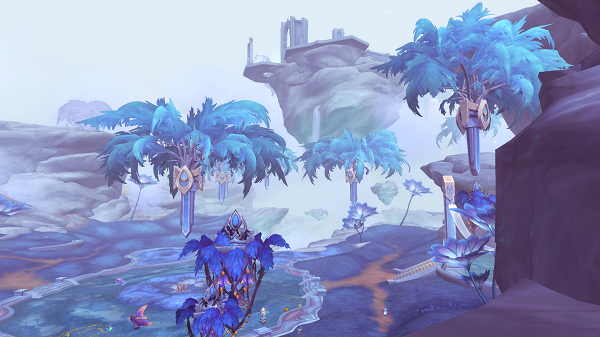
Eppu: I quite like the design of three new zones: Ardenweald, Bastion, and Revendreth. The really fascinating feature about the Shadowlands landscapes is how aggressively height differences—ledges, ridges, ginormous trees, stupendously tall buildings, levitating platforms—are used to squeeze questing areas side by side in order to keep the whole zone from ballooning out to an uncontrollable size. Blizzard has used the same principle before; in Shadowlands it’s really matured, but I don’t think you could take it any further without land shapes turning ludicrous. (Then again, this is fantasy, perhaps they could do it and make it work!)

It’s an interesting choice to tweak each zone’s color scheme so far, though—it’s not unheard of to have a subtle overall color in zones (e.g. Icecrown, Suramar, or Drustvar)—but this time Blizzard really pushed it. There have been times when I’ve switched zones after a while, because I’ve wanted more variation in the colors around my toon.

Lastly, I’m irritated that moving between covenant zones only can take place via Oribos. (Forced hub-centered travel is one of my pet peeves in the real world, too.)

Erik: I agree about wishing for ways to get between zones that don’t rely on Oribos. I understand the idea of Oribos as a central point, but we’ve seen individuals travel directly between zones in the questing experience, and I see no reason we as players couldn’t have gotten some options for that, too.

The artistic design of the zones is really strong this expansion. Each zone feels very different not just in terms of color palette but landforms and buildings. There are some that I like (Bastion, Ardenweald) and some I don’t (Revendreth, Maldraxxus), but every zone feels like a deeply concentrated expression of an idea. I find that Bastion and Maldraxxus feel small, while Ardenweald and Revendreth feel big. I wonder if that’s intentional, or just an effect of how I experience the zones.

And then there’s the Maw. All I can say is that they did such a good job designing the zone to feel like a bad place to be that I spend as little time there as possible. If the Maw was supposed to be what kept our characters occupied once they got to max level, it missed the mark.

Although my favorite covenant is the Night Fae, I think my favorite zone to spend time in is Bastion. Do you have a favorite?

Eppu: Hm. Ardenweald or Bastion, for both have strong pros and some cons. Although I have to say none of the areas feel quite right for hanging out with my numerous female Dwarves.

WoW Shadowlands Bastion Near Heros Rest

Story

Erik: I’ve enjoyed the story of Shadowlands on the whole. It’s interesting to go to a new place we’ve never known about before and start figuring out just how it all works. We have met a lot of compelling characters and seen some great moments along the way. They’ve done a lot with the characters we interact with to help us understand the nature of the different realms of the Shadowlands, from the earnest soul-searching of the Kyrian aspirants to the gung-ho warmongering in Maldraxxus, the intertwining of despair and hope in Ardenweald, and the crumbling ancien regime in Revendreth.

The parts of the story that haven’t worked for me have been the overarching plot involving the Jailer and the Maw. I know some people really enjoy digging up secrets and spinning tin-foil-hat theories about the nefarious motives of cosmic powers, but I’m not among them. The Jailer is just one more generic villain to me. I am also utterly uninterested in Tyrande’s super-powered vengeance rampage or the emotional life of Sylvanas. As so often in expansions past, I find the little, ground-level stories in Shadowlands much more interesting than the big story of the overarching plot. Give me more Kyrian buddy cops and Night Fae drama nerds, not another giant villain vaguebooking about their plans to conquer reality.

Eppu: I’m trying to figure out just why I felt that playing through the zones differed from previous expansions. The basic progression through all of the covenant zones is surprisingly similar from area to area—until you hit Maldraxxus. There we get an item with runes periodically slapped on along with the story reveal, which felt more drastic to me than reveals elsewhere. The other areas felt more or less like the usual quest grind. Combined with the utterly unique landscape design ethos, Maldraxxus really stands out to me.

Have a take of your own? Do chime in!

Of Dice and Dragons is an occasional feature about games and gaming.

The Couple that Eats Together Stays Together

This terra cotta Etruscan sarcophagus depicts a couple reclining on a dining couch together. Etruscans adopted a great deal of cultural influences from the Greek world (including, for instance, the style of dining while lying on a couch), but one sharp difference from the Greeks was while in the Greek world dinner parties were exclusively male affairs, Etruscan women and men dined together.

This couple looks particularly happy and loving, smiling and holding one another affectionately. Of course, art is not always a reflection of life; just because a couple wanted to be depicted as a happy family in their funeral portrait doesn’t necessarily mean they were happy together in life, but it’s certainly nice to imagine that they were, and the very fact that they wanted to be perceived as a loving, intimate couple tells us something about the values of their culture.

Image: Sarcophagus of the spouses, photograph by Sailko via Wikimedia (CC BY-SA 4.0) (found Caere, currently National Etruscan Museum at Villa Giulia, Rome; c. 530-520 BCE; terra cotta)

Out There is an occasional feature highlighting intriguing art, spaces, places, phenomena, flora, and fauna.

Visual Inspiration: Traditional Textile Patterns and Colors on Outdoor Stairs

In Lima, Peru, artist Xomatoc and local residents painted a number of stairs with colors and combinations more typically associated with traditional South American blankets and other textiles.

Colossal Jeremy Flores Xomatoc Striped Staircase

This project was a part of the Pinta Lima Bicentenario. Xomatoc’s project was only one of public art installations painted around the municipality to celebrate each participating neighborhood’s history and cultural memory.

Municipalidad de Lima Bicentenario Painting
Colossal Jeremy Flores Xomatoc Diamond-Pattern Staircase

The length of the stairs, the vibrant colors, and the large enough scale of these patterns make them really eyecatching. And, good grief, the degree of the slopes! (I grew up essentially on a flood plain, which is why mountains look so drastic to me.) The stairs definitely will be visible a long way.

Found via Colossal.

Images: Striped and diamond-patterned stairs by Jeremy Flores via Colossal. Painting in progress via Municipalidad de Lima.

Out There is an occasional feature highlighting intriguing art, spaces, places, phenomena, flora, and fauna.

Earliest Singular They According to the OED

I’ve long been seeing mentions that the use of the plural pronoun they to refer to a singular antecedent is older than the present attempt to introduce it as a gender-neutral option. Here’s a little history I ran across.

Dennis Baron, Professor of English and linguistics at the University of Illinois at Urbana-Champaign, blogs about singular they for The Oxford English Dictionary. According to him, the oldest recorded use within the OED is from 1375, in the medieval romance William and the Werewolf.

BrLib Digital Catalogue Illuminated MSS Royal 10 E IV f12 Detail

Continues Baron:

“Here’s the Middle English version: ‘Hastely hiȝed eche . . . þei neyȝþed so neiȝh . . . þere william & his worþi lef were liand i-fere.’ In modern English, that’s: ‘Each man hurried . . . till they drew near . . . where William and his darling were lying together.’ [original emphasis]

“Since forms may exist in speech long before they’re written down, it’s likely that singular they was common even before the late fourteenth century. That makes an old form even older.”

Since I’m a Finn and we don’t have grammatical gender in our language, singular they seems natural to me. In fact, I fail to see a reason to choose to kick up a major kerfuffle over it; after all, (normative) English already mixes up the numbers with singular and plural you.

I’m pretty sure that within the past decade or so I have spotted multiple examples from non-woke modern English sources, both television series and novels, that do use singular they seemingly unconsciously, very naturally, and entirely unambiguously. I wish I had realized to write them down for my own interest.

Image: Group of men, detail of illuminated manuscript Royal 10 E IV, f. 12, via The British Library Digital Catalogue of Illuminated Manuscripts (France, S. [Toulouse?]; last quarter of the 13th century or 1st quarter of the 14th century; illuminated manuscript)

On, of, and about languages.

Fantasy Religions: Divinity and the World

It’s been a while since I last wrote about ways of making religious elements of a secondary world feel more authentic, but here’s another thought worth considering when you’re writing: how people feel about the gods tends to reflect how they feel about the world.

Traditional religions tend to see the world differently and posit that divinity exists within the world, that the physical world around us and the social world we inhabit as humans is also inhabited by sacred forces. Interacting with the world means necessarily interacting with divine entities. Some modern religions preserve this view of the divine, notably Hinduism and Shinto. In traditions like these, divine forces are located within the world, whether they are gods associated with natural features such as mountaintops or rivers, or divinities connected to human relationships, such as blessed ancestors or household spirits.

For many of the major modern religions, by contrast, such as Buddhism, Christianity, Islam, and some versions of Judaism, the divine exists outside the world. The physical world we live in and the social world we inhabit as human beings is a barrier between ourselves and divinity, and the function of religion is to help us transcend that barrier. Attachments to worldly goods or to social relationships are seen as impediments that must be resisted or shed in order to achieve harmony with the divine.

This distinction is not an absolute one. Traditional religions can also understand divine forces as abstractions or seek ways of achieving a closer communion with the divine through asceticism, and modern religions can see sacredness connected to specific places and people. Still, one of the defining characteristics of any religious tradition is whether it encourages people to seek harmony with the divine by inhabiting the ordinary world in meaningful ways or by escaping from its distractions and temptations.

The point for writers is not that one or the other of these religious approaches is right or wrong for an imagined world, but that each one responds to the needs of societies under different circumstances. People are inclined to see the divine in the world around them when they feel at home in that world. Well-established cultures with a strong sense of identity and long history moored in place are likely to see the world itself as sacred. Shinto in Japan and Hinduism in India both arise out of this kind of long history. Religions that see the world as a barrier to be overcome tend to arise in times when people are unsettled and feel powerless within the world they live in. Buddhism, Christianity, and Islam all arose among peoples who lived with chaos, violence, and a lack of control over their own destinies, while Judaism has been deeply shaped by a history of diaspora and oppression.

What kind of religions exist in your invented worlds depend on what the people in them have experienced. If your characters feel connected to and safe within the world they inhabit, they are likely to perceive divine forces all around them; if their world feels dangerous and alien, they are likely to feel equally alienated from the divine.

Other entries in Fantasy Religions:

History for Writers looks at how history can be a fiction writer’s most useful tool. From worldbuilding to dialogue, history helps you write.
Rating: Babylon 5, Season 4

It’s an action-packed, emotional roller coaster of a season for Babylon 5. The previous three seasons of development and growth come to a head in some unexpected ways. Here’s how we rated this season’s episodes:

Babylon 5 season 4 DVD cover
  1. “The Hour of the Wolf” – 6
  2. “Whatever Happened to Mr. Garibaldi” – 3.5
  3. “The Summoning” – 6.5
  4. “Falling Towards Apotheosis” – 5
  5. “The Long Night” – 7
  6. “Into the Fire” – 9.5
  7. “Epiphanies” – 4
  8. “The Illusion of Truth” – 2.5
  9. “Atonement” – 3
  10. “Racing Mars” – 3.5
  11. “Lines of Communication” – 4
  12. “Conflicts of Interest” – 2.5
  13. “Rumors, Bargains, and Lies” – 5.5
  14. “Moments of Transition” – 3.5
  15. “No Surrender, No Retreat” – 6
  16. “The Exercise of Vital Powers” – 1.5
  17. “The Face of the Enemy” – 1.5
  18. “Intersections in Real Time” – 0
  19. “Between the Darkness and the Light” – 7.5
  20. “Endgame” – 6.5
  21. “Rising Star” – 6
  22. “The Deconstruction of Falling Stars” – 4

Various shenanigans with the networks broadcasting Babylon 5 led to the originally planned seasons 4 and 5 being squished down into a single season, and the results are visible. In some ways, the results were good, as the pace of the action noticeably picks up and gives an urgency to important episodes dealing with the Vorlon-Shadow war and the Earth civil war. In other ways, the effects were less positive, though, as the story often feels cramped and rushed. In the end, we have an average rating for this season of 4.5, down from season 3 but on par with season 2.

Given how much story had to be condensed into this season, it is particularly jarring when the season pauses for a number of self-contained (and sometimes self-indulgent) episodes such as “The Illusion of Truth,” a demonstration of how propaganda works, “Intersections in Real Time,” in which Sheridan is tortured, and “The Deconstruction of Falling Stars,” a meditation on how history is transformed into legend. None of these episodes scored very well with us. “Intersections in Real Time” is our lowest rated episode of the season, at a complete 0, for being both unpleasant to watch and unnecessary to the larger story. The season also spends an inordinate amount of time watching Garibaldi make bad life choices, which we could also do without.

But when this season works it really works. At the top of the ratings we have “Into the Fire,” at 9.5, which pays off years of development as the younger races of the galaxy stand up to the ancient Vorlons and Shadows and tell them to get the hell out. This episode fully delivers on the promise of the series, being both exciting and thoughtful, and deftly transforming our entire perspective on the two mysterious races at the heart of the series’ central story. The last few episodes of the season proper, “Between the Darkness and the Light” (7.5), “Endgame” (6.5), and “Rising Star” (6), are less spectacular, but they bring the long-simmering Earth storyline to a satisfying close.

A lot of what makes Babylon 5 great is on screen in season 4. It may not be exactly what was planned at the outset, but it lives up to the promise of the earlier seasons.

Season 1

Season 2

Season 3

Image: Babylon 5 Season 4 DVD cover via IMDb

In the Seen on Screen occasional feature, we discuss movies and television shows of interest.

Mashup of Themes from Avengers and The Lord of the Rings

Perfection can be improved on occasion. Bearing witness is this inventive mashup of various themes from The Lord of the Rings by Howard Shore and the Marvel Cinematic Universe’s Avengers by Alan Silvestri:

The Lord of The Rings X Avengers EPIC ORCHESTRAL MASHUP by Samuel Kim Music on YouTube

The mashup was arranged and orchestrated by Samuel Kim. I don’t have enough formal musical education to tell you why it works—both movie scores certainly are epic enough—I just know it does. 🙂 Kudos!

An occasional feature on music and sound-related notions.

A Drink with Star Trek Characters

Red Headed Trekkie posed a question on Twitter:

I thought of a quick, throw-away answer and moved on. For some reason, however, the question didn’t leave me alone, so we’re bringing it back to discuss here.

Eppu: It would depend a lot on my mood and energy levels. Hm. In the end, I think for me it may be easier to weed out some of the more difficult choices first.

Even though she seems fun, not Dax; I don’t have the stamina to keep up with her. As much as I admire Kira’s frankness and relentlessness, a drink with her might be too strained if we don’t hit it off. Janeway seems too active and tireless for me to sit back with.

Erik: Agreed. There are some iconic Star Trek characters and drinks that come to mind right away: Janeway and coffee, Picard and tea (Early Gray, hot), anybody from Deep Space Nine and raktajino. I don’t think any of those would work for me, though. I hate coffee and don’t care for Earl Gray, and whatever is in a raktajino would probably not be good for me.

Eppu: It would be nice to have a cup of tea with Captain Picard, but I’m not sure of how informal the conversation would be. He seems such a consummate commander and politician, and I’d like a tea break to be more personal, relaxing, and homey than I imagine possible with him. Ditto for Worf and prune juice.

Erik: For good company, I might enjoy sharing a glass of whiskey with Dr. McCoy. That man probably has some interesting stories to tell. He could probably also drink me under the table, though, so maybe not. I could have a root beer with Rom, since I love root beer and Rom is a sweetheart, he’d probably be too nervous to enjoy it, and that wouldn’t be a nice thing to do to him.

Eppu: Garak would be an in-te-res-ting drinks partner—never mind your beverage choice!—but I suspect I’d feel too dumb half the time and would question the whole conversation the other half.

Erik: I suppose it isn’t really a fair answer to say a glass of wine with Kai Winn, with iocaine powder in it!

Eppu: In the end, I think it’s a tie between Chakotay and Guinan. Both are curious and considerate, have excellent listening skills but are not withdrawn, and show a combination of both humor and tact, so they seem excellent partners for unwinding with. And since it’s fall, I’d pick a sweet, alcoholic, toffee-flavored cider, preferably a low-alcohol version. (Note to Europeans: In North America, cider refers to freshly-pressed apple juice, which I only learnt after living there.)

Erik: I like both those options, but I guess I would settle on cocoa with Kira. One of the things I love about the character is that, as tough as she is and as much awful stuff as she’s seen in her life, she still has warmth and an appreciation for simple pleasures. I think she’d enjoy cocoa, and I’d enjoy getting to talk with her about everything and nothing.

Memory Alpha Guinan Chakotay Mashup

What about you? Any clear favorites one way or another? (Bonus points for type of drink!)

Images: Guinan via Memory Alpha. Chakotay via Memory Alpha. Kira via Memory Alpha

Q&A is an occasional feature in which we share our responses to quizzes, questions, and quirky ideas for your entertainment.

Bringing Color Back to Ancient Statues with Light

Here are a few interesting pictures from the Pergamon Panorama in Berlin where colored lights are used to show a few different variations on what marble ancient statues might have looked like in their original colors. A very neat idea and some great photography from Twitterer @BelovedOfOizys!

An ancient Greek marble statue of a draped woman
An ancient Greek marble statue of a draped woman with blue light showing on the clothing
An ancient Greek marble statue of a draped woman with magenta light showing on the clothing

Images: Statuary from Pergamon with colored lights, photographs by @BelovedOfOizys via Twitter

Out There is an occasional feature highlighting intriguing art, spaces, places, phenomena, flora, and fauna.