I find that this fall I need to go all out on coziness to try and offset some of the horrible in the world. My comfort browsing therefore includes several of the core aesthetics: cozycore, naturecore, forestcore, summercore, hobbitcore, cottagecore, and more.
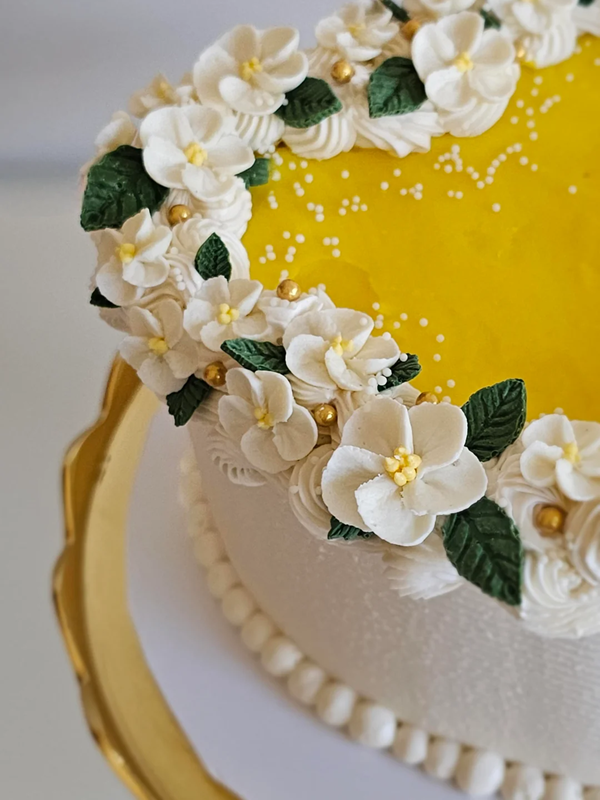
In addition to comfy things, now and then you find something simply stupendous. For instance, Reddit user Green-Cockroach-8448 makes just incredible, absolutely jaw-dropping cakes. Here are two examples that I adore:
The incredible thing is that she bakes as a hobby, not professionally. These results definitely do put some professional efforts to shame, they’re so astounding. My gast is thoroughly flabbered.
With these mouth-watering treats we wish a Happy Thanksgiving to our readers in the U.S.!
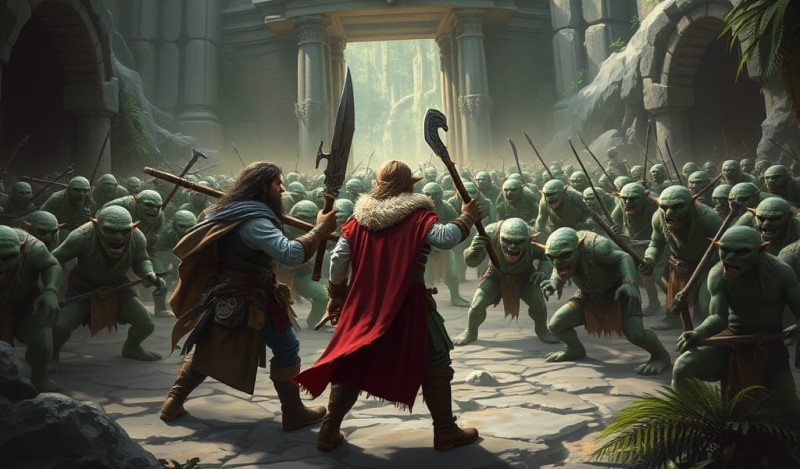
Part of the appeal of Dungeons & Dragons as a tabletop role-playing game is that it provides a robust and detailed set of rules for paying out fantasy fights, from smashing your way through pesky goblins to assaulting the lair of an evil dragon. You can see the tabletop war games in D&D‘s roots when you have a table full of figurines maneuvering and trading blows. Unfortunately, that same detailed set of rules for combat also means that fights tend to drag. Everyone who’s played the game knows how one large combat can eat up an entire gaming session, leaving little room for character development or story progression. That’s where narrative combat comes in.
Narrative combat is an alternative to the full combat rules that lets you as a DM challenge your players and put them in danger while also speeding up the action so you can move on with the game and make room for other activities. You might not want to use it all the time, but it is a useful technique for getting your party through an encounter that is meant to build the story more than to present a tactical challenge.
Narrative combat is a battle-focused version of an old D&D standby: the skills challenge. Instead of making attacks or casting spells by the usual combat rules, players declare what their characters are attempting to do in order to win the fight. The DM (or the DM and players working together) decide on an appropriate skill check or other d20 roll for the action. When the players have scored enough victories on the skill checks, they win the battle. Failed skill checks bring consequences.
Preparing the encounter
As a DM, you need to prepare for a narrative combat, just like you need to prepare for a traditional combat, but in a different way.
First of all, make sure that the encounter you’re planning is appropriate for narrative combat. This method isn’t well suited to encounters that could potentially be deadly for the adventuring party. It serves to speed up combat, but that comes at the expense of characters not getting to use their full suite of abilities, and most gaming groups won’t be happy about seeing a character die just because they didn’t have the chance to use an ability that could have saved them. If an encounter is meant to push your players’ character to their limits, it’s better to opt for traditional combat.
Once you’ve decided to make a fight narrative rather than traditional, describe the encounter in narrative terms, laying out what role it plays in your story. How would you describe this event in a novel or a screenplay? Think about not just the monsters your characters will face but their motivations, goals, and personalities. Instead of “One Vampire Spawn (CR5) and five Skeletons (CR 1/4),” try describing your scene something like: “A recently-turned vampire spawn, drunk with her newfound powers, gathers her own minions from the ancient dead of a nearby graveyard, and ambushes the party as they journey toward their next destination, hoping for an easy kill to add to her subservient throng.”
Next, you need to make three mechanical decisions which will determine the difficulty of the encounter:
Number of successes needed to complete the encounter
DC for the encounter’s skill checks
Consequences of failure
The number of successes required to complete the encounter determines how long the encounter will take to play out. The more successes required, the more opportunities for failure and consequences. I recommend making the number of required successes a multiple of the number of player characters involved.
Encounter difficulty
Multiplier
Trivial
1x
Easy
2x
Average
3x
Challenging
4x
Hard
5x
I don’t recommend going above 5x; at that point, you may not be saving much time over just running a regular encounter. If you are planning for a longer encounter, it’s also a good idea to plan for a few changes in the fight after a certain number of successes to give your players new problems to think about—the monsters change tactics, reinforcements show up, a sudden snowstorm hits, parts of the floor give way, etc.
Our example encounter with a Vampire Spawn and Skeletons could be a significant challenge to a novice adventuring group, warranting a multiplier of 4x or 5x, but to an experienced group this encounter would be more of a speed bump, a way of alerting the players to the presence of a larger threat lurking in the shadows without putting their characters in much danger. For such an encounter, I would choose a multiplier of 1x or 2x.
The DC for the skill checks is the most direct way of setting the difficulty of the encounter. If you have a specific set of monsters for your encounter, you can use the average of their ACs. For our example above, Vampire Spawn has an AC of 16 and Skeleton has 14. Five Skeletons and one Vampire Spawn have an average AC of 14.3, which you can round down to 14. Feel free to tweak the DC if it doesn’t feel right for your encounter; you might decide that the Vampire Spawn’s control makes the Skeletons more coordinated than mindless undead usually are and bump the DC up to 15.
If you don’t have a specific set of monsters in mind to check the AC of, here’s a guide for choosing an appropriate DC.
Party level
Trivial
Easy
Average
Challenging
Hard
1 to 4
10
12
14
16
18
5 to 8
11
13
15
17
19
9 to 12
12
14
16
18
20
13 to 16
13
15
17
19
21
17 to 20
14
16
18
20
22
Finally, you need to decide the consequences of a failed roll. The easiest and most obvious one is to do damage to the character whose attempt failed, but the circumstances of your story might suggest other possibilities, such as losing vital resources or reputation with the local community.
To determine the amount of damage a failure should cost, if you have a specific set of monsters in mind, you can again use an average of one round’s damage from their standard attacks. A Vampire Spawn’s Claw attack does 8 damage on average (2d4+3), and it can use the attack twice, making a total of 16. A Skeleton’s Shortsword attack does 6 average damage (1d6+3). Our example monsters therefore have an overall average damage of 7.6, rounded up to 8. You can just use the average damage, or to keep some of the fun of rolling, you can make it 2d4+3, 1d6+4, 1d8+3, or something else that gives the same average.
Instead of doing damage as a consequence in the example encounter, you might instead decide that characters who fail fall victim to the Vampire Spawn’s bite and must make a Charisma save (same DC as the encounter overall) or temporarily fall under the villain’s sway, telepathically revealing information that the spawn’s Vampire Lord will later use against the party. Play into the story of the encounter; if a good alternative to damage for a consequence presents itself, use it!
If you don’t have a specific set of monsters in mind for your encounter, just look for one at the appropriate CR and use its basic attack damage. The whole point of narrative combat is to reduce the amount of time it takes to play out an encounter, so don’t make things more difficult for yourself than you need to.
Playing the encounter
As the encounter begins, give the players a narrative description of how the combat begins. Again, imagine you are narrating a novel or setting the scene in a screenplay.
“As you walk through the heavily-shadowed avenues of the decrepit graveyard, slow, shambling movements in the undergrowth on your left catch your eye. Everyone make a Perception check… Those of you who failed the check are distracted by the movements of five skeletons lumbering out of the thicket on the left, but those who succeeded realize that the skeletons are a diversion and prepare yourselves to face the sudden attack of a red-eyed, sharp-fanged shape that lunges out of the sepulcher on your right, reaching for you with her sharp, talon-like hands!”
Once you’ve given your players the set-up, it’s now time for them to act. Your players narrate how their characters engage with the challenge in front of them. There are no rounds or turns in narrative combat, just contributions to the story. If your players are good at making room for each other, you can just invite everyone to contribute a story moment whenever they feel moved to. If you think it’s better to impose some order on who talks when, you can go around the table one at a time, or have them roll for initiative. The monsters do not get a turn of their own; they only get a chance to hurt the player characters when characters fail a check.
Players describe their character’s acts not in terms of game mechanics but as if narrating a story. Their options are limited only by their imagination and the constraints of what you as DM are willing to accept. Instead of “I use my bonus action to rage and my action to attack with my axe,” a player might say, “I yell my warcry and charge into the thick of the enemy, hacking furiously away,” or “I slip into the shadows waiting for a chance to strike at an enemy when their back is turned,” or “I open my senses to the currents of magic in this area and try to disrupt the monsters’ sources of power.” A character’s act might be something closely tied to their abilities, but they can also be more creative, such as “I create a distraction on one edge of the fight to set up my allies for a better shot,” or “I help the innocent townsfolk caught in the middle of the fight get to safety.”
Players have a lot of leeway in describing how their characters engage in the battle, as long as they play fair. No one gets to just say “I kill all the monsters and save the day single-handedly.” As DM you can always say no to a poorly-thought-out or bad-faith act, but it’s also good to let the players have agency to shape the story of the fight themselves. If someone wants to push the monsters onto uneven ground, impersonate an enemy leader and confuse them with conflicting orders, or start an avalanche, as long as it’s something their character could reasonably pull off in the circumstances, go with it and let the fight evolve accordingly.
Once a player has described their character’s contribution to the story, pick an appropriate skill for them to roll. You can do this yourself as DM, or collaborate with the player on picking something that plays to their strengths. In place of a skill roll, you might also use an attack roll, or even a saving throw if it seems appropriate (“I raise my shield hurl myself into the line of fire to take the brunt of the attack so it doesn’t hit any innocent bystanders” could merit a Constitution save, for example).
For a character fighting in the front lines, a weapon attack may be the best roll, but look for opportunities to call for other skills like Athletics (like tackling and grappling with an opponent), Acrobatics (nimbly jumping from tree branch to tree branch to stay ahead of a pursuing enemy), Perception (watching enemy movements and calling out their maneuvers to one’s allies), or Insight (analyzing the enemy’s tactical plan and devising an effective counter-strategy). Characters relying on magic can always roll a skill relevant to their particular variety of magic such as Arcana (wizards, sorcerers, and warlocks), Religion (paladins, and clerics), Nature (druids), or Performance (bards), but consider also using magic as a bluff to distract the enemy (Deception or Intimidation) or to create hazards in the field of battle (Survival). If a player uses a spell or other special ability of their character’s, or if they come up with a particularly original or interesting twist in the story, let them roll with advantage.
If the roll succeeds, mark down a success for the party; if it fails, the character in question suffers the consequences. A player who takes damage has the opportunity to mitigate that damage in any way they could in regular combat, like the resistance granted by a barbarian’s Rage or a ranger casting Absorb Elements.
When the party has scored enough successes to complete the encounter, narrate how the remaining monsters flee or are destroyed. Then the characters can lick their wounds, and the adventuring day continues.
Employing narrative combat effectively
There are advantages to using narrative combat in place of full combat. There are also times when it’s not a good choice.
Pros of narrative combat
It’s quicker than traditional combat. It can be a good way of dealing with encounters that are of little mechanical threat to the party but contribute to the ongoing story.
It makes much less work for the DM—no tracking monster abilities or hit points, just the party’s successes.
It keeps the action with the players. There are no separate monster turns.
It encourages creativity and storytelling, which can be rewarding for a group that likes those aspects of play more than the hard tactical thinking of traditional combat.
Cons of narrative combat
It takes time to explain to a group of players who haven’t tried it before, and may be confusing to players used to the routines of regular combat.
It sacrifices detail for speed, sometimes leading to results that could feel unsatisfying—will a wizard player casting Fireball feel good about having the same effect on the outcome of the battle that a fighter using Action Surge does?
When confronting a particularly dangerous or important enemy, players may be unhappy about not having their full range of combat options open. Narrative combat is not a good choice for such fights.
Narrative combat is a useful tool to have at your disposal as a DM, but make sure your players understand how it works, and know when to use it and when not to. It’s a good thing to introduce to new players in a short, trivial encounter that poses no real risk so that they can learn how to play it without the pressure of a dangerous fight. Once your players know how to do it, though, it can save time for more exploration, role-playing, social encounters, plot advancement, and other fun things.
Lately Erik and I have been preparing for the new player housing in World of Warcraft, to be released before the upcoming Midnight expansion. Before that arrives, though, there’s a little detail in the current expansion, The War Within, that I want to save for posterity. (Even if it’s just myself. 🙂 )
Blizzard is known for using references to pop culture personages or phenomena in WoW. What comes immediately to mind is Rio Duran (a Duran Duran reference) in Mount Hyjal, Harrison Jones (Harrison Ford / Indiana Jones), the Very Light Sabre swords (Star Wars lightsabers), and Haris Pilton (Paris Hilton) in Shattrath City, for example.
Now there is also a compatriot of mine! The Finnish artist Darude has been immortalized as D’rude, a randomly appearing NPC found in delves. One of the mob’s abilities is Sandstorm, which confirms it. “Sandstorm” was Darude’s big hit single in 1999, and still pops up here and there.
Incidentally, the “Sandstorm” music video with parkour and running (so much running!) around southern Helsinki was directed by Juuso Syrjä and has become a bit of a hit, too, with over 300 million views.
To celebrate the 25th anniversary of Darude’s career, a Sandstorm Run event was held in Helsinki, Finland, at the end of this August. We were not in town for it, but we did save a map of the route and walked it later for our own enjoyment.
The level of detail is incredible. There are both 2D and 3D versions of the map that you can zoom in on and fly around like a modern digital map. Here’s a view of Rivendell and the nearby Misty Mountains from the 3D version.
The Middle-Earth Map is a project Micah Vander Lugt, a geographic information sciences analyst. It’s great to see people put their professional skills to work on hobbies that they’re passionate about!
Hey, look! We found a thing on the internet! We thought it was cool, and wanted to share it with you.
I was browsing a ren faire board the other day for research. Someone there was asking for inspiration and advice, saying they usually dress “quite gothic”, which I somehow misread as “white gothic”.
That would be really interesting, I thought, and wanted to check whether it’s a thing… And of course it is! Known as white goth or ice goth: instead of the ubiquitous black, dressing only (or mostly) in white, but spiky or moody, sometimes puffy or lacy or ruffly, too.
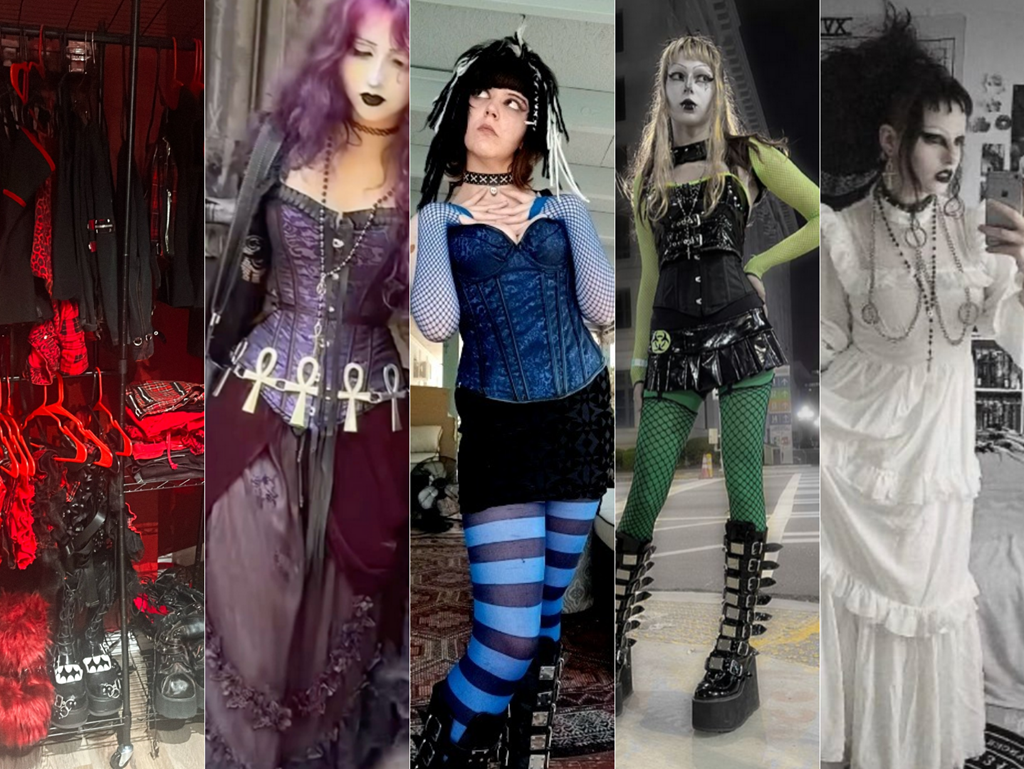
Then I poked around some more. I already knew that various flavors of goth aesthetic exist, of course, but I was specifically interested in color-based ones. Apart from red and purple goth, less immediately obvious colors such as pastel goth (especially pink goth looks big), blue, and green goth do seem to exist. Yellow, orange, and brown goth seem marginal (with varying levels of recognition), but there doesn’t seem to be gold, silver, or bronze goth, per se.
The most intriguing find, I think, emerged from my yellow goth search. There seems to be some interest in dressing styles inspired by bugs, including bees. One seller on Etsy even used both the word bee and goth in their sweater description. (Personally, I couldn’t call that sweater goth style, but you do you.) Below is a bee-inspired ensemble by EJ on Pinterest that the user labeled as “yellow Y2K goth outfit”:
So, there’s bee goth now? Bee core? (Buzz core???)
Some modern holidays, including Halloween and Dia de los Muertos, are rooted in the idea that on certain special occasions the spirits of the dead can return and walk among the living. The living can join the celebrations by disguising themselves to mingle with the spirits.
The ancient Romans did not celebrate a holiday quite like our modern ones, but the idea that the dead could still be present in the living world, and that living people can use masks and costumes to blur the line between living and dead, is one that they would have recognized. Here is a detail of Roman funeral customs reported by the Greek historian Polybius:
After burying the body with the customary rites, they place an image of the deceased in the most prominent part of the house with a wooden shrine around it. This image is a mask of the deceased’s face, shaped and painted to be an extraordinary likeness of the dead person. They display these masks with great reverence on public occasions, and whenever some prominent member of the household dies, they are worn by participants in the funeral procession, whoever seems to best match the original’s appearance in shape and size. They also don appropriate clothing: if the ancestor was a consul or praetor, a toga with purple edges; if a censor, a wholly purple toga; if he had celebrated a triumph, a toga worked through with gold.
Polybius, History of Rome 6.53
(My own translation)
Our modern traditions are different (these Roman worthies weren’t going trick-or-treating), but there is something ancient about the feeling that, on certain special occasions, the line between living and dead may not be quite as clear as we think.
History for Writers looks at how history can be a fiction writer’s most useful tool, from worldbuilding to dialogue.
Jimtheviking on Tumblr wrote about how the Dwarven names in J.R.R. Tolkien’s The Hobbit connect with Old Norse, especially Dwarf names listed in the poem Völuspá.
According to Jimtheviking, Tolkien chose a number of names from Old Norse and tweaked those names in an interesting way. Namely, Tolkien grasped Old Norse grammar well enough to know that the omission of one n from a name ending in –inn changed it from masculine to feminine. To quote Jimtheviking:
“Well, I give you the names of the Dwarves from the Hobbit, as they appear in Dvergatal (stanzas 14-16) and in the order they appear:
“Now, you notice something with the way those names got changed? That’s right, he changed the masculine -inn definite suffix to -in, which is feminine.
“That means that, at least grammatically, Dwalin, Dáin, Thorin, Thráin, and Glóin are female Dwarves.”
Then, moving on from purely linguistic, Jimtheviking continues with an intriguing argument:
“Since we know Tolkien was meticulous about his grammar, this was done most likely as an in-joke […] [emphasis original]
“But there’s a not-inconceivable chance that the Dwarves were using the masculine pronouns in Westron because that’s what the Men who met them used, despite the fact that a third of the company was female, and hey, it’s kinda neat to think he wrote a bunch of Dwarf-ladies going on an adventure.”
It is really interesting, isn’t it, to posit male and female Dwarves in Tolkien’s adventures?!
Poking around, I found versions of Völuspá that differ from the Dwarf list as given by Jimtheviking*. Not just the list itself, but also spellings differ depending on the edition you’re using (which isn’t rare at all in philology). Nevertheless, the main point stands: Tolkien changed names that had –inn in the original to just –in in English.
Of all Tolkien’s Dwarf names, he seems to have adopted Durin, Dwalin, Náin, Dáin, Bifur, Bofur, Bombur, Nori, Óin, Thorin, Thrór, Thráin, Fíli, Kíli, Fundin, Náli, Oakenshield (Eikinskjaldi, cf. Icelandic ‘oak shield’), Glóin, Dori, and Ori from the Völuspá.
Of them, Durinn, Dvalinn, Náinn, Dáinn, Óinn, Þorinn, Þráinn, Fundinn, and Glóinn are all originally spelled with a double n. (In addition, there’s a change from a double r to a single one in Bívurr / Bívǫrr, Bávurr / Bávǫrr, and Bömburr / Bǫmburr, which Jimtheviking does also comment on.)
Anyway, the whole thing kinda reminds me of the first time I read The Lord of the Rings, decades ago now. I was young enough that it was in translation, which means the young me ploughing through LotR was quite confused over the gender of some characters. The Finnish language doesn’t have grammatical gender, you see. Instead of he or she, we just have one third-person singular pronoun, hän, which is used of all people regardless of sex, gender, age, kinship, marital status, whatever, just like the English third-person plural they is. Normatively, in Finnish everyone is a hän.
Even at that young age, I knew that (apart from Astrid Lindgren) most of the publications, including those for the younger audience, centered boys and male characters. Contextually, I could tell that Frodo and Sam were male. Same for Legolas and Gimli, Aragorn and Boromir, and Gandalf and Elrond. Arwen, Galadriel, and Eowyn were female.
But Glorfindel? Maybe male, I thought, but there is nothing explicit at all in the Finnish translation. And Merri and Pippin? Somehow at that time I couldn’t make them out at all; indeed, they’re the two characters whose gender confused the young me the most.
Having grown up reading the Moomins, Pippi Longstocking, Ronia the Robber’s Daughter, The Famous Five series, and The Dark Is Rising sequence, I saw nothing odd in girls and women also going on adventures. So I thought it was quite plausible that Merri and Pippin could be female, and was too young to read all of the textual cues that imply they aren’t. (Remember that in Finnish the gender-neutral pronoun hän gives absolutely no clue whatsoever about anyone’s gender.)
The possibility of a linguistic in-joke regarding these Dwarven names really tickles the imagination and would be completely plausible of Tolkien. Interestingly, the name Gandalf also originally comes from the Dvergatal (see e.g. stanza 12 in Pettit’s 2023 edition, which lists the name as Gandálfr). A Dwarven Gandalf would, indeed, give quite a different vibe to LotR.
And now I kinda want new movies of The Hobbit, with the amazing attention to detail that Weta lavished on the effects and props in Peter Jackson’s versions, but with more heedful writing and with half the Dwarves in the party female. That would be a truly intriguing take!
ESA’s Mars Express takes viewers on a flight over Xanthe Terra, a highland region just north of the equator. The film is a mosaic created from images taken during single-orbit observations by Mars Express’s High Resolution Stereo Camera (HRSC). The images were combined with topography information from a digital terrain model (DTM) to create a three-dimensional view of the Martian landscape. The main feature in this video is Shalbatan Vallis, a 1300 km-long (~800 mi) outflow channel that transitions from the Southern Highlands to the Northern Lowlands.
There are two amazing things about this video. First, as large as the area clearly is, compared to the rotating image of the planet in the very beginning, the features we see are completely dwarfed by Valles Marineris (the huge canyon south of Xanthe Terra). And second, the amount of detail is surprisingly ample. I wonder how much an exogeologist would be able to deduce?
I’ve said it before, and I’m sure I’ll say it again: it is a very good time to be a space geek. 🙂
(Also interesting to me, at least, is that since the video is silent, my brain started playing the main theme from the movie Gravity. Space imagery must be accompanied by majestic music now?)
“Show, don’t tell” is one of the old chestnuts of writing advice. Like most such nuggets of wisdom, it has value, but there are also good cases for ignoring it, even sometimes doing the exact opposite.
Telling, as a writer, means giving the reader a direct and straightforward description of a character’s thoughts, emotions, or personality. Showing means providing the reader with tangible evidence of the same things without stating them outright. “She was nervous” is telling. “She fidgeted and took hesitant, aimless steps while her eyes darted about, refusing to focus on anything in the room” is showing.
Showing is valuable in writing because it engages the reader’s imagination. It makes the characters’ experiences more relatable, but also requires the reader to pay attention and figure things out for themselves. When we read about a character fidgeting and taking hesitant steps, we discover her nervousness for ourselves rather than have it served to us. Making little discoveries like this is part of the joy of reading, and that joy is diminished if we have nothing to figure out.
While it’s useful to show your readers things, there is also a good case for telling things sometimes. You don’t want your readers to have to figure out everything for themselves. For one thing, that’s exhausting. For another, it divides your readers’ attention and keeps them from focusing on the elements of the story that you want them to pay attention to. It’s perfectly fine to write “She was nervous,” if the character’s nervousness isn’t the point of the scene.
Jane Austen uses telling rather than showing to excellent effect in her novel Emma. The very first line of the novel tells us exactly who Emma is:
Emma Woodhouse, handsome, clever, and rich, with a comfortable home and a happy disposition, seemed to unite some of the best blessings of existence; and had lived nearly twenty-one years in the world with very little to distress or vex her.
As the novel goes on, we get plenty of chances to observe these qualities in Emma for ourselves, but Austen starts by telling us straight out who her heroine is. By giving us this portrait of Emma up front, Austen frees us from having to figure her out for ourselves and allows us to focus our attention on the world around her, discovering the characters who make up her life bit by bit through their own interactions with handsome, clever, rich Emma.
At the same time, the straightforward way Austen introduces Emma may trip us up. As the novel unfolds, Emma discovers that she has misunderstood who her friends and neighbors in Highbury really are. By telling us about Emma instead of showing her to us, Austen lulls us as readers into expecting similarly straightforward introductions to the other characters, and so we get to go along with Emma’s own discoveries rather than getting ahead of her.
Showing is a skill you need as a fiction writer, but knowing when to tell is a valuable skill, too.
How It Happens looks at the inner workings of various creative efforts.
It really packs a lot into its minute-and-a-half running time. I can’t figure out a single thing that’s extraneous or out of place; everything fits either into disco or Discovery, even the tempo change at the end. Ha! 🙂







 Co-Geeking
You must be logged in to post a comment.