Blood Elf Subtlety Rogue Transmog Tweak

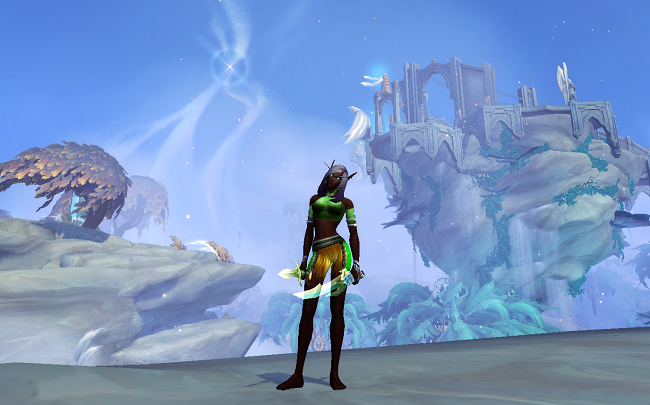
It was time to re-do some of my World of Warcraft transmogs. Among others, I updated my Blood Elf rogue’s look. I still like her previous shadow concept mog a lot, so this update was more a teeny tweak than a grand change.

WoW Shadowlands BE Rogue in Bastion

Her chest remains mogged to Ghostclaw Tunic, but I updated her legs to Jadefire Pants and hid her belt. Then I dinked around with her weapons and ended up with Enchanted Azsharite Felbane Dagger as a partner to the ever-gorgeous Ethereum Phase Blade.

Here is the outfit in Wowhead’s Dressing Room.

Image: screenshot from World of Warcraft

Of Dice and Dragons is an occasional feature about games and gaming.
Blood Elf Protection Paladin Transmog

If you’ve got it, flaunt it. And Blood Elf paladins? They’ve got it.

Here’s my paladin in the set I call Blaze of Glory. It starts with the Blood Elf racial helm and shoulders, and keeps going from there.

They’ll see him coming, that’s for sure!

Image: Screenshot from World of Warcraft

Of Dice and Dragons is an occasional feature about games and gaming.

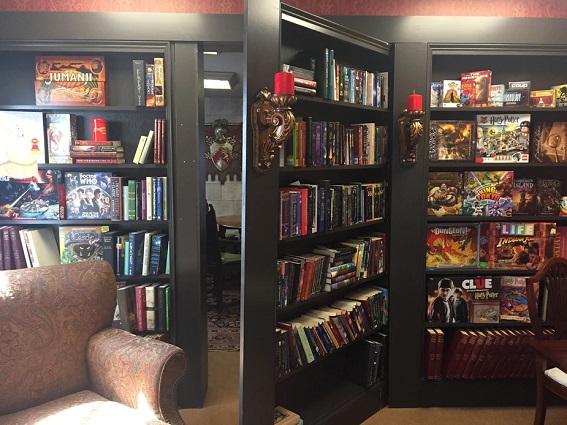
Hide a Gaming Room behind a Swinging Bookcase

Lisa Natcharian at The Storyteller’s Cottage transformed a long, narrow room into two smaller ones, namely a library and a gaming room with entry through a swinging bookcase.

The house is Victorian, built circa 1891, and located in Simsbury, Connecticut. Before the covid pandemic, Natcharian and her crew organized various book-themed events: author talks, writing classes, poetry slams, summer camps, book clubs, D&D game nights, tea or cocktail parties, live murder mysteries, even escape rooms.

Lisa Natcharian Secret Castle Room

The door into the gaming den opens when you pull a candle sconce attached to the bookcase:

Lisa Natcharian Secret Castle Room Door

The new secret room is papered with stone-block-look wallpaper and equipped with various furnishings that nod towards medieval castles: a round table with ornate wood chairs, a small suit of armor in the corner, and wall textiles, for example.

I’m flabbergasted that she was able to source so much of the furnishings second hand. I mean, who has a miniature suit of armor just lying around until you decide to sell it off on Craigslist?

Lisa Natcharian Secret Castle Room Decor

The results are well worth the effort, and surely will be enjoyed by all event visitors. For more images, visit her site, or, should you prefer to watch a video about the build process instead, you can see it on YouTube.

Images by Lisa Natcharian at The Storyteller’s Cottage

In Making Stuff occasional feature, we share fun arts and crafts done by us and our fellow geeks and nerds.

Quotes: No Call for Nastiness

The Roman orator Quintilian has a thing or two to say about making jokes at the expense of groups of people:

I have already noted, when talking of jokes, how unworthy it is to go after someone’s circumstances in life, and there is no call for nastiness against classes, ethnicities, or nations, either.

Quintilian, The Institute of Oratory 11.1.86

(My own translation)

Now, Quintilian is specifically speaking here about how to comport oneself as an advocate in court, and he goes on to say that if your opponent comes from a group whose moral qualities might seem dubious to a Roman jury, like soldiers or tax farmers, it may sometimes be appropriate to make a joke at their expense. His advice is tactical, not moral: this is how you sway a jury and win your case. Still, it’s good advice in general that “just joking” about people’s ethnicities, origins, or life circumstances is not a great way to get people on your side, in ancient Rome or today.

Serving exactly what it sounds like, the Quotes feature excerpts other people’s thoughts.

Second Trailer for Doctor Strange in the Multiverse of Madness

The release date for the next movie in the Marvel Cinematic Universe is approaching. Here is the second official trailer for Doctor Strange in the Multiverse of Madness:

Marvel Studios’ Doctor Strange in the Multiverse of Madness | Official Trailer by Marvel Entertainment on YouTube

To me, the creepiest thing in the trailer is the mention of a repeating dream Strange says he’s having. Brr, merely the thought is hair-raising. (Not to mention that I can’t even think of the kinds of nightmares you might have if your reality had shifted to a multiverse of possibilities. Anyway.) Apparently MoM is the first MCU film to be released under the horror genre, so that sounds appropriate.

The trailer looks as astounding as all of the MCU movies do; indeed, technical accomplishments have never been Marvel’s weakness. Where it might fall is the story. I don’t recognize the writing team for MoM at all: Michael Waldron (who’s apparently written the Loki series) and Jade Halley Bartlett (with a total of four credits to her name in IMDB).

Another aspect I’m completely ignorant of is superhero America Chavez, played in MoM by Xochitl Gomez, who will be introduced in this film. I’ve sometimes wondered whether I’d be enjoying the MCU more had I read Marvel’s superhero comics as a kid instead of the mutant ones, but it hasn’t been a big deal so far. In phase four, however, as the stories are moving further away from the biggest names and most popular heroes, it might make a difference.

I’m also ambivalent towards the director Sam Raimi. His Spider-Man trilogy certainly faded from my memory soon enough. MoM is also Raimi’s first film in nine years. I have to wonder whether directing is like riding a bicycle—will he be able to handle the reins of a massive production again?

Apparently the events will also tie in with the series Loki and WandaVision. As I haven’t seen either, I hope any links will be clear enough anyway. I guess we will see. It’ll surely be nice to see more of Wong (Benedict Wong) and Dr. Christine Palmer (Rachel McAdams).

The release day for MoM is still listed as May 06, 2022.

Hey, look! We found a thing on the internet! We thought it was cool, and wanted to share it with you.

Ukraine Is at War, and I’m Not Okay

Russia has attacked Ukraine, and I’m not okay.

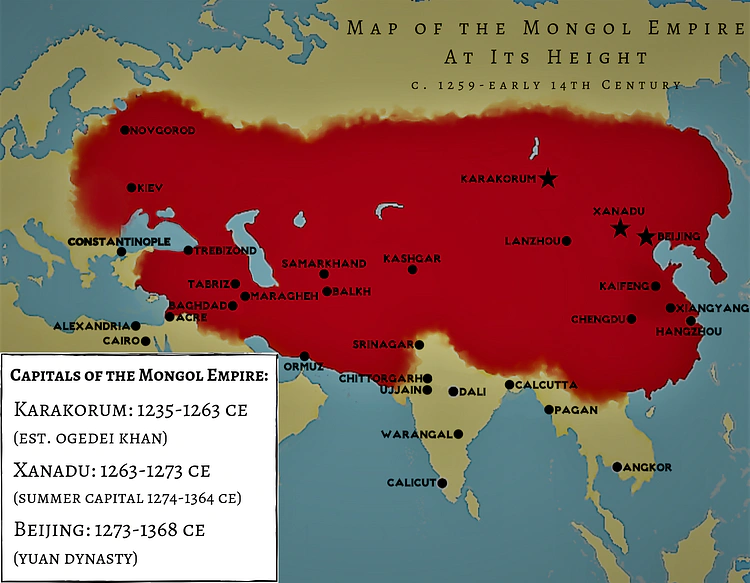
Russia’s unprovoked attack is not okay. The Russian president’s mumbo jumbo about annexation of historical areas is exactly that. Neither the Russian Empire nor Soviet Union exist anymore. If we go down that path, we might as well cry out for the restoration of the Roman Empire, other empires, or basically any polities for “historical” “reasons”.

Arienne King World History Encyclopedia Map of the Mongol Empire

As a Finn, I am not intellectually okay with this.

Twitter Jon Copper Map of Not Russia

Nor do I feel okay.

My age group has grown up in peace, but we have grandparents who lived through our two modern wars with Russia, and you can bet your pants some of our parents carry some inherited wounds. I have a friend, in fact, who grew up in the east near the Russian border. People there had a habit of saying “When the Russians come, [blah blah blah]”. Not ifwhen.

We remember.

The responsibility for this heinous act lies with Russia, and Russia alone.

Ukraine may be a lot bigger than Finland, but I wish them every ounce of dedication, not to mention willfulness and obstinancy I can muster.

I’m not okay. But I will be better. In the meanwhile, I’ve made donations, and I’m following the situation.

Images: Map of the Mongol empire by Arienne King via World History Encyclopedia (CC BY-NC -SA 4.0). Map of not Russia via Jon Cooper on Twitter.

Announcements from your hosts.

Living Vicariously Through Social Media: Tree-lined Road Abloom

I’ve been reading more fantasy lately than is typical for me. One of the novels paid more attention to everyday colors than Anglo-American fantasy writing tends to do, which turned my brain onto thinking about colors in our environments.

This photo of a tree-lined road with masses of flowers in Parkview, Johannesburg, South Africa, certainly grabbed my attention:

Tumblr Isle of Skye Tree-lined Road in Parkview Johannesburg S Africa

It’s not that I haven’t seen purple or fuchsia flowers on trees or bushes, or tree-lined roads, or tall trees. I just haven’t seen tall trees with purple flowers lining roads before. Fantastic!

Image by traveltrotters_za, found via Isle of Skye on Tumblr

The Visual Inspiration occasional feature pulls the unusual from our world to inspire design, story-telling, and worldbuilding. If stuff like this already exists, what else could we imagine?

The Unspoken Messages of an Unswept Floor

This floor mosaic comes from the dining room of a Roman house. The central parts of the floor have been lost, but the edges of the room were decorated to look like the untidy remains of a banquet. We can identify leaves, fish and poultry bones, nut shells, bits of fruit, and the shells of a wide variety of shellfish. This may seem like an odd choice for home decoration, but mosaics in this style were popular in well-to-do Greek and Roman households. To contemporary guests, mosaics like this sent a number of messages about the people who dined on them.

On one level, this mosaic simply reflected the reality of the room it was in. Diners at an ancient banquet could toss their refuse on the floor with abandon because they were not the ones who had to clean it up. The widespread use of enslaved labor for domestic service meant that the rich could lob greasy chicken bones and half-eaten olives around the place without caring about the time and effort involved in cleaning up afterward. In that sense, this mosaic identified the owners of this house as the sorts of people who had other people to do the cleaning up after them.

On the other hand, the evident abandon with which the detritus is strewn around the room is deceptive. The individual pieces are precisely placed so that there the space between them is relatively even. Larger items are spread out with smaller ones between them. They are positioned in loose diagonal lines with a subtle aesthetic regularity; similar objects repeat to help unify the image, but are spaced out and given different orientations to avoid any sense of pattern. This mosaic is an extremely fine one made of very small tesserae in many different shades that must have taken a substantial amount of work by a skilled mosaic artist and a team of workers. The details of this Roman mosaic also imitate a famous Greek predecessor created by the mosaic artist Sosos of Pergamum. The effect was meant to project wealth and power: only the very rich could afford to put so much care into looking so careless.

The choice of food to show in this mosaic is also significant. Meat had a religious, even moral, significance in Greek and Roman culture. Large land animals like cattle, sheep, and pigs were typically eaten as part of a communal religious sacrifice, and religious custom dictated how they could be cooked and served as well as who should partake in the feast. Fish, shellfish, and poultry were not constrained by similar rules and could be eaten when, how, and in any company one liked. As such, this sort of food was associated with indulgence, even decadence. To say that a fellow Greek or Roman dined on fish had a sting of moral judgment akin to declaring that someone today enjoys champagne and caviar. The variety of fish bones, chicken claws, and shells in this mosaic makes a statement that this room is not one for solemn sacrificial meals but a place where the diners can indulge in their favorite delicacies free of any religious scruples or moral condemnation.

A great deal of meaning is packed into a mosaic of an untidy floor. These were messages that the original guests in this dining room would have implicitly understood in same way that we today grasp the status-signaling meaning of a four-car garage or a water view.

Image: Detail of unswept floor mosaic, photograph by Yann Forget via Wikimedia (currently Gregorian Profano Museum, Vatican; early 2nd c. CE; glass tessera mosaic; by Heraclitus, copied from work by Sosos of Pergamum)

History for Writers looks at how history can be a fiction writer’s most useful tool. From worldbuilding to dialogue, history helps you write.

Fine Art as a Three-in-One Quilt

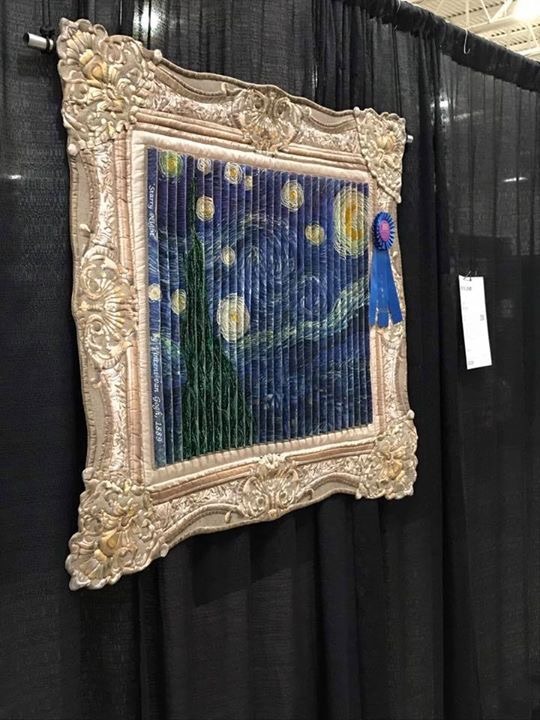
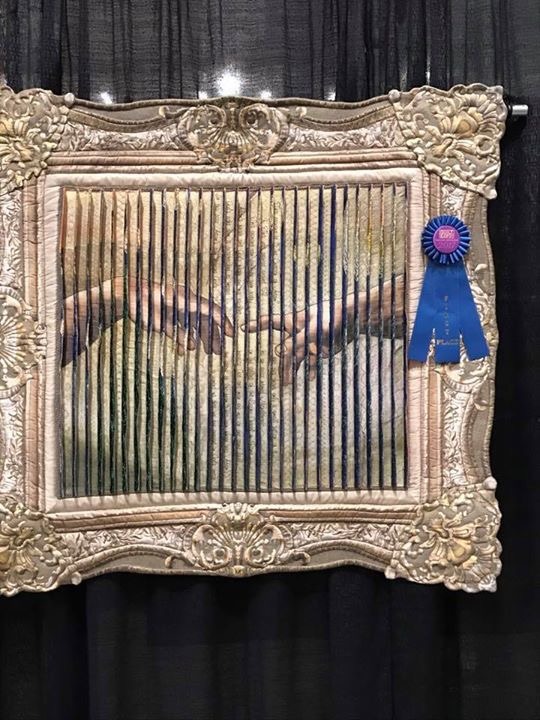
Check out this mind-blowing quilt simultaneously copying three fine arts pieces, namely Vincent van Gogh’s Starry Night, Michelangelo’s The Creation of Adam, and Edvard Munch’s The Scream:

Tumblr Good Stuff Flora Joy Quilt1
Tumblr Good Stuff Flora Joy Quilt2
Tumblr Good Stuff Flora Joy Quilt3

Even the intricate gold frame is sewn!

This astounding piece is called “Sleep, Play, Scream” and it was made by Flora Joy. She was deservedly awarded for her innovative trispective technique.

Any time I come across someone, typically an older white man (seriously, dudes, you’ve got to do better), sneering at sewing or other textile work, I can’t but shake my head. Poor twits, showing what they emphatically don’t know jack shit about.

Images via Good Stuff Happened Today on Tumblr

Out There is an occasional feature highlighting intriguing art, spaces, places, phenomena, flora, and fauna.

DM-ing Past an Impasse

One of the difficult situations you can find yourself in when acting as Dungeon Master / Game Master for a tabletop role-playing game is when your players find themselves stuck. An adventure is about forward movement, whether it’s fighting the next band of goblins so you can take their loot, discovering the secret door that leads into the hidden underground facility, or navigating through the asteroid field to get to safety. When your players feel like their characters aren’t making progress, that can sap the fun out of your game. What can you do as a DM to help your players get past an impasse?

Sometimes, you don’t have to do anything. Remember that your players are not the same as the characters they play. Being on an adventure is often not a lot of fun for the characters as they face danger, uncertainty, and the possibility of death. Sometimes even though the characters may be stuck, the players are still having a good time. They may be relishing the chance to role-play how their characters deal with failure or enjoy the prompt to think outside the box and come up with wacky new schemes so crazy they just might work. Some players want a game that plays strictly by the rules, even if that means they “lose.” When the characters run into trouble, watch how your players react. If they’re still having fun, you can just let them keep at it, but if the characters’ frustration leads to your players being frustrated, then it is time for you to step in as DM. In that case, here are some things to think about.

Break the DM Wall

As DMs, we have a barrier between us and the players, not just the physical barrier of the DM screen (for those who use them), but the distance between ourselves, who know all the secrets of the adventure, and the players, who do not. When your players are feeling stuck, it can help to open that barrier a little.

Suppose your players’ characters are trying to get into a castle to stop the evil duke from doing an evil ritual with an ancient artifact of evil. They try to get through the front gate and are stopped by the guards. They decide there are too many guards to fight, so they try to bluff their way in. The bluffing doesn’t work, but the players are committed this plan and keep trying to argue and make rolls to get through the gate.

Try saying something like: “I’m stepping in as DM to let you know that the guard just isn’t going to budge, no matter what you say or how well you roll. You’ll have to find another way in.” Giving the players this out-of-game information can help in several ways. It lets the players know that they weren’t on the right track so they can focus their energies on something else. It reassures the players that you are playing fair with them—they didn’t do something wrong, this approach was just never viable, and there is a way forward if they can figure it out. It also helps everyone take a step back from the characters’ frustrations to refocus on the fun of the game.

If your players like to actively role-play their characters and speak for them, it can help to shift perspective and speak about them instead. If you can get your players from “I’ve tried everything I can think of, but this guard captain is just stonewalling” to “Whiteleaf the bard is feeling frustrated and at a loss because her skills aren’t helping her group accomplish their mission,” that can help your players reframe their problem and work toward a solution.

No, but

You may have heard of the rule that in improv you always want to say “Yes, and.” “Yes, and” means you accept whatever ideas someone else brought to the scene and add your own contribution to develop it further. DM-ing is a kind of improv, but an adventure is also constrained by rules, rolls, and the story you have built for your players to explore. Sometimes the best thing to do is just throw out the other stuff and go with your players’ ideas, but if you always ignore the rules and the story, then you leave your players without a structure to work within. So there’s a corollary to the “Yes, and” rule: the “No, but” rule.

“No, but” means that when you say no to something your players want to do, you nudge them toward an alternative. This could be anything from a subtle hint on how to sway the current encounter successfully to a neon arrow pointing at the next plot point.

In the example above, you could “No, but” as you play the castle guard with a grouchy reply: “Look, His Grace said no one gets into the castle but Merchant Severan’s crew with the monthly wine shipment. I don’t see any wine barrels, so you’re not getting in here.” Alternatively, you could step out of character and say: “As you continue to argue with the guard, you notice that the northern wall of the castle overhangs a sheer cliff; there are no guards there, for obvious reasons.” These options give your players a hook for a way forward without interrupting the scene.

It’s up to your players to pick up on the “No, but” and figure out how they want to take advantage of it, but it allows you to steer them out of a dead end and back into the adventure without breaking the immersion of the game.

Change something

If your players just keep trying something that won’t work, you have the option as DM to change the rules and make it work. If necessary, you can always just say: “Okay, ignore that last roll. You succeeded. Move on,” but it’s better if you can fit the change into the story. If the situation the players’ characters find themselves in is a deadlock, you’ll want to either add something or take something away to break the stalemate.

Adding something may mean a new character comes on the scene, an event occurs to disrupt the current stalemate, or the characters get new information that gives them a way forward. For instance, perhaps the evil duke himself comes out to see what the fuss is and decides to invite the characters in so he has someone to gloat at as he does his evil thing. Perhaps a band of marauders swarms out of the nearby woods, giving the castle guards something more important to focus on and letting the characters take advantage of the chaos.

Instead of adding something, you might take away one of the things causing the impasse. Perhaps the guard captain gets frustrated and walks away to let her subordinate handle the characters, and that subordinate turns out to be much more gullible or a secret ally to the party. Perhaps several of the guards get called away to handle another problem elsewhere in the castle leaving a smaller number that the player characters can take in a fight.

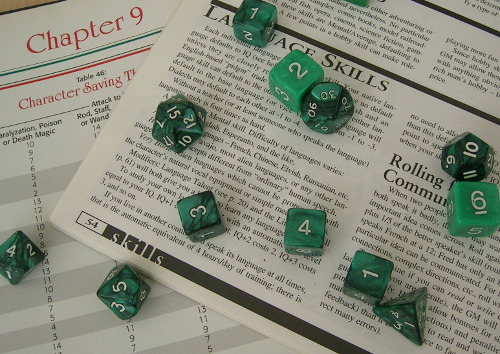
In the end, remember that a role-playing game is a collaboration between players and DM. The most important thing is that everyone, including you, gets to have a good experience. Sometimes your players are going to get themselves into places where they aren’t having fun, but as a DM you have options for helping them get out.

Image by Erik Jensen

Of Dice and Dragons is an occasional feature about games and gaming.